
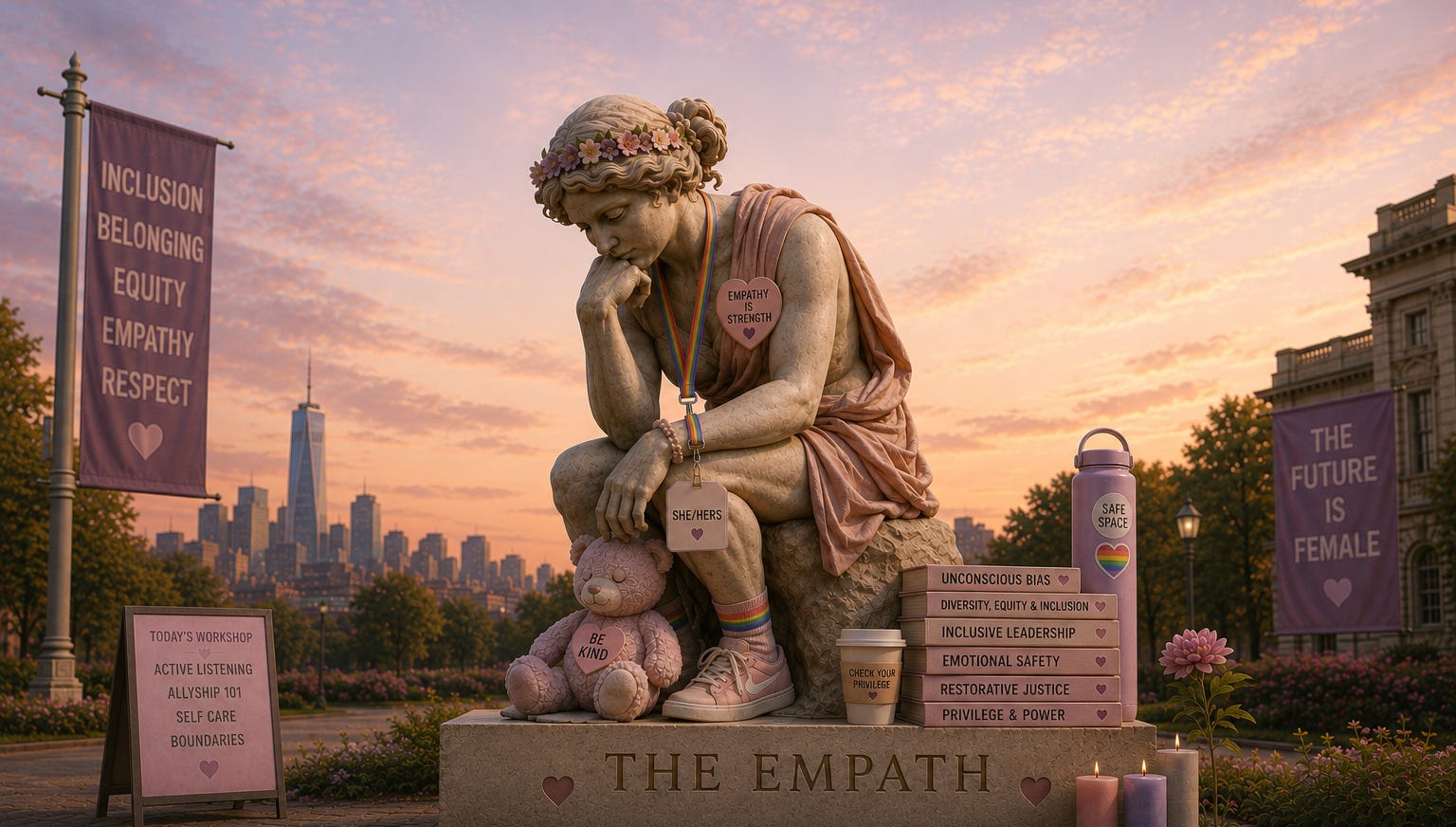
Like many women of my generation, I never questioned the idea that we lived in a patriarchal society. It was the background assumption of almost every discussion about power, politics and inequality. Why would I have? It required little of me beyond accepting that my sex had been historically disadvantaged. Like most people, I was hardly inclined to interrogate a worldview that was not only intellectually satisfying but personally affirming.
According to the modern feminist account, Western institutions were built by men, for men, to preserve male power. Women may have won a few battles, but we’re assured the war is still underway. Almost every social problem, it seems, is evidence that we simply need more feminism.
Then, after spending years moving through universities, corporate workplaces and consuming media, I found myself looking around in bewilderment. Where, exactly, was this all-powerful patriarchal system I’d been warned about?
Whatever these institutions were, they didn’t seem organised around traditionally masculine ideals. Or at least, not anymore.
I know the standard reply. I used to deliver it myself. Patriarchy, I would explain, was invisible. It was woven so deeply into society that those living within it mistook it for normality. If I couldn't see it, then either I was one of the fortunate women it hadn't affected, or I'd simply internalised my own misogyny. It was a wonderfully self-sealing theory. But eventually, that explanation began to wear thin.
So let us set aside the invisible for a moment and start with what is plainly visible. If this really is a patriarchy, it has some rather unusual priorities. It asks for my preferred pronouns on virtually every registration form, opens gatherings of every kind with Acknowledgements of Country recognising the Indigenous traditional custodians of the land, and requires employees to sign codes of conduct centred on inclusion, belonging and psychological safety.1 They speak less the language of competition, authority and resilience than that of care, emotional sensitivity and the avoidance of harm.
In other words, the moral revolution succeeded so completely that many of our institutions now operate according to a traditionally feminine moral psychology while continuing to describe themselves as victims of a patriarchal order.
A caveat, because this is the internet. None of this is to suggest that women are never abused, discriminated against or treated unjustly by men, nor that misogyny has somehow disappeared from society. I would never claim either.
But if the existence of bad actors is sufficient to prove the existence of a patriarchal system, then the theory becomes impossible to falsify. By that definition, patriarchy could never end, because no society has ever eliminated every act of violence, prejudice or abuse, and none ever will.
Nor am I suggesting traditionally feminine virtues are undesirable. Empathy and care are indispensable to any healthy civilisation. We evolved these instincts because they help us raise children, protect the vulnerable and cooperate. The problem arises only when they become the organising philosophy of institutions responsible for truth, justice and national security.
Civilisations are sustained not by one moral instinct, but by the creative tension between many. They require both the instinct to nurture and the instinct to protect, both the capacity for compassion and the willingness to uphold standards, because neither is sufficient on its own.
Perhaps this is simply what success does. A strange thing happens when comfort becomes the default. People forget it was built. Much of the civilisation they now criticise exists because generations of men built the roads, fought the wars, kept the lights on and died defending it. Like wealthy heirs spending an inheritance while sneering at the people who earned it, prosperous societies have lost sight of the qualities that made their comfort possible. As societies became materially safer, our understanding of harm steadily expanded from the physical to the psychological.
Today, many of the traditionally masculine qualities that helped build civilisation, such as the willingness to confront unpleasant realities, compete, take risks, endure hardship and value duty, discipline and resilience, are viewed with suspicion, even as expressions of oppression, while those more commonly associated with the feminine are elevated almost without qualification.
As its original aims were progressively realised in the West, contemporary feminism gradually turned its attention away from obvious injustices towards ever more subtle forms of oppression.
Meanwhile, some of the world's clearest forms of misogyny remain clearly visible. Forced marriage, honour killings, female genital mutilation, compulsory veiling and legal inequality require no sophisticated theory to detect.2 In many countries they are written directly into law.
Yet confronting them requires something uncomfortable within progressive politics: making unpopular judgments about cultures that subjugate women. It proved far easier to debate manspreading, boardroom quotas or whether Barbie reinforced unrealistic beauty standards than to consistently challenge societies in which women remained systematically subordinated.
The irony is quite something. A movement that began by confronting injustice has now directed the bulk of its moral energy towards the societies that had done the most to expand women's rights, while showing comparatively less urgency towards places where women's oppression remained overt and undeniable.
Once a particular moral psychology becomes the organising philosophy of institutions, it does not remain confined to human resources departments, university campuses or debates about gender. It begins shaping how societies understand every major question they face.
Suffering itself no longer guarantees equal concern. It is now filtered through assumptions about power, vulnerability and historical injustice.
Immigration becomes primarily a question of compassion rather than social cohesion or cultural continuity.
Education shifts its emphasis from building resilient adults to protecting vulnerable children from discomfort.
Parenting increasingly prizes self-esteem and emotional validation while becoming more uneasy with authority, discipline and risk.
Foreign policy often rewards empathy for immediate suffering while struggling to confront aggressive ideologies, long-term strategic threats or the unpleasant realities of power.
Even the world's most complicated geopolitical conflicts are filtered through the same framework. The Israel-Palestine conflict, for example, which I focus on, is most commonly understood through emotionally compelling images of suffering, which is the entire engine of the “pro-Palestine” cause.
Again, none of this is an argument against empathy itself. Civilisations without compassion become cruel. But compassion without restraint can also become cruelty because it rarely looks like cruelty at all. It arrives draped in the language of justice, fairness and protection, convincing otherwise decent people that almost any sacrifice is justified in pursuit of a supposedly kinder world.
We readily recognise domination, aggression, coercion and the abuse of power. We are far less adept at recognising the darker aspects of the virtues traditionally associated with the feminine. Perhaps the greatest blind spot of modern feminism is not that it overestimated the faults of men, but that it became reluctant to acknowledge that women, like every human being, are capable of manipulation, exclusion, emotional coercion, status-seeking, tribalism, vindictiveness and cruelty.
Once society begins to treat one sex primarily as victims and the other primarily as perpetrators, those assumptions become embedded within institutions. Women can undoubtedly be victims, but they can also be perpetrators. A moral framework that struggles to recognise both realities will inevitably develop blind spots.
A civilisation that becomes highly literate in the pathologies of masculine power while remaining almost illiterate in the pathologies of feminine power sees only part of the human condition. Human nature has not changed. Only our willingness to recognise different expressions of power has.
This is why the same institutional ethos repeatedly produces the same blind spots. It struggles to distinguish actual victims from those strategically performing victimhood. It becomes uncomfortable with deterrence, punishment, borders, exclusion and force, even when those things are necessary to protect innocent people.
Perhaps the greatest irony is that, having achieved many of its original aims, modern feminism in the West gradually came to measure female success by traditionally masculine standards. Career first. Depend on no one. Get back to work as quickly as possible. Boss babe and all that.
It did not simply broaden women’s opportunities, but established a new hierarchy. Paid work became the primary measure of achievement, while motherhood became something to postpone or fit around a career. Women were promised more choices, yet only one came to be regarded as truly successful.
At the same time, the economic and institutional structures of the modern West evolved around the assumption of two full-time incomes. For many families, paid employment became less an expression of freedom than an economic necessity. Governments, employers and public policy assumed continuous workforce participation as the norm, while offering comparatively little recognition to the social and economic value of raising children.3
Ideas do not remain confined to universities or HR departments. Eventually they become the assumptions through which the next generation understands itself. What, then, are we teaching our children, especially our boys?
We are told they are simply being taught “accountability.” But it is far more than that. Young boys are increasingly taught that, by virtue of their sex, they were born into history’s oppressor class and bear inherited responsibility for society’s injustices.
As the mother of a son, I do not believe it is healthy to raise boys within institutions that teach them to associate their own masculinity with oppression, privilege or harm.
As birth rates collapse across the developed world, family formation is delayed and the informal networks that once helped raise children are disappearing. The village gives way to the ideal of self-sufficiency. Yet human beings did not evolve to flourish in isolation, and neither do civilisations.
At exactly the moment Western societies most need strong families and cohesive communities, we have become strangely reluctant to celebrate the people performing civilisation's most indispensable task. One of history's great ironies is that a movement devoted to empowering women came to elevate the traditionally masculine world of career, status and paid work while treating motherhood as something to justify.
It is a remarkably strange legacy to leave the West.
If you value this kind of long-form work, paid subscriptions are what make it possible. I don’t publish often, but when I do, this is the level of time, research and care that goes into each essay.
If subscribing isn’t for you, there’s also a one-off support option here: https://ko-fi.com/lucytabrizi. Thank you for reading and for supporting this work in whatever way fits you.
Related Essays:
The Slapstick Consequences of Comfortable Democracies
·
Apr 4
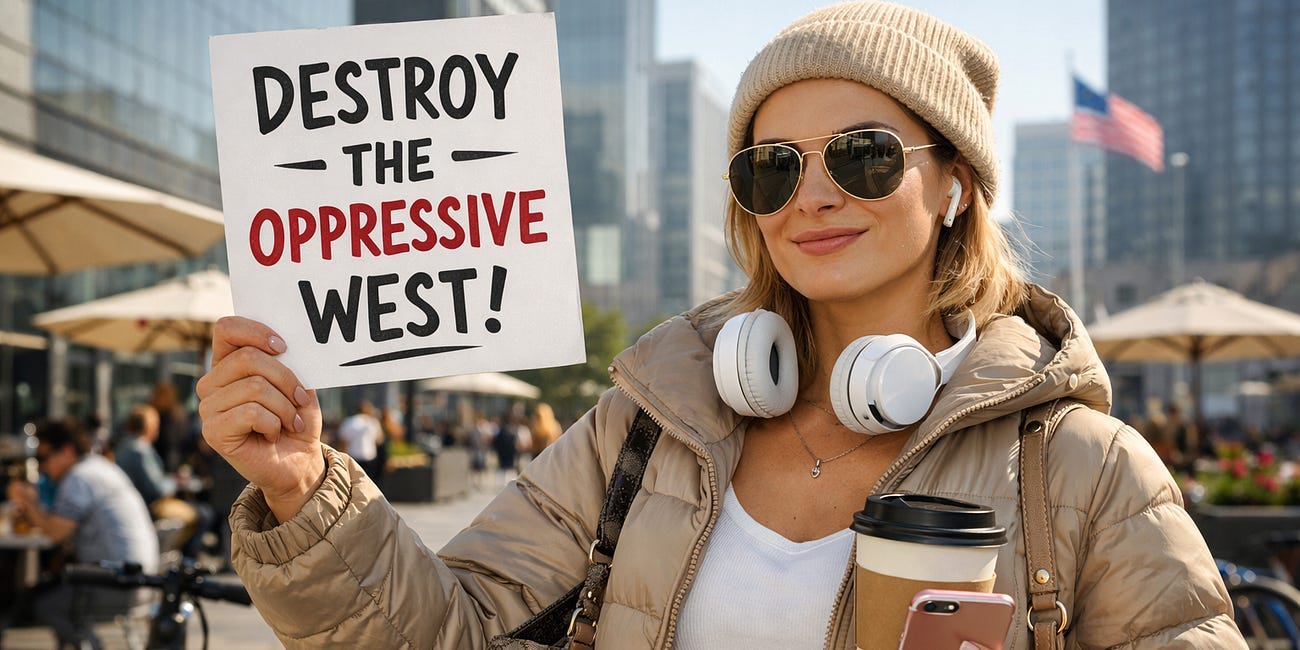
Last week there was a march against the “far right” in the United Kingdom, followed shortly after by a “No Kings” rally in the United States. The British, who quite literally have a King, turned out in solidarity with Americans protesting a democratically elected president — who is not …
American Association of University Professors, On Trigger Warnings (2014); Foundation for Individual Rights and Expression, annual campus free speech reports (various editions).
United Nations Population Fund (UNFPA), Female Genital Mutilation (FGM); UN Women, Facts and Figures: Ending Violence Against Women; UNICEF, Child Marriage: Latest Trends and Future Prospects.
OECD, Employment Outlook (various editions); OECD, Society at a Glance (family policy and labour-force participation).
No posts
Comments
Nothing yet. Say the first thing.
Sign in to join the conversation.