
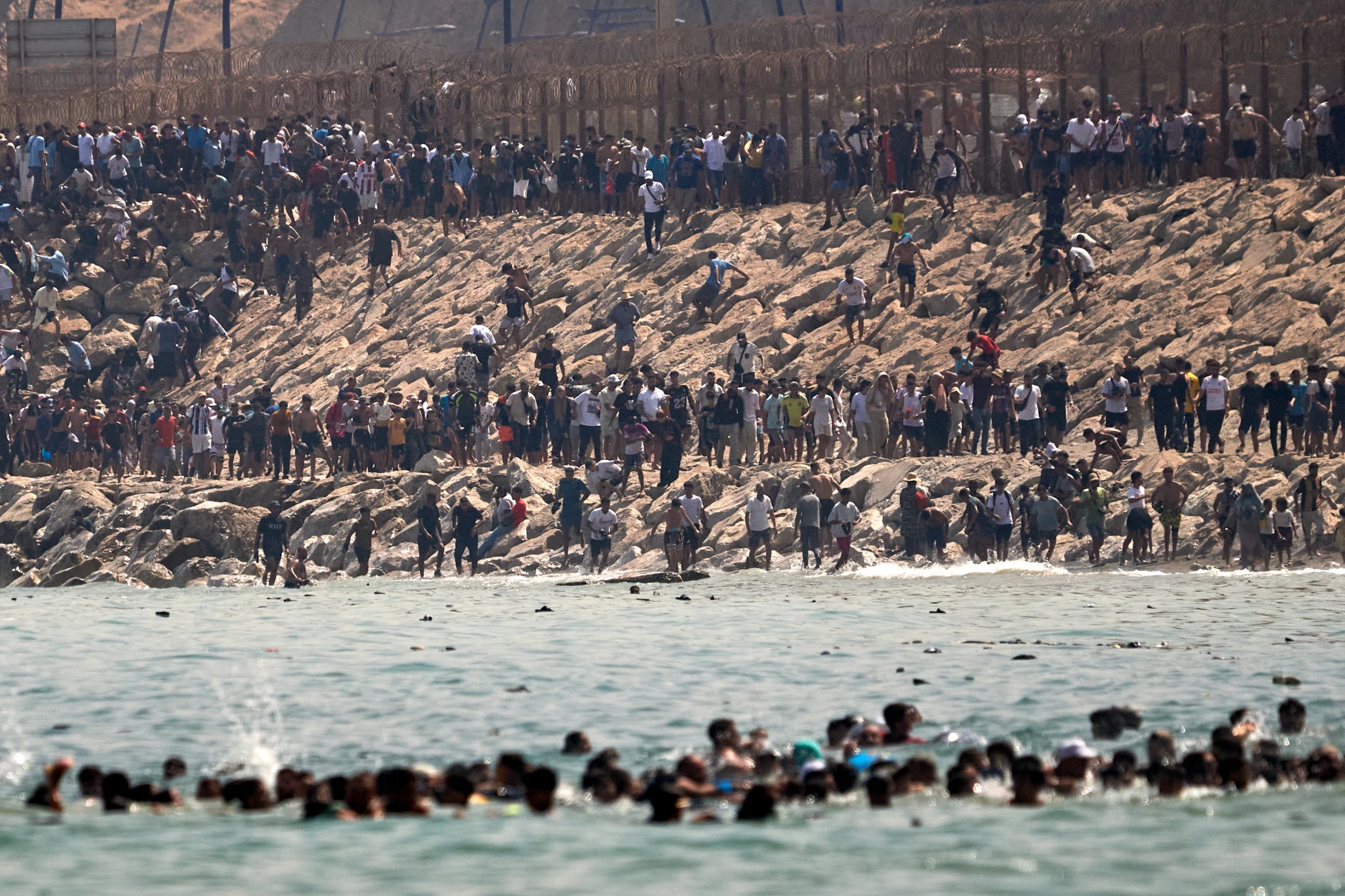
Editor’s Note (1 August): Since publication, authorities have reported that more than 48,000 migrants have already been returned to Morocco. Ceuta is a small Spanish territory on the North African coast, and offers limited opportunities for long-term settlement or onward travel. Although the majority of those who crossed have already returned to Morocco, several European leaders including Macron, who have spent years championing open borders, responded by tightening border controls and increasing security.
The aftermath also demonstrated how quickly conspiracy theories race ahead of reality. Figures on both the far left and the far right insisted the crossings had been orchestrated by Zionists to infiltrate Europe. Presumably the Zionists also orchestrated the return of tens of thousands of migrants to Morocco.
Watching thousands of migrants cross from North Africa into Spain this week, breaching the border at Ceuta, I was reminded that Europe has seen this gateway before. Fourteen centuries ago, it became the point through which one of history's greatest imperial expansions entered Europe, leaving the Iberian Peninsula (modern-day Spain and Portugal) under successive Islamic dynasties for almost eight centuries.
In 711 AD, Arab and Berber armies crossed the Strait of Gibraltar and, within only a few years, conquered most of the Iberian Peninsula.1 It formed the western frontier of the widespread military expansion and colonisation of the early Islamic Caliphates, which, in little more than a century, had exploded out of Arabia to conquer vast swathes of the Middle East and North Africa before reaching Europe.
It was the very same wave of imperial expansion that had already conquered the Byzantine province of Palestine.2
Yes, that Palestine.
The one progressive activists, including Spaniards like Javier Bardem, speak of as though its Arab identity had always been indigenous, despite the fact that Spain itself spent nearly eight centuries reversing that very imperial expansion.
When these activists chant "Free Palestine," believing they are standing against colonialism, they seldom ask the awkward question of how Palestine became Arab in the first place. The answer, unfortunately for the slogan, is conquest by the sword. As the early Islamic Caliphates expanded across the Middle East, Arab-Islamic rule became the dominant political and cultural force, subordinating the diverse peoples already living there, including Jews, Aramaic-speaking Christians, Copts, Assyrians, Samaritans, Berbers, Persians and many others.
In other words, many of today’s anti-colonial activists have aligned themselves with the legacy of one of history’s most successful colonial expansions.
So, with Spain once again in the headlines, let's return to its history. Because it tells us something many in the modern West seem to have forgotten.
Conquest was only the beginning. What followed was centuries of rule under successive Islamic dynasties. Christians and Jews were generally permitted to remain, but as dhimmis: protected but subordinate minorities with fewer legal rights, much as they were elsewhere under Islamic rule. They paid special taxes, faced restrictions on the public practice of their faith, and were largely excluded from political and military power.
Then came the Almohads.
If the previous arrangement had been "not ideal," the Almohads were considerably less enthusiastic about religious pluralism.
This period is remembered for forced conversion to Islam or exile, the destruction or conversion of churches and synagogues, and the far stricter enforcement of Islamic law. Among those driven into exile was the great Jewish philosopher Maimonides, who fled Córdoba with his family rather than convert.3
After the conquest of 711, Muslim rule appeared almost total. Yet a small Christian kingdom survived in the mountains of Asturias. From that foothold began the Reconquista, a struggle that lasted almost eight centuries before the last Islamic kingdom fell in 1492.
The Reconquista was fought by force of arms, as the original conquest had been. Territory changed hands through war and, particularly in its later stages, Muslims also faced persecution, forced conversion and, ultimately, expulsion. By the end of the fifteenth century, Christian kingdoms had reclaimed the peninsula, laying the political and cultural foundations of modern Spain.
Those Christians did not believe they were simply fighting over land. They believed they were recovering a civilisation, preserving their faith and restoring a way of life they feared had been lost.
Fast forward to today, and that is largely the only part of the story we remember. Much of Europe’s political and cultural conversation now casts Christian Europe as the imperialist while viewing Muslims almost exclusively through the lens of marginalisation, discrimination and victimhood. Meanwhile, centuries of Islamic imperial expansion into Europe have been reduced to an embarrassing footnote, if they are acknowledged at all.
Spain’s Prime Minister now often speaks as though Islam’s relationship with Europe has been defined only by prejudice against Muslims, rather than also by conquest, empire, religious discrimination and centuries of conflict.
Under Spain’s current socialist government, that historical amnesia has often been accompanied by migration policies that have made Ceuta an attractive entry point. Earlier this month, Spain’s Supreme Court ruled that migrants who enter Ceuta by sea, including by swimming around the border fences, cannot be immediately returned to Morocco but must instead go through Spain’s official immigration procedures.
The ruling has created a powerful incentive that traffickers and migrants have wasted little time exploiting. Combined with repeated mass crossings, a broader political reluctance to enforce the border consistently, and the Sánchez government’s large-scale migrant regularisation programme,4 the result is a frontier under mounting pressure. Nor is this simply Spain’s problem. Once migrants obtain legal residence in Spain, they can travel throughout much of the Schengen Area,5 making Spain’s southern border, in effect, one of Europe’s borders.
Much like Spain, modern Europe has become deeply uncomfortable with its own Christian inheritance. Few politicians speak positively about Europe's Christian roots, despite the fact that many of its defining ideals, from the dignity of the individual and equality before the law to the development of universities, hospitals and charitable institutions, emerged within a civilisation profoundly shaped by Christianity.6 Europe continues to enjoy the fruits of that inheritance while actively distancing itself from the tradition that produced it.
The reaction to this week’s events revealed just how fractured our civilisation has become. Rather than asking whether Spain’s own history might have something to teach us, both the far left and the far right immediately reached for the same conspiratorial explanation: the Zionists did it. This, incidentally, is hardly the first time Spain has played host to antisemitic myths. Palestinian serial internet firestarter and conspiracy theorist Susan Abulhawa claimed the crossing had been “engineered by the US, Israel and Morocco” to punish Spain for challenging Israel, while white nationalist Nick Fuentes declared it an “Israel-backed Muslim invasion.”
Horseshoe theory claims yet another victory, while Spain's history is forgotten all over again.
Civilisations don’t survive unless enough people believe they are worth preserving. The generations who spent centuries reclaiming the Iberian Peninsula believed their civilisation, faith and way of life were worth defending. Modern Europe, by contrast, seems more comfortable questioning its own inheritance than articulating why it deserves to endure.
Spain’s relationship with Islam stretches back more than thirteen centuries and encompasses conquest, coexistence, persecution, reconquest and profound cultural transformation. Yet remarkably little of this history finds its way into modern education. When it does, the more harmonious periods of coexistence stand as representative of the entire era, while the conquest itself, the legal inequalities of dhimmi status, episodes of persecution and the centuries of conflict that followed are often dropped out entirely.
Perhaps that is how we ended up with a generation of keffiyeh-wearing anti-colonial activists enthusiastically cheering for Arab colonialism.
Historical memory is not, in itself, an argument against immigration. It is an argument against collective amnesia. A civilisation that forgets its own story eventually loses the ability to understand its present. Watching thousands of migrants arrive on Spain’s southern frontier, met by a political and cultural response seemingly detached from the thirteen centuries of history bound up in that gateway, suggests we may already be there.
Civilisations do not disappear simply because new people arrive. They begin to disappear when the people already living within them lose confidence in the civilisation they have inherited and no longer believe it is something worth preserving. Historical amnesia rarely produces wise decisions. More often, it convinces each generation that history has nothing left to teach it, and that the lessons it most needs are the very ones it has forgotten.
If you value this kind of long-form work, paid subscriptions are what make it possible.
If subscribing isn’t for you, there’s also a one-off support option here: https://ko-fi.com/lucytabrizi. Thank you for reading and for supporting this work in whatever way fits you.
Related Essays:
We Haven’t Learned the Lessons of History
·
November 3, 2025
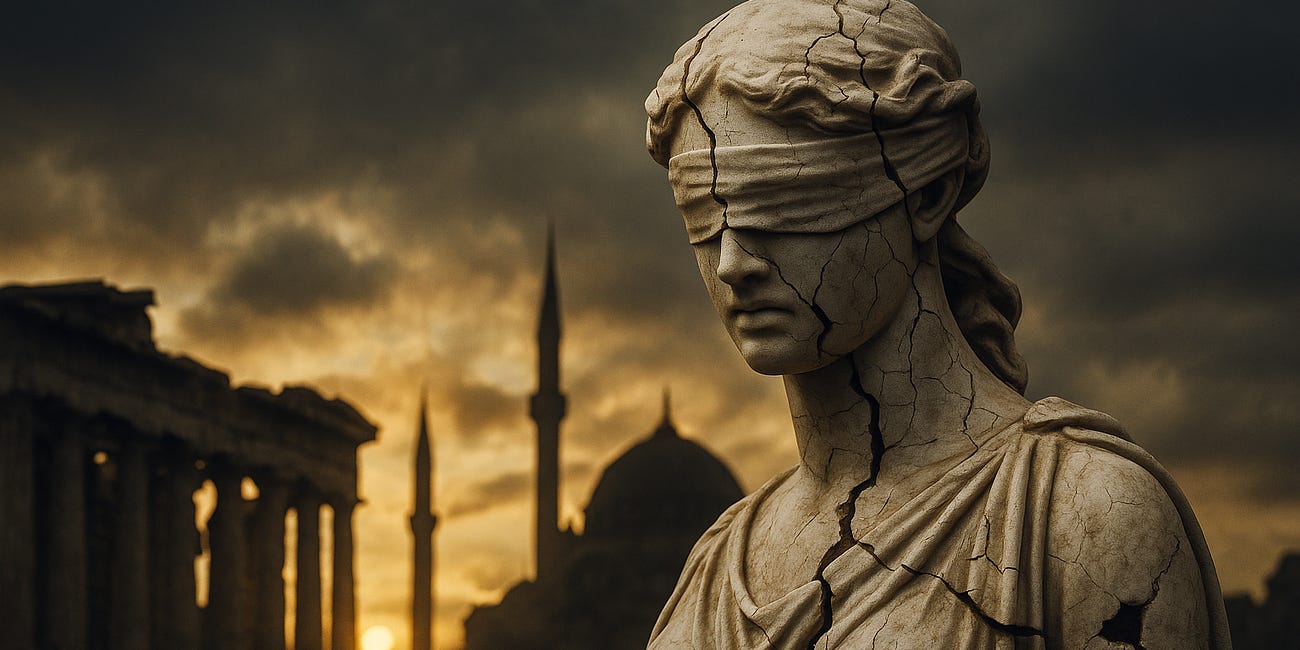
We all grew up asking, “How could they let it happen?” The ghettos. The yellow stars. The camps. The silence. We saw the grainy footage, the hollow faces behind the barbed wire, and reassured ourselves we would’ve done better. Hidden Anne Frank. Refused the salute.
The Comfort of Tyranny
·
November 19, 2025

Readers often push back when I criticise the modern left, but I grew up inside it politically, culturally and psychologically. I recognise its anxieties because they were once my own. And what we are witnessing today is not a slight deviation from liberalism but a wholesale departure …
Roger Collins, The Arab Conquest of Spain, 710–797, and Hugh Kennedy, The Great Arab Conquests.
Hugh Kennedy, The Great Arab Conquests, on the Muslim conquest of Byzantine Palestine (634–638).
Mark R. Cohen, Under Crescent and Cross, and Maimonides' biographies regarding his family's flight from Córdoba under Almohad rule.
See Reuters, "Spain to grant around half a million undocumented migrants legal status" (27 January 2026), and Reuters, "Spain receives 900,000 applications in migrant legalisation drive" (15 June 2026).
See European Commission guidance on residence permits and travel within the Schengen Area.
Tom Holland, Dominion, on Christianity's influence on Western institutions.
No posts
Comments
Nothing yet. Say the first thing.
Sign in to join the conversation.