
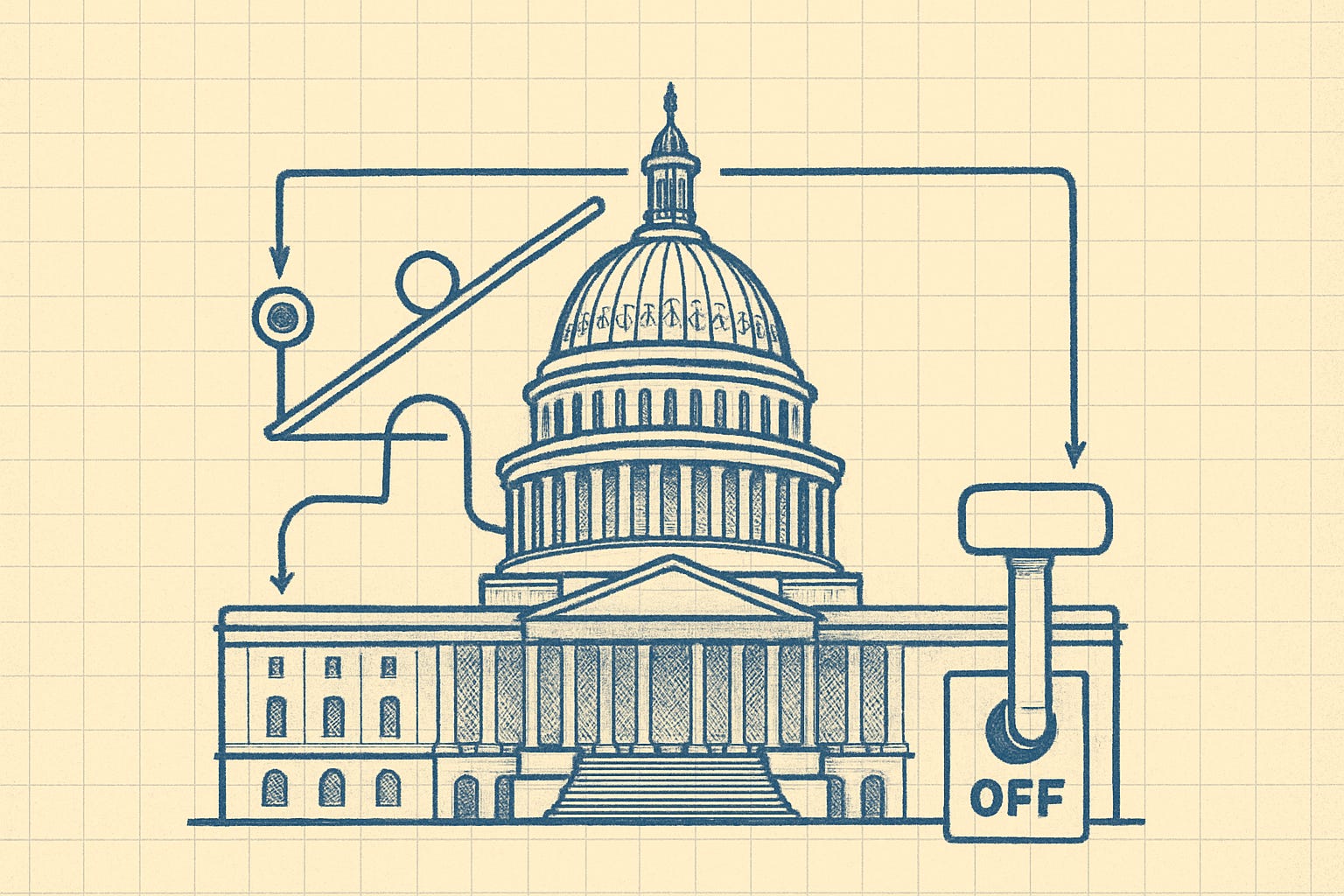
The American government shutdown isn’t a bug. It’s a feature—not in the sense that founders intended modern shutdowns, but in the sense that they built mechanical possibilities that today’s politics has learned to weaponize. Understanding why requires returning to the founding fear that animated the entire American project: concentrated executive power.
The Constitution’s framers were revolutionaries against royal authority. Their central concern was preventing any American executive from wielding the financial independence that had made British monarchs so difficult to constrain. George III had been able to fund years of war in America with far too little parliamentary constraint—and maintained standing armies to enforce his will. The Americans would not repeat that mistake.
They gave Congress, not the president, the “power of the purse”—and made it absolute. Article I, Section 9: “No Money shall be drawn from the Treasury, but in Consequence of Appropriations made by Law.”
This was the primary mechanism for legislative control. A president cannot spend a dollar without congressional authorization. Unlike parliamentary systems where the executive controls the budget process, American presidents must ask a separately elected Congress for every cent.
The mechanism creates genuine legislative power. Congress can rewrite executive requests completely, attach conditions, or refuse funding entirely. Presidents cannot dissolve Congress for refusing their budgets. Congress cannot dismiss presidents for proposing budgets they dislike. Deadlock is inherent to the design. But paralysis was not.
For most of American history, agencies continued operating when appropriations lapsed. In 1980, Reagan’s attorney general issued a legal opinion that would change everything: the Antideficiency Act required agencies to cease operations when funding expired. What had been a gray area became a hard stop. The amendments of 1982 and 1984 codified this.
Law created the switch. Then politics learned how to flip it. As parties became ideologically sorted and polarization increased, budget deadlock transformed from friction into crisis. The check on executive overreach became a weapon in partisan warfare.
Yet the underlying logic persists. The public outcry during shutdowns isn’t “Why does Congress have this power?” but “Why are they using it this way?” The mechanism retains legitimacy even when its application does not.
This reflects American political culture. The system assumes government power needs constant checking, even at the cost of dysfunction. Efficiency was never the aim. Constraint was. Shutdowns are the price.
The question isn’t whether this design is logical within its own framework—it is. The question is whether political conditions have changed enough that the constitutional machinery now produces costs that exceed its benefits. Here’s the hinge point: the design created the possibility of shutdowns. Party evolution made them likely, then frequent, then severe.
When parties were loose coalitions with cross-cutting differences, the system encouraged compromise. When parties are nationalized, ideologically homogeneous, and locked in zero-sum competition, the same mechanisms produce crisis. The machine is the same. The operators have changed.
Other democracies chose different tradeoffs—governmental continuity over legislative independence, executive efficiency over separation of powers. Americans chose the opposite and live with the consequences every time shutdown looms. Which raises the question: could America borrow from other systems without abandoning its constitutional design? And what would it sacrifice if it did?
No posts
Comments
Nothing yet. Say the first thing.
Sign in to join the conversation.