
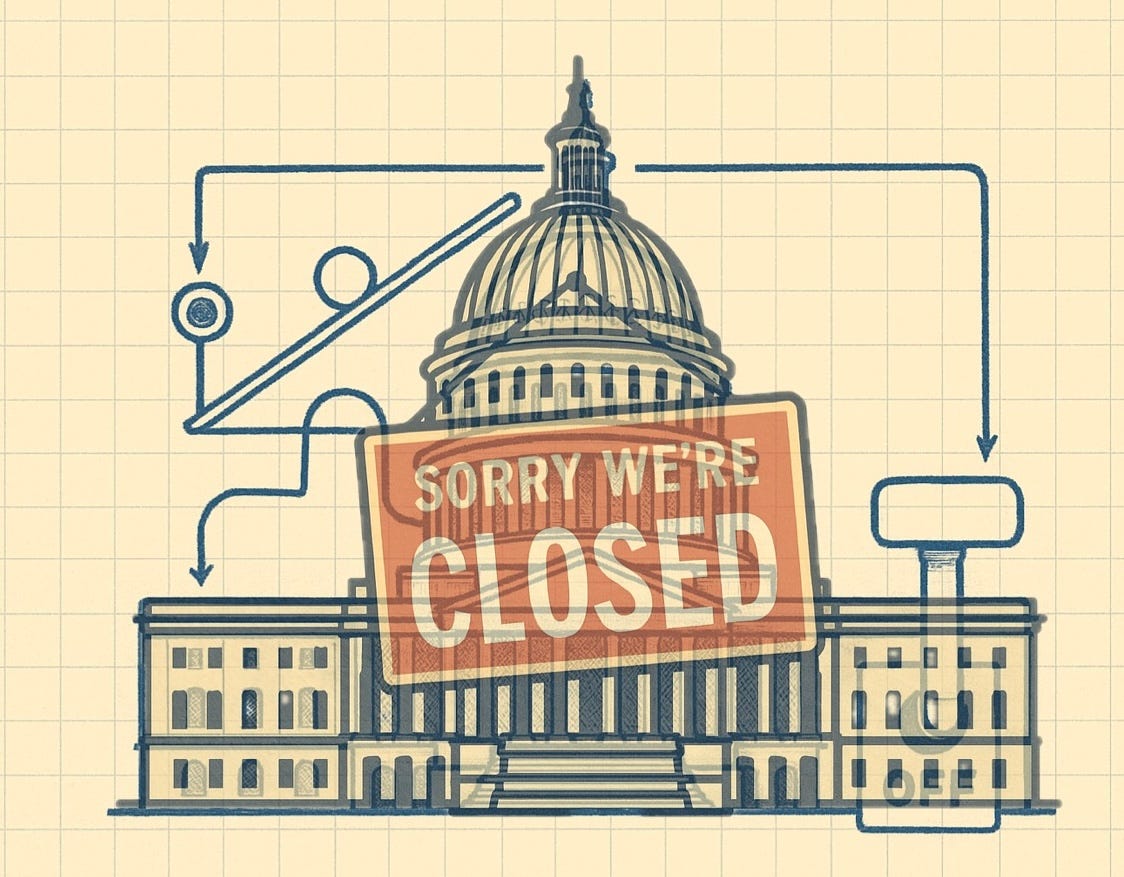
The obvious lesson from comparing American shutdowns to other democracies seems simple: adopt their mechanisms and solve the problem. Install automatic continuing resolutions. Build in safety valves. But wholesale adoption misunderstands what makes shutdowns persist.
Here’s what everyone gets wrong: the problem isn’t that solutions don’t exist. It’s that the problem isn’t a problem—not for everyone.
Shutdowns are leverage. And the leverage is asymmetric. Minority parties in Congress can extract concessions by threatening to block funding. Presidents facing opposition Congresses can use shutdown threats to protect their priorities. The party less concerned about public backlash—or whose base views shutdowns as principled stands—holds more cards. Cruz in 2013 wore the shutdown as a badge of principle, forcing Republican leadership into confrontation. Trump in 2018 declared he’d be “proud” to shut down the government over border wall funding. Both weaponized dysfunction to shift negotiations.
America could borrow specific mechanisms. Automatic continuing resolutions at previous year’s funding would eliminate shutdown risk while preserving Congress’s power to alter spending. Several proposals have emerged from both parties. The policy solution exists. Political will doesn’t. Eliminating this leverage shifts the balance. The dysfunction is useful—to someone.
Yet before concluding parliamentary systems are superior, consider what they sacrifice. Some argue shutdowns reflect democratic accountability—they force visible conflict over spending priorities.
But here’s the part most people miss: in parliamentary systems, the executive controls the budget process. Legislative bodies can amend or reject, but rarely develop budgets independently. The power of the purse belongs to the executive.
The American system gives Congress genuine power to scrutinize spending. Congressional committees can investigate programs, redirect funds, and attach conditions in ways parliamentary oppositions cannot. The GAO and CBO provide independent checks with no parliamentary equivalent.
Parliamentary systems achieve efficiency by concentrating power. Governments with legislative majorities face few obstacles. That’s smoother but less checked. When majorities go wrong—through corruption or overreach—fewer barriers exist.
Different democratic designs optimize for different goods. Parliamentary systems prioritize governmental effectiveness. Presidential systems prioritize checks on power. You can’t maximize both.
What other democracies can learn isn’t “don’t separate powers” but the value of genuine legislative scrutiny. The pathological version—shutdowns—shouldn’t obscure the healthy version: independent analysis and oversight based on legislative priorities.
What Americans can learn isn’t “eliminate separation of powers” but that checks needn’t halt operations. You can preserve legislative independence while preventing crisis—if enough legislators value continuity over leverage.
Shutdowns aren’t inevitable in presidential democracies. Brazil, Mexico, Argentina don’t shut down despite similar structures. They made different choices. A few countries experience temporary funding gaps, but nothing approaching American-style full operational cessation.
The shutdown problem is solvable. Solutions exist. What’s missing is political commitment to valuing continuity over leverage. Americans make this choice repeatedly as shutdowns loom and reforms fail.
The 43-day shutdown of 2025—military families at food banks, federal workers without paychecks—wasn’t failed governance. It was leverage working as intended. It was a system built to jam under pressure meeting a political culture that has learned to weaponize that jamming. The machinery does what it was designed to do. Just not what most Americans think it was designed to do.
And here’s the cold truth: if the dysfunction persists across decades and administrations, through unified government and divided government, it’s not dysfunction. It’s the system working exactly as those who benefit from it want it to work.
No posts
Comments
Nothing yet. Say the first thing.
Sign in to join the conversation.