
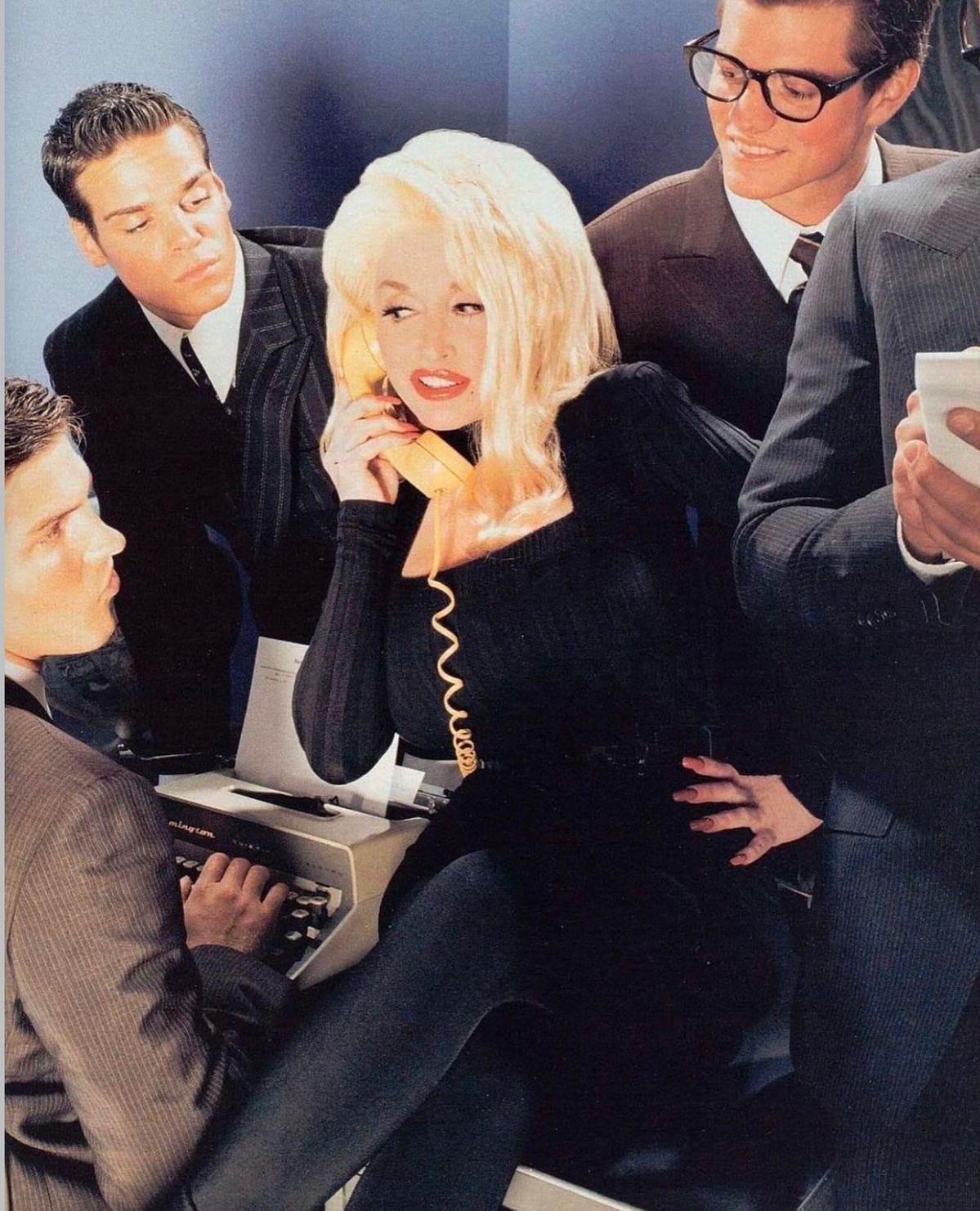
There are so many things I want to write about Dolly. I’m not a big country fan, so my idea of her has primarily been shaped by the warmth of her social presence and, of course, her remarkable writing catalog, but I’ve been surprisingly moved by her death. I’ve been reading about her and impressed by a number of the things I’ve learned about her life — the 49 albums (!!) she released in her lifetime, her extensive charitable work, her business empire in Tennessee, her strong relationship with her extended family despite having no children of her own. It’s clear that her existence alone was trailblazing.
When reading obituaries and reflections on her work, I came across this great piece by Alexis Petridis in The Guardian where he shares her response to an interviewer in 1977 putting out the idea that her larger-than-life stage outfits and wigs, the rhinestones and frills in sugar-sweet colours paired with the peroxide perm, were making her look like a joke.
“The joke’s on the public,” responds Parton, her smile never slipping. “I know exactly what I’m doing and I can change it any time … I’m sure of myself. I’m sure of my talent.”
Petridis writes: “A woman whose first solo hit was called Dumb Blonde, she used it both to lure in a certain type of country fan (“rednecks with flat tops who bring women who wear short skirts or tight pants,” as one 1970s journalist sniffily put it) and as a kind of glitzy, fluffy shield.”
While I enjoyed the article, I wouldn’t necessarily describe her look as a shield — I believe she wielded it, and perceived it herself, as more like a weapon.
Dolly knew that her look was a driving force in her business, helping her music reached as many ears as possible and enabling her to have a career that outlived that of most female pop artists. It was a subversive, smart move to differentiate herself.
Dolly once said, “I look like a woman but I think like a man. I’ve done business with men who think I’m as silly as I look. By the time they realise I’m not, I’ve got the money and gone.” She famously turned down the opportunity for Elvis to record I Will Always Love You because his manager wanted 50% of the publishing (the money earned by the writer of the song.) She started her own company to manage and own her publishing rights when she was just twenty years old — being a performer from aged six, she must have already seen what happens when you don’t protect your work.
Last week I finished reading Happy Hour by Marlowe Granados, in which two best friends in their early twenties move to New York for the summer, working cash-in-hand jobs to cover their rent and meeting numerous celebrities, elites and socialites in the clubs and bars they frequent. One of the quotes that stuck with me was when the protagonist Isa says, “I am comfortable saying I don’t do anything because that way people are always surprised by me.”
I am someone who always fought to be understood. It felt like an uphill battle to be taken seriously. I didn’t like it when people assumed I hadn’t gone to university, and it used to really get my back up when I got scapegoated in work because I’m the creative at the end of the chain. I felt haunted by the idea that creatives are all a bit young and unprofessional — but there was a moment where that switched for me; I accepted that I couldn’t control the narrative. If I became a scapegoat but fulfilled my obligations, if I was honest and clear, that was all I could do. I know I’m good at my job, and there’s no use in sweating about whether someone I probably haven’t spoken to agrees.
Both Dolly and Granados have been reminders to me that there is a strange power in being underestimated. What is achieved by begging to be acknowledged? We can’t force someone to understand us. As Dolly said, if you are sure of yourself and your talent it’s best to get comfortable with being misunderstood. If you are shrewd, you can even engineer some of it, choose the elements you are happy for people to make assumptions about or be outraged by. Lots of people will wilfully misunderstand you anyway, like that journalist in the 1977 interview. Is it worth the energy to fight it? Let them underestimate you.
No posts
Comments
Nothing yet. Say the first thing.
Sign in to join the conversation.