
BEYOND THE PRESCRIPTION is on sale now!
Get your copy here:
You can purchase and gift a copy here:


📣 Click here to send me your questions for future Q&As! ✍️
The following questions have been lightly edited for length and clarity.
Dr. McBride, my partner wants to lose weight and is suspicious about GLP1s like Ozempic and Zepbound. So instead, he’s taking 8 other peptides from a naturopathic doctor. Is this something you think is okay? What are the risks and benefits?
—Leah
Hi Leah,
This is fascinating, and I’ll be blunt: I wonder why he would trust an unproven set of peptides and not a rigorously studied and FDA-approved peptide like Zepbound that has been shown in robust clinical trials to help patients lose weight and improve metabolic health? Because not all peptides are the same.
Most of these substances (for example BPC-157 and TB-500) operate in a regulatory gray zone, with limited human evidence and significant safety concerns. Sure, some animal studies do show compelling things like faster healing times, reduced inflammation, and faster fat loss. But human are not rodents!
Ever since the blockbuster drug Ozempic hit the market, the peptide economy has been booming. Unregulated peptides are touted by wellness influencers and biohackers and are increasingly being taken up by people searching for healing and an edge against aging.
But here’s the truth: If you have diabetes or obesity, GLP-1s have been shown to be safe and effective when paired with lifestyle modifications and careful medical supervision. But for other peptides that claim to do the same thing, we just don’t have the data to say they’re safe or effective in humans. That doesn’t mean they don’t work, it just means we don’t know. The absence of evidence is not evidence of absence, but know that using under-studied peptides means you’re essentially experimenting on yourself.
Does that help?

Hi Dr. McBride, for seniors, losing vision, hearing and other abilities can be distressing. But I know some parts of aging are inevitable and can’t be “fixed.” How do I tell my terrific internist that I’m not necessarily looking for solutions for every problem I have (although I welcome her advice) and that what I need most is her support and understanding plus reassurance when there’s no real cause for alarm?
—Linda
Dear Linda,
I hear you loud and clear. A doctor’s impulse is to make a diagnosis and fix problems, but what patients often need most is to be seen and heard and reassured when reassurance is appropriate. Not everyone wants a pill for every symptom or a prescription for every body part, But if you don’t make your needs known, you may become like so many older patients—medicalized and at risk for what we call “polypharmacy.”
Of course reassurance from a doctor must be rooted in facts and paired with the patient’s personal risk tolerance. For example, I wouldn’t reassure a patient with heart failure that their chest pain was “nothing to worry about” without ordering an EKG and lab work first! But empathy and intellectual rigor aren’t mutually exclusive. Caring for patients is not only about prolonging life; it’s about enhancing it.
Take, for example, two patients with foot pain. Patient A might want every available X-ray, MRI, lab test, and specialty assessment. They might desire a definitive diagnosis and/or expect full resolution of symptoms. Patient B with the same problem might be satisfied with adjusting their footwear and getting (appropriate) reassurance from their doctor.
Getting what you want out of your medical care begins with communicating to your doctor and taking time for her to understand your goals and needs. It also should include the doctor setting realistic expectations and clearly understanding the patient’s tolerance for risk, discomfort, and medical interventions.
So whether it’s with a “full-court-press” or a “less-is-more” style, your doctor should understand that you already accept the natural course of aging. I think that’s a very healthy approach!
I’m 44 and have really bad social anxiety, and alcohol helps take the edge off social situations. How can I manage my social anxiety and still be social? I want to be more comfortable around other people, but alcohol is everywhere, so it makes it doubly hard to say no. I feel like I would lose friends if I abstained. Anything you advise your patients like me?
—Anonymous
Dear Anonymous,
You are in good company when you say you use alcohol to quiet social anxiety. The disinhibition from alcohol can temporarily get us “out of our head,” but alcohol can also negatively affect every organ system. Depending on the person, it can put us at higher risk for things like heart disease, cancer, depression, and anxiety. Because alcohol is legal and socially acceptable, I think this is easy to forget!
Bravo for being self-aware enough to understand your relationship with alcohol. My first piece of advice is ask yourself these questions: Are you certain that your social life hinges on alcohol? What evidence do you have that friendships would change without it? Be honest. For example, when you’re in a social situation and feel anxious, you may have negative thoughts such as “I’m going to embarrass myself” or “People are judging me.” Challenge these thoughts by asking yourself if they’re really true and coming up with more realistic, positive thoughts instead.
Here are some tips that I recommend to my patients like you who want to socialize without alcohol:
Tell your friends that you aren’t drinking that night. It’s much easier to stick to your goals when you make your plan public.
Try not to confuse well-intended questions from friends like, Why aren’t you drinking? with disapproval of your choices. They may simply be curious—or even envious of your fortitude!
Find a good substitute for alcohol, and bring it with you. There are so many non-alcoholic options out there! (Personally I love Athletic NA beer.) Having a fun alternative puts an unprepared host at ease.
Remind yourself the next morning that you did it. Keep practicing. You are strengthening a new muscle one day at a time.
PS. You might like an article I wrote last year that expands on this idea “How’s Your Relationship with Alcohol?”
When, if ever, do you recommend a patient find out their APOE status? I am prone to health anxiety, but I also hear there are lifestyle interventions you should take if you carry an APOE4 gene. Thanks!
—Amanda
Hi Amanda,
Great question. As you know, the APOE4 gene mutation is primarily associated with Alzheimer’s disease risk assessment. The mutation in the APOE gene is considered a risk factor for late-onset Alzheimer’s disease.
What does it mean if you have the gene variant? It’s important to note that having the APOE4 mutation does not guarantee the development of Alzheimer’s. Conversely, many people with Alzheimer’s do not have the APOE4 mutation. In other words, screening for Alzheimer’s is much more complicated than a single test.
Why wouldn’t you want to know your APO4 status? There are ethical considerations and potential psychological harms associated with APOE4 testing. The knowledge of the presence of the APOE4 variant can be emotionally difficult. Because APOE4 status doesn’t necessarily change the management of a symptom-free patient at risk for dementia, this test is typically best suited for clinical trials focused on Alzheimer’s treatments—or for people with objective evidence of cognitive problems where this test would lead them to get an early treatment.
What can you do to prevent Alzheimer’s, regardless of APOE4 status? A lot. We know that lifestyle modifications such as engaging in regular physical exercise, maintaining a healthy diet rich in antioxidants and omega-3 fatty acids, and staying mentally and socially active can reduce your risk for dementia. We also know that screening for cardiovascular risk factors, such as high cholesterol, hypertension, and diabetes can protect your cognitive health, regardless of APOE4 status.
The upshot? It’s crucial to understand the limitation of APOE4 testing. Like many other diseases, the development of Alzheimer’s reflects a complex interplay of genetic, environmental, and lifestyle factors—some of which we cannot control, and some of which we can.
PS. You might like my recent article “There’s Now a Blood Test for Alzheimer’s. Should You Get It?”
🙏 Lucy

*BEYOND THE PRESCRIPTION* UPCOMING EVENTS 👉
August 12 @ 7-8 pm | Politics & Prose | Washington, DC | in conversation with Franklin Foer
August 15 @ 1-2 pm | Mitchell’s Book Corner | Nantucket, MA | book signing
My book, Beyond the Prescription, comes out on August 11. I wrote it with you in mind. The book is a roadmap for navigating your health in real life without perfectionism, pseudoscience, or shame.
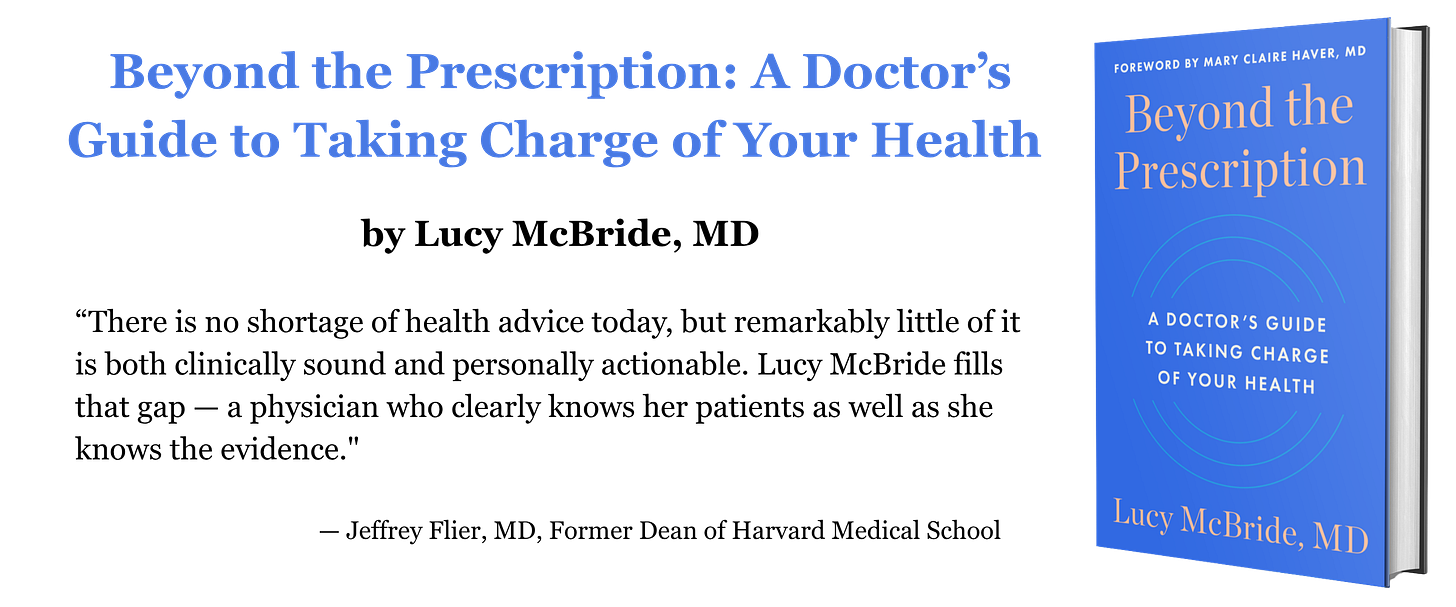
You can order your copy at Amazon, Bookshop.org, or Barnes & Noble.
Comments
Nothing yet. Say the first thing.
Sign in to join the conversation.