
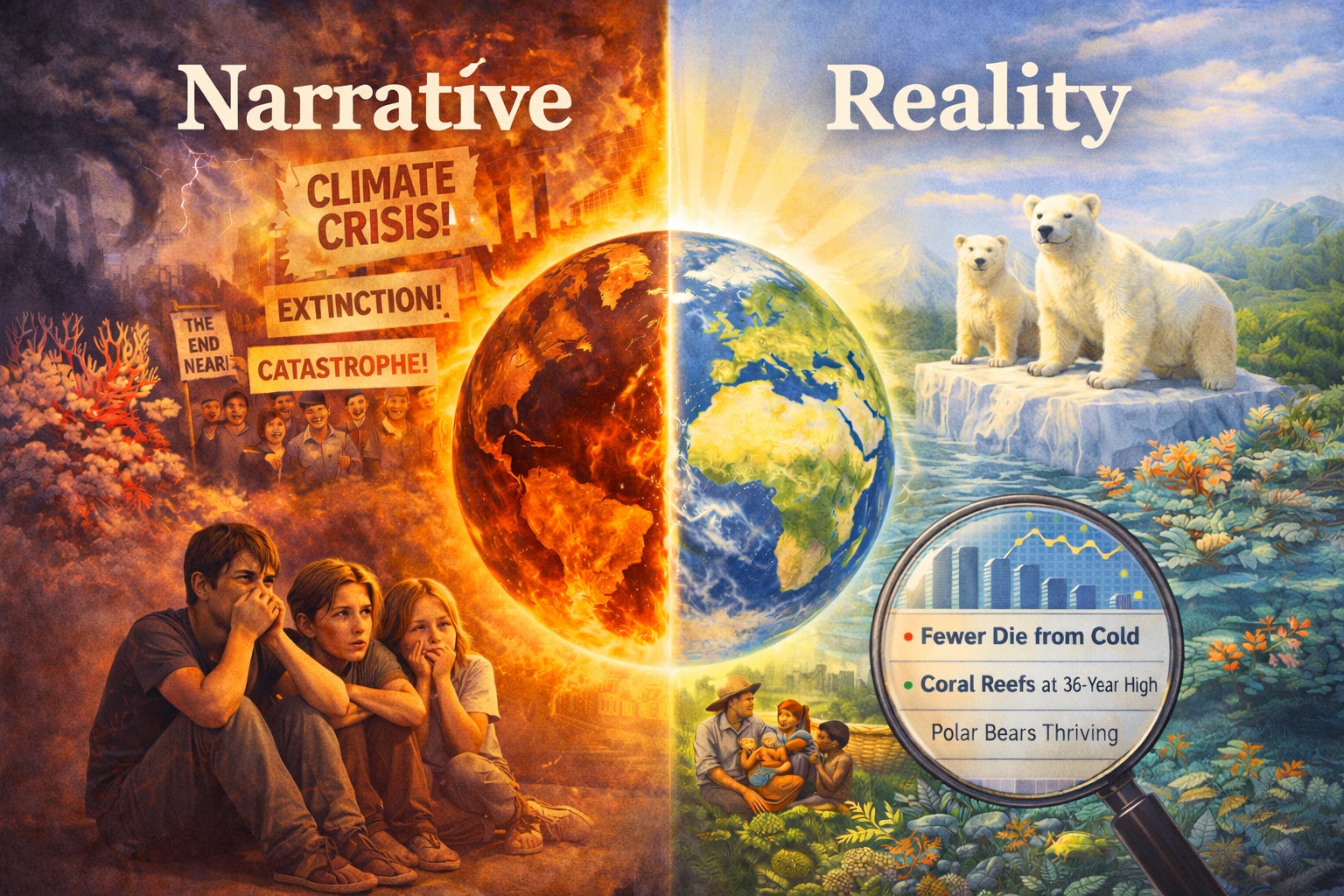
The more I’ve researched climate change, the more I’ve realized the common knowledge surrounding climate change isn’t just slightly wrong. It’s that the truth is usually the opposite of what we’re told.
We’re told polar bears are going extinct because of climate change. In reality, thanks to a 1973 hunting ban, global polar bear populations are booming.
Or take coral reefs. We’re constantly warned that warming oceans are driving reefs into irreversible collapse through mass bleaching events. And yet the Great Barrier Reef, the only reef with constant data going back to 1985, is near a 36-year high.
Then there’s the claim that climate change is making the world deadlier. In fact, deaths from climate-related events are down 99% over the past century. Why? Because we’ve gotten richer which makes use safer from extreme weather events.
But isn’t heat dangerous? Well, the data shows that 9x more people die from cold than from heat. Heat deaths have risen slightly in some regions, and every preventable death is a tragedy. But overall, as the planet has modestly warmed, total deaths from extreme temperatures have slightly decreased.
What about supercharged storms? Global data shows no meaningful upward trend in climate-related natural disasters since the year 2000. Droughts have declined. Hurricanes have remained stable. Tornado activity has decreased. Extreme weather still exists, and always will, but the claim that it’s getting worse isn’t supported by the observational data.
We’re told a warming world is bad for humans, so why do warm periods in history consistently coincide with human flourishing?
Just look at our own time, over the past 150 years, the world has warmed by about 1.3 degrees Celsius. During that same period, humanity created the greatest explosion of wealth, longevity, health, and abundance in its entire history. Global poverty collapsed. Life expectancy soared. Infant mortality plummeted. Literacy, human rights, and women’s rights are at record-levels. If warming were really bad for humans wouldn’t their be some impact on our prosperity?
This is the part where climate activists say, “Well we should still transition away from fossil fuels because solar and wind are better, cleaner technologies.” Not so fast.
Over the past two decades, governments have spent trillions promoting solar and wind energy. The promise was cheap, clean, reliable power. The reality has been higher energy costs, grid instability, and industrial decline—especially in Europe.
Germany and the UK offer cautionary tales. As energy prices soared, manufacturing has become prohibitively expensive. Factories are shutting down or relocating. Less industry means less wealth and less jobs, which leads to lower morale and growing public anger. The trillions of dollars spent have not led to a green utopia; they’ve only created a degrowth mindset, nihilism, and a dependence on China for rare earth minerals and the renewable energy supply chain—or, in the case of the EU, a dependence on Russia for natural gas. What could possibly go wrong?
There’s also a fundamental technical problem with solar and wind that no amount of wishful thinking can fix: they are intermittent. The sun doesn’t always shine. The wind doesn’t always blow. To compensate, countries must either maintain a 24/7 backup—usually fossil fuels—or massively overbuild capacity just to guarantee reliability. According to the Wall Street Journal this has already happened: “The U.K. used to meet its electricity demand with 60-70 gigawatts of power capacity. Now, the country requires twice as much capacity, 120 gigawatts, to meet slightly lower demand.” So really these green technologies are not “clean” at all, what they are is land, material, and infrastructure intensive and, of course, expensive.
And yet, despite all this, the West continues to lecture the rest of the world about using fossil fuels.
It was okay when we developed using oil, gas, and coal. Even today, fossil fuels still supply roughly 80 percent of our energy. But when countries in Africa or Asia try to build natural gas plants—one of the fastest ways to lift people out of poverty—they’ve been scolded, denied financing, or blocked by institutions like the World Bank.
The result is that climate policy is now actively keeping people poor. It is slowing development, raising costs, destabilizing grids, and fostering resentment—all while being justified by a “feel-good” narrative that doesn’t hold up against reality. The road to hell is paved with good intentions.
And don’t even get me started on the fact that climate doomerism has created an epidemic of climate anxiety among young people who’ve been told they have no future. The amount of human capital that is wasted worrying about this nonsense can not be overstated.
In spite of all this climate change mishigas—and thanks to capitalism and fossil fuels—humanity today is, across the board, safer than ever, wealthier than ever, and more resilient than ever. Of course, we still face challenges as a society, but instead of addressing the things we can change, we’re told to fear the future, distrust progress, and dismantle the very systems that made modern life possible.
I simply do not see an upside to climate propaganda.
Climate fear hasn’t made us safer. It has only wasted our money, made energy more expensive and less reliable, and scared a generation of young people. Enough is enough.
No posts
Comments
Nothing yet. Say the first thing.
Sign in to join the conversation.