
“What’s for dinner, Lynn?” Dan would holler lovingly as he entered our home, usually on a Tuesday or Wednesday night in the dead of Vermont winter.
Dan the Puzzle Man, we called him.
He’d step in from the blustery dark, a swirl of snowflakes following him through the door. He’d pause in the mudroom to remove his shoes, that trademark grin already forming.
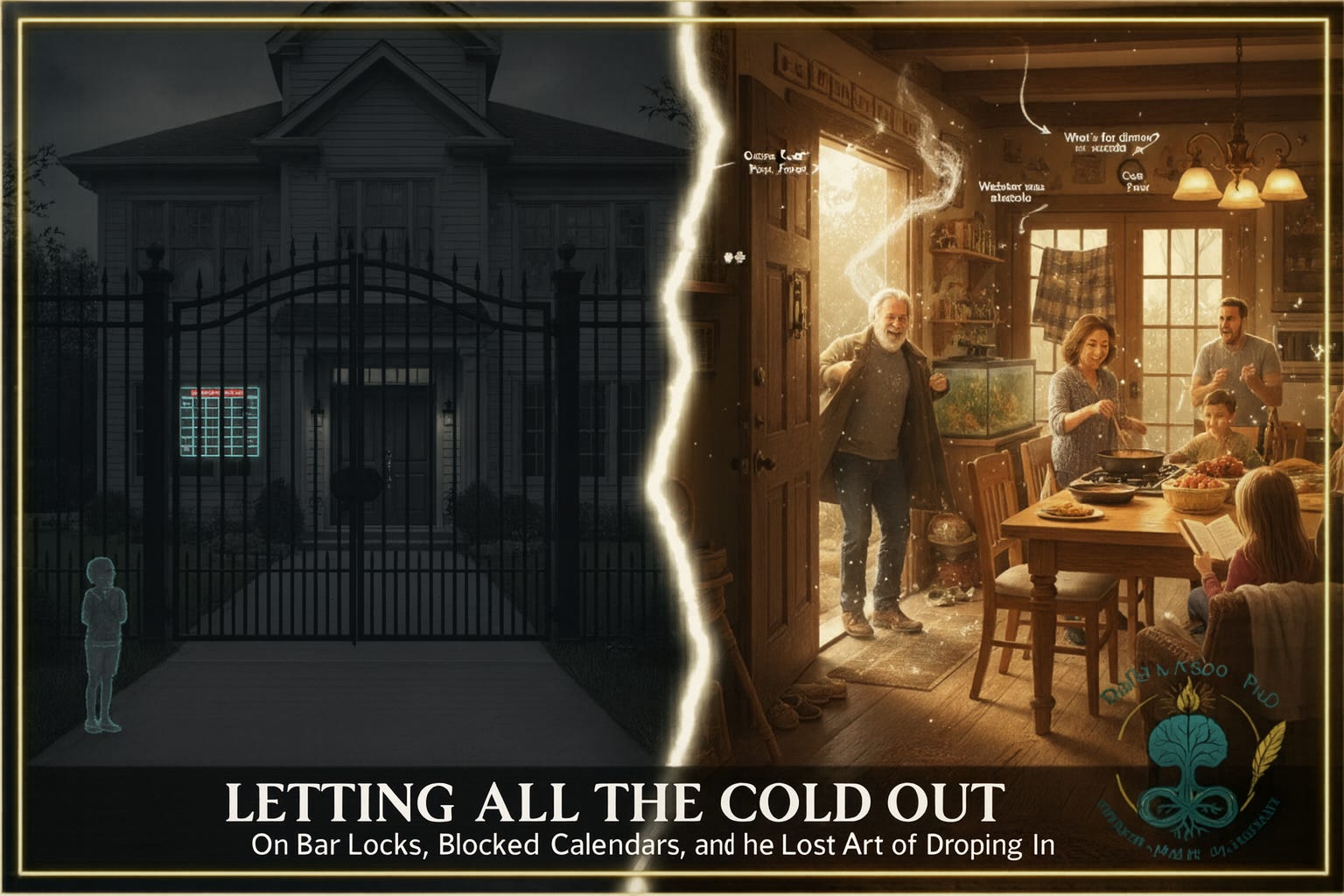
And it was a joke. A borrowed one. A family friend of his had done the same thing in his childhood—walked into their house and hollered “What’s for dinner, Joanne?” He often shared the story with us, and in carrying it forward, he carried a piece of his own past into ours.
My parents’ faces would light up at his arrival. The dogs would bark. The kids—me included—would shout, “Dan’s HERE!”
Unless I was in the den reading, of course. If so, I was gone. So deeply ensconced in another world that I wouldn’t even notice the commotion. Even today, if I’m tucked into my reading nook, I am oblivious to the world—you may need to physically tap my shoulder to pull me back.
Dan didn’t have a phone. So there was no easy way to arrange his visits. He just appeared. But with three kids in school, it was a pretty good bet that we’d be home on a mid-week November evening after 6pm.
Mom cooked most nights. The kitchen was always alive. It was likely that the burners had a cast iron skillet with onions sizzling away, another with Winter Squash or Brussels Sprouts. Maybe there was also a pasta pot on one of the back burners, a light rolling boil with some olive oil on the top of the water, and the pasta jar sitting open next to the stove, waiting for just the right timing.
Some meat would be cooking somewhere. Perhaps chicken in a third skillet, or meatballs in the crockpot over in the corner, tucked between the bread cupboard and the toaster oven, steam rising in a soft vertical ribbon.
“Don’t just stand there! Close the door! You’re letting all the cold out!”
Dad would yell at him. It was a running joke. Our home was huge, and heating it was a challenge. Most of the house was sectioned off with a combination of blankets and doors. The internal walls weren’t insulated, so the heat in the kitchen and living room would slowly leak into the bedrooms upstairs and the den.
We Roots are hearty folk. Jeans and a sweater made the 62-degree indoor temperature quite comfortable for us. But 62 is cold for most. Jokes make a challenging situation into something we can appreciate. We didn’t know any different. It’s just how it was.
“I’ve been experimenting with drinking all of the water I’m going to drink for the meal at the end of the meal,” Dan proclaimed, walking in and grinning. He’d hug each and every one of us. His hugs were real—a full-body squeeze that made you feel seen. He’d hold you for an extra second, look you in the eye, and only then launch into whatever idea had his attention.
One night, it was linguistics.
“The sound ‘ew’ shows up in a dozen different spellings…”
“Queue. Cue. Pew. Few. Jew. Rue. Crew. Shoe. Mew. Phew. Brew. Drew. Lieu.” He was delighted by oddities. Delighted to delight.
Dad, without missing a beat, from the head of the table: “Webster was a fucking asshole.”
The evening’s discussion began, and was off to the races.
“He did a good thing, I suppose,” Dad continued, “But he did it by being an arrogant prick. We didn’t really have a great set of rules. So Webster decided what they were going to be and started to abuse people into compliance.”
It wasn’t always words. Sometimes it was accents. “Stone Harbor, New Jersey,” he’d say, as though he had rocks in his mouth. He would visibly chew on the words as they rolled out, contorting his cheeks to achieve the desired sound. I’ve since been to Stone Harbor; I got married not far from there. He had it right. “Boston, Massachusetts,” the Boston coming out more like if it was spelled “Bwahssten.” My mother might jump in and follow on with her version of the Florida accent, pronounced the way her mother did: “Flahhrhidda.” The entire evening might be carried on in the rhythm of whatever phonetic curiosity had captured Dan that day.
Dan frequented our lives on winter evenings for the better part of a decade. Most visits blurred into a warm, familiar tapestry. But that one? That one I still see clearly.
We had a huge, beautiful dining room table. It was a family heirloom, passed down through now at least three generations, stunning golden oak with the quarter-sawn rays visible in some places. The feet of the table showed where one of our dogs had chewed it up as a puppy.
In the winter, the huge double glass doors looking out over the yard were covered with a few layers of blankets to keep the cold in. It looked funny, but since the sun sets at 4:30pm, you can’t see anything out the windows anyway. On that particular evening, Dan sat at the southeast corner of the table, between the blanket-covered windows and the ever-present fish tank.
We always had a fish tank, right there at the head of the table. Or the foot of the table, depending on where Dad was sitting. Whatever side Dad sat at was the foot of the table. Ask the kids—we’ll tell you. Unless he was carving a ham. Then where he sat was the head. Of course.
Recently, as I’ve been thinking about family—the real architecture of it—that dinner resurfaced.
I’ve been postulating that the “nuclear family unit,” as our culture defines it, is actually a mismatch to human biology, human psychology, and human history. Humans were never meant to be raised by two adults.
The proper family unit for a human family is a minimum of six parental figures.
Historically, the simplest form was two parents and four grandparents. But as the proverb says, “It takes a village.” The constellation can include aunts, uncles, elders, beloved family friends.
Maybe, Dan the Puzzle Man.
At the time, I couldn’t see the richness he brought into our lives. I thought my parents were just being friendly. I didn’t understand that they were intentionally cultivating these relationships. Not consciously. Not strategically. But instinctively. They were tapping into an ancestral wisdom that said a family is not complete with only two of the six.
This “Sixth Parent” framework, which I’m now actively mapping in my own work, was just life to them. These adults, these modern Bards, filled our home with perspectives we couldn’t have even fathomed on our own. They enriched our minds with their travels, their oddities, and their simple, steady presence.
I’ve had full conversations in accents. Not good ones, but joyful ones—because my childhood home was a place where ideas were played with, not protected.
You can’t drop into a $7M mansion in Lafayette, CA, and holler, “What’s for dinner, Lynn?” Not anymore.
Doors are locked. Gates are closed. Security systems set. Cameras recording. Calendars are automated and electronic. Visits require invitations. Friendship requires scheduling.
Make an appointment.
Ironically, we live in the safest era in recorded human history. (Perhaps slightly safer twenty years ago, but we can quibble over that infinitesimal slice of time.) We are unimaginably safe compared to the vast sweep of humanity. And yet, we are more paranoid. More disconnected. More armored. More alone.
Our protections have become our prisons. Our conveniences have quietly amputated serendipity.
Make an appointment.
And yet here I am—writing this to you instantly, across distance, with a level of ease my parents could never have imagined. Technology is giving us something extraordinary. A new kind of hearth. A new kind of presence. But like all tools, it cuts both ways.
“What’s the correct number of parental figures in the nuclear family?” Dan might ask, the sparkle of a trick in his eye as the words come out, perhaps in the Stone Harbor accent. He never did. But he might.
Tonight: I did.
But like all tools, it cuts both ways.
So here is my question for you: How did parental figures show up in your life? Who were the grandparents-by-nature, not by blood? Which adults carried stories that shaped you?
What ancient wisdom were your parents tapping into—without ever naming it—that gave you the village you needed?
How are you carrying those lessons into your family today? And, critically: How is technology enriching that experience—and how is it making it harder?
Because tonight, on an early winter Monday, I dropped into your home the way Dan dropped into ours. No phone. No scheduling. No appointment.
A demonstration of the lost art of dropping in. Just a story. Just in time for dinner.
Dr. Lucas Root
Techno-Shaman. AI Strategy Advisor. Author of “THE FORGE & THE FLOW.”
I am a storyteller, but above all, a permanent student of human potential. My work is a deep exploration of the unseen contracts and hidden systems that exist at the intersection of technology and humanity. Here on The Lucid Path, we practice learning in public and building with purpose. I’m a rabid enthusiast for finding the patterns that help us build better, more human ways of being, freeing ourselves from the complexity we create.
If this piece resonated, consider sharing it with someone who might also be walking this path.
Explore My Work Further: https://smartpa.ge/LucRoot
No posts
Comments
Nothing yet. Say the first thing.
Sign in to join the conversation.