
To get to the North Country, you have to leave the city while it’s still dreaming.
You start early, well before the sun comes up, escaping the gravitational pull of New York City in the dark. It’s a shedding process. Mile by mile, the concrete falls away, replaced by the gray-brown blur of highway, and finally, the white silence of Upstate.
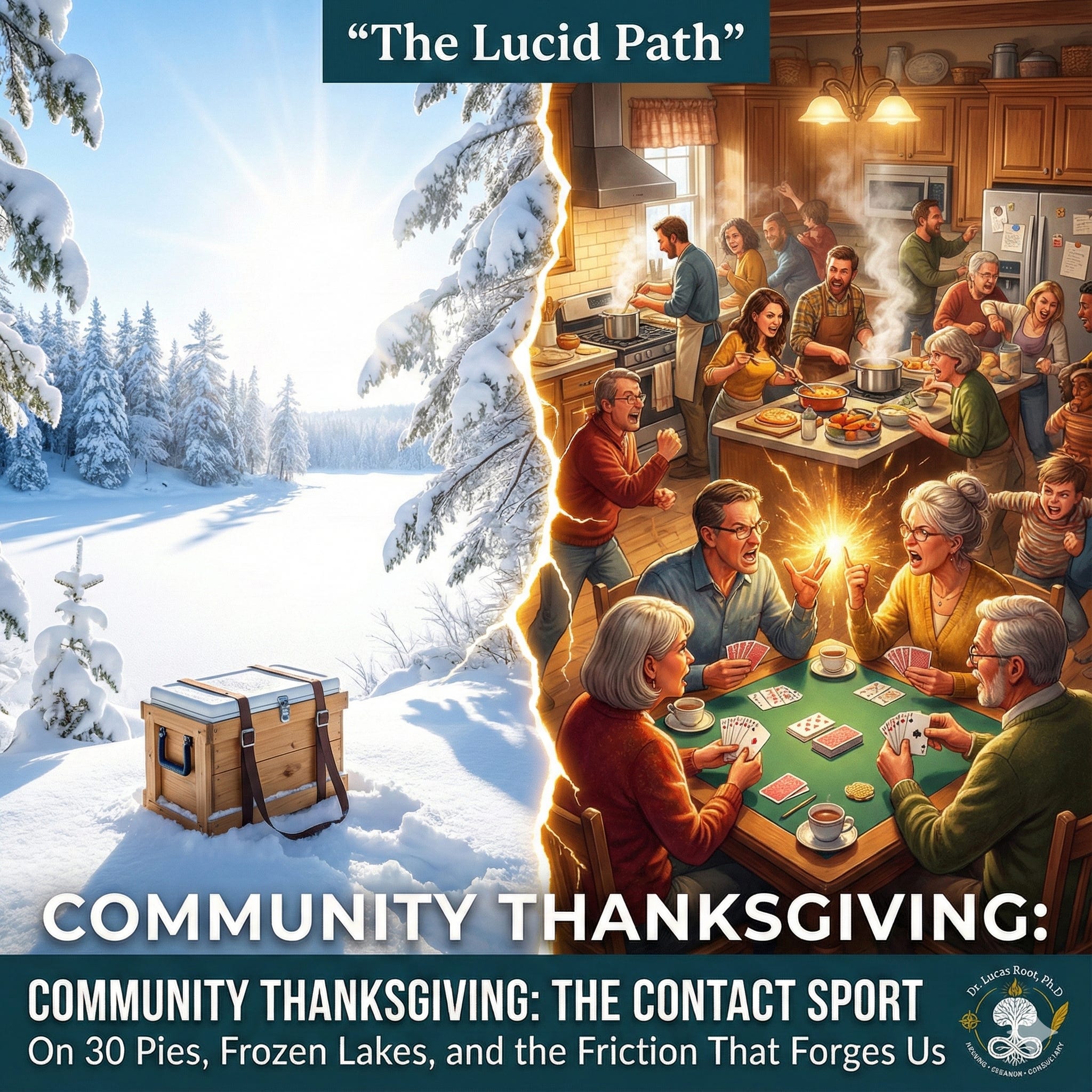
It is always snowy when we arrive. For me, it is like coming home.
I step out of the car and the silence hits me first. It is the vast, untouched silence of deep winter. I look at the pine trees, their boughs weighed down by heavy, wet snow, bowing toward the earth. I remember being small enough to crawl underneath those trees, way down at the base near the trunk, finding a hidden room of dry needles and safety, a whole new world of quiet comfort protected from the wind.
And then, there is the light.
In the city, I forget about the light of winter. But up here, snow and ice are mirrors. They reflect and refract everything, amplifying the sun until the world feels over-exposed. The light of day is brighter than any day you’ve ever experienced. It is the beauty of a world completely and fully illuminated, utterly filled with brilliance, so deep it feels like it could reveal the darkest corners of your soul.
Arriving is its own experience. It is a transition from the gray ambiguity of the world into the blinding clarity of home.
My father’s extended family gathers here every year. Thirty-plus people descending on a small lake community to cook, clean, and be together. Logistically, it shouldn’t work. My uncle’s house is generous, but it is not a hotel. Where do thirty people sleep?
They sleep in the goodwill economy.
My aunt and uncle are neighbors in the verb sense of the word. And because of that, when the Root family invasion begins, the community opens its doors. We borrow the homes of neighbors and friends. We sleep in their guest rooms, their cabins, their spare beds. We walk into empty houses, turn up the thermostats, and make the beds, knowing that this hospitality is the accumulated interest of decades of kindness.
But the center of gravity is the kitchen.
To say we “cook together” sounds pastoral. It sounds peaceful. It is not. It is a contact sport.
Thirty people in one house is a riot of noise and heat. It is a confined space filled with strong personalities, sharp knives, and boiling water. We do not move without colliding.
There are elbows in ribs. There are voices raised over the din of clattering pans to be heard. There is the constant, physical friction of navigating a space that is too small for the ambition of the meal. “Move, move, hot pan behind!” “Who took the good knife?” “That is not how you cut an onion.”
In a polite society, we avoid collision. We give each other space. We apologize if we brush shoulders. But here, the collision is the point.
We bump into each other. We get in each other’s way. And in that friction, something happens. The politeness burns off. The pretense evaporates. You cannot maintain a facade when you are sweating over a stove, negotiating oven space with an aunt who has a fierce and specific opinion on the roasting of root vegetables.
It is chaotic. It is loud. It is messy. And it is entirely additive.
And then, there are the pies.
My mother is an exceptional baker. Thanksgiving is her masterwork. She makes upwards of thirty variations of pies. Apple, pumpkin, pecan, mince, berry—a staggering inventory of pastry. Transporting thirty pies is a logistical challenge that requires more than cardboard boxes.
So, I built a system.
One year, I hand-crafted a set of shelves, carefully designed with the precision of a skyscraper. I measured the dimensions of her extra-large Igloo cooler. I calculated the height of a pie plate. I built a cantilevered racking system with straps to lift the entire assembly out in one smooth motion.
It was over-engineered. It was ridiculous. It was perfect. It was my way of bringing order to the abundance, of loving my mother by ensuring her art survived the journey.
The days are for the body—walking on the frozen lake, the heat of the hot tub meeting the bite of the winter air. The evenings are for the mind. And this, too, is a collision.
For me, the highlight is the bridge table.
I sit with my mother, my father, my aunts, and my uncles. These are exceptionally intelligent people. They do not coddle ideas. We talk deep history. We tell the stories of our family legacy, which inevitably bleed into the history of this country. And we fight. Not with malice, but with rigor.
The bridge table is where I go to get tumbled.
One year, fresh from a series of tech conferences and feeling the confident glow of my own expertise, I launched into a theory about the inevitability of digital currencies, framing it as a radically new evolution of value. I was articulate. I was passionate. I was feeling pretty good about myself.
My uncle listened, shuffling the deck with a rhythmic thwip-thwip-thwip. He didn’t interrupt. When I finished, he dealt the cards and looked over his spectacles.
“That’s a compelling narrative, Lucas,” he said. “But you’re mistaking the mechanism for the principle. Read up on the panic of 1907 and the localized scrip currencies of the Great Depression. The technology changes. The human need for trust does not.”
He then proceeded, over the course of three hands of bridge, to dismantle my “radical new theory” piece by piece, grounding it in economic history I had glossed over.
I didn’t win that argument. I got schooled. It stung. My ego, puffed up by the city and the conferences, took a hit.
But as I sat there, looking at my cards, I realized something. I wasn’t being dismissed. I was being sharpened. I was trustingly allowed to make mistakes with my own ideas, and I was lovingly brought back in touch with a reality I had ignored.
We often think of community as a place of seamless harmony. We want the warmth without the heat. We want the belonging without the bruise.
But the lesson of the North Country is that friction is a feature, not a bug.
Community is not just a safety net to catch us; it is a rock tumbler to polish us. The energy of the kitchen comes from the chaos. The clarity of the bridge table comes from the debate. The strength of the family comes from the fact that we are close enough to collide.
If you avoid the collision, you avoid the growth. You stay in your own head, safe and small and right. But when you step into the kitchen, when you sit at the table, you submit yourself to the friction. You allow yourself to be bumped, corrected, challenged, and held.
I haven’t lived on the East Coast for years. I miss the drive. I miss the blinding light that reveals everything.
But mostly, I miss the noise.
The “Lucid Path” isn’t about finding a quiet corner to be alone with your thoughts. It’s about building a table strong enough to handle the argument. It’s about engineering the cooler so the art can survive the journey. It’s about finding a group of people who love you enough to tell you when you’re wrong.
Collision, when held in the container of community, is always additive. It adds depth. It adds resilience. It adds truth.
The silence of the snow is beautiful. But the crash of the kitchen is where the life is.
Dr. Lucas Root
Techno-Shaman. AI Strategy Advisor. Author of “THE FORGE & THE FLOW.”
I am a storyteller, but above all, a permanent student of human potential. My work is a deep exploration of the unseen contracts and hidden systems that exist at the intersection of technology and humanity. Here on The Lucid Path, we practice learning in public and building with purpose. I’m a rabid enthusiast for finding the patterns that help us build better, more human ways of being, freeing ourselves from the complexity we create.
If this piece resonated, consider sharing it with someone who might also be walking this path.
Explore My Work Further: https://smartpa.ge/LucRoot
No posts
Comments
Nothing yet. Say the first thing.
Sign in to join the conversation.