
It all seems ridiculous now, but once upon a time, etiquette reigned supreme with books and charm schools for people to learn how to act in public. (Charlotte Chilton, 40 Strange Etiquette Rules Through the Years, Good Housekeeping, 2020).

A friend who knows of my interest in odd etiquette tips recently sent me a magazine article titled, “The Weirdest Etiquette Advice from the Past 100 Years” (Charlotte Chilton, 40 Strange Etiquette Rules Through the Years, Good Housekeeping, 2020).
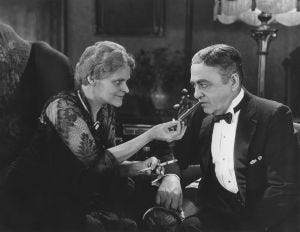
The article contained the quote above about the ridiculousness of etiquette and itemized forty rules of protocol from the past that the author apparently found very strange. The list included instructions for parents to leave their babies in their cribs instead of playing with them (to avoid spoiling the children), for diners to always pass the pepper with the salt (even if the pepper wasn’t requested), and for hosts to constantly have cigarettes on hand whether they smoke or not (to supply to guests who might actually do so).
I have to agree that etiquette has changed over the past 100 years and that some of the “rules” in the article are surprising. But I do quibble with a couple of things.
First of all, etiquette is still a big business, with many books on the subject published yearly. Schools of protocol still exist to certify new etiquette teachers and educate individuals and corporate employees on diplomatic skills that can be necessary in business, politics, and everyday life. And classes at so-called “charm schools” like The American School of Protocol are very popular even today.
My second quibble is that sending the salt and pepper down the table as a unit didn’t seem all that odd to me, since the rule still applies today (according to the Emily Post Institute’s Awesome Etiquette podcast from 2024, salt and pepper are considered a pair and should be passed together when someone requests one or the other). It certainly isn’t on my list of the oddest etiquette advice from the last 100 years, and neither is catering to the needs of your guests by trying to have whatever they might want on hand, although cigarettes are certainly no longer one of those requirements.
All quibbling aside, however, reading the Chilton article did inspire me to do a quick dip into my collection of etiquette books to come up with my own list of etiquette guidelines from the 1800s to the current century that I thought were truly “weird.” Here are a few of my favorites:
1. On women’s dress: “Custom regulates the veiling or unveiling of the figure, according to different periods in the day. In the morning the arms and bosom must be completely covered to the throat and wrists. From the dinner-hour to the termination of the day, the arms … may be bare; and the neck and shoulders unveiled as far as decency will allow” (A Lady of Distinction, Regency Etiquette, 1811).

2. Duties of a husband: “There are times when the wife’s variable conditions of health will be likely to make her cross and petulant. The husband must overlook all this, even if the wife is at times unreasonable” (Hill, The Essential Handbook of Victorian Etiquette, circa 1873).
3. Duties of a wife: “Make the home so charming and so wisely ordered that your husband will gladly be relieved of its care, and will willingly yield up its entire management to yourself” (Hill, The Essential Handbook of Victorian Etiquette, circa 1873).
4. On the treatment of servants: “Traditionally, Twelfth Night is the date for the annual servants’ ball, with family and staff reversing roles for the night and mingling on the dance floor” (Binney, Wise Words and Country House Ways, circa 1920).
5. On women in the working world: “Be impersonal at all times. The more machine-like, especially in a subordinate position, the more efficient you will be … This is particularly necessary in a woman executive” (Moats, No Nice Girl Swears, 1933).

6. On men’s treatment of women: “The whole code of manners toward a woman is based on the assumption that she belongs to a weaker sex, with frailer muscles and more delicate sensibilities … The man who wants to have good manners should refrain from trying to prove that a woman can open a heavy door just as efficiently as he can” (Benton, Etiquette, 1956).
7. On touching: “A well-mannered man avoids touching a woman unnecessarily. In helping a woman down from a bus or over an icy sidewalk, a certain amount of touching is necessary, but in ordinary conversation, patting on the shoulder or squeezing the arm is wholly unnecessary. The line between friendliness and pawing is a very fine one” (Benton, Etiquette, 1956).
8. On cell phones: “Talking on your cell phone, allowing the ring to be heard or a pager to beep, is rude and annoying to the others around you no matter where you are” (Casperson, Power Etiquette, 1999).

9. “Don’t rush … if you’re in a hurry, it means you’re late and you care, which knocks you back several notches in the business hierarchy. It implies you work for someone else, in short, you’re the help” (Gache, 24 Karat Etiquette, 2013).
10. On first dates: “Understand that a first date is an experiment in physical chemistry, so don’t hide yourself in layers of heavy clothing” and “don’t noticeably take your cellphone with you to the bathroom. Your date will know you are checking messages and possibly arranging a later hook-up” (Gache, 24 Karat Etiquette, 2013).
What etiquette rules have you come across that you thought were really weird or impractical? Were you forced to follow any guidelines as a child that you thought didn’t make sense? Send me a note on my contact page, Contact - Lucinda Gerlitz, and let me know.
QUESTION:
What is the best way to remind guests at a ceremony to silence their phones?
A. Make an announcement before the event begins.
B. Put a small notice in the event program.
C. Post a sign by the entrance.
ANSWER:
All three are fine. B and C are better because they are less of an intrusion on the event.
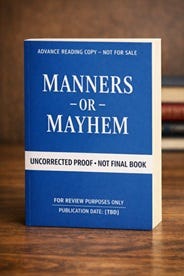
Book News: I received good news this month: Manners or Mayhem is back from the proofreader, and the publisher is now working to get the galleys ready.
I wasn’t quite sure what to expect from a galley, so I looked it up. For anyone else who didn’t know, “Galley proofs are books in the pre-publication stage that are sent out to reviewers and those who may have an interest in them. Publishers send them out before the final version of a book is printed and distributed. They are usually publishing-ready except for a final proofread and are not meant for sale or general release as they occasionally contain minor errors and placeholder elements … These days, the most common galleys distributed are in ebook format, PDF, or paperback” (What Is a Galley Proof, and Why Do You Need One?, The Reading Room).
Authors use galleys to proofread the story, share with early readers, and promote the book before launch, and I’m looking forward to this next step in the process.
Request for suggestions: While I’m waiting to proofread the galleys, I’m planning a newsletter swap with a developmental editor who is also a book and marketing coach. I’ll be sending her a list of questions about the etiquette of working with an editor/coach, and suggestions are welcome. What would you like to know about her work and the services she offers? Please get in touch on my contact page (Contact – Lucinda Gerlitz) with any questions you may have.
Personal news: Finally, on a personal note, my husband and I just celebrated our 37th wedding anniversary, and I’m feeling very lucky to have been married to him for all these years.
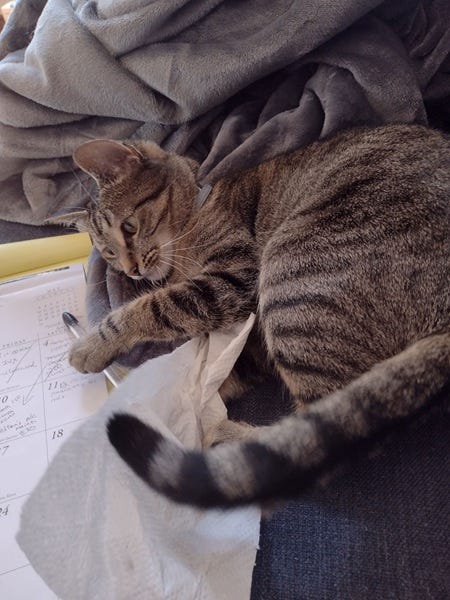
For my monthly picture, here is a shot of my favorite pen thief. Nothing is safe around Cricket!
Hope you’re all having a wonderful May!
No posts
Comments
Nothing yet. Say the first thing.
Sign in to join the conversation.