
Happy new year, I hope you will enjoy the post #1 of this 2025 here on Substack.
My goal is to show you and list here the latest update on the European tourism industry, highlighting the recovery progress and discussing future trends. As we move forward, it's crucial to understand the current landscape and anticipate the evolving preferences and behaviors of travelers.
This will enable industry stakeholders to make informed decisions and adapt their strategies accordingly. The insights provided in this article aim to equip the readers with the necessary knowledge to navigate the dynamic tourism landscape and capitalize on emerging opportunities.
The structure will be as it follows:
The reality behind the numbers.
European Tourism in 2024.
Travel bookings trend analysis by category.
Italian tourism trends for 2025.
Let’s start!
I want to take a quick look back at the results from 2024, with a focus on European tourism results.
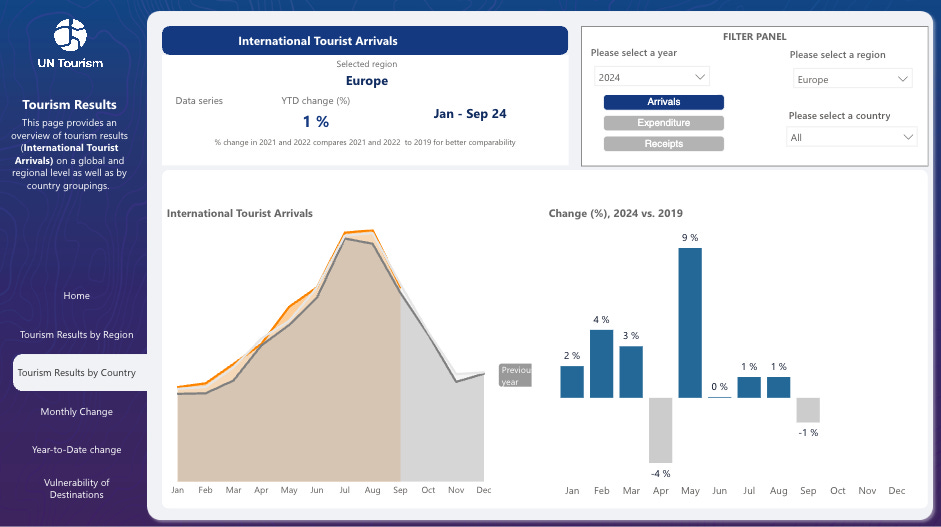
Arrivals in Europe trend analysis: from January to September 2024 (latest data available to date):
Source: UNWTO Dashboard
The numbers compared to 2019 are showing a different picture from the common narrative that is spreading around: International tourist arrivals in Europe were down by 15% in the first 9 months of 2024 compared to the pre-pandemic levels.
This suggests a more gradual recovery than initially expected.
However, the trends vary significantly across different European destinations, with some countries performing better than others.
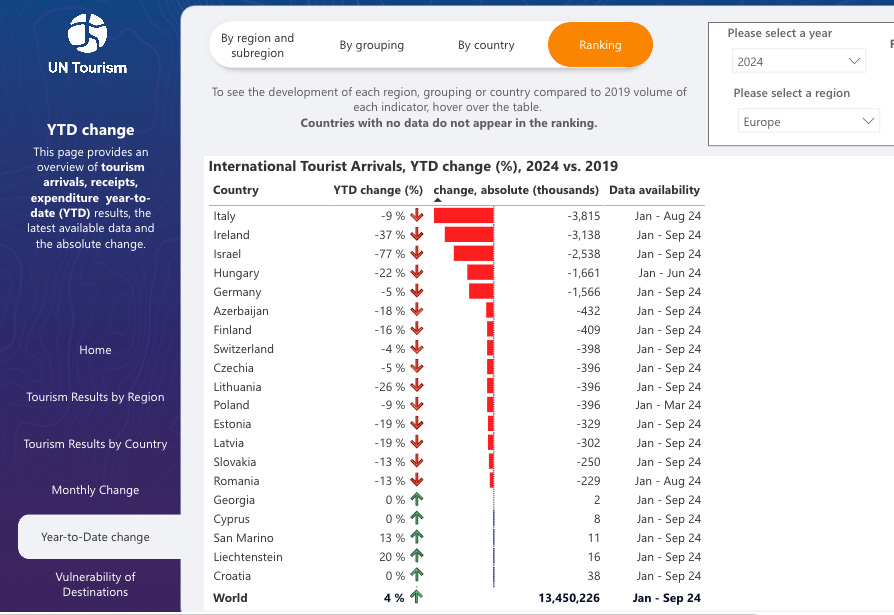
A deeper dive into the 2024 data will provide more insights into the uneven recovery.
Source: UNWTO Dashboard
Here's an overview of the key insights:
🇮🇹 Italy experienced a 9% decline, with 3.8 million fewer arrivals.
🇮🇪 Ireland saw a sharp drop of 37%, losing 3.1 million tourists.
🇮🇱 Israel faced the most significant decrease, at 77%, equivalent to 2.5 million fewer arrivals.
Some countries, such as 🇨🇾 Cyprus (+13%) and 🇱🇮 Liechtenstein (+20%), surpassed 2019 levels.
The global 🌍 average for 2024 showed a modest 4% increase compared to pre-pandemic levels.
This highlights a mixed recovery in Europe, with some regions still struggling while others exceed pre-2020 figures.
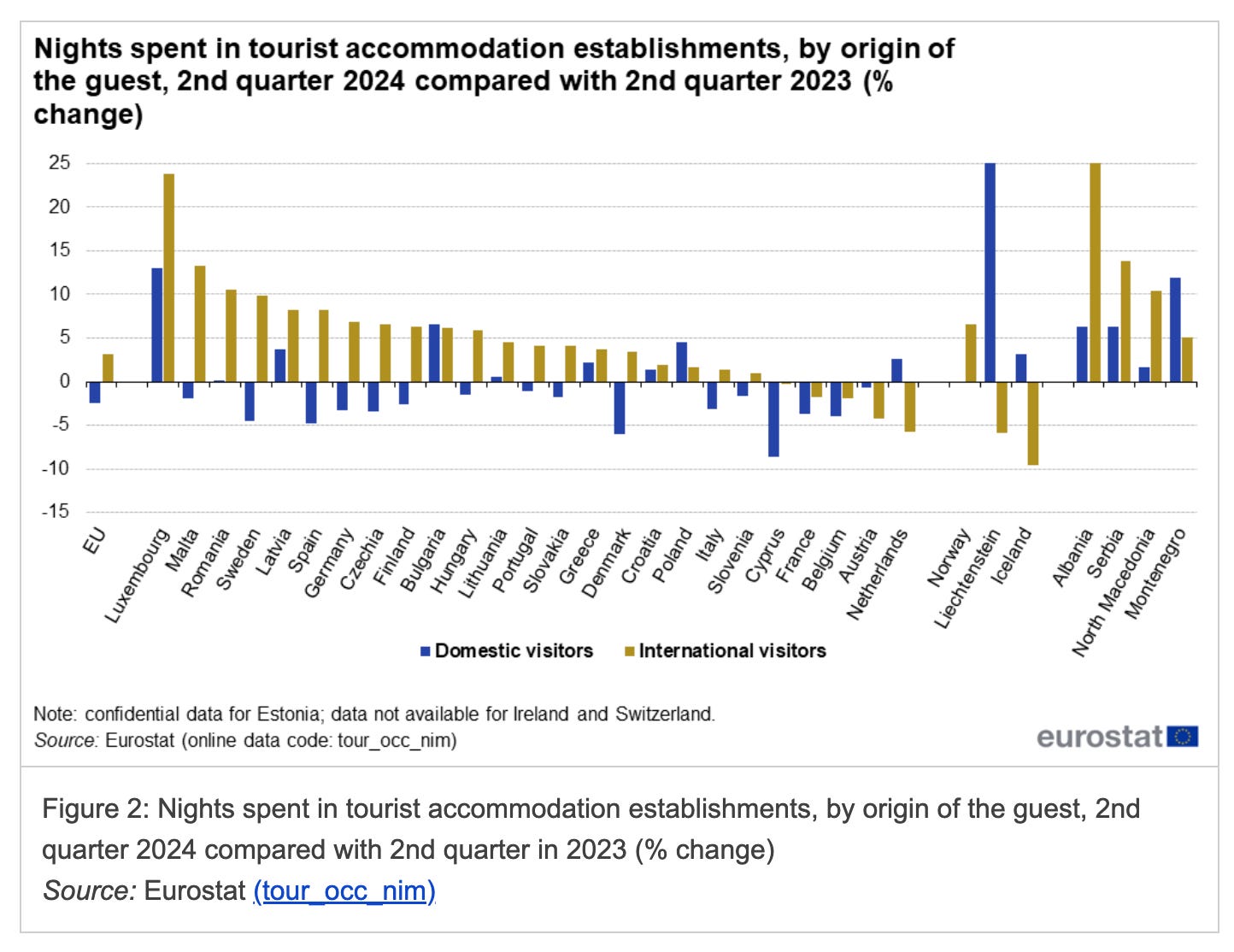
780 million nights spent at tourist accommodation establishments in the EU in the second quarter of 2024, up by 0.2% compared with the same period in 2023.
Hotel nights grew by 4.4 million in the second quarter of 2023 and approached half a billion nights spent.
EU tourism nights reach a record 1.2 billion nights in the first year half of 2024 (+26.6 million nights).
Central and Eastern European Landscape
🇩🇪 Germany showed a 5% decline (-1.6 million visitors), indicating challenges even for major economies.
🇭🇺 Hungary (-22%) and 🇵🇱 Poland (-9%) demonstrate ongoing recovery struggles.
🇨🇿 Czech Republic's modest 5% decline (-396,000 tourists) suggests better resilience.
🇭🇷 Croatia stands out with positive growth (+2%), showing successful adaptation to new market conditions.
🇸🇰 Slovakia's 13% decrease (-250,000 visitors) reflects regional challenges.
Baltic States' Common Challenge
🇪🇪 Estonia (-19%), 🇱🇻 Latvia (-19%), and 🇱🇹 Lithuania (-26%) all showed significant declines.
Combined, these countries saw about 1 million fewer visitors than in 2019.
Mediterranean Mixed Results
🇮🇹 Italy's 9% decline represents one of the largest absolute drops in visitors.
🇪🇸 Spain made a robust recovery, surpassing expectations with just a 2% decline from 2019 figures.
🇬🇷 Greece demonstrated remarkable resilience, reaching 98% of its 2019 visitor numbers.
🇵🇹 Portugal showed strong performance with only a 3% gap from pre-pandemic levels.
🇨🇾 Cyprus's positive growth (+13%) stands out as a Mediterranean success story.
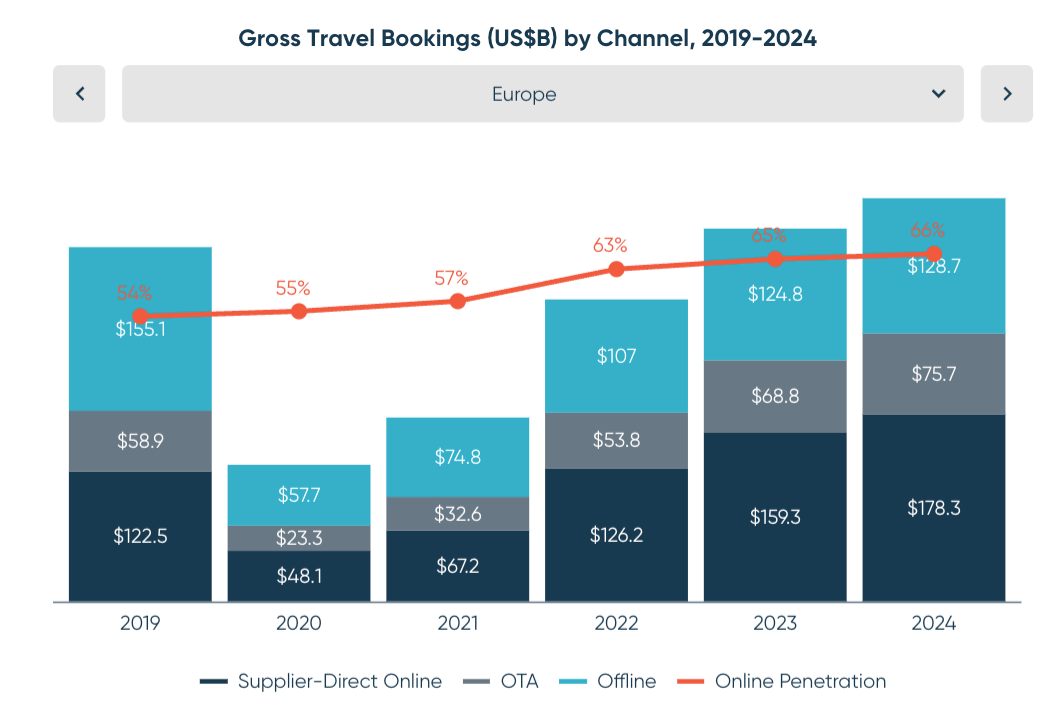
Analyzing travel booking trends by category reveals important insights into the evolving preferences of European tourists.
The data shows a shift towards more domestic and short-haul travel, with increased demand for outdoor activities, nature-based experiences, and smaller, less crowded destinations.
Source: Phocus Wright
Additionally, there is a growing emphasis on sustainability, with travelers seeking eco-friendly options and supporting local communities. These trends highlight the need for tourism providers to adapt their offerings to cater to the changing demands of the post-pandemic traveler.
As we previously anticipate Italy, a perennial tourism powerhouse, faced a 9% decline in arrivals in 2024, shedding 3.8 million visitors compared to 2019.
However, the country's tourism landscape is evolving, with a growing emphasis on sustainable travel, experiential offerings, and lesser-known destinations. Travelers are seeking immersive cultural experiences, outdoor adventures, and opportunities to support local communities.
As Italy adapts to these shifting preferences, industry stakeholders must strategize to capitalize on emerging trends and position the country as a premier sustainable tourism destination for the future.
Source: UNWTO Dashboard
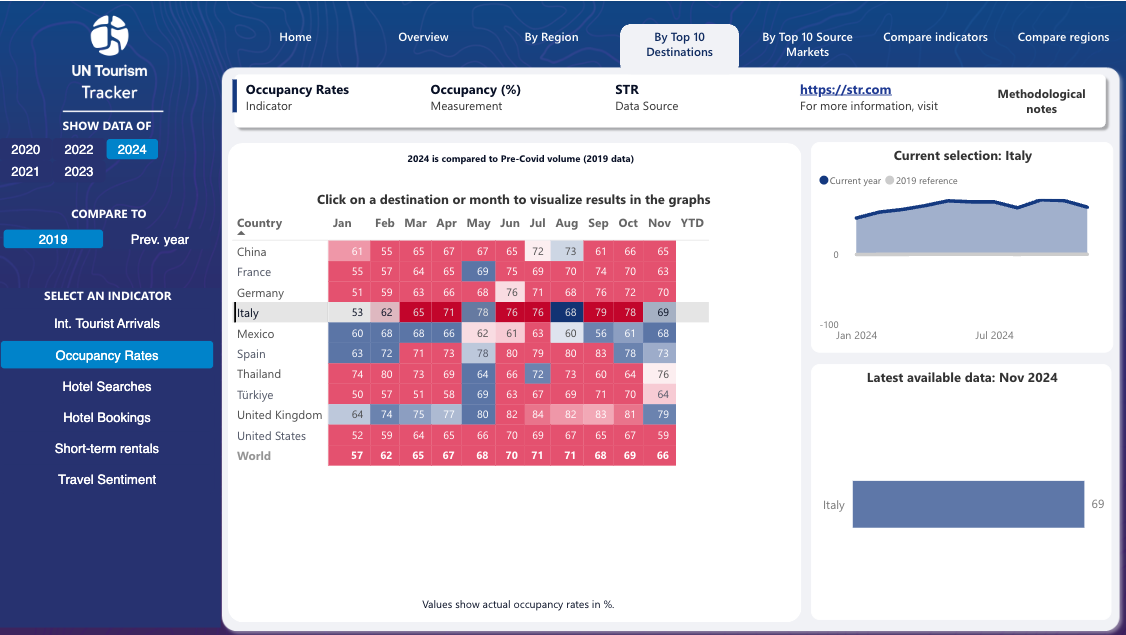
Despite we don’t have the full picture because we are missing the latest data from December 2024 the available data for the first 11 months of 2024 suggests that Italy's hotel occupancy rates have remained relatively stable, fluctuating between 65-75% across key destinations.
This indicates that while overall arrivals declined, those visitors who did travel to Italy maintained a consistent demand for accommodation. Industry experts anticipate a gradual recovery in 2025, as Italy's tourism sector continues to adapt to evolving traveler preferences and implements sustainable strategies to attract environmentally-conscious visitors seeking authentic experiences.
Annual Performance
Average occupancy rate: 69% throughout 2024.
Consistently strong performance across seasons.
Peak Months
Highest rates recorded:
May: 78% occupancy.
September: 79% occupancy.
Traditional summer months (June-August) maintained 70%+ occupancy.
Key Insights
Strong shoulder season performance (Spring/Fall).
Fall months surprisingly outperformed peak summer periods.
Successfully compensated fewer international visitors with domestic tourism.
Effective capacity management by accommodation providers.
Italy is poised to capitalize on the growing demand for cultural and culinary experiences. Travellers are drawn to the country's rich history, stunning landscapes, and renowned cuisine. Sustainable tourism initiatives and the rise of agritourism are also expected to shape the Italian travel landscape in the coming year.
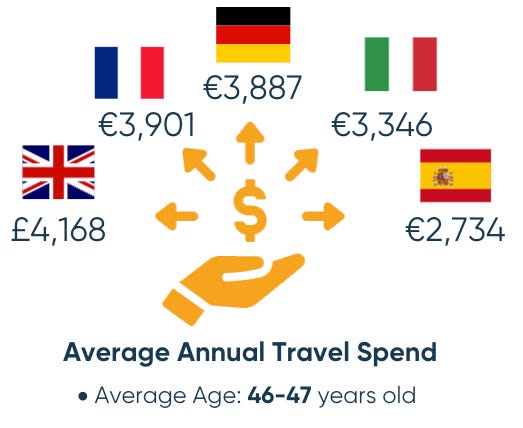
Italian tourists are spending an average of 3,346.00 euros per year on travel, indicating a strong appetite for exploring the country's diverse offerings. Luxury and high-end experiences are also gaining popularity, as travelers seek exclusive and personalized itineraries. Additionally, the rise of remote work and digital nomadism is expected to contribute to a longer tourism season, as visitors take advantage of flexible schedules to extend their stays in Italy.
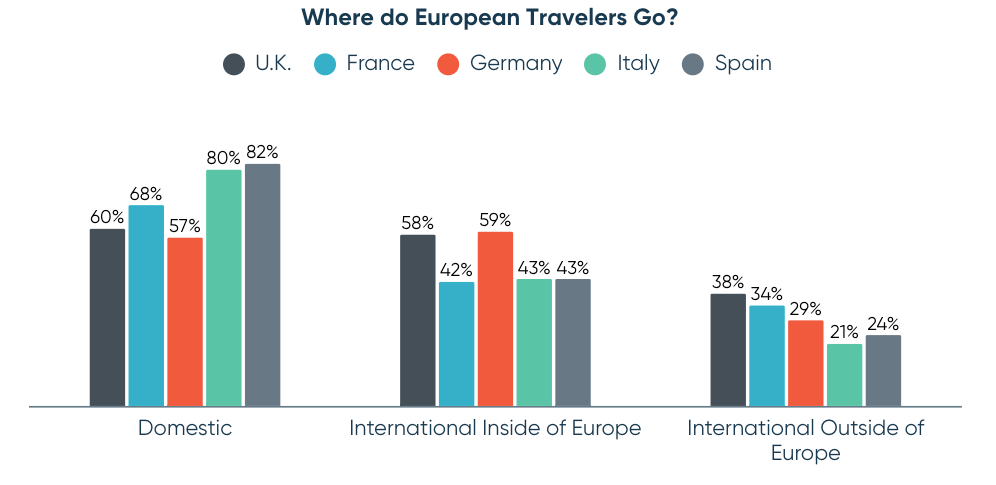
80% of Italian travellers prefers domestic travel, indicating a strong focus on exploring Italy's diverse regions and attractions. This trend is expected to continue in 2025, as Italians prioritize domestic tourism and seek to support local economies. Additionally, the rise of sustainable and eco-friendly travel options is gaining traction, with travellers seeking out experiences that minimize their environmental impact. Overall, the Italian tourism industry is poised for a robust year, driven by the country's enduring appeal and the evolving preferences of domestic and international visitors.
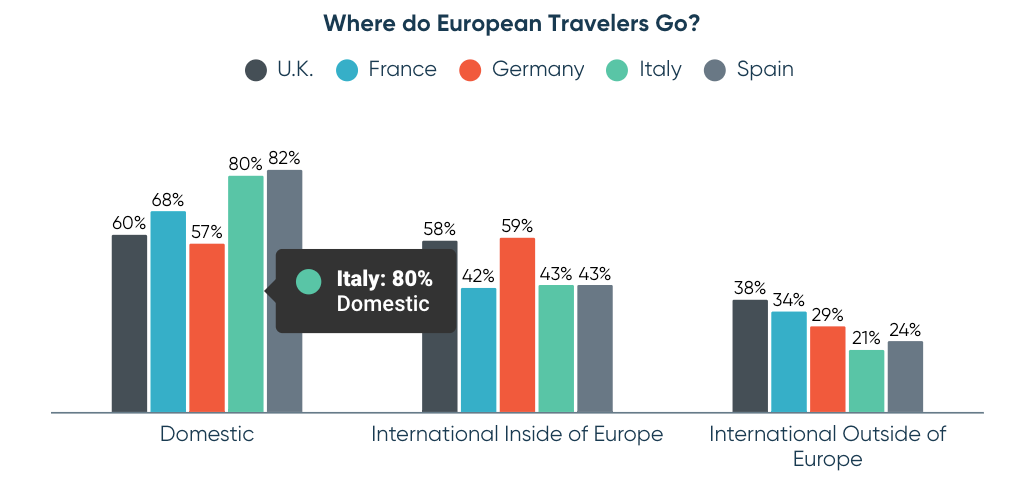
In the next 12 months almost 50% of Italian travellers are planning a european trip while the remaining 50% are planning domestic trips within Italy. This reflects the ongoing trend of Italians prioritizing local and regional travel experiences.
Sustainable tourism options, such as eco-lodges and agritourism, are gaining traction as travelers seek to minimize their environmental impact.
Additionally, the rise of remote work and digital nomadism is expected to contribute to a longer tourism season, as visitors take advantage of flexible schedules to extend their stays in Italy's diverse regions.
To conclude this post I want to mention one of the articles published by the company I work for, Fareharbor (part of Booking Holdings), about the future trends for tour operators: click here to read it.
The article highlights the growing demand for personalized and immersive travel experiences, as well as the importance of sustainable tourism practices. Tour operators are encouraged to diversify their offerings, leverage technology to enhance the customer experience, and prioritize environmental responsibility to meet the evolving needs and preferences of travelers.
By adapting to these trends, tour operators can position themselves for success in the dynamic tourism landscape of 2025 and beyond.
The article from BBC “The seven travel trends that will shape 2025” where are mentioned Noctourism, a growing trend where travelers seek out nighttime experiences, Calmcations, AI technologies to improve travel stakeholders, the holiday romance, off-the-beaten-tracks ramping up, Coolcations and Nostalgia travels.
Last but not least the Skift’s article about what to expect in 2025.
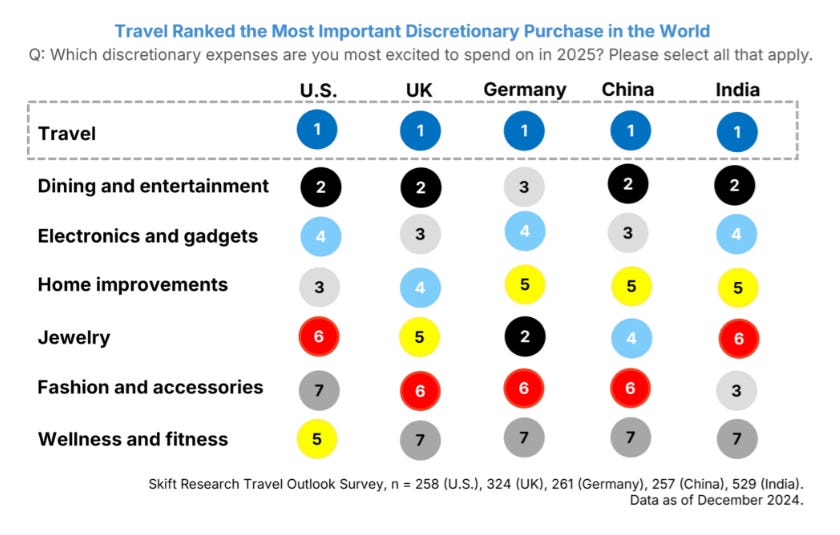
Travel aspirations are reaching new heights in 2025, with consumers planning to increase both their frequency of trips and travel budgets. Their focus extends beyond traditional sightseeing - they're seeking out undiscovered destinations while treating themselves to premium accommodations and memorable experiences.
This shift reflects a sophisticated evolution in travel preferences, where wanderlust meets wellness and luxury intertwines with mindful exploration.
Looking ahead, 2025 promises to be a transformative year for travel, marked by a delicate dance between personal indulgence and global responsibility. As travelers craft their journeys, they're writing a new chapter in tourism - one where adventure meets accountability, and luxury finds harmony with sustainability.
The modern traveler isn't just crossing destinations off a list; they're crafting meaningful experiences that respect both their desires and the destinations they cherish.
Enjoy your travels in 2025!
No posts
Comments
Nothing yet. Say the first thing.
Sign in to join the conversation.