
Every time I open my laptop, a first draft is staring back out.
I’m currently working on the first draft of a vertical series.
And the first draft of a grounded sci-fi thriller feature.
And the first draft of a body horror.
It’s gotten me thinking a lot about first drafts and how I approach them.
No matter how many scripts I’ve written, the first draft always somehow feels like a mountain to climb. I personally prefer to write my first drafts as fast as possible. I want to sprint up the hill so I can frolic down the other side on the second and subsequent drafts.
But how do I actually do it?
To steal the term from authors, there are two main ways to write a first draft of a screenplay: Plotting and Pantsing.
Plotting is, as it sounds, the act of meticulously plotting out everything that will happen in a screenplay from beginning to end.
Pantsing, from “flying by the seat of your pants”, is discovering the plot and story as you go along.
Both have their advantages and drawbacks.
I’m going to talk about both methods because I actively use both in my own first drafts.
Generally speaking, I plot for scripts I am paid to write. And I pants for specs.
If you’re writing a script after having written a highly detailed outline, like I do with all of my TV movies, you’re already in such a great place when you start your first draft. My outlines, which I construct directly in Final Draft, are usually around 25 pages.
So when I start writing the first draft, I am immediately hoodwinked into thinking: “25 pages! I’m already a quarter of the way there!” This is obviously not what’s happening, since those 25 pages of outlined scenes ALL need to be written. But it’s a nice psychological trick.
Cause honestly, being a writer requires a lot of self-imposed trickery (at least it does for me) to get started and, most of all, to keep going.
Before we continue, if you’re interested in how exactly I outline, here’s the excruciating detail on that:
I swear by plotting. I really do.
The first draft is a breeze to write because you’ve mapped everything out during the outlining phase.
You never get lost or wonder “Ok, now what?” because it’s all laid out in advance.
Plotting is great for scripts you’re being paid to write, because it maximizes your time, which increases your hourly rate.
Almost eliminates writer’s block: It’s very easy to jump back in to your first draft because you always know exactly where you are and where you’re headed.
Can limit chances to make discoveries during the scripting process.
May make you feel like a script-writing robot.
Remember when I said I swear by plotting? That said, when I can, I choose to pants.
Pantsing is my preferred method of writing a first draft when writing on spec (meaning a script that I am writing “for myself” which my agent will try to sell when it’s complete). It gives me the flexibility to make discoveries as I get to know my characters and the situations they will encounter.
“Getting to know your characters?!” Huh?!
When I’m pantsing, I often don’t even write character sketches! I’ll just dive right in and learn who my characters are through their actions in the story. I LOVE to be surprised by what my characters say and do. Sometimes they make me chuckle, sometimes even cry. If you know me, you’ll know that I have toddler levels of impatience, so doing boring stuff like character sketches is not instantly gratifying enough.
But sometimes when I have my big girl pants on, I’ll do a full writeup of my characters, who they are, what they want, what happened to them to make them how they are today, etc. It definitely helps to start thinking about how characters will conflict with each other when you pointedly give them opposing qualities off the hop.
Which leads me to the truth about pantsing: I really don’t believe that anyone is a true pantser (despite what Stephen King says about his approach to writing!). In my mind, writing out character sketches is part of plotting because the choices they will make in a given situation are part of who they are. So writing a character sketch IS plotting.
Plus, once I get started on a pantsy first draft, I’ll also start getting ideas for things that come later, so my script starts to look like a sandwich.
At the top is what I’ve already written, then there’s the layer that I’m actively working on. And down below are plotting notes about things that will happen later in the script.
So really, I’m plotting as I pants.
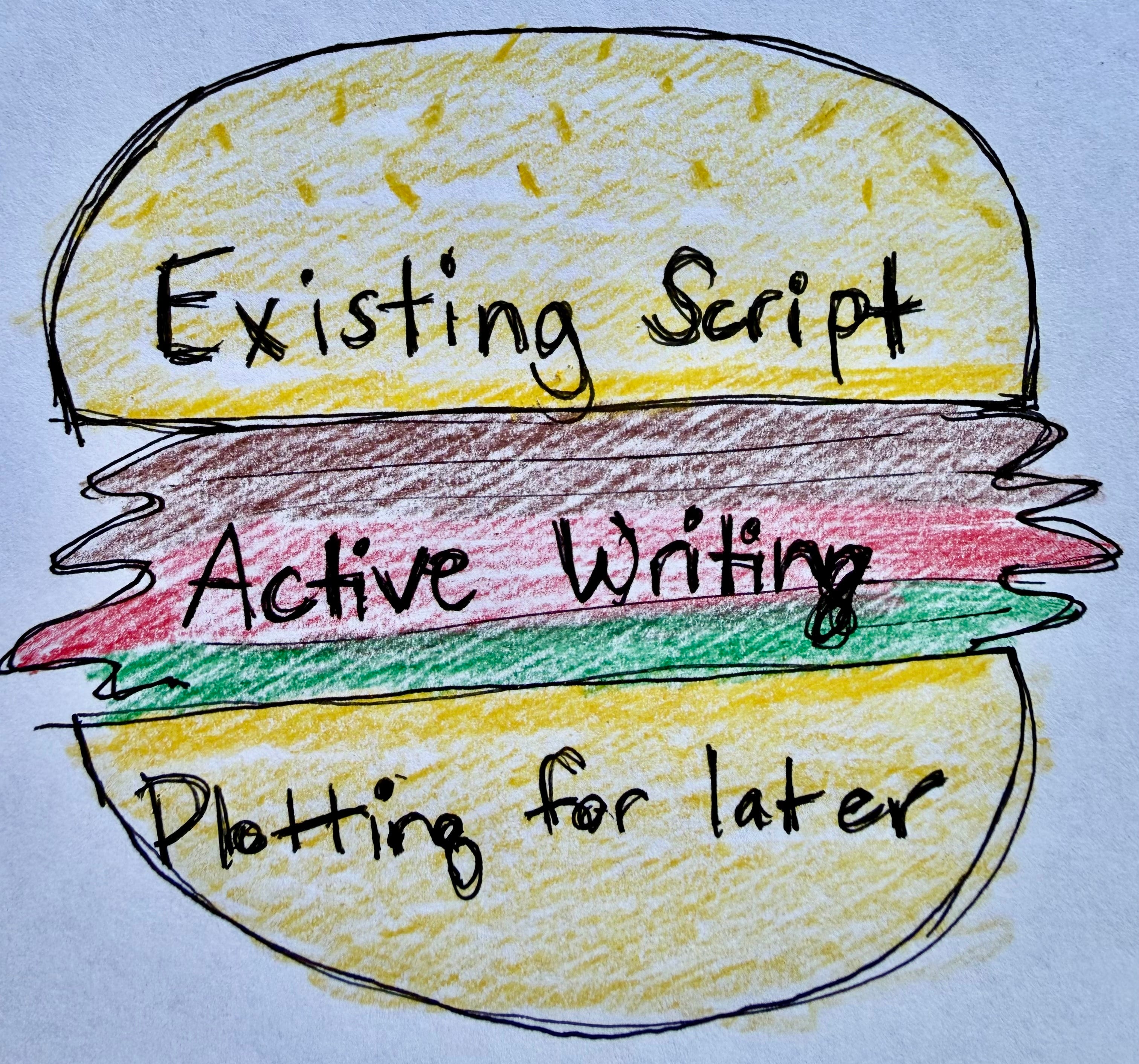
There’s an old screenwriting adage that says something like “a screenplay is like a journey. You need to know the destination.” Meaning that you need to know how your script will end in order for the rest of it to lead up to that ending. Makes sense, right?
When I’m pantsing, I would say I have a general idea of how I want the story to end 50% of the time. The other half, I want the story to surprise me with where it goes. To continue the travelling analogy: Sometimes I have a specific destination in mind and sometimes I just want to get in the car and drive around til I find something that’s worth pulling over for.
Neither is more or less right.
I’m also one for believing that you can absolutely change your ending at any point and work backwards to make it work. Just because you think you know the ending when you start pantsing your first draft, doesn’t mean that’s where you’ll end up!
That’s why subsequent drafts are so important for the pantsing approach.
More on that later…
One piece of peddled screenwriting advice that I always follow when pantsing is: “Never stop at the end of scene or sequence”.
If you put a cute little button on the end of a scene or sequence, I promise at some point you’ll come back and go: “adorable, but now what?!”.
Nothing is more deflating and discouraging when writing a script than the feeling that you don’t know what comes next.
Before I stop a writing session, I like to end maybe three quarters of the way into a scene or sequence and then give myself bullets points or write a paragraph about what will happen next.
Here’s an example from the micro-drama THE MAGICIAN’S SECRET LOVECHILD I’m pantsing the first draft of at the moment:
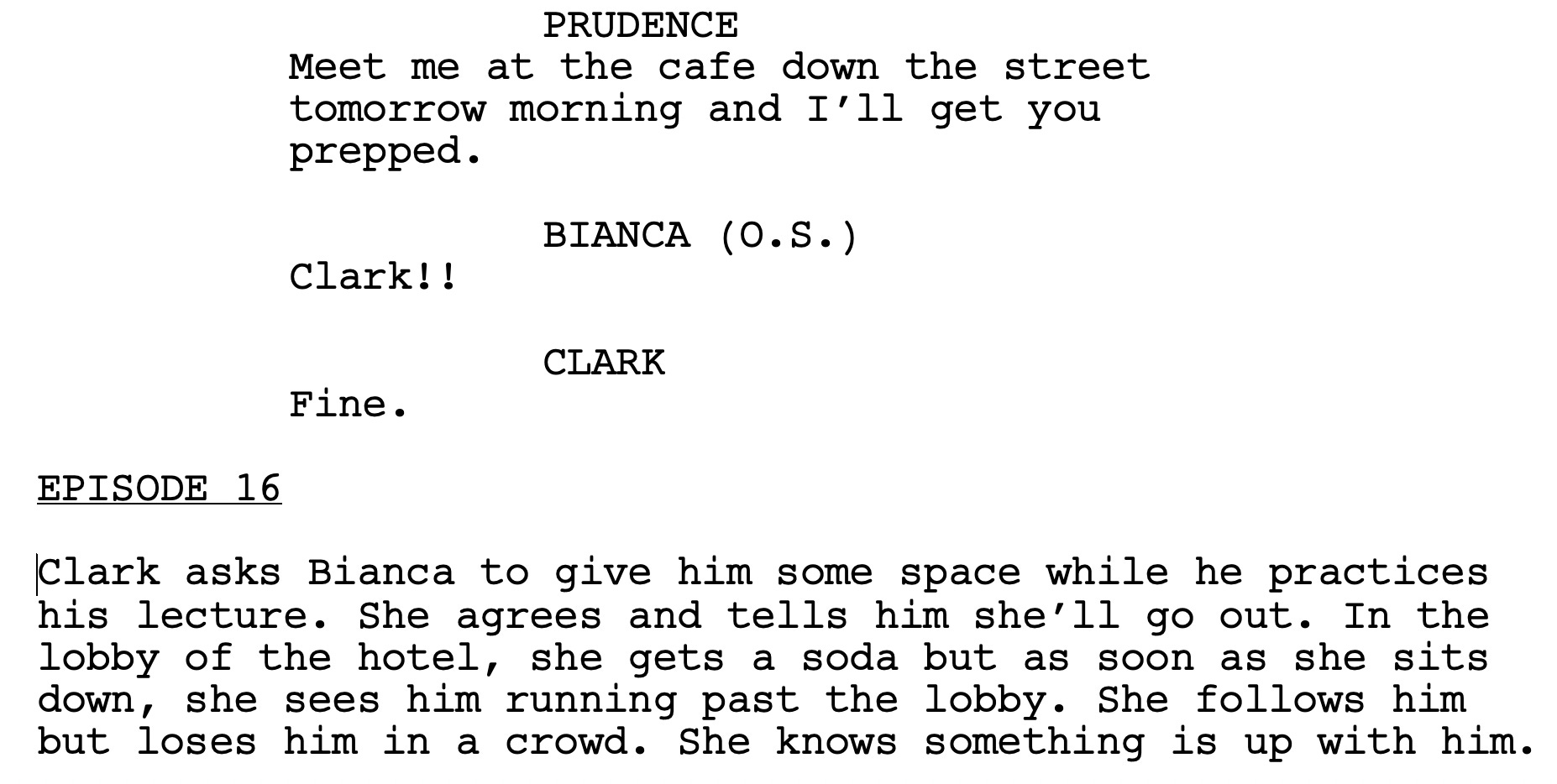
Now I know exactly what is going to happen next in Episode 16 so I don’t go back in cold.
Lots of room for discoveries to happen with character and plot as you write.
Avoids the lengthy process of putting a detailed outline together.
Gives you a sense of euphoria of diving straight into a script when you have an idea (con: rubs off faster than you hope)
If you’re not careful how you end a writing session, you can easily get the feeling of being stuck.
It’s easier to get lost or confused with your story and characters, taking more time to find it again (which isn’t always a bad thing).
It takes MUCH longer to write the first draft.
Because it is more difficult and the “hard” way to write a first draft, it can be discouraging. I don’t have any data but I’d say people probably give up faster on their pantsing scripts than their plotted scripts.
Looking at these pros and cons lists, it seems like a no-brainer to choose plotting, right? So why do I choose to pants when I don’t have a specific deadline looming?
Both methods are play. They are just different types of play…
An organized activity that has a specific set of rules or a specific goal. It’s still fun. It’s still playful. But there are rules in place to keep the play within the bounds of the activity and with a specific outcome in mind. You “win” by achieving that outcome.
Unstructured, unhindered and without a specific goal. It’s fun too but in a different way. The objective of free play is the act of play itself. There’s no expected outcome. It exists simply to be play.
That is probably why I always choose pantsing over plotting when it’s a script I’m writing for myself. It feels like play for the sake of play, a luxury you can enjoy without a specific deadline!
Depending on which your choose, plotting or pantsing, how you approach your second and further drafts will be impacted.
In the case of plotting, second and subsequent drafts are more about further refining the story, tightening the plot, strengthening relationships between characters and filling all the logical gaps that might creep in even from a solid outline.
If you want to read in detail about how to approach a second draft after plotting, read more here:
If you’re choosing pantsing to write your first draft, your second and subsequent drafts are where your story will actually come together. You’re finding it in the drafts, rather than in the outline.
On average for a plotted script, I need 7-9 drafts of the script until I feel truly confident. That’s about half a year’s worth of work if I’m working on it relentlessly with almost no breaks in between drafts.
On average for a pantsed script, I need upwards of dozens of drafts for the story to find itself. The two favourite pantsed scripts that I’m actively trying to get made right now have been decades in the making.
One I started writing in 2007. The other I started writing in 2009. Not all of that was active writing time, of course. Both sat for (necessary) years to percolate while I worked on other things. They have both changed enormously over time (along with me as a writer and a human being). But both are finally at a place where I am 100% happy with them.
In the end, neither is more right than the other. Both have their advantages and their place in screenwriting.
Now, you must tell me, which method do you use?
Comments
Nothing yet. Say the first thing.
Sign in to join the conversation.