
Next week, I get to watch the first assembly of my directorial debut short film SWATHE.
Here’s the logline, to give you some context for the below: When a newly-widowed recluse afraid of falling asleep hires a professional cuddler to keep her awake, she’s forced to confront the unusual way her grief has manifested.
It’s a film I’ve wanted to direct since I wrote the first draft way back in 2017.
But of all the shorts I’ve written… Why did I choose this one?
It’s because I wanted to go easy on myself.
Don’t confuse this with not wanting to be challenged artistically. I definitely wanted that.
I mean that I was well aware of my limitations and chose the one script that best worked within those constraints.
These were the realities I was dealing with:
While I had directed theatre, been on set a lot and even directed some corporate videos where I daylight as a copywriter, I wanted to set myself up for success as a first time director.
How did I fix it in the script?
I kept the production size feasible by including only two actors at one location. That meant that the characters had to do the heavy lifting, which is something I’m used to doing as a professional screenwriter. That in turn meant I could focus on making the characters the centre of the story as a director, as well.
After I crowdfunded and had a solid idea of how much money I was working with, I knew I could only afford a single day shoot, so the script needed to be short enough to feasibly shoot.
How did I fix it in the script?
I started cutting out and combining scenes. The more scenes / setups you have, the longer it takes to shoot. I trimmed a page off the script and reduced twelve scenes down to ten. Even on the day, as we were approaching the end, we saw we would only have time to shoot one more scene, but we had two scenes left. On the fly, I cut a scene with more complicated choreography, combining the essential dialogue into the scene previous, thereby reducing the final number of scenes to nine.
Now that I knew my script was going to have to be shorter, I also knew that it had to be BETTER. Every single word needed to do double and triple duty.
How did I fix it in the script?
I spent the weeks leading up to the shoot revising. I also did more research, including taking my cast to a cuddle therapist, to ensure that the story was air tight and authentic to the profession. I got dialogue notes from my cast. I think I tweaked the script four or five times in the three weeks leading up to the shoot, including the morning of the shoot. That day, I was certain I had written the best version of the script I could.
Given my budget, I needed to source everything cheaply, despite the main set being a room that was completely swathed in fabric. And fabric is EXPENSIVE.
How did I fix this in the script?
I made my protagonist Maja a shut-in, meaning that everything we see in her space are things she already had in her apartment. They had to be everyday objects that a person would plausibly have at home. I had the idea that one wall should just be her own clothes pinned to it, with the thinking that she ran out of fabric at some point and was forced to improvise.
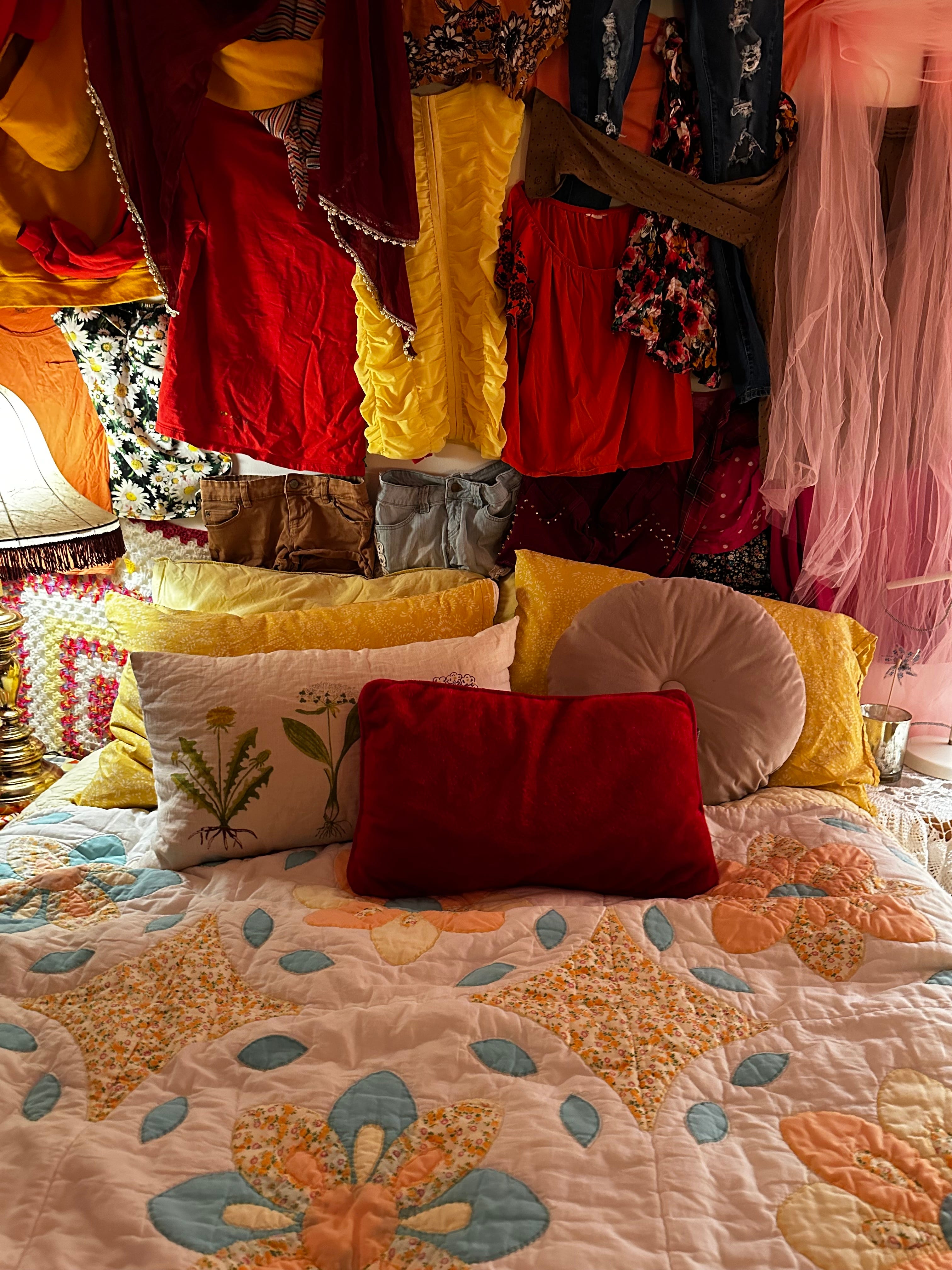
I didn’t have a budget for a lot of fancy extras in terms of the cinematography, so I worked closely with my DP to determine what visually interesting shots we could feasibly incorporate into a one day shoot. I chose an overhead shot that framed just the bed.
How did I fix this in the script?
Since I knew we were doing an overhead shot, I went back to the script to determine what scenes would benefit most from this perspective. I changed some of my shots to be overhead, which of course, added new layers to those existing scenes, which inherently impacted character and story.
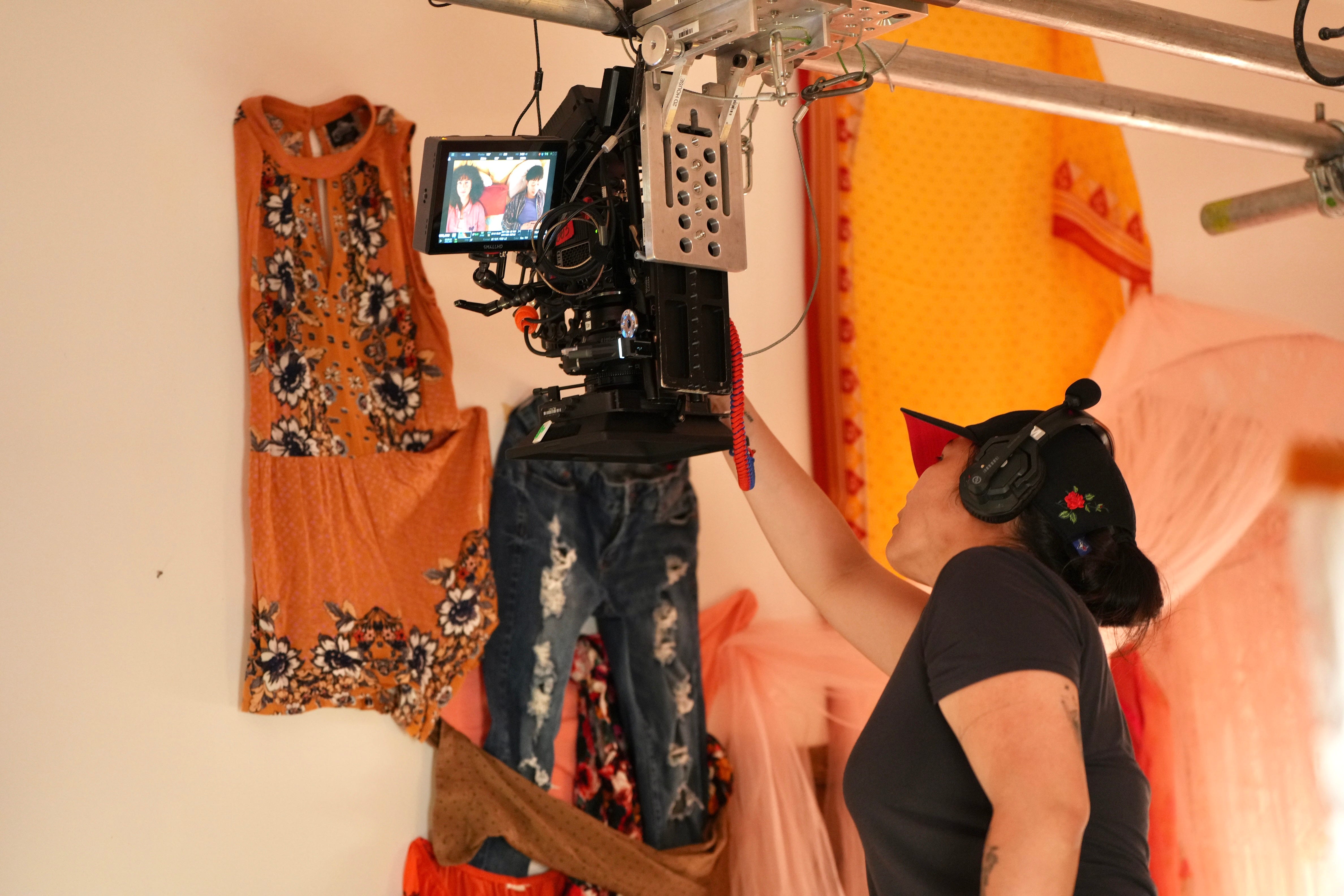
Given the quick pace of the shoot that day, we knew early on that we didn’t have time for additional setups. I had always imagined key shots being taken from Arty’s POV (the life-sized stuffie Maja’s made out of her dead husband’s clothes), but these would have been impossible given our tight shoot schedule.
My DP, Jess De Los Santos, had the brilliant idea to strap a POV camera on Arty the Puppetman and shoot the A cam and Arty’s POV simultaneously. Because we used exclusively practical lighting and we set decked the whole room, we were able to do double duty on our setups.
How did I fix it in the script?
When I knew that Arty could have a true POV, I actually went back to the script and added MORE instances of his POV than hadn’t been in the original script. It let me amplify that aspect of the story that I had always loved. This lead to a discovery of how to shoot the climax that is genuinely now my favourite moment in the film.
But it wasn’t just SWATHE. CONTRACTIONS, the horror feature that I wrote and we shot earlier this year (currently in post) was also packed with budget constraints.
First we couldn’t afford a location, so we needed to find one for free. We secured that months before the shoot. And then, for the first time in my career, I wrote a script for a specific location.
Knowing exactly where each scene would unfold actually gave me the freedom to be more creative and take advantage of my knowledge of the layout to add tension to the film.
I find it not just easy but very enjoyable to write to strict constraints. It allows me to access a different kind of creativity, one bound up in problem-solving.
The fact that I’ve written four TV movies, which are on very strict budgets, has helped immensely to understand where money can be saved already at the script level. Production rewrites, which happen in the three week pre-production period of a TV movie, are almost always just budgetary rewrites. Learning to avoid these pitfalls in the first place will save you a LOT of time in these three weeks!
In my experience, most screenwriters have no idea how to bake a budget into a script. That’s because in film school or in our training, we are never told to consider budget when writing. No one wants to limit their imagination with boring ol’ money.
But that thinking is a vestigial reality from a time in filmmaking that no longer exists.
The reality of our industry right now is that being “just” a screenwriter isn’t enough anymore. There was a time when “screenwriter” was a standalone (and very lucrative) career. Today, you need to make your own luck by producing and directing your own work.
Understanding how to work a budget into your script makes it 1.) infinitely more attractive as an indie project if you’re going to sell it, 2.) infinitely easier to execute if you’re going to shoot it yourself (and you should!).
If you’re interested in honing this skill, I’m hosting a workshop about baking a budget into your script (see details below) during which I’ll teach you the main budget-busters to look out for while you’re writing a screenplay and how to find creative workarounds right in the script.
I encourage you to bring a few pages of your current script to the session so we can workshop it together and identify areas where you can work within your limitations to create a script you love AND you can feasibly make.
You can register here:
All proceeds from this workshop go directly towards the post production costs of finishing my directorial debut film SWATHE. I hope to see you there!
Comments
Nothing yet. Say the first thing.
Sign in to join the conversation.