
I’m one week out from shooting my directorial debut short film SWATHE.
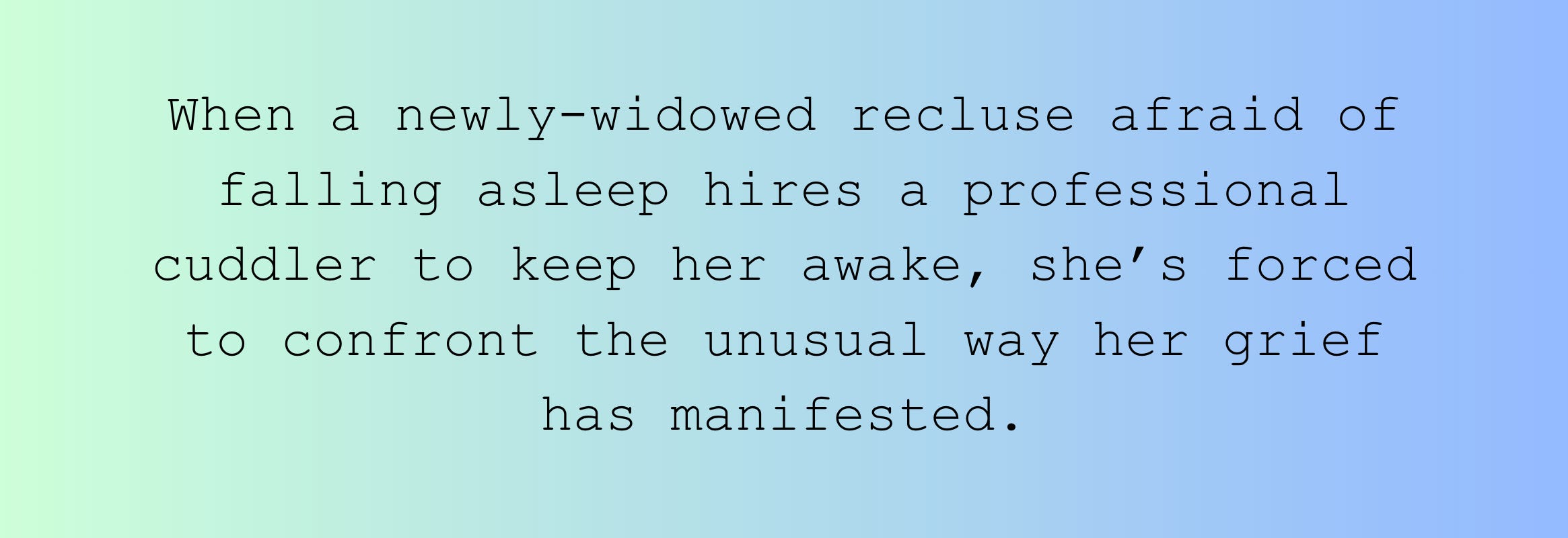
Here’s the logline for those unfamiliar with the story:
The script must be final, right?
Well, it WAS final. Or at least I thought it was, until we started preproduction.
Though, I’m not sure why I thought that, given my experience.
With TV movies, for the screenwriter, the preproduction phase is usually the most hectic part. During preproduction, you’re getting director AND production notes that you have to implement right NOW.
These notes are usually for budgetary reasons: They need you to axe a location. They need you to pull a character from a scene. You need to drastically simplify a stunt or change it entirely, which happened in my upcoming thriller THREE HOUSEWIVES AND A BODY (I’ll let you try to guess which scene it was when you watch it!).
With my own film projects, like the short & OTHER CONCERNS that just premiered on CBC Gem, I was making edits on the Final Draft mobile app in the car on the way to our filming location (thankfully my husband was driving).
I guess I spent so much time rewriting and rewriting SWATHE over the course of nine years, and more intensely for the last year in anticipation of shooting it, that I naively believed it was finished.
But as I meet with my HODs and my actors, I’m consistently gaining more clarity about how this film should look and sound.
And these discoveries are making the script infinitely better.
It got me thinking: why not approach polishes from a cinematographic, production design and performance perspective to make my spec scripts better too?
Let’s look at the opening scene of SWATHE to show you what I mean…
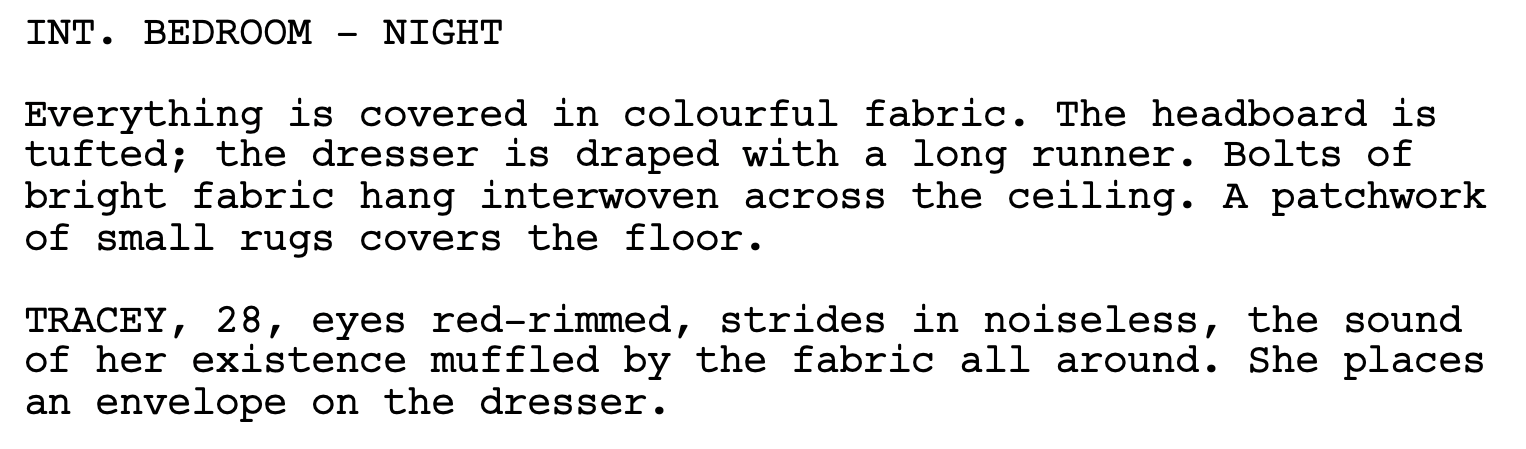
ORIGINAL DRAFT (JUNE 2025):
LATEST DRAFT (MAY 20, 2026):
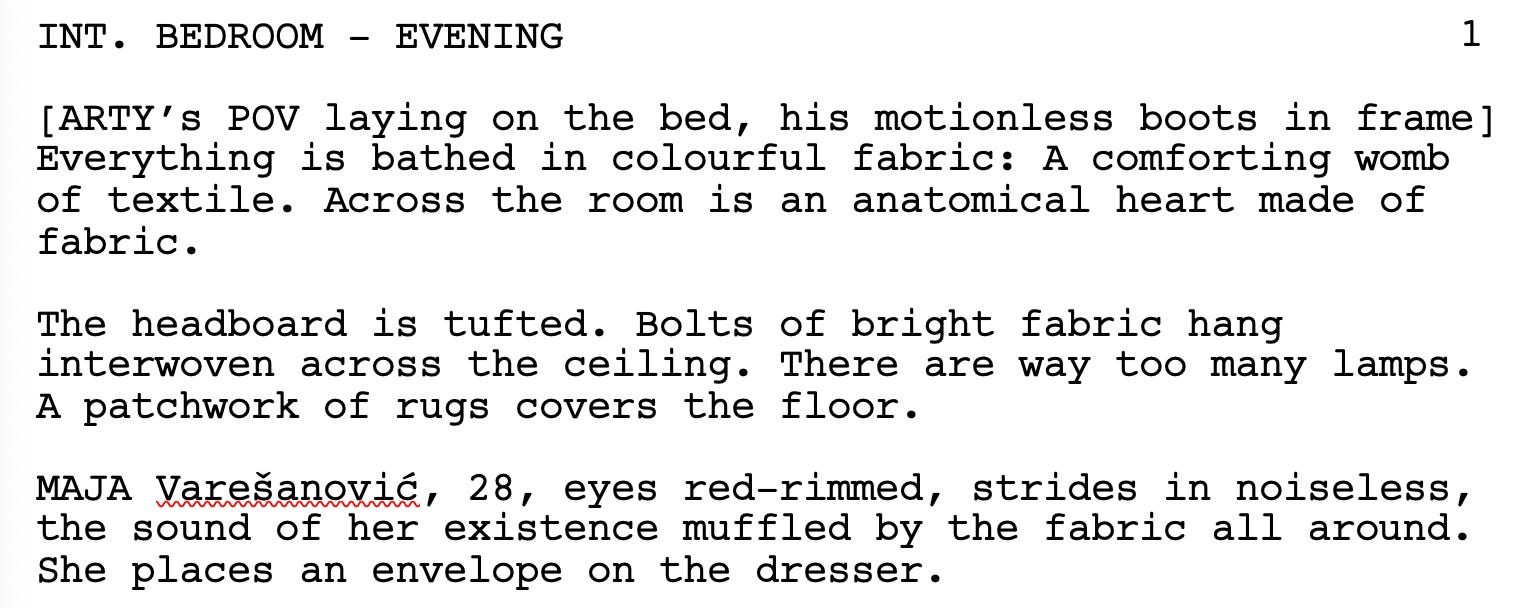
What changed?
I asked my actors if they wanted to rename their characters to connect better with them and they both delivered. This came from working with them and realizing I want them to feel as invested in their characters as I am. What better way than to give them a name that means something to them?
Preparing to direct this film has caused me to think about how to open this story cinematically. As a screenwriter, you’re often just thinking of the best way to open from a story perspective. Its easy to forget that our job as the screenwriter is actually to invite the reader to hallucinate along with us (thanks for the analogy STORY PERSON!)
The lighting has been built into the script in this latest draft, since my DP and I have been discussing shooting this with mostly practicals. So walking through initial blocking also informed production design.
The space is described in more specific detail, using more intentional words.
Details are what turn a generic scene or character into a fascinating one. Talking with my actors about the way that Maja feels inside her room informed my choice of the words “A comforting womb of textile”. This specificity is useful for your production designer, of course, but it makes for a more interesting read overall.
The anatomical heart, for example, came from a discovery that we made when I took my actors on a field trip to visit a real professional cuddler (I won’t spoil it here now!). So an outing with my actors informed my production design.
[It was at this cuddle session that I realized that I’m not just making a film that I love, but I’m making one that will be deeply meaningful and impactful for many who see it.]
Overall, conversations with the artists I’m working with have resulted in a much clearer vision for the story, which I’ve now translated into a better, more compelling script.
These highly-targeted polishes led me to the conclusion that I should be doing a “I’m really gonna make this movie!” polish for my spec scripts too.
It’s extremely important to bring the reader into the world of your story with a spec. Your prowess as a writer who can create worlds with words is of greatest importance. It’s what’s going to set you and your script apart.
I’ve always been a very visual screenwriter, seeing it all in my imagination and using my words to nail that hallucination to the page. It wasn’t even until this past weekend when I gave a screenwriting workshop at the Eye2Eye Film Showcase that I learned some screenwriters don’t think visually like that.
If you’re one of those screenwriters who doesn’t think visually, this method for polishing will be especially helpful to you.
First do a “paint me a picture” check: Listen to your script with “Speech Control” in Final Draft (I’m sure other screenwriting software have similar functions). If you can really see the scene, smell the scents, appreciate the textures with that monotonous computer voice in your ears, you’ve done it right.
Intensify visual language word by word. If you’re feeling like there’s room to improve, go through your script line by line and identify where your descriptions could be yet more descriptive. What adjectives would add depth? What verbs would better convey emotion? Every single word should be working double and triple time for you in a spec, so analyze each one individually.
Compare these two sentences:A woman goes to a store to buy something.
VSA matronly woman tiptoes to a rundown liquor mart to buy tequila.
The first is informational. The second makes you want to know who she is and what she’ll do next.
Do a field trip (if applicable). Go see the types of people you are writing about in their natural environment. What can you learn about how they move? How they speak to each other? The jargon they use? Of course, you’ve done this before and during the writing of your script, but this you doing a final check that your primary research is air tight. What were you missing that you can address now to make your script world feel more real?
Pretend you’re the director. Read each scene and run it through in your head. What does the blocking look like? Better yet, get up and move around the room as you read to get a sense of where the actors will be in space. Even better still: Ask some friends to come over and read your script aloud as you play director. You can make interesting discoveries when you have real people in front of you. Film it too to analyze later.
BUT remove any “directing” action lines: I broke this rule myself in the example above with my POV opening shot, but that’s because I am actually directing SWATHE. If you’re selling a spec, this last polish is your chance to make sure you’re not committing one of the cardinal sins of screenwriting: not leaving room for the director’s vision. Remove all camera angles and suggestions for how the director should do their job. That’s for them to figure out.
Do a table read (in person or online): Cast actors who are close to how you imagined the characters. Based on how they speak, could your dialogue be more authentic? Could their voices be more distinct?
Do a final cut pass: The polish is your last chance to tighten and heighten. Can your characters say more with one line than they are with five? Are your longer descriptions killing the pace? Conversely, are there scenes you rushed (you know the ones!) and do they need more room to breathe?
You don’t need to use all of the above, of course, but if you incorporate just a couple into your next polish, I promise your script will be better for it!
Maybe you’re already doing something similar? Let me know below so everyone can learn from your polishing methods too.
The greatest benefit of approaching your polishes with a “this film will be shot” mentality is: You’re one step closer to making sure it WILL be shot. You’ve breathed that wish into the script and now it’s more true than ever.
Good luck and let me know if you try this!
Lauren Greenwood is an award-winning screenwriter, story editor and soon-to-be-director. Lauren’s fourth TV movie THREE HOUSEWIVES AND A BODY is premiering summer 2026 on Lifetime Movie Network. Want to work together? DM me or reach out here.
Comments
Nothing yet. Say the first thing.
Sign in to join the conversation.