
Quix, a 35-year-old software engineer in Silicon Valley, is convinced he is ugly.
Generationally, unspeakably, irretrievably ugly.
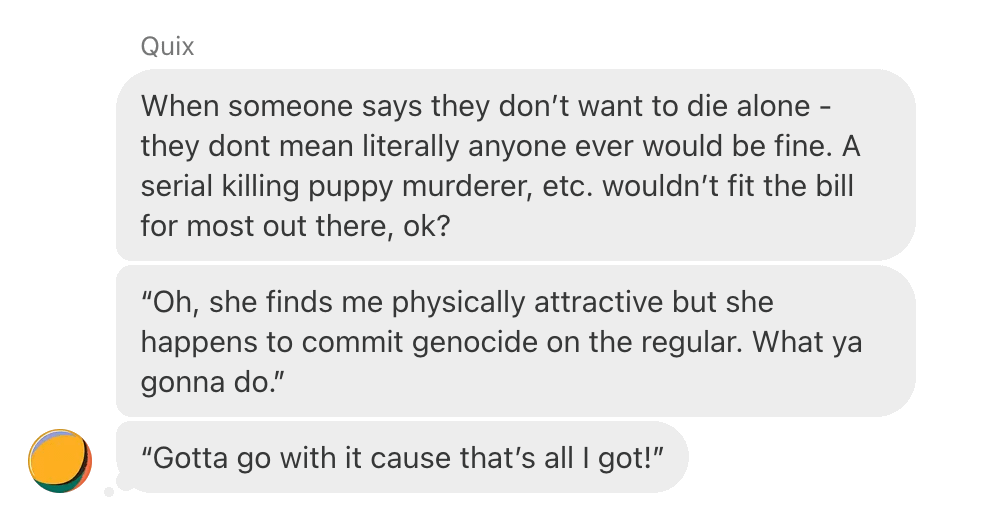
For the past year, he’s been commenting publicly, in great detail, about exactly how ugly he is. How he suffers precisely the wrong mix of facial ratios that render him forever alone, doomed to his lonely, hideous fate.

He is one of my most prolific Substack commenters. His lament shows up in every communication I’ve ever had with him - DMs, subscriber chats, article comments. Women, he notes, are impossibly picky now, reserving their desire for top 5% of hot men; professional women find their partners exclusively on apps that rely on looks; his fortunes rest on the one physical attribute he cannot alter any further.
Suggest the gym, a better haircut, even surgery, and he will list the procedures he has already endured—the ear pinning, the rhinoplasty, the microneedling—as proof that he has already fought the gods and lost. In every exchange, optimism is crushed under the slow, steady grind of this one true story.
That he is ugly.
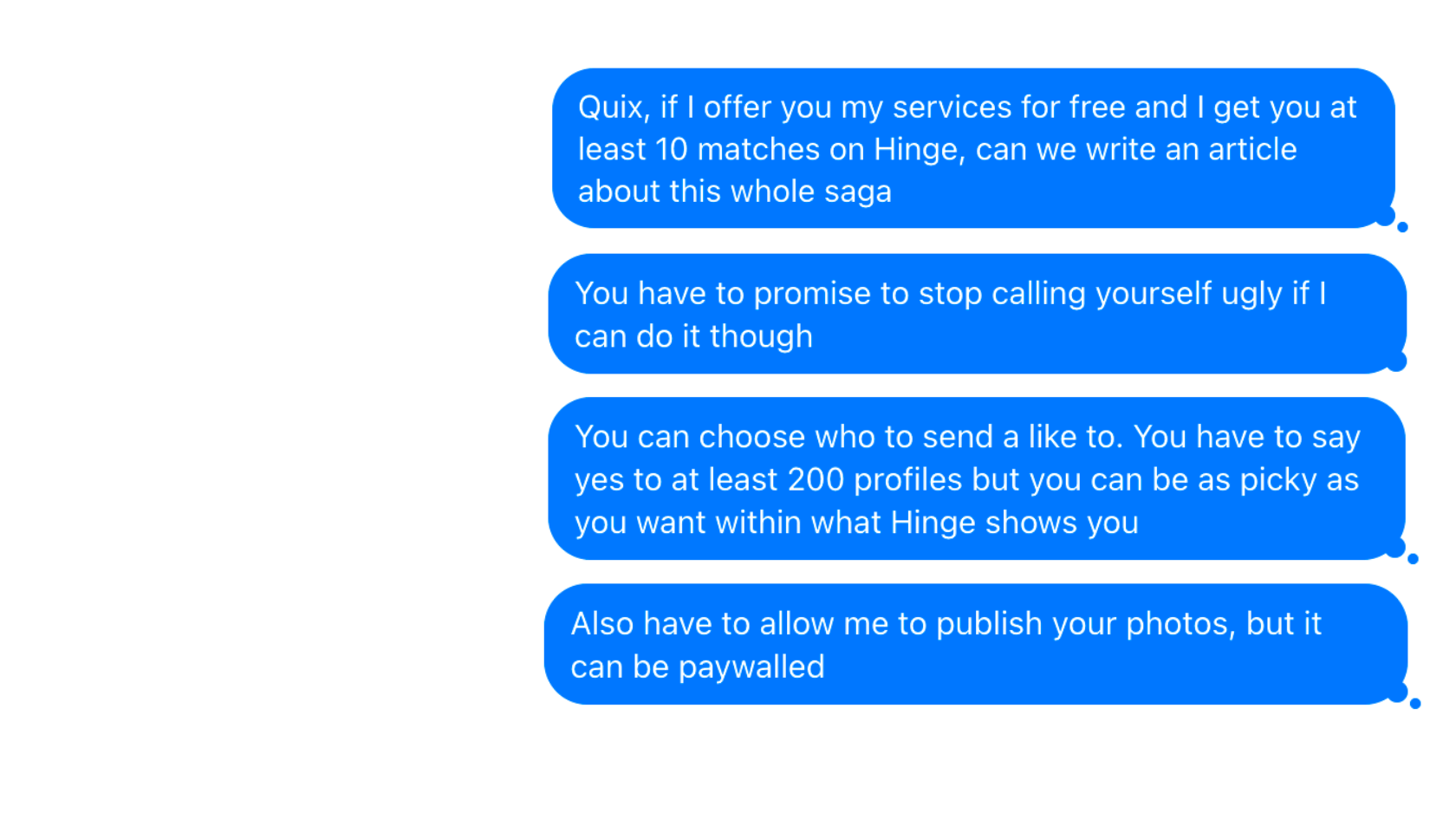
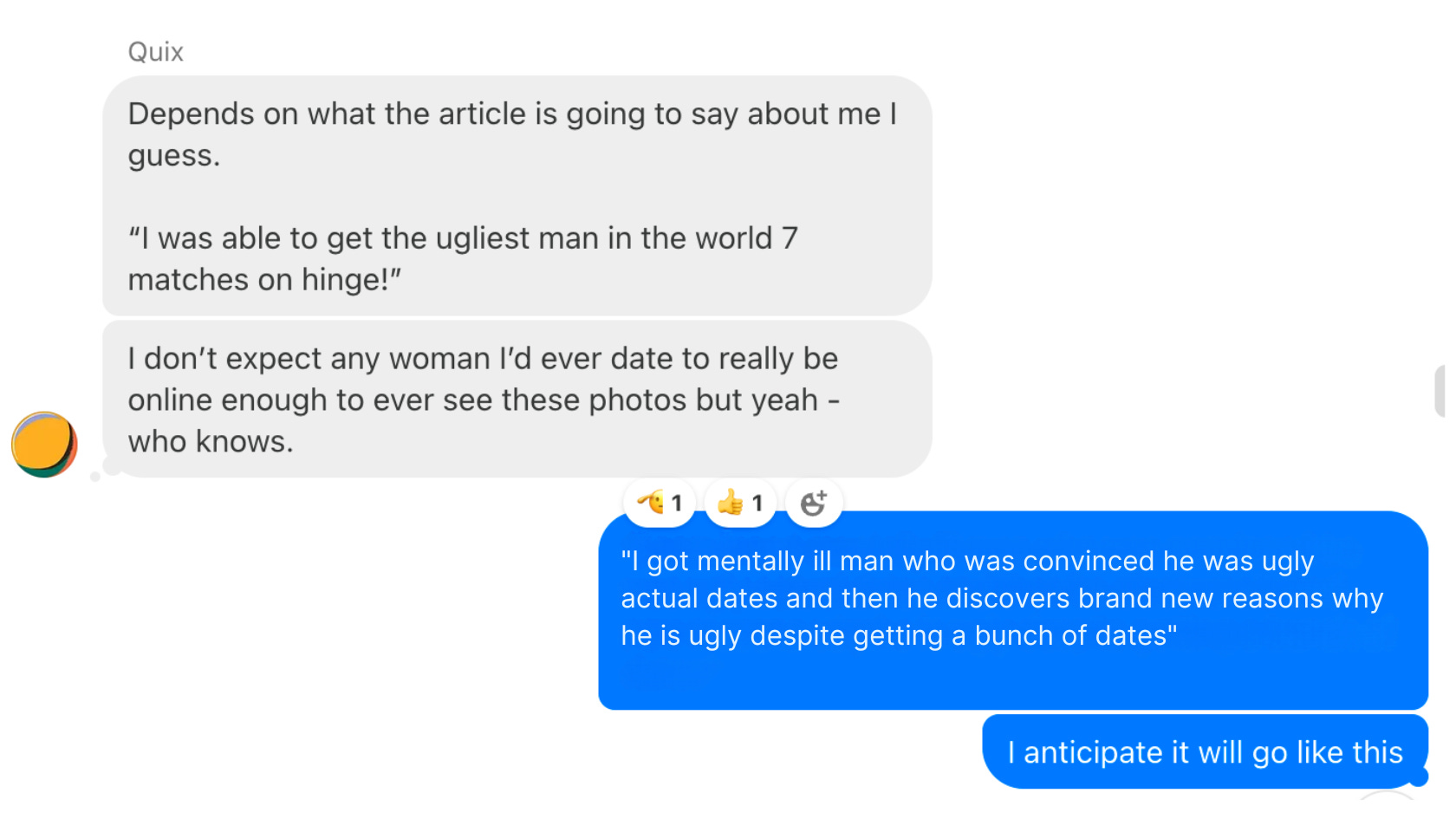
Convinced he was just delusional, I offered him a bet: let me overhaul his Hinge profile if I could write about the process. I promised that his photos would be paywalled to discourage casual gawking. He agreed. He said his match rate was 0.5%. I said we could do 10x better and hit 5%.
We began texting. His number arrived with a contact photo, a moody profile of the face he so despises. He was coming to New York soon, he said.
“If you want to see elephant man adjacent in the flesh, I’ll have time,” he texted me.
I agreed.
Quix is unique in his particulars, unremarkable in his pathology, from what I’ve seen from young men in the past year.
About half of the men who consult me on their Hinge profiles seem perfectly normal and mentally balanced. These tend to be men chasing optimization: they want to squeeze out the last few percentile points of performance - which have outsized returns if they’re already doing okay. They understand that the only volume play they have is dating apps, and they intend to maximize it.
The other half have deeply twisted self-concepts. Oddly, these men tend to be better looking — even very good looking — but are convinced they’re ugly. They speak the bizarre language of looksmaxxing, weaving terms like PSL, chads, high tier normies, stacies, hunter eyes, canthal tilt, and interpupillary distance into casual conversation. They debate extreme surgeries like limb lengthening and jaw implants like it’s an iPhone upgrade. For a generation that encounters the world first through a small rectangular pane of glass, looksmaxxing is the natural endpoint of managing what can be measured.
Quix belongs to this congregation. He has purchased a Qoves report, a service that examines the face through supposedly scientific principles and delivers its verdict in a crushingly dull twenty-page PDF. He has also paid a looksmaxxing influencer named Wheat Waffles for a written assessment, excerpted below, which reassures him that with sufficient effort, he might eventually reach a “6.”
(Upgrade to a paid subscription to see what the Wheat Waffles custom looks assessment said about Quix’s appearance.)
So we began.
He shared photos. Then we hopped on a video call.
The face that appeared on my screen produced a genuine jolt. How could this man call himself ugly? Did he have eyes?
It would be easy to mistake Quix for a victim-mentality-addled do-nothing, but he is not. Among the interventions he’s tried: a natural-looking rhinoplasty, ear pinning, microneedling for acne scarring, RF microneedling, eyebrow threading. Our most recent messages describe his upcoming Invisalign. He is slightly above average in height, 5’10”, and considered limb lengthening surgery before deciding against it. He works out religiously and pumps his body full of peptides and protein. For someone who constantly talks about his ugliness, his camera roll obsessively tracks his appearance: selfies of his face, over and over, documenting what is objectively an impressive glow-up. (Of course, he describes it as going from a 3 to a 4 on the 10 point beauty scale.)
In his early 30s, he took three years off work, flush with savings from his tech career, to move to NYC with the sole aim of finding a wife. He hired a dating coach - who happens to be a friend of mine - to no avail. (The coach declined to comment about Quix specifically.) He took meetings with elite matchmakers that charged six figures, but decided that would also fail because there was no secret cache of women willing to accept such an ugly man.
Before our experiment, he selectively sent likes to 200 women in May and June of 2025.
One became a match.
It is on this basis that he declares his match rate 0.5% — the benchmark for our test.
Can we beat 0.5%?
We set the terms: Quix would send out 200 likes, accept my coaching, and execute instructions. I gave strict rules: a comment with every like, 20 likes per day, no dealbreakers checked, though he could set preferences how he wanted: 23–31, agnostic/atheist/spiritual, monogamous, 40-mile max distance from his Bay Area home, wants children/might want children.
As I started building his profile, I ran into the first roadblock.
I often do subtle AI edits for clients’ dating photos, mostly to remove extraneous people and distracting elements.
To my eyes, Quix looked the same. To Quix, the minor AI changes clearly vaulted him into a different stratosphere of attractiveness where women would reject him on sight in the flesh. So I painted the original facial pixels back onto the images.
We then ran the photos through a rating service. Many scored 8 or 9 out of 10. This doesn’t budge his self-concept, of course. He explains it away as an editing artifact.
Then I made some minor edits to his prompts.
And so the experiment began.
[Upgrade to a paid subscription to see exactly what Quix looks like and what his Hinge photos and prompts looked like.]
He started sending me screenshares of himself swiping, narrating his selection process. I told him to only like people he’d actually want to date, always with a comment attached, in the format of statement + question. (For example, if her prompt mentions skiing, he comments with a detail about his own skiing experience and asks where she likes to hit the slopes.) We tried some other openers in the middle— silly canned puns, teasing references to the horror movie Obsession — but none of those worked, so we returned to the customized statement + question format.
Watching him swipe, I quickly see the problem.
Quix experiences Hinge primarily as a machine where women reject him. But watching him use it, I realized he spends almost the entire session rejecting women.
His standards sound reasonable when he describes them. Like many men seeking to start a family, he doesn’t want to be rushed on timeline, so he prefers women in their mid-20s despite being a decade older himself. And of course, he has to feel attracted to them. But as he narrates, I realize that’s no low bar, especially for a self-described 4. The women he does swipe right on, while not models, are at the top of the Hinge heap. These are not women lacking options, and worse, they’re young, beautiful women in the Bay Area: they have endless exited founders, highly paid engineers, and newly minted AI millionaires to choose from. Sure, they might be very awkward, but how can a woman tell through a screen?
“If I’m going to work all day, and if everything I do is to see her smile, I need to like her smile,” he explains as he rejects yet another very attractive doctor whose pearly whites are insufficiently bewitching.
But a real tripping point is his requirement that she make over $200k a year. On this he is firm, referring to women who make a mere $100k as “broke as shit” unless she happens to come with rent-controlled housing and a generous inheritance.
The terror he contends with is being used: that some wicked woman will sneak through his years-long vetting process and, after ten years and children, quit her job, divorce him and invoke California’s mandatory lifetime alimony that no prenup can protect him from.1
Quix: “The scenario that *will* happen, is that she will be broke as shit, want to use me for money, and then we’ll have kids, she gets upset about whatever she wants or changes her mind about our agreements, and then wants a divorce and to take me to the jailhouse. That’s the realistic scenario with every woman I’ve ever interacted with.”
Out of the first 50 profiles, he rejects 49. Twelve are outside his age filters — fine — but of the remaining 38, exactly one survives his judgment, a right-swipe rate of 2.6%. He sends one abysmal opener: “I also want a family. How big are we talking?”2
By the end, he collects nearly 90 inbound likes, about half of them received in the first two days. He rejects all of them, for a similar panoply of reasons: too old, too ugly, bad job, bad taste.
As the week ticks by, I find myself emotionally detaching. I’ve sunk over a dozen hours into this project for free - usually time people gladly pay me high hourly rates for - but Quix is a demanding client: anxious, constantly asking me to rate some random male friend who, he says, has far more success with women, discrediting any sign of success as meaningless, doubting every single directive he’s given.
One night, after I get off a call with him, I call up to my boyfriend working upstairs: “Babe, I hate him. I hate him.”
He responds: “I hate him too. He’s so sure of himself. He wouldn’t listen to a single thing you said.”
Why did I keep going? Partly the deal we’d struck — I get to write this. I find him fascinating, in a slow motion car wreck kind of way. And partly because, buried under the exasperation, I kept thinking he was just one killer, logical explanation away from being fine.
He was so close, I kept thinking. If only I could convince him that he should try relaxing his age requirement, especially since he’s already planning on becoming a solo parent through surrogacy should Mrs. Quix never arrive. (Obligatory note: he gave me a speech about how there’s no quality women over 30, etc. etc.) Sure, not ideal, but a younger woman isn’t a guarantee of fertility, either, as any IVF clinic can tell you.
I want to give Quix some credit. He’s self-aware that no woman wants to be settled for. He was in a four-year relationship with a woman he wasn’t attracted to and who refused to get a job. He isn’t looking to repeat that. “Unequivocally attracted to her Hinge photos, high-paying job, under 30” isn’t the craziest list of expectations I’ve ever heard.3
And in many ways, he’s doing it right. He’s not blaming women for their desires or saying they’re not allowed to have their preferences. So rather than blame them, he calls himself ugly and focuses on looksmaxxing protocols instead.
Dating coaches trying to persuade women to broaden their standards usually appeal to rationality: they calculate what percentage of the pool disappears with each additional height, income and education requirement.
But millions of people play the lottery and gamble everyday, despite seeing the odds published.
What happens when most of them never win? What if they never give up the belief that they’ll be one of the exceptions?
I don’t ask about his upbringing, but he volunteers it several times: abuse, a meth-ridden trailer park, his parents out of the picture. He is constantly aware of how he’s ascended to levels of income inconceivable to his childhood peers. He pooh-poohs someone’s $800k annual salary, but I correctly peg his own at $400–700k; he’ll get it much higher, he promises.
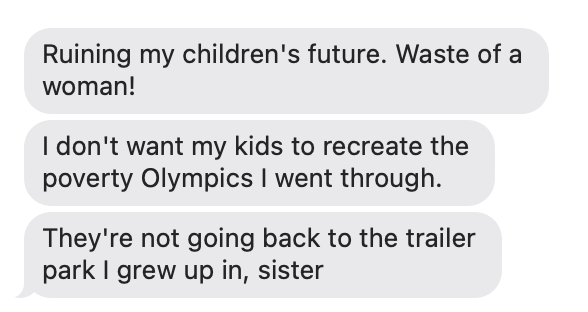
His core fear is returning to that trailer park. When I ask him how long he’s believed he was ugly, he says his entire lifetime: since childhood, he was bullied for his sticky-out ears and ethnically ambiguous features. When I press him on why his future wife must make at least $200k, he keeps circling back to how that’s the bare minimum to raise a family in the Bay Area should they divorce or should he die. At some point, I stop trying to reason further.4
You can take the boy out of the trailer park, but you can’t microneedle the trailer park scars out of the boy.
He is always comparing himself to whoever is ahead; he needs to achieve just as much. It’s the instinct that carried him out of grueling poverty and abuse and helped him become a Silicon Valley millionaire with a wide circle of friends—more than the child he once was could have dreamed. He’s proud of this, and he should be.
His rigidity and tenacity propelled him to where he is now. But the same punishing standards he applied to himself, his push to ignore the overwhelming odds, he now applies to his romantic search.
As infuriating as he is to debate, I think he would make an attentive and loving father, which makes all of this sadder. He wants to take time off work to raise his future children. He cares deeply about providing a stable, well-resourced home. He keeps telling me how he would bring everything his partner brings to the table, and more.
Except looks. There’s always that pesky matter.
And then the story about his ugliness begins to unravel on its own terms.
He mentions, offhand, the women he’s dated. Several of them. I see them in his camera roll. And they’re… cute. Not models, but girl-next-door cute — the level of good-looking where they have no trouble dating.
I feel almost offended, like I’ve been clickbaited by a YouTube thumbnail. In what universe does an ugly man pull multiple cute women? “If you’re really so ugly,” I say, “why would all these women date you?”
He then pulls his favorite magic trick, one I became excruciatingly familiar with: the Quix Cognitive Shuffle. He compensates for his ugliness, he explains, with extremely high volumes of approaches and likes.5
Quix presents himself as rational and data-driven, but his intellect is selectively applied. He seizes on anything that fits the “evidence I’m hideous” folder and rejects anything that contradicts it. Remember his benchmark — one match from 200 selective likes in 2025? What I didn’t mention: that campaign was preceded by carpet-bombing over 2,500 profiles with likes, which yielded 223 matches. Since he deemed 218 of those matches undesirable, their opinions did not count. Still ugly.
But I begin to see a more adaptive logic: if Quix is simply too ugly, then the entire problem has a single cause. It absolves him of the harder work of questioning how he makes decisions.
He does not have to go on dozens of exploratory dates to discover whether his suspicions are true: whether the dismissed women are gold diggers, whether the sunglasses and filters conceal an unattractive face, whether the woman he rejected for smirking in her photos might possess a smile worth seeing. He does not have to expose himself to uncertainty, disappointment, or the possibility that his judgments are wrong.
Ugliness gives him a clean explanation and, crucially, a problem he can work on alone. He can alter his face, improve his body, analyze his ratios and optimize his photographs without ever changing what he wants or how he searches for it.
Quix isn’t unique in his psychological defenses. I think many of us pick reasons and stories that maximize agency while minimizing vulnerability.
So many of us, my former self included, believe that we just need to wear better clothes and hang out in the right hotel bar or download the right dating app to solve all our romantic struggles. Believing these stories absolves us of harder, less pleasant self-interrogations.
The punchline:
By the end of the Bay Area data collection, we fall just short of the target. Quix sent 193 likes and came away with eight matches — a match rate of roughly 4%, instead of 5%, but still 8x his 0.5% benchmark. I provide a full breakdown behind the paywall, along with charts. Some interesting data on the effectiveness of roses for paying subscribers!
But it’s a Pyrrhic victory. He discounts many of the matches as “coerced,” since I convinced him to try sending likes to a few 30–34 year old women. Unsurprisingly, he has some success with that age group. He points out that many are unresponsive; two are marginal in looks; another seems to be collecting IG followers despite being responsive on the app. He keeps insisting the experiment failed because he was bullied into swiping on women over 30, making it an incomparable sample.6
When I question him about his age requirements, he sends me a long voice note laying it out: the plan is to date for three years (during which time she must prove that she’s NOT using him), propose, one year of wedding planning, married by year four or five, then kids, then a house in the forest with their brood.
As the experiment draws to a close, he begrudgingly admits that two of the matches are actually good ones (beautiful women with high-paying jobs, nice smiles and flattering bikini photos), but the effort required to obtain them is just further proof that he’s ugly.
“Every man I know has it easier than this. That’s my more general point. I wouldn’t complain if this was what every guy I knew went through,” he says.
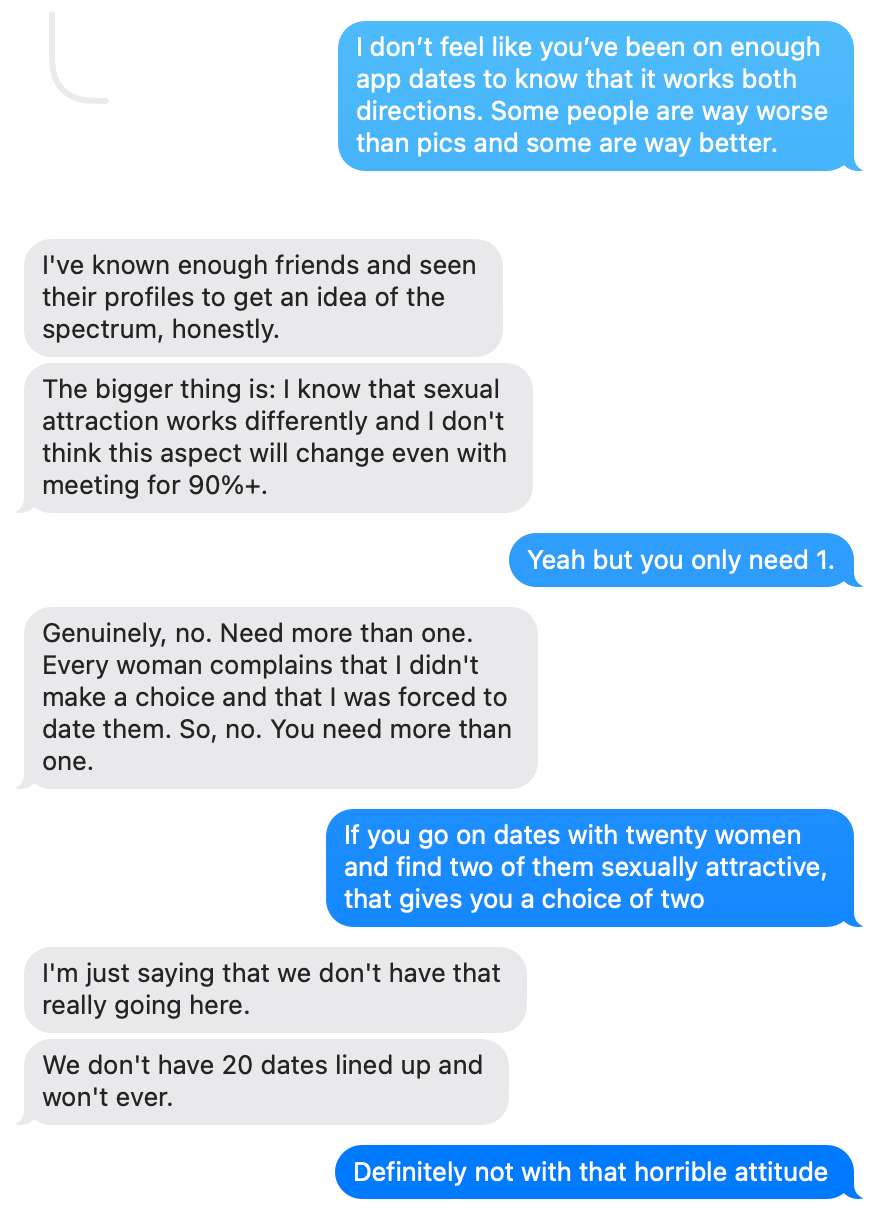
I know better than to point out that he has rejected thousands upon thousands of profiles, or that his combination of age, income, and looks requirements reduces his pool to a sad dribble, or that he dates from a place of anxiety and fear that would send any healthy woman running even if she passed his filters. When you can replace the messiness of human connection with the cold reliability of hired wombs and hired help—the alternative to a wife, for Quix, is a surrogate + nanny—why change the way you swipe?
After all, if he’s going to risk his hard-won wealth, the woman has to be worth it. He’s not going to waste an evening talking to any person whose profile doesn’t instantly assuage his many concerns. As a child, he never knew what horrors the next day might bring. As an adult, he does everything he can to never feel that uncertainty again. He seems to believe that if he builds enough upfront filters, he will spare himself the pain of disappointment. After all, this hypothetical woman could ruin him: he’ll be banished back to being the poor, abused kid with big ears. The stakes are existential.
I don’t doubt he’s encountered genuinely extractive, transactional women. But consider what he’s actually offering the 26-year-old he wants: his money (which she’s required to already have) and his looks (which he insists don’t exist). His income requirement makes his strongest asset nearly useless as a draw. A woman clearing $200,000 is likely dating within a narrow pool where salary is less differentiating than Quix imagines. She is therefore more likely to choose according to personal taste, and at 26 that taste often runs toward men only a few years older, not a decade. Quix’s seriousness, resources and desire for children may appeal most to a woman who has already established her career and shares his urgency to start a family. Instead, he is concentrating on the age group where flash matters more and urgency less.
I’ve heard similar reasoning from other single men 35+ who insist on dating women no older than 29, 30, 31, 32 at most. They don’t want to feel rushed. They want the woman to move on their timeline and not be pushed towards commitment.7 They’re allowed to want what they want. I understand their logic perfectly.
And yet falling in love is deeply human and doesn’t always respect the vision we lay out for it.
Many years ago, I was at a party in the enormous SoHo loft of a billionaire entrepreneur. His partner — late 30s, a partner at a white-shoe law firm, willowy in leather pants — told me he’d initially sworn to her he’d never date a woman older than 30, or one with a kid. It hadn’t fazed her; she knew her worth as an older woman who came with a daughter. A decade later, they’re still together, now with two kids of their own.
That is the magic of love. It is not entirely about sexual market value and Elo scores and app algorithms. Love does not always reward the person who best satisfies our stated criteria. Sometimes the person who changes our life arrives disguised as an exception to them.
My patience with Quix waxes and wanes over the course of the experiment. But one thing he says sticks in my head. While wrapping up the free, company cafeteria lunch during his NYC visit, I told him I would have sent him a like on Hinge, and asked why that fact was meaningless to him in his self-assessment.
“I don’t think you would have picked me 10 years ago,” Quix said to me.
But the fact of the matter was, I didn’t pick anyone ten years ago. I don’t think I really wanted, truly and deeply, to be in a relationship at that age. I wanted something far harder to quantify and far more capricious: I wanted a man who made me feel, somehow, like I had “won.” I thought of myself as holding a good poker hand, waiting for the perfect moment to cash in my chips. More than anything, I wanted to feel like I was starring in my own fairy tale — that something improbable and beautiful and impossible was happening to me.
After struggling with the pandemic, bad career stints, and hundreds of failed dates, I became a very different person. Dating wasn’t an exciting adventure anymore. By 35, I watched the first episode of “Married at First Sight” and immediately googled how to get cast. I was so very tired. I didn’t need a fairy tale. I just wanted an actual partner: someone willing to work on whatever eventually came up, rather than going poof the second I did something they didn’t like.
When I started dating my boyfriend (he was, funnily enough, my Most Compatible on Hinge), there were initial speed bumps that, a decade earlier, I would have avoided by simply never seeing him again. At 36, I was finally old enough to realize that there wasn’t some magical bachelor that had all the good parts and none of the minor annoyances.
So I gritted my teeth and communicated. To my surprise, we worked through them. The concerns that loomed so large on our early dates either stopped mattering or were resolved by talking honestly.
I wouldn’t have picked my boyfriend ten years ago; I was too stupid. I wouldn’t have appreciated the qualities I admire so much today. But I can say for sure that I’ve never been so consistently happy in my life.
Watching Quix reject almost everyone Hinge showed him reminded me of a funny fact. I — especially I — would have been rejected in his screening, which he confirmed with his “you ten years ago” comment. Too old. Not enough money. Marginal in appearance, probably: acceptable, not someone to be brimming with excitement about. I can imagine the screenshare voiceover he’d make about my profile if it surfaced in his inbounds.
But if I hadn’t known about his negativity, I would have sent a like, back when I was single.
He looks similar to someone I dated before meeting my boyfriend. I sent Quix a picture of that man, just to prove my point, and he agreed.
Of course, that didn’t matter.
For paid subscribers … a very detailed and hilarious account of what became of his matches. Hint: it’s deeply ironic yet perfectly fitting.
Based on my cursory research, it’s a little more nuanced than that, but marriages over 10 years are treated differently than shorter marriages if the spouse stops working. Divorce lawyers, feel free to chime in!
In a later session, with age dealbreakers turned back on for the duration of swiping, Hinge had acclimated to his tastes and he liked about 9% of the women he saw.
The days go by like this, and each day he seems more flustered. Since he isn’t matching with his picks, the algorithm now shows him endless profiles he refuses to like. He has some early success with three matches, but two are unresponsive, and the third expects him to pick her up, which he declares too far out of the norm for the Bay Area. I remind him that flakiness is par for the course in online dating, especially with younger women, but he isn’t having it. For him it’s just more proof he’s ugly.
If Quix were a woman, we would be kinder. We wouldn’t pooh-pooh a woman’s need for a man who can provide for a family. We wouldn’t insist she say yes to men with distasteful buzzwords in their prompts. Social media would say: keep your standards high!
His plan for solo parenting sounds extreme, but women don’t get interrogated for how many short, bald, non-rich men they rejected before deciding to become a single mother by choice.
I offer alternatives: if he died, his widow could take his life insurance payout and move somewhere cheaper, for example, but he sticks stubbornly to his black-and-white thinking:
He has a similar explanation when I meet him in person and he reveals that one of the women he’s seeing is a bit in love with him. And when I point out what that implies, a second explanation appears alongside the first: many of these women are foreign-born Chinese women, which means they are uniquely blind to the ugliness that only American-raised eyes can detect.
I point out that even if he ended up with a hypothetically barren 33-year-old, he was already planning to pay for donor eggs, a surrogate, and a nanny as a solo parent — so how is going it entirely alone better than compromising a few years on age, when technology can fill the gaps and he’d at least save on the surrogacy? (And not leave his children orphaned if anything happened to him?
Moreover, they see the youth of their own partner as validation of their own value.
(I would consider this a fine conversion rate from match to date - typically, I’d expect about 1 date per 10 matches. Many other people have corroborated this experience.) Of course, he interpreted this to mean that online dating was hopeless.
No posts
Comments
Nothing yet. Say the first thing.
Sign in to join the conversation.