
It’s my birthday next week, Christmas arrives promptly the following week, and a brand-new year opens its doors the week after that. Like an old friend, the last three weeks of every year capture the essence of connection, goodwill, and the promise of a fresh new trip around the sun for me!
In honour of this sentiment, I thought I’d end this year with a few things for you :)
A gift
Three things worth leaving behind as we head into 2026
An invitation to join me on the 16th December as we explore “The Human Readiness Gap: What People Need Before AI Change Can Succeed”. This is part of the 7th annual Insight Jam event on “Human Development Focus & the Impact of AI” (December 15th to 18th). Find out more.

If you haven’t yet read my book, you’re welcome to get your free copy (in ebook format) on Amazon anytime between now and the 15th of December. I can’t think of a better way to say a heartfelt “thank you” for your connection, rich insights and business this year. And if you love the book, I’d really appreciate a recommendation on Amazon.
Relevant: Future-Focused Leadership
No two years are the same, and this one has been a wild ride for many. As we close the doors on 2025, it’s time to take a moment to reflect.
What’s worth carrying into the new year?
What can you happily leave behind?
The beautiful thing about the future is that it’s not yet written. It’s full of opportunity if we’re prepared to free ourselves of the shackles of what worked in the past.
But first, we have a choice to make. We can go with the flow, hoping beyond hope that things will turn out ok, or we can take a moment to focus our attention on actively shaping the future we want.
“Rethinking Leadership for the Future of Work”, from The Institute of Internal Communications podcast. Click on this link to listen to the full episode.

As we depend more on GenAI LLMs, our critical thinking and trust in our intuition are being eroded. Language always reflects the world around us, and last year’s official word of the year, Brain Rot, captures this perfectly.
In academia, terms like “Cognitive Offloading”, “Cognitive Atrophy”, and “Cognitive Dependency” (if you don’t use it, you’ll lose it) are being used to explain our cognitive decline.
And in the corporate world, a couple of recent high-profile cases involving Deloitte have highlighted the financial and reputational costs of our growing reliance on LLMs. The firm was hired to deliver reports for both the Australian and Canadian governments, which contained fabricated academic citations, false quotes, incorrect references, and several factual errors.
Yes, Deloitte were fined. More importantly, their reputation suffered a significant blow, eroding trust with both current and potential clients and stakeholders. And that’s hard to recover from.
So how can we use AIs in ways that actually serve us? The first step is to understand how LLMs make judgment calls. Professor Walter Quattrociocchi said it best when summarising his paper ‘Counterfeit judgments in large language models’:
“Human judgment is embodied. It emerges from experience, memory, emotion, context, intention. It is grounded in a life.
LLM “judgment” is not. It has no experience, no time, no world. It operates on statistical regularities among symbols, not on events in reality.
And yet — this is the trap — the outputs can look the same.”
A trap that’s easy to fall into. It’s the first on my list because it underpins our professional value in the world. When we stop using and trusting our judgment, the quality of our decision-making declines.
It’s all too easy to resort to ideas that worked in the past, but are no longer fit for today’s (and tomorrow’s) world of work.
A “used future” is an outdated vision or plan for tomorrow, based on past assumptions that no longer fit our current reality – often adopted by copying others instead of innovating.
We tend to operate on autopilot, recycling old beliefs, stories, and assumptions about what people want, what will or won’t work, or the role of technology in our lives and businesses.
We’re also susceptible to chasing other people’s futures, attempting to follow in the footsteps of a family member, business idol or influencer who seems to embody what we want for ourselves.
The problem is that “used futures” will always be elusive – their foundations were laid by others in a different time and context, and created for a future we won’t be occupying.
This is second on my list as it’s worth taking the time to deconstruct your ideas and strategies for 2026, and removing any elements that are used, done or spent.
The Q to ask yourself here:
“Am I designing a strategy/solution/model based on the assumption that our world will stay the same, or am I enabling something innovative, and attuned to the evolving context we’re operating in?”

Strategy is essentially a bet on a theory of how we can win in a competitive market. It involves a desired outcome which is reliant on external factors that are hard to control. And yes, strategy can make us feel anxious or uncomfortable because it is both dynamic and uncertain.
An effective strategy requires us to accept uncertainty, clearly explain the logic behind our theory, and communicate it as a continuous journey.
Planning is different – it’s relatively static. It involves actions that focus on costs and controllable activities to reach a goal. Think change and transformation projects (AI, digital, organisational…), launching a new product, expanding into a new market or integrating a new technology.
When we use the terms interchangeably or bundle them into ‘strategic planning’, we miss the point. Yes, it’s important if all we want to do is reach a goal while participating in a competitive market. But to win by creating new value, we need a big, bold strategy first.
Whenever I work with clients on their strategy, I always share a well-known study from MITSloane Management Review, which opens up a much-needed conversation.
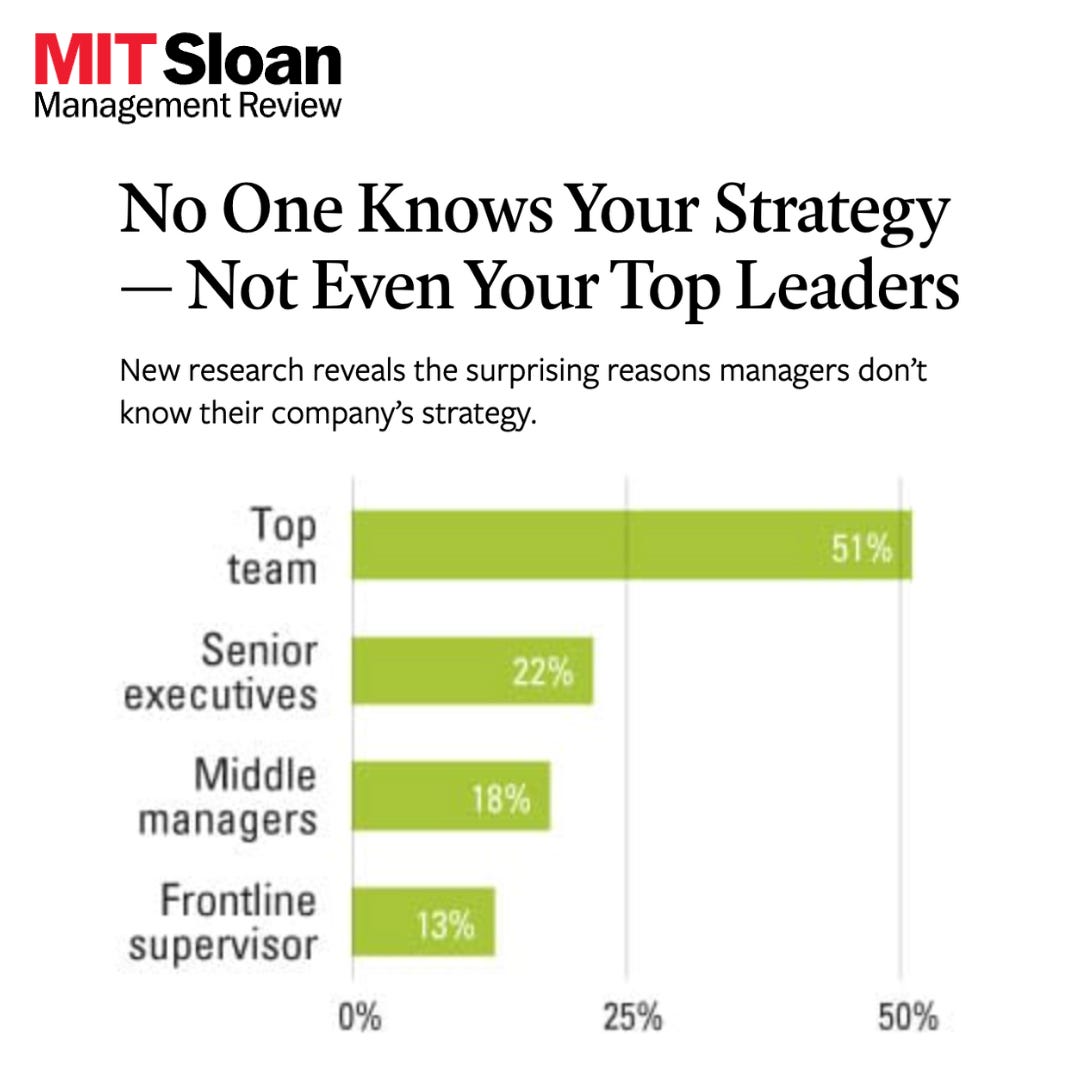
Strategic priorities are rarely well communicated throughout an organisation. Rather, leaders spend their time and energy doubling down on performance, productivity, and optimisation – within the confines of a ‘plan’.
While our business contexts and technologies may be changing at lightning speed, people, the systems we work in, and the cultures that hold it all together, quite simply, don’t.
Being able to bring strategy to life in the minds and hearts of the people who will make it happen will be a key competitive advantage in the coming year. And the skills worth honing? Storytelling, communication, connection… the human stuff.
As ever, please feel free to share ‘Relevant’ with someone you know who would benefit from reading this.
Until next time, take good care of yourself.
Best, Louise
Comments
Nothing yet. Say the first thing.
Sign in to join the conversation.