
Hello everyone,
This letter has come forth—as do all forms of expression—from the well of silence. This particular well was built by John Cage, the avant-garde composer probably best known for his silent piece 4’33” in which the musician (often a pianist) ‘performs’ silence for four minutes and thirty-three seconds.
The letter starts with a paragraph from the magnificent book Where the Heart Beats: Zen Buddhism and the Inner Life of Artists by Kay Larson. The year is 1952, and the audience looks on as 4’33” is about to be performed for the first time ever. Musical history is about to be made—without making a sound.
o - I - II - III - IV - V - o
August 1952, Woodstock, USA
David Tudor (pianist) walks across the stage and sits down within the boundaryless universe. He crosses his legs (so to speak) and begins an interval of non-doing.
As the stopwatch ticks, he will perform “nothing.”
In these four-plus minutes an opening occurs.
No expression of will or ego.
No walls between composer and performer.
No dualistic division into “high” or “low,” “good” or “not good.”
No “art” versus “life.”
No value judgments and no lack of value judgments.
No arising and no lack of arising.
No separation of any kind - no walls at all - and therefore perfect inter-penetration.
No form and no lack of form, no emptiness and no absence of emptiness.
No sensation and no lack of sensation.
No music and yet the music of the world.
-
Is this music?
Meditation?
Art?
Let’s loosen these concepts
and see what remains.
…
fiVe parts
(sometimes)
make
a whole
-
Contents:
o
introduction
I
meditazione
II
lived mystery (stop & look)
III
suitable daisies
IV
nothing to say (and saying it)
V
coda (mushrooms)
o
fin
-
here we go:
o - introduction:
this five-part-meditation-rumination will loosely interconnect - just like everything else. background knowledge (that) might be helpful and muddling:
this is 4’33”
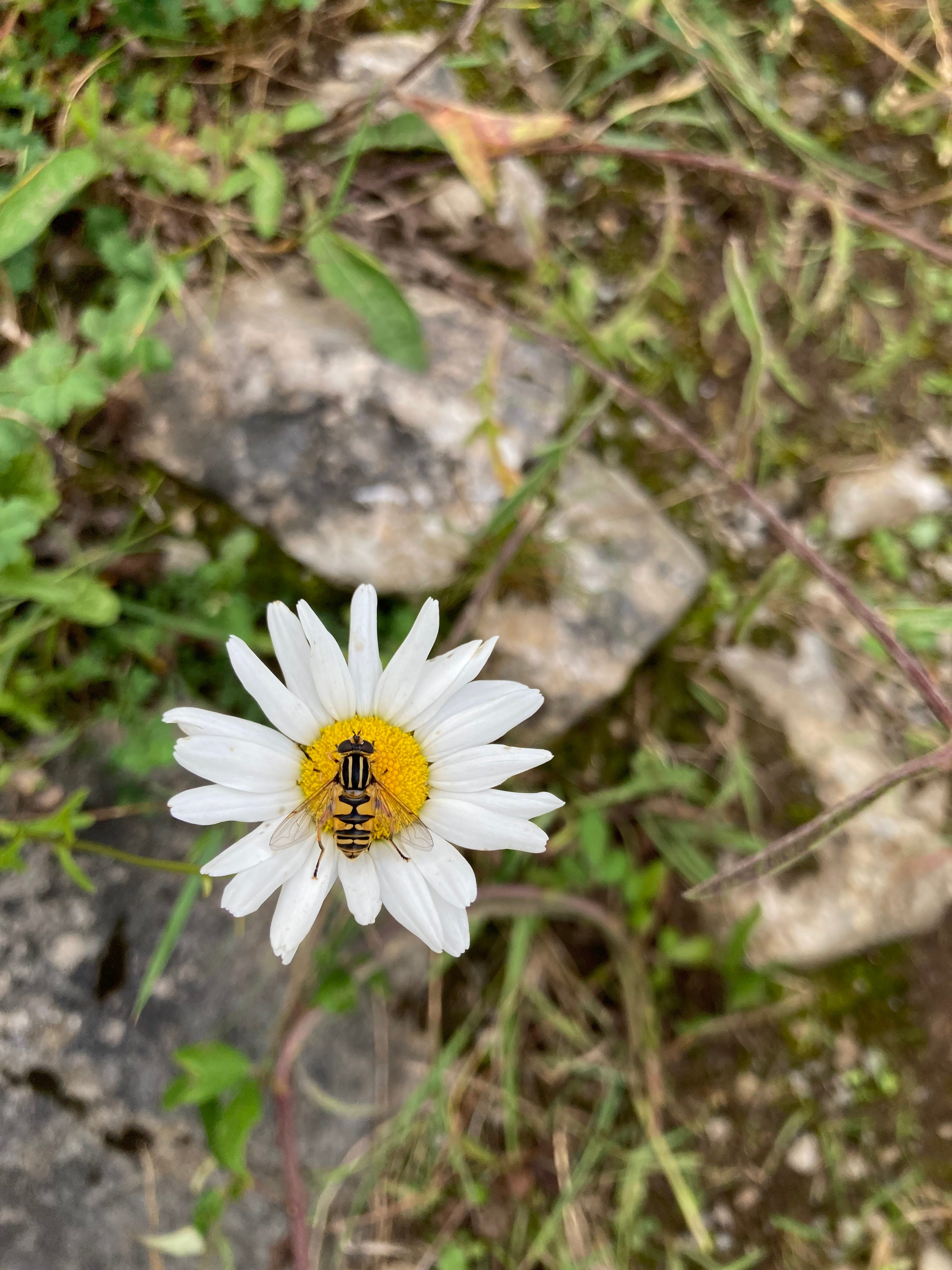
this is a daisy
this is john cage
this is the spirit of john cage awakened in a book (a great book)
mary oliver is a poet
-
so, let’s see what happens.
-
I - meditazione
0:00
-35:19
II - let mystery live
Cage’s musical piece of silence-not-silence is a proposition, it says:
stop.
stop for a moment
stop and look.
listen:
is it possible to surrender to this being
without trying to understand it?
-
let’s play around. i invite you to play along. don’t meditate!
we’ll perform the piece -
first, some words as introduction - a prelude to the score; the composer wanting to make sure you understand the piece (so silly of him).
Get ready. You’re about to perform.
First: you cross your legs (so to speak)
The performance will be an interval of non - doing
You will perform “nothing.”
In these minutes an opening occurs.
No expression of will or ego.
No dualistic division into “high” or “low,” “good” or “not good.”
No “meditation” versus “life.”
No value judgments and no lack of value judgments.
No separation of any kind - no walls at all - and therefore perfect inter-penetration.
No sensation and no lack of sensation.
No music and yet the music of the world.
No understanding of what we are doing and no lack of understanding what we are doing.
Stop & look
Stop & listen
(See what happens)
The roar of being never ceases
Can you enter this spaciousness?
Can you surrender to this spaciousness?
Can you surrender to not-knowing?
Can you let the mystery live?
The more we let the mystery live,
The more we live the mystery
So,
Stop & look
Stop & listen
(don’t make it into a meditation)
only experience
So,
here you go:
perform silence for 4 minutes and 33 seconds
and listen to the music of silence
the music of the world
the roar of being.
First, read the score below
(‘TACET’ is the instruction in a score that tells one instrument to be silent in the midst of the sounding of the other instruments of the orchestra)
set your timer
(to 4’33”, of course)
and
…
go
-
I
TACET
II
TACET
III
TACET
-
(…)
-
III - daisies - Mary Oliver - field
he must turn silent
were he suddenly assaulted with answers
DAISIES
It is possible, I suppose, that sometime
we will learn everything
there is to learn: what the world is, for example,
and what it means. I think this as I am crossing
from one field to another, in summer, and the
mockingbird is mocking me, as one who either
knows enough already or knows enough to be
perfectly content not knowing. Song being born
of quest he knows this: he must turn silent
were he suddenly assaulted with answers. Instead
oh hear his wild, caustic, tender warbling ceaselessly
unanswered. At my feet the white-petaled daisies display
the small suns of their center-piece — their, if you don’t
mind my saying so—their hearts. Of course
I could be wrong, perhaps their hearts are pale and
narrow and hidden in the roots. What do I know.
But this: it is heaven itself to take what is given,
to see what is plain; what the sun
lights up willingly; for example—I think this
as I reach down, not to pick but merely to touch
the suitability of the field for the daisies, and the
daisies for the field.
IV - John Cage has nothing to say (and says it)
I have nothing to say and I am saying it
and that is
poetry as i need it
this space of time is organized
we need not fear these silences,-
we may love them
V - coda (mushrooms)
John Cage is able to loudly say nothing and let the music of silence reverberate.
Paying attention - or standing as though with your arms open - or silence is, like Cage’s musical piece of silence-not-silence, a proposition. It says:
stop.
stop for a moment.
stop and look and
listen:
is it possible to surrender to this being
without trying to understand it?
The boundaries of music, sound, meditation, attention and all we think and make of it become permeable; and then, with everything permeable, it becomes strangely clear we exist in an unending center-less interconnectedness.
The ego-mind might resist, but this is all part of it - this mind is within and NOT - as we usually experience it, the other way around; the mind builds walls that don’t exist. (these walls make mind king, so it is an understandable endeavor)
From the book:
‘In 4’33” the “music of the world” arises from the ground that is no ground at all - unnamed and unnameable - empty of categories - beyond anything that can be said about it - the nothing that sings.’
Words naming the unnamed - experience impossible to pin down - a musical piece that consists of nothing? how irritating!! - exactly.
This review for the Woodstock performance of 4’33” mentioned at the beginning of this letter, appeared eleven days after the event:
This form of phony musical Dadaism built up by sensational publicity, frightens audiences away from the real music of our times. The arrogance of its nihilistic sophistries might be just amusing to most people. But there is a war of nerves against common sense today particularly in all fields of art. And if we don’t check these insipid fungus growths that eat into the common sense of our people, their destructive influence will grow and gradually undermine the health and vitality of our civilization.
Well, quite! Insipid fungus growths!! Stuttering outrage it is! — and why? Because someone performed silence. It’s just silence! Amazing.
Kay Larson writes:
‘We observe that 4’33” is always itself, and it’s always wide open to everything. It gives a perfect opening to people, who will unfailingly reveal who they are: arrogant, dismissive, argumentative and/or peaceful, accepting, reverent.’
The piece a blank canvas.
What you see and hear is what you are.
Now try to recall:
How did your performance of 4’33” play out?
…
We’re nearing the end.
In the post meditation conversation, an italian friend asks: are the mushrooms mentioned in the book?
Does he mean the insipid fungus growths?
No.
Something different. Apparently Cage was a big mushroom enthusiast. Turns out that, yes, it IS in the book (emphasis mine):
‘When I left New York for Stony Point, it was like a revelation! I had never taken seriously (zen master) Suzuki’s remark that there is no Zen life except outside the city. Well, the mushrooms allowed me to understand Suzuki. Rockland County, where Stony Point is located, abounds in mushrooms of all varieties. The more you know them, the less sure you feel about identifying them.
Each one is itself.
Each mushroom is what it is-its own center.
It’s useless to pretend to know mushrooms.
They escape your erudition.
I have studied mushrooms a great deal.
-
Mushrooms, daisies.
We have to leave the structure
to see the structure.
-
In 1959 Cage appears on an Italian television quiz show and wins first prize for correctly answering all the questions about mushrooms. Italian television audiences watch him play his music. And everything begins happening at once.
-
Can we be like the mocking mockingbird? - knowing enough to be perfectly content not knowing.
Knowing that the inter-connectedness is right here
without knowing how, where, when -
without seeing it -
but knowing enough,
nonetheless.
-
Let’s end without end with a final quote of John Cage:
(A) religious spirit in which one feels there is nothing to which one is not related…. This is the experience of silence.
Enjoy the silence,
the roar of being,
and
thank you for reading
(and
for your amazing performance,
of course).
Love
from
Louis
o - fin : less is more, more or less
Comments
Nothing yet. Say the first thing.
Sign in to join the conversation.