
May in Ireland has many beautiful floriferous displays; hedgerows full of white and pink hawthorn (also called May flower), wet fields full of yellow buttercups and flag irises, and verges billowing with cow parsley. But to my mind, one flower beats them all; the bluebell (Hyacinthoides non-scripta).
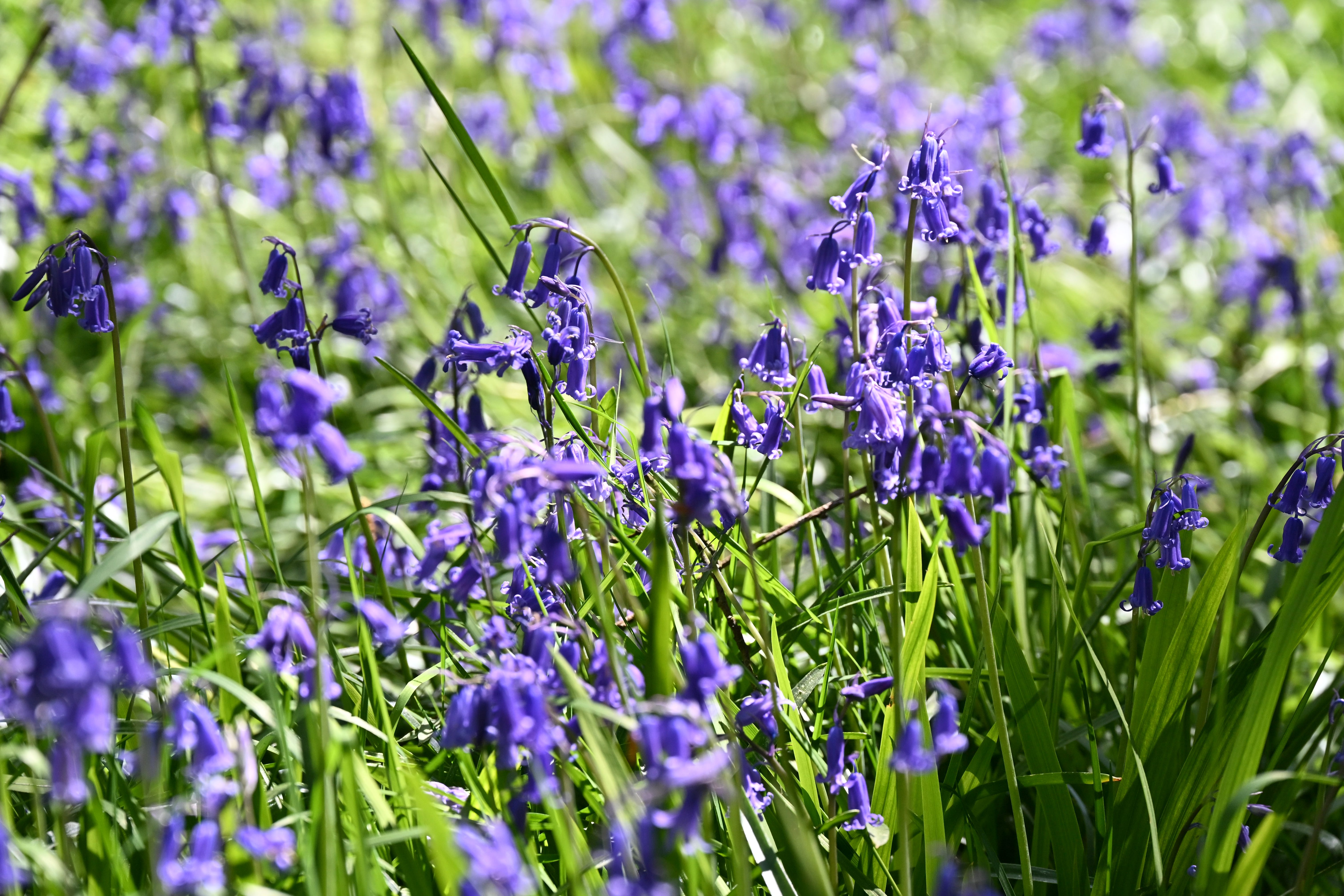
“The blue bell is the sweetest flower
That waves in summer air;
Its blossoms have the mightiest power
To soothe my spirit’s care.”
Emily Brontë
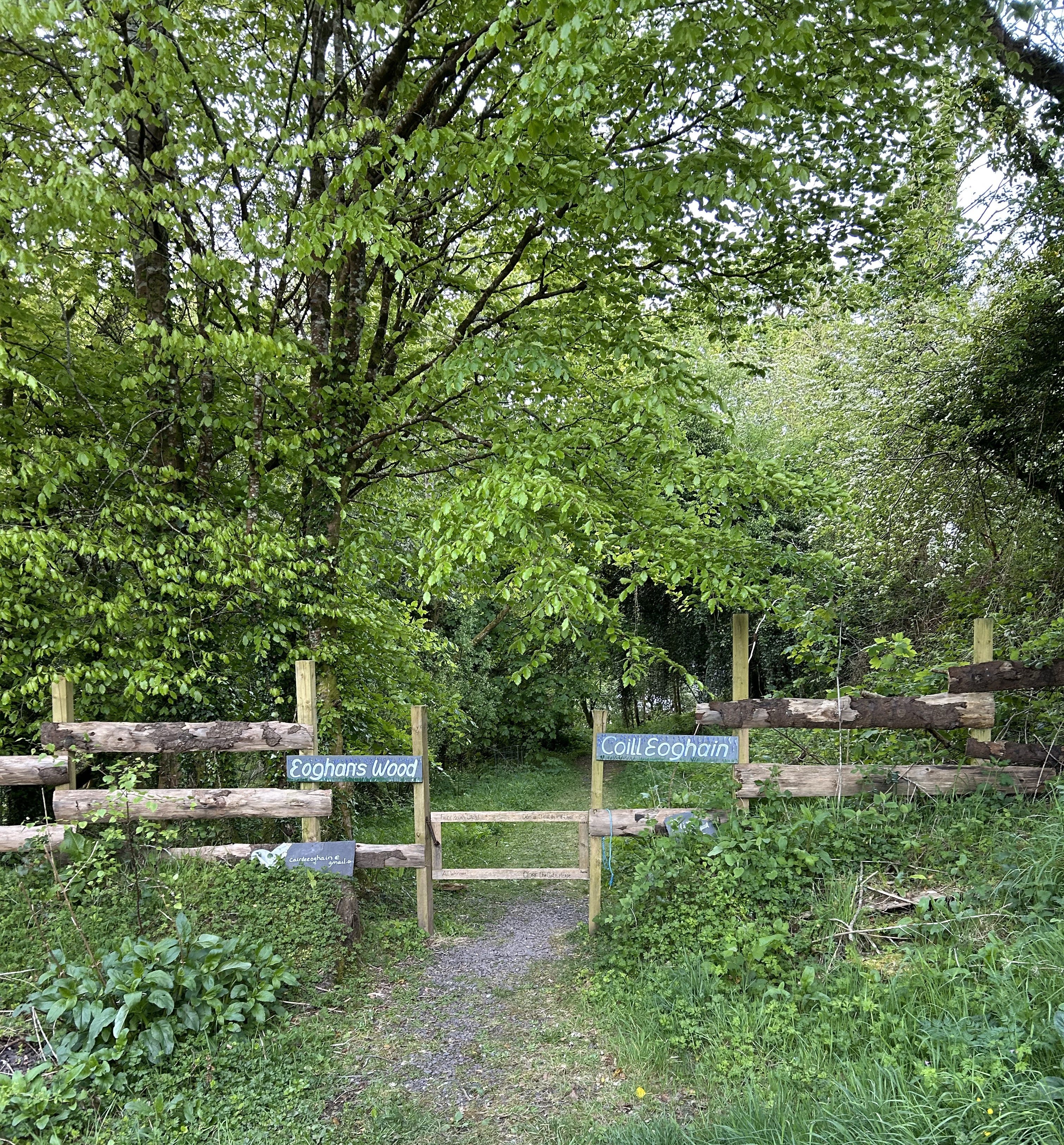
A narrow road winds up the hillside out of the village, scattered houses give way to more fields of sheep with their lambs and the hedgerows spill out into the road. It’s early morning, with a blue sky, but a chill in the air as the wind blows in from the north across the sea. Just off the road, tucked away down a short gravelly track is a small gate overhung by beech and oak trees, coming into leaf. The path beyond gently meanders down the slope, through a mix of native deciduous trees, and all around is the sound of birds singing. A thrush flies out across the path and disappears into the cover of undergrowth. As the path starts to level out, there is the sound of gurgling water from the stream we are about the cross. Another path joins at this point, and looking up it, a hare is sat frozen looking back! Suddenly it turns and bounds up the path and out of sight, its white tail flashing against the shadows.
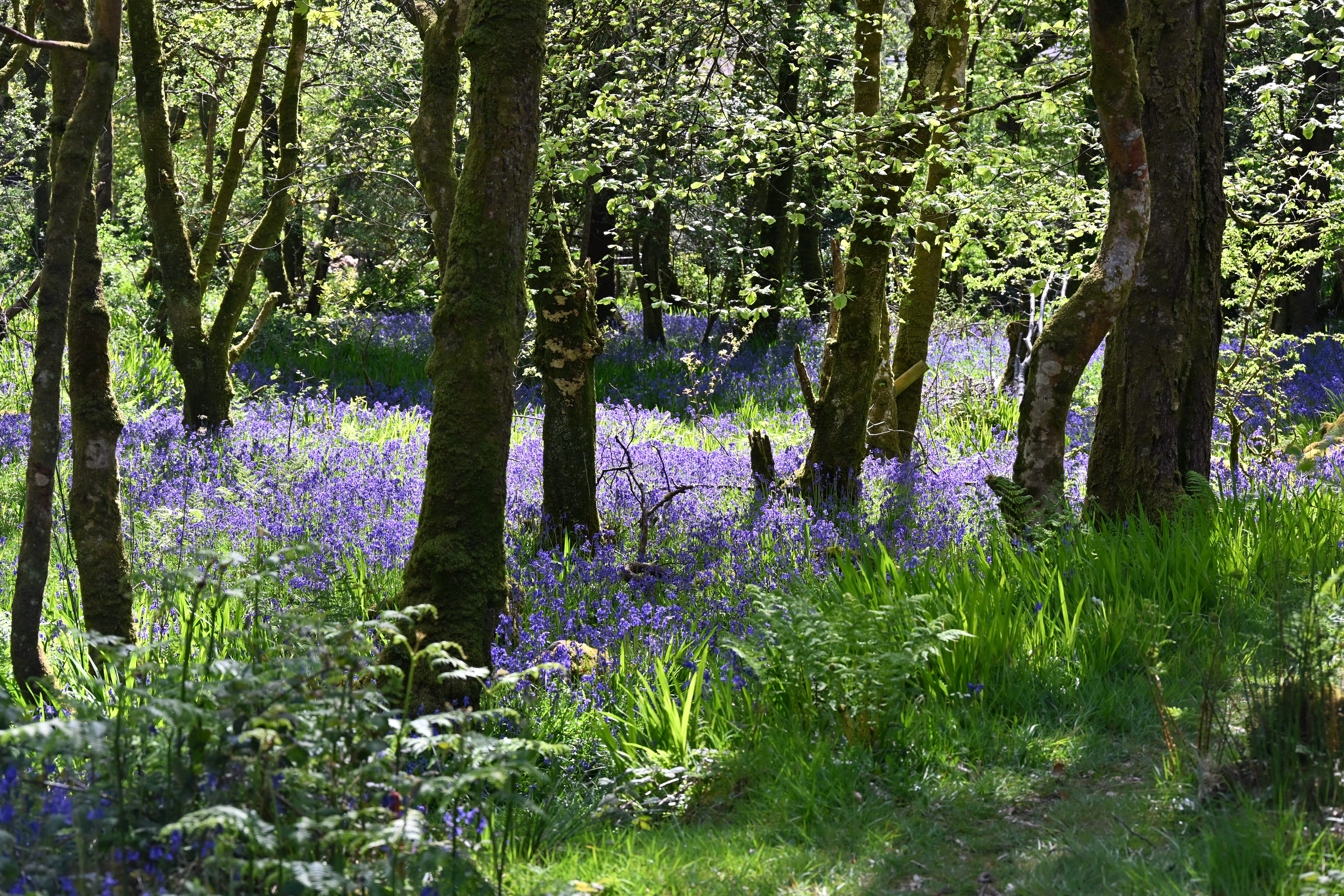
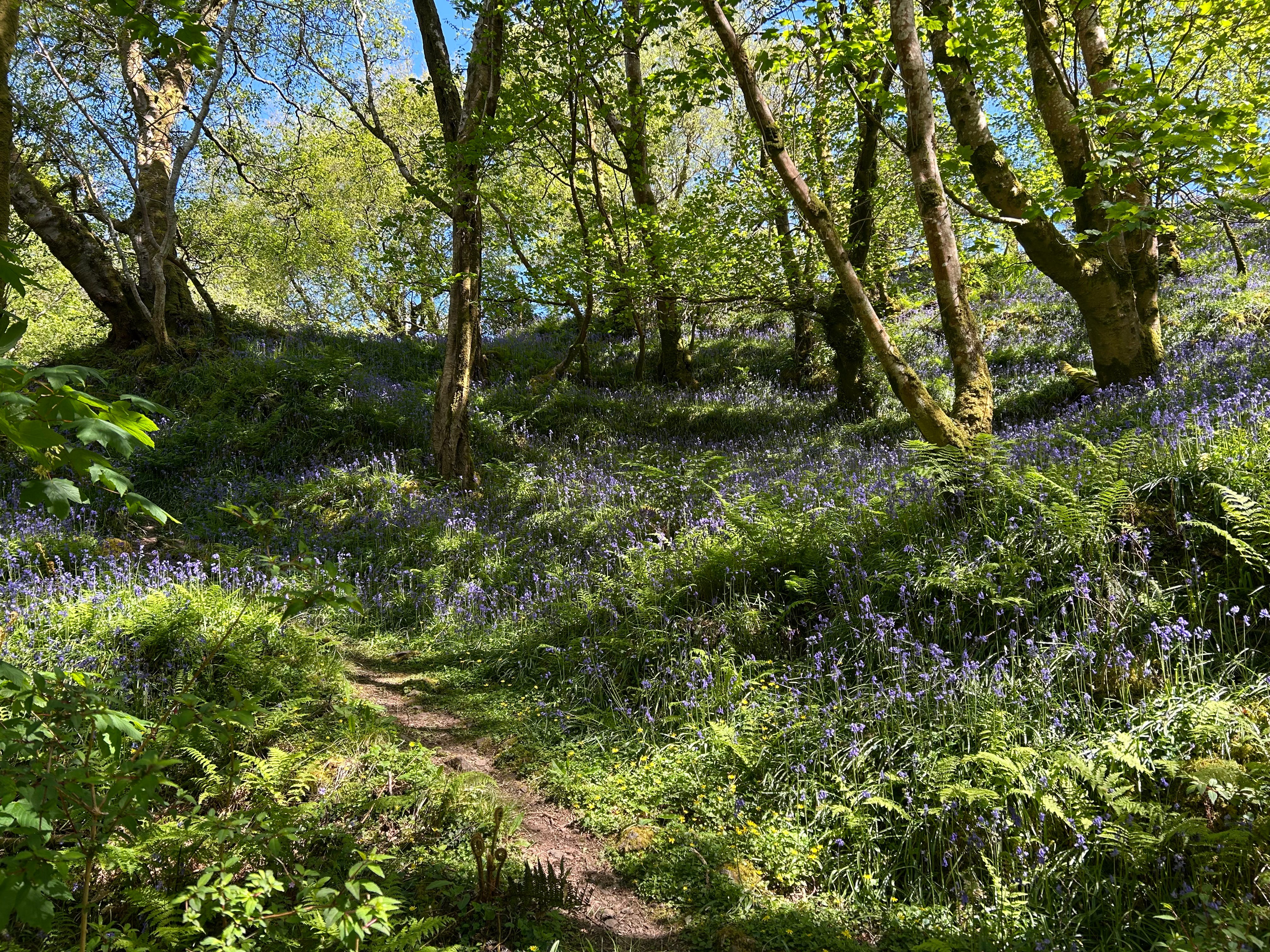
Carrying on, the stream runs along side us and there across on the other side is a haze of blue spread out under the trees. The early morning light has just started to reach over the hills behind, and is filtering down through the glowing spring green leaves. Seeing all that blue, takes your breath away for a moment, and certainly ‘soothes the spirit’. Crossing the small bridge over the babbling stream and we are immersed into the blue. At this point virtually the entire floor is covered in bluebells, with their deep purply-blue nodding flower heads. Narrow paths weave through them, with a trail marked out to keep visitors from straying off the path and damaging the blooms.
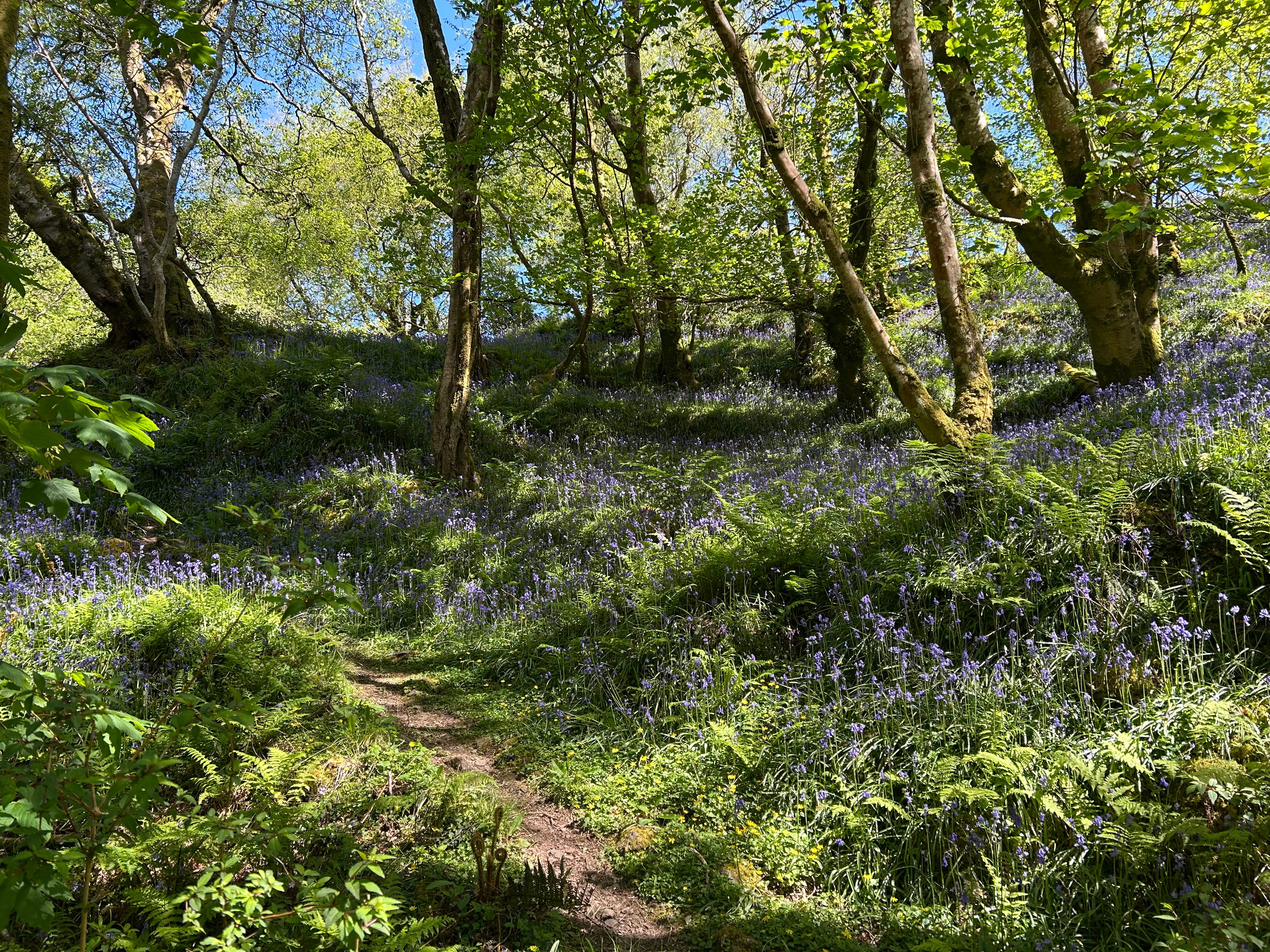
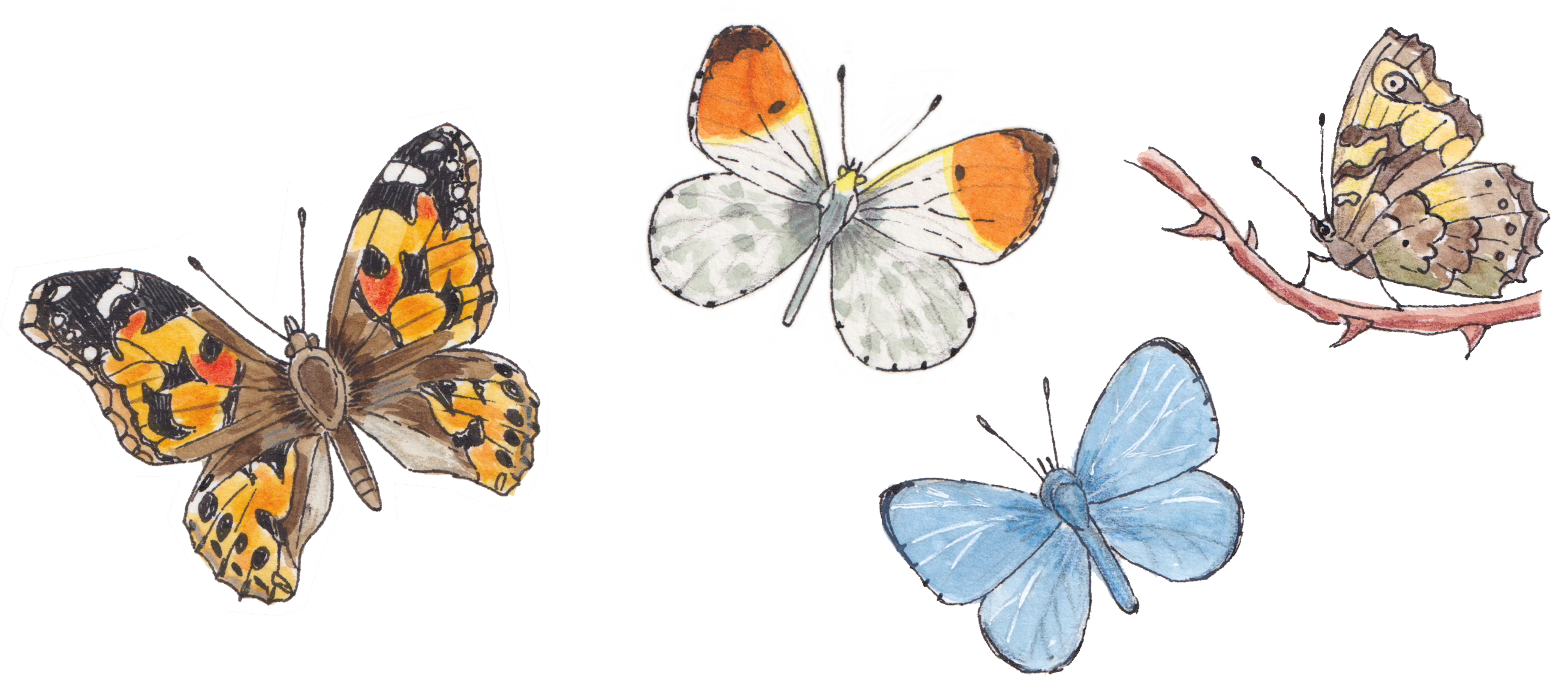
Walking along the trail takes us in a loop, through the woods and up a steep bank deeply shaded by old trees. Here primroses, wood sorrel and lesser celandine cover the slopes, along with ferns, moss and of course more bluebells. In the open sunny patches between the trees, the warmth of the sun is starting to release their sweet scent, which delicately perfumes the air. Also in the air are butterflies flitting above the sea of violet-blue; painted lady, holly blue, speckled wood and orange-tip.
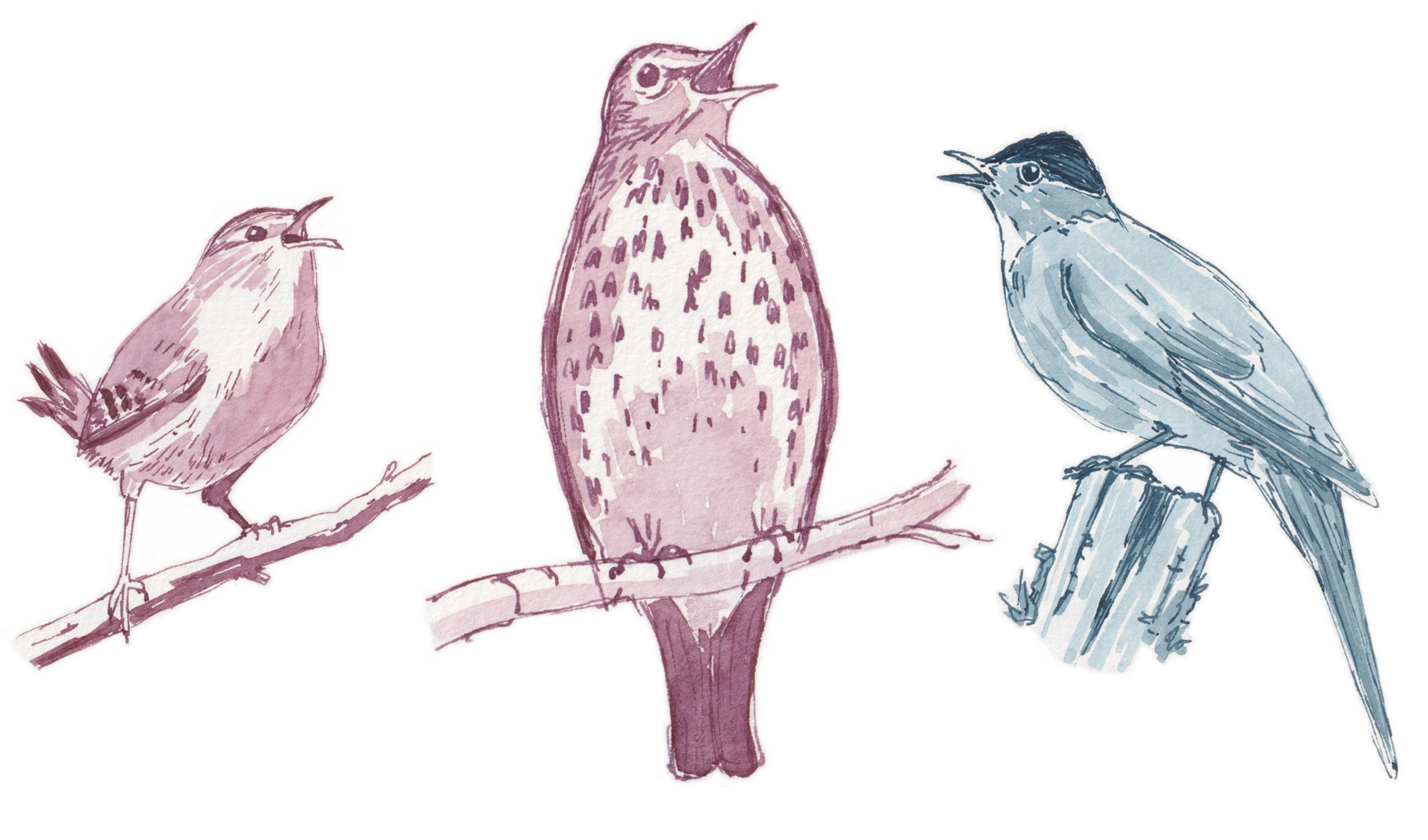
Weaving our way back toward the starting point, the birds are still singing, and occasionally flying from tree to tree. The most vocal are the wren, thrush and blackcap, who are singing out for most of the time. Occasionally, in the distance, there is the soft sound of ‘cuck-coo, cuck-coo’.
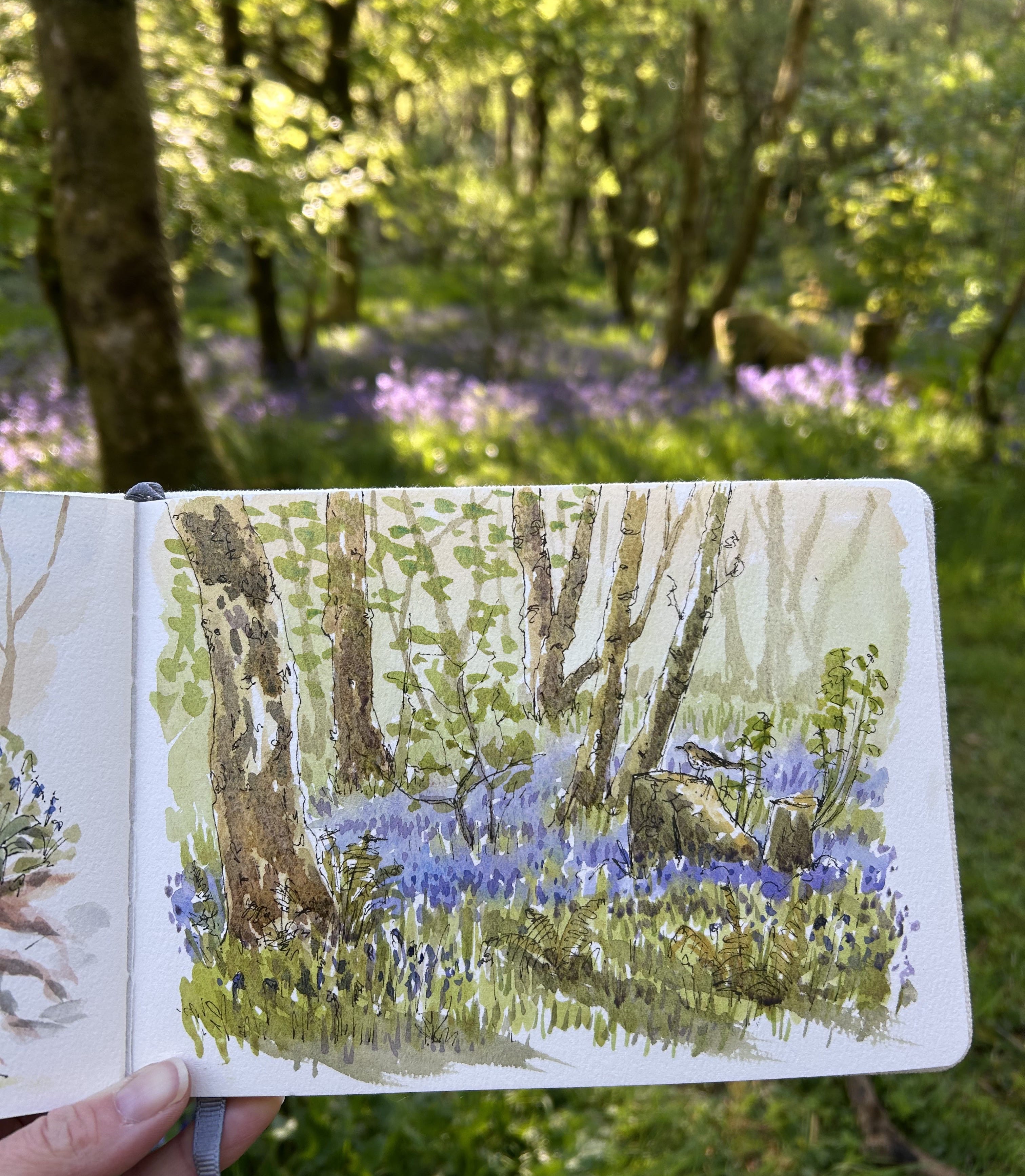
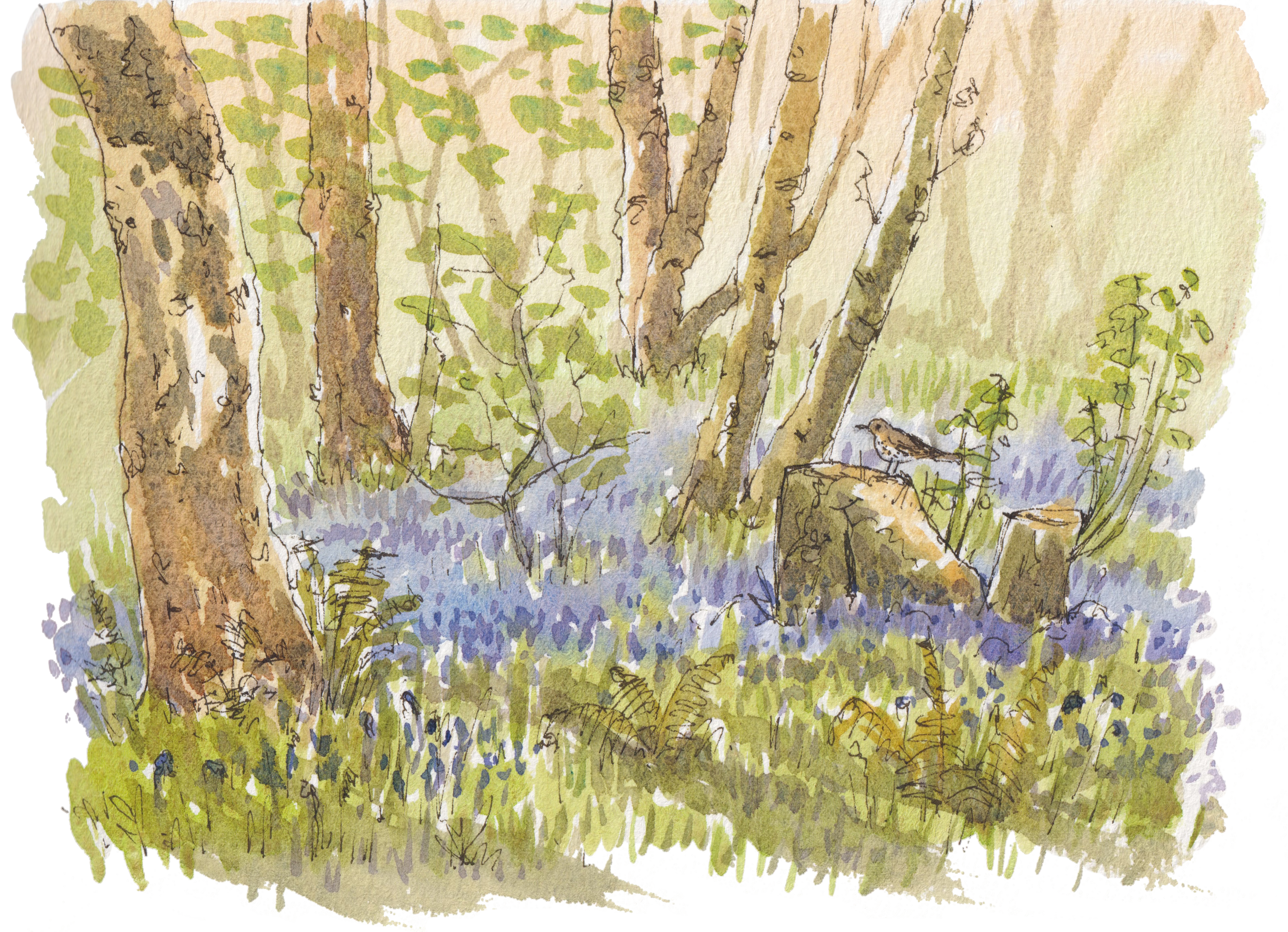
Now we are back by the stream. It is a good place to stop and have a rest. There is a convenient mossy tree stump (mercifully dry), so I will sit here a while with my sketchbook, and soak up the beautiful surroundings while I draw and paint the bluebells.
I hope you enjoyed that little walk?
Now you may be interested in a few more facts about this delight woodland flower.
The common name of ‘bluebell’, could of course refer to more than one plant. In America the Virginia bluebell (Mertensia virginica) is another woodland ephemeral, that forms large swathes. In Scotland the name bluebell is given to Campanula rotundifolia, known as harebell else where. And also another bluebell from Spain and Portugal, Hyacinthoides hispanica, the Spanish bluebell. It is a popular garden plant, that looks similar to the native bluebell, but not so delicate and with paler flowers. The Spanish bluebell is a bit of a thug, growing more vigorously than our native, and also hybridising with it, which has caused concern this garden cousin could reduce the prevalence of our native bluebells.
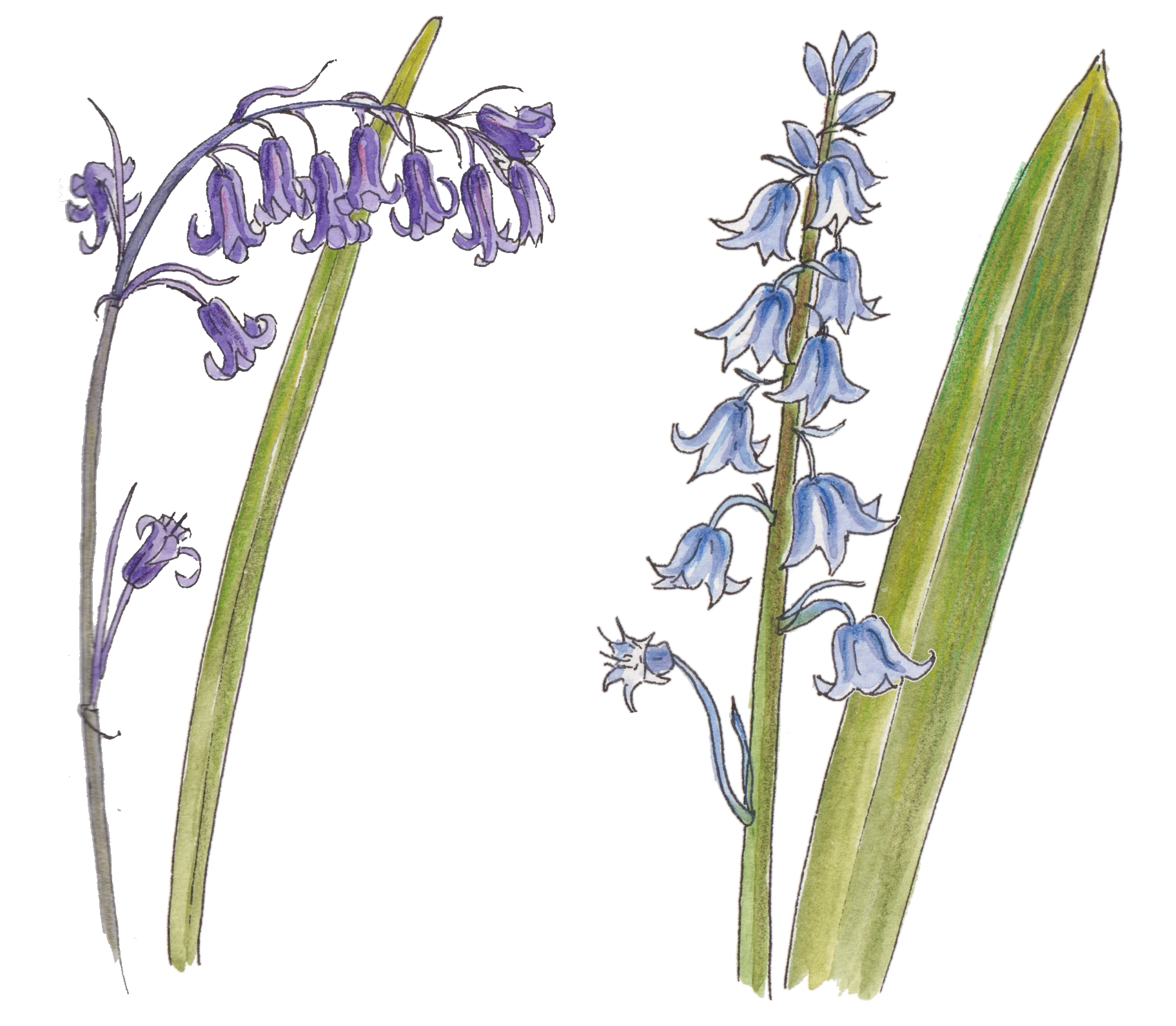
The latin name, Hyacinthoides non-scripta, means ‘hyacinth-like, not written on’. This cryptic name was bestowed by Carl Linnaeus1, referring to the Greek myth of Hyacinthus, a young lover of Apollo, who was killed and from his blood grew a hyacinth flower. In his grief, Apollo inscribed ‘Ai Ai’ (meaning ‘alas’) on the petals. Linnaeus, therefore, gave it the epithet ‘not written on’, to distinguish it from the mythical hyacinth flower.
Bluebells appear in Irish folklore, usually in association with the fairies or sidhe2. These are not kind and wholesome flower fairies, but a dark, mysterious and often malevolent group that would be easily angered by humans damaged or picking their bluebells. A story from the 1930s National Folklore Collection3 from Co. Sligo, tells of an old ring fort:
“In Summer-time and Spring under those trees grow clusters of primroses and bluebells. It is said that if you pluck one of those flowers the fairies will be after you.”
And another story from Co. Donegal:
“There is a woman who lives beside us… One day, she picked bluebells in a fairy hill, and she broke some of the stalks. She went to bed that night, but in the morning there was not any hair on her head. It grew again, but it was never the same colour afterwards.”
Maybe these were stories to discourage over-enthusiastic picking of these beautiful flowers?
They are definitely a flower to be celebrated and I think because of their brief appearance, usually en-masse, it becomes something of a ritual to seeing them each spring. They are also most abundant in Ireland and the UK, with up to 50% of the world population found in these two countries (with the rest confined to northern France, Belgium, the Netherlands, and a small area of Spain4).
Certainly, for me, May wouldn’t be complete without at least one visit to the restorative atmosphere of the bluebell woods.
Do you have any bluebell woods near where you live? I’d love to know…
The Swedish biologist, known as the ‘father of modern taxonomy’.
Pronounced ‘shee’ in Irish.
A rich resource of old folktales and accounts of daily life, collected throughout Ireland in the 1930s. The collection has been digitalised and is searchable, so you can dip into all sorts of fascinating lore from the period.
No posts
Comments
Nothing yet. Say the first thing.
Sign in to join the conversation.