
Some of you know me for Hell of a Hat, the newsletter I started in 2021 to promote my book Hell of a Hat: The Rise of ’90s Ska and Swing. This is something different. It’s a love letter to freestyle music, and if you’re not sure what that is, please check out the introductory article I published last year. This is the second installment of a three-part article about the girl groups of freestyle. Part 1 is all about Exposé. Part 3 arrives in your inbox next week.
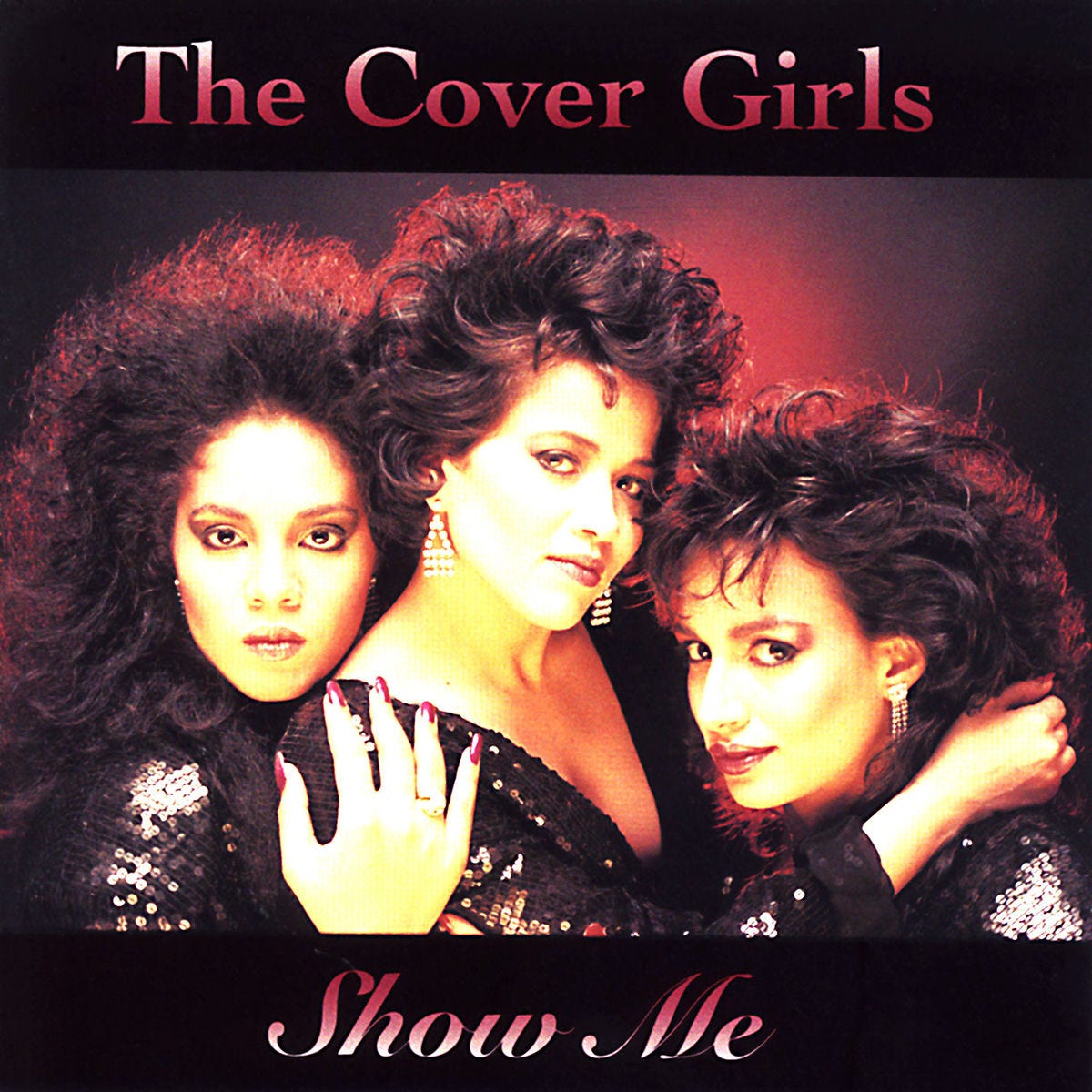
The Cover Girls
The Supremes cast an incredibly long shadow. Two decades beyond their heyday, they led Lewis Martineé to assemble three beautiful women to sing the synthed-out club jams he was writing in his South Florida studio, and all the way up I-95 in New York City, right around the same time, they inspired songwriter, producer, nightclub manager, and eventual TV host Andy “Panda” Tripoli to launch his own female freestyle trio.
“Motown was always fascinating to me,” Panda told the podcast The Freestyle Club in 2019. “It was the music my mother grew up on. I loved the girl groups. I love The Supremes. I loved The Ronettes. I loved The Shirelles. I just had this thing that I wanted to put a girl group together. Because I thought there was something cool and glamorous about what those girl groups from the ’50s and ’60s had done.”
Even before he set about forming a girl group, Panda was already a bona fide freestyle pioneer. He co-wrote and produced a string of club hits for Nayobe, including 1984’s “Please Don’t Go,” inspired by The Supremes’ “Love Child.” Now, he was ready for his next project. He first approached Caroline Jackson, a Queens beauty who was cousins with a girl he was dating, and she was into joining the group. She recommended another girl, Lisa Martinelli, who lived out on Long Island. Both were tall, and Panda figured they would look great singing together. He was two thirds of the way there.
Panda then went to Sal Abbatiello, the man who’d discovered Nayobe, founded Fever Records, and opened The Devil’s Nest, the seminal freestyle nightclub located at the corner of Webster Avenue and Tremont Avenue in the Bronx. Panda was managing The Devil’s Nest, and Abbatiello liked his idea about the girl group. Abbatiello suggested a third member, singer and model Sunshine Wright, and now they were really in business.
Next, Panda needed a song, and he found a couple of key collaborators in Tony Moran and Andy Cabrera, known together as The Latin Rascals. Moran had started DJing as a high school student at Brooklyn Tech, and he met Cabrera, a fellow DJ, while working at Downtown Records on Worth Street in Lower Manhattan. The shop specialized in 12” dance singles, and Moran hobnobbed with all of New York City’s top club DJs. In 1982, he and Cabrera formed The Latin Rascals, and they became known for their editing—the literal cutting and pasting of reel-to-reel tapes to create thrilling mashups and Frankenstein versions of existing tracks. It was a bit like remixing or DJing, but it was an art form all its own. The Latin Rascals were editing beasts, and they soon earned their own radio show on 92.3 WKTU.
Moran and Panda were admirers of each other’s work, and the result of their initial songwriting team-up was “Show Me,” a hooky club jam about how, in romance, talk is cheap. They recorded a demo with singer Pam Russo, and if it’s the version that’s kicking around on YouTube, it was super skeletal. There’s little more than Russo’s voice, Panda’s grabby melody, and a slamming freestyle beat. And yet that demo went over like gangbusters at The Devil’s Nest when resident DJ Little Louie Vega threw it on the sound system.
Panda now had three girls and a crowd-tested banger for them to sing. But it soon became clear that Lisa Martinelli wasn’t working out, so they needed to find a replacement. He and Abbatiello held auditions, and that’s how they met Louise Angel Sabater, aka Angel, a petite Latina from the Bronx who’d started her showbiz journey as an actress at the age of nine. After appearing in a play at her local community center, Angel earned a scholarship to the Academy for Theatrical Arts in Manhattan. She attended the school for one year, and in that time, she experienced her first taste of racism, as the teacher in charge of the year-end show wouldn’t let Angel have the lead role, on account of her being Latina.
“She gave me a smaller part, but it doesn’t matter,” Angel told Pacific Rim Video in 2018. “I’m gonna be that bitch. I’m gonna be fierce.”
Angel quit acting at 13, when she discovered boys, and after a stint doing makeup at Bronx flea markets, she took up singing. She slayed the local talent-show circuit and won lots of prize money and clock radios. At her very last talent show, sponsored by Fever Records, she ended her streak of first-place finishes and came in second, right behind Nayobe. But that’s how she learned about the audition for the group that would become The Cover Girls.
At the time, Angel had a state job working with mentally handicapped children. The five-foot tomboy turned up for the tryout in jeans, Reeboks, and a thermal shirt. Her hair was shaved on the side. All of the other girls were 5’6” or taller. Angel might’ve seemed like a long shot, but she won over the managers when they offered her a drink and she actually took them up on it. Then she sang Whitney Houston’s “Saving All My Love For You.” It was great, but it wasn’t what they were looking for. They wanted someone who sounded sweet and nice, not commanding. So Angel performed Rainy Davis’s 1986 dance-pop gem “Sweetheart” (later covered by Mariah Carey) and sealed the deal. They called her back a couple weeks later to offer her the gig.
The visual concept behind The Cover Girls was classic glamour: big hair, tight dresses, and lots of makeup. Angel wasn’t a natural fit, but she’d been acting since she was a kid, and she easily slipped into the role of girly-girl chanteuse. She promptly went into the studio and recorded a new version of “Show Me.” “My sound was what they needed for the song,” she told the Dope Nostalgia podcast in 2023. “I had more of a young sound. A young fun sound. Almost like a Muppet-type sound.”
“Show Me” is one of the great freestyle songs of the mid-’80s. The drums are massive. The swerving synth line is dramatic and unmistakably Latin. Angel sounds like a genuine teenager who suspects her boyfriend is feeding her bullshit. “Show Me” began earning radio airplay before it was released in October 1986, and it cracked the Top 5 of Billboard’s Dance Club Songs chart and narrowly missed the Top 40 on the Hot 100, peaking at No. 44.
Things were moving quickly. As The Cover Girls finished recording their debut album, Show Me, which arrived in 1987, they were playing clubs on weekends, sometimes performing four times a night. While not a songwriter, Angel had some say over the material, and she introduced the group’s managers to “Because Of You,” written by her friend David Cole and his writing partner, Robert Clivillés. Cole and Clivillés would eventually brand themselves as C+C Music Factory and make America sweat profusely with their aerobic blend of hip-hop and house, but they were equally handy with the freestyle.
Reminiscent of Exposé’s early hits, insofar as it’s deliriously happy, “Because of You” was released as The Cover Girls’ third single, after “Spring Love,” a perfectly fine pop song lacking freestyle’s requisite drums and drama. On “Because of You,” Angel proclaims that she’s “jumping up and down, spinning all around” because of her lover. The synths match her euphoria, and the verses employ a five-note riff similar to the one heard in Shannon’s “Let the Music Play” and countless subsequent freestyle jams.
“Because of You” reached No. 16 on the Dance Club Songs chart and broke into the pop Top 40, peaking at No. 27. By then, Sunshine Wright had quit the group to focus on her modeling career. She was replaced by Queens native Margo Urban. As Urban told Dick Clark on American Bandstand, she got her start as the purple-haired singer in a New Wave band. Urban learned about The Cover Girls through her brother, already a super fan. “He used to play ‘Show Me’ 20 times a day,’” she told the Los Angeles Times.
A fourth single from the album, the ballad “Promise Me,” written by Panda and the Latin Rascals and sung from the POV of a woman whose ex has returned to patch things up, reached No. 40 on the Hot 100. The B-side, the Miami-style freestyle delight “One Night Affair,” was written by none other than Lewis Martineé, the king of Miami freestyle delights. There’s even a bodacious guitar solo.
The follow-up single, “Inside Outside,” only made No. 55 on the Hot 100, but it’s another prime example of the exuberant freestyle burners Panda and the Rascals were churning out. Thematically, it’s similar to “Show Me,” only this time, Angel has fallen for a playboy she tried to resist. He won her over, but now she’s not sure where she stands. “Tell me if you want my love/Or tell me if we’re through,” she begs, this time content with the kind of verbal reassurance that wouldn’t fly on “Show Me.”
Show Me also includes one outlier, “That Boy of Mine,” a full-on Ronettes wall-of-sound pastiche, complete with a Hal Blaine drumbeat, strings, castanets, and a milkshake-sweet melody. It’s an early indication The Cover Girls’ managers were thinking beyond the clubs, and the plan worked. Although the album was only a moderate success, The Cover Girls snagged a deal with Capitol Records.
Their sophomore album, We Can’t Go Wrong, arrived in August 1989, and once again, it was a mix of dance tracks and ballads, with “That Boy of Mine” thrown in once again for good measure. The lead single, “My Heart Skips a Beat,” is another David Cole composition, and it has the same general feel—and the same five-note synth riff—as “Because of You.” It gave The Cover Girls their third Top 40 pop hit, but just barely, as it peaked at No. 38.
The album’s biggest single was the title track, written by Cole, Panda, and Moran. It’s a gloopy power ballad—complete with a screaming guitar solo and a lighters-up chorus—about two lovers recommitting to each other in hopes of saving their relationship. “We Can’t Go Wrong” went all the way to No. 8 on the Hot 100, the highest placement The Cover Girls would ever see.
It’s a shame the American public didn’t fall harder for the third single, “All That Glitters Isn’t Gold.” It’s certainly freestyle-adjacent, what with that heavy kick drum, but like Lisa Lisa’s biggest hits from a couple of years earlier, it owes more to classic ’60s pop. Props to Urban and Jackson for the way they sing “Aah-OOH!” on the chorus. For whatever reason, the single stalled out at No. 49 on the Hot 100.
That was it for singles—and for Angel. Leading up to the release of We Can’t Go Wrong, tensions were mounting in the group. “I was having friction with the girls,” Angel told Dope Nostalgia. “I didn’t like them, and they didn’t like me. But I was raised a different way than them. I was raised to keep my feelings to myself and never be a punk.” What’s more, Angel was always into hip-hop and R&B, and she wanted to do a solo album.
One day, when The Cover Girls were getting ready to perform at Universal Studios, Angel got a call from her lawyer telling her not to bother going to the airport, as she’d been fired. Into her place stepped Evelyn Escalera.
“It was very underhanded,” Angel said. “But the joke was on them, because we were signed to Capitol Records, and [the label] dropped them right there.”
After getting booted from the Cover Girls, Angel began work on a solo album with David Cole. Unbeknownst to Angel, Cole was battling a severe illness, and he kept canceling studio sessions. He died in January 1995 of complications from spinal meningitis at the age of 32, and the album was never released. Five years later, Angel returned with a self-titled solo album executive-produced by Jellybean Benitez. Her house remake of “Show Me” topped Billboard’s Dance Club Songs chart.
Meanwhile, the new lineup of The Cover Girls made its debut on the 1990 Epic Records compilation Music Speaks Louder Than Words, featuring American artists like Cyndi Lauper, Roberta Flack, and Patti LaBelle performing tunes written jointly by U.S. and Russian songwriters. This now-forgotten exercise in cultural exchange was probably not responsible for ending the Cold War, but it couldn’t have hurt. And The Cover Girls’ contribution is a winner.
Written by Russian songwriter Viktor Reznikov and a pair of Americans, Todd Cerney and Harold Payne, “Don’t Stop Now” is a plutonium-enriched freestyle banger about taking a chance on love. As lead singer, Escalera picks up more or less where Angel left off. She sings from the perspective of a young woman who meets a shy guy in the club and tries to convince him to make a move. “If you want me, go on and prove it,” Escalera begs. “What have we got to lose?” It’s a quintessential freestyle lyric and vocal performance.
In 1991, The Cover Girls returned with the booming hip-house single “Funk Boutique,” backed with “Don’t Stop Now.” The following year, Margo Urban left the group, and management decided to bring on a second lead singer, Michelle Valentine, an Afro-Latina from Harlem who’d been in showbiz most of her life. As a kid, she appeared on Sesame Street and sang jingles for commercials. Valentine didn’t immediately mesh with Escalera and Jackson, but she thrived in the studio, and she wound up singing lead on the majority of The Cover Girls’ third album, Here It Is, released on Epic in 1992.
Valentine takes the helm for the ballad “Wishing On a Star,” a cover of the Rose Royce hit from 1978. “Wishing” went all the way to No. 9 on the Hot 100, but the other singles from the LP flopped, and The Cover Girls’ days as hitmakers were through.
Jackson, the lone remaining original Cover Girl, left before 1996’s house-centric Satisfy, which yielded no hit singles. The group disbanded shortly thereafter, and in 2001, Escalera began leading a new version of The Cover Girls with Lorraine Muñoz and Sabrina Nieve. In 2011, Angel reunited with Jackson and Urban. They billed themselves as The Original Cover Girls to avoid confusion with the other trio. As of today, both still exist.
Angel might have reason to be salty about her dismissal from The Cover Girls. And she probably feels some type of way about the existence of a competing group. But she’s happy with her place in the genre that she helped to popularize.
“Freestyle has been so good to me,” she told the podcast Reliving My Youth in 2020. “I couldn’t have asked for a better career. I’ve had my ups. I’ve had my downs. I’ve had no regrets. I love everything about it … I will tell you one thing about freestyle: We need to pat ourselves on the back. Everybody that has anything to do with freestyle needs to pat themselves on the back right now. It’s been over 30 years, and we’re still filling up arenas.”
Watch out for part 3 next week!
No posts
Comments
Nothing yet. Say the first thing.
Sign in to join the conversation.