
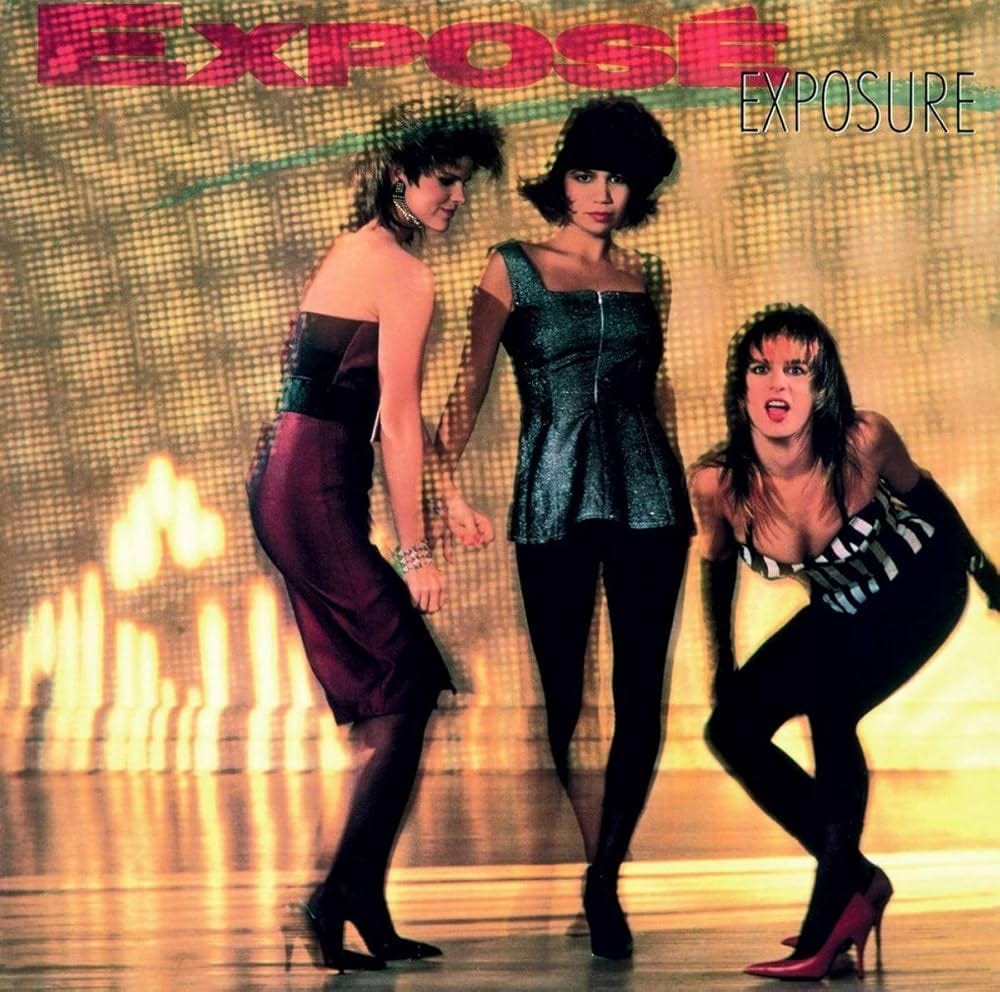
Some of you know me for Hell of a Hat, the newsletter I started in 2021 to promote my book Hell of a Hat: The Rise of ’90s Ska and Swing. This is something different. It’s a love letter to freestyle music, and if you’re not sure what that is, please check out the introductory article I published last year. This is the first installment of a three-part article about the girl groups of freestyle. Part 2 arrives in your inbox next week.
There’s no greater delivery system for pop music than the girl group. This was true in the early ’60s, when The Ronettes, The Marvelettes, The Supremes, and a zillion other beehived, chiffon-clad trios and quartets expressed teen longing as nobody had before, and it’s still true today, in the age of BLACKPINK, KATSEYE, and the smash 2025 Netflix movie KPop Demon Hunters, featuring the fictional HUNTR/X.
Girl groups function on many different levels. While they’re often staffed with extremely attractive young ladies who don’t exactly deflect the male gaze, they primarily appeal to female fans. For this audience, they’re both aspirational and relatable, projecting beauty and glamour but also singing about heartbreak and yearning and other emotions familiar to their target demo. Interestingly, a lot of girl group classics—including heavy-hitters like The Shirelles’ “Will You Love Me Tomorrow” (lyrics by Gerry Goffin)—were written by men. (Carole King composed the music for “Will You Love Me Tomorrow.”)
While the golden age of girl groups spanned the early to mid-’60s, every subsequent decade has built on the legacy. In the ’70s, there were The Pointer Sisters. In the ’90s, R&B groups like SWV, TLC, and En Vogue ruled the charts. The 2000s brought the commercial heyday of Destiny’s Child and Pussycat Dolls. The 2010s gave us Fifth Harmony and the rise of K-pop. But what about the ’80s, a time not typically associated with girl groups?
If you type “girl groups of the ’80s” into Google, the bullshit AI response that comes up before the actual search results mentions The Go-Go’s and The Bangles. As brilliant as they were, they represent something altogether different. The Go-Go’s and Bangles played their own instruments and wrote their own songs—rare in the world of traditional girl groups—and they spearheaded two rock ’n’ roll subgenres: pop-punk and Paisley Underground, respectively. For these reasons, they don’t quite count.
But the ’80s were a fertile period for old-school-style prefabricated girl groups, and several of the biggest were freestyle acts. Club music proved an especially good fit for the girl group formula, because a manager or producer could simply find or write a song, audition a bunch of pretty young hopefuls, and create a viable act from thin air. This model unfortunately resulted in a lot of groups afforded little control over their own careers, and to varying degrees, all three freestyle trios profiled in this article suffered at the hands of their makers.
The similarities don’t end there. All three started out very freestyle and veered more pop over time, and all three scored their biggest hits with gooey ballads. All three underwent lineup changes and petered out in the early-to-mid ’90s, only to reform in the 21st century with some degree of controversy.
Exposé
Exposé aren’t just the biggest freestyle girl group of all time. In 2017, Billboard ranked them No. 8 on its list of the Top 10 Girl Groups of All Time, and they definitely deserve that spot. Over the course of 10 years and three albums, Exposé notched a remarkable eight Top 10 singles on the Billboard Hot 100, America’s flagship pop chart. That includes 1987’s “Seasons Change,” which made it all the way to No. 1.
No fewer than seven women served significant time as members of Exposé, but the central figure in this story is songwriter, producer, and overall mastermind Lewis Martineé. Born Luis Martinez in Cuba, Martineé moved to California when he was 10 and became obsessed with music. He played drums and percussion in rock bands and eventually relocated to Florida, where he fell in love with dance music and started DJing. During his sets, Martineé would spice things up by adding live keyboards and electronic drum sounds to the records he was spinning. That led to local producers hiring him to mix their records.
Somewhere along the way, Martineé sold his drum kit and bought a then-cutting-edge Roland TR-808 drum machine, which he used to begin making his own records. He founded Pantera Records with business partners Frank Diaz and Ismael Garcia, and in 1983, the label released the synthed-out post-disco delight “Woman,” written and produced by Martineé and credited to the brilliantly named Techno-Lust.
Martineé and his associates held auditions for dancers to perform live with Techno-Lust, and among those who turned up was Laurie Miller, a singer, dancer, actress, choreographer, costume designer, and makeup artist who was destined for more than backup dancing. After Miller performed with Techno-Lust a handful of times and turned some heads in the process, Martineé invited her to be part of another musical project, a new girl group he was putting together.
Martineé had written a bunch of songs, and one of them, “Point of No Return”—a Miami take on the syncopated, synth-driven dance music spawned by Shannon’s “Let the Music Play” in 1983—seemed to excite everyone he played it for. He asked his girlfriend, Aléjandra Lorenzo, a.k.a. Alé, to sing a scratch vocal on the demo, and even though (or maybe because) she was an untrained vocalist, he dug how it sounded. For a while, he tried to find someone who sang like Lorenzo—until he realized he should just put her in the group.
The blueprint for this new ensemble was The Supremes—who would’ve been enjoying a popularity resurgence thanks to the 20-year nostalgia cycle—though Martineé had a slightly different vision. “I didn’t want one girl to sing and the other two to be backgrounds,” he told the podcast Choons. “I wanted each girl to have her own style.”
Rounding out the trio was Sandra Casañas, a.k.a. Sandée. Martineé initially wanted the group, which he called X-Posed, to have a ’40s aesthetic, complete with tight pencil skirts. As choreographer, Miller gave the girls a lot of arm movements to compensate for their lack of below-the-waist mobility, and she eventually changed the look to something sexier and more modern. Under Miller’s guidance, the trio opted for short, tight, neon outfits; teased-up hair; and heavy makeup with lots of sparkles.
At first, Miller wasn’t a proper member of X-Posed. There was another girl named Lori Creevay who rehearsed with the group but left before they made it anywhere. Miller eventually joined the lineup, and the trio recorded “Point of No Return,” an instant freestyle classic. Opening with a four-on-the-floor kick drum and a zigzagging synth lick, “Point of No Return” is clearly the work of a songwriter with experience playing in bands. Martineé is a master of layering textures and piling hooks on hooks on hooks. He withholds vocals until the 0:48 mark, and yet the extended intro never gets boring. Then Lorenzo pops in to deliver his semi-cryptic lyrics with guileless enthusiasm.
The common road
Seems just like a dream
It’s a mystery to me
Fills me within
When we’re together
Oh, baby, can’t you see?
“I just liked the title ‘Point Of No Return,’ so I decided to write a song around that,” Martineé told Songfacts in 2022. “Then I started coming up with the beats and the synthesizer lines and then both melody and words. I wrote that song so fast it was crazy, like, literally 15 minutes.”
The exact meaning of those words aren’t important. If profound heartbreak is the engine driving most great freestyle songs, “Point of No Return” exemplifies a subset of tunes on the polar opposite end of the spectrum. It draws power from the all-consuming joy of new love. “Point of No Return” is about losing yourself in the feelings you have for someone else. Martineé called the song “a little sexual” in a recent interview with the podcast 1980s Now, and there’s a tinge of danger in the chorus: “You’re taking me / To the point of no return.” There’s even a wailing guitar solo that you can imagine some long-haired metal dude ripping on a B.C. Rich.
Although it was essentially a demo, “Point of No Return” exploded onto the Miami club scene. One of Miller’s side gigs was singing in a local Top 40 cover band, and she performed “Point of No Return” with that outfit in the months after the song’s release. The song was so ubiquitous in South Florida that Arista Records A&R man David Jurman heard it repeatedly during a trip to visit his parents in Fort Lauderdale. Jurman later convinced legendary label boss Clive Davis to sign the record and give it a national push. Arista changed the group’s name from X-Posed to the tamer Exposé and put the label machinery behind “Point of No Return.” In April 1985, the single reached No. 1 on the Billboard Dance Club Songs chart.
Exposé followed “Point of No Return” a few months later with “Exposéd to Love,” an even better song built on similarly ecstatic energy. The track begins with a twinkling synthesized harp sound not unlike the groovy shimmer Fleetwood Mac would use on 1987’s “Everywhere,” and from there, it just gets hotter and stickier in the best possible ways. Lorenzo again handles lead vocals, and Miller adds lots of her signature “Ah!” exhortations, the audio equivalent of jazz hands. The theme is experiencing romance of unparalleled intensity. The chorus makes it sound almost like the ebola virus.
Exposéd to love (Oh, oh)
Never felt like this, no (Oh, oh)
(Melt you with my love)
“Exposéd to Love” reached No. 12 on the Dance Club Songs chart, and now that Exposé had proven itself with two hit singles—which the trio promoted tirelessly by singing over backing tracks in nightclubs across the country—Arista commissioned a full album. This is where the story gets complicated. By the time the LP hit shelves in March 1987, all three girls had been replaced in the lineup.
According to an anonymous source from Arista who spoke with the Los Angeles Times in 1987, the label fired the original members, deciding they had “the wrong look and little star potential.” Martineé maintains that’s not true. He told the podcast Choons that it was a “mutual thing,” and that all three ladies “were on board with changing the group.”
Miller’s story falls somewhere in between. She admits that Lorenzo left on her own accord, as she suffered from horrible stage fright and never really wanted to be an entertainer. Lorenzo even helped to choose her own replacement, Jeanette Jurado, whom she spotted singing with a Top 40 band in L.A. called New Breeze.
As for Casañas, Miller says she had “issues,” though out of respect for her former bandmate, who died in 2008 at the age of 46, she’s never said what they were. (Under the name Sandée, Casañas went on to release a handful of freestyle singles, including 1988’s excellent “Notice Me,” and the 1991 album Only Time Will Tell.) “[Casañas] was one of the reasons why Alé wanted to leave, and that’s why the whole thing started to fall apart, because Alé was not comfortable,” Miller told Choons.
Miller says Casañas was going to be fired from the group, but that Casañas had no idea her days were numbered. Although work had begun on the album, Casañas wasn’t invited into the studio. Meanwhile, Miller had broken up with her fiancé, Frank Diaz, Martineé’s business partner. Both of these volatile situations exploded one night at the Waterfront, a gay nightclub in Miami where Exposé were performing. As Miller recalls, Casañas confronted her about the studio sessions, and Diaz turned up drunk with a bunch of strippers and ruined everyone’s evening.
“I decided right then and there that if they weren’t telling Sandra anything, they could do the same thing to me,” Miller said. “I quit on stage that night. I just said, ‘I love you all. Let’s have a toast to this great music. It’s never going to be like this again.’”
Before then, Miller had planned on remaining in Exposé and singing with the two new girls. But on top of the drama with Casañas and Diaz, there were financial reasons to leave. The contract that Exposé’s management had offered Miller stipulated an extremely unfavorable 60-40 split. What’s more, Miller and her original bandmates had only been getting $100 per show, while their managers were apparently pocketing five times that amount. Although Miller had done more than anyone to shape the identity of Exposé, she felt the need to walk away.
Following her departure, Martineé finished building the second edition of Exposé. Alongside Jurado, an East L.A. native of Mexican descent, Martineé enlisted Gioia Bruno, who was born in Italy and raised in New Jersey, and Ann Curless, a University of Miami Frost School of Music graduate who’d started her career singing in cover bands. The new girls re-recorded vocals for most of the songs on the album, though Lorenzo and Miller can still be heard throughout. (None of the original singers are credited in the liner notes.)
Exposé Mk. II made its debut in early 1987 with “Come Go With Me,” a close cousin of “Point of No Return.” It’s a two-against-the-world freestyle love anthem with echoes of Latin brass in the synths and another monster guitar solo. Jurado’s narrator feels trapped in the boring 9-to-5 world, and she urges her lover to grab her hand and follow her someplace more exciting. As in most great freestyle songs, she longs to disappear “into the night,” that mystical place where there are DJs and smoke machines and anything is possible. The final chorus is among the purest expressions of freestyle’s central promise.
Come go with me (Oh-oh; into the night)
Have no fears (Into the night)
Two hearts in one
Eternal through the night (Hey, hey, hey, hey)
“Come Go With Me” reached No. 1 on the Billboard Dance Club Songs chart and No. 5 on the Hot 100. Exposé had gone from club act to pop crossover, and in March 1987, they finally released their debut album, Exposure. The next single, a re-release of “Point of No Return” with lead vocals from Jurado, matched “Come Go With Me,” hitting No. 1 on Dance Club Songs and No. 5 on the Hot 100. (The first 125,000 copies of Exposure featured the original version of “Point of No Return,” with Lorenzo’s vocals. All subsequent pressings had Jurado’s version.)
Exposé kept the hot streak going with the next single, “Let Me Be the One,” a slower, moodier variation on the themes outlined in “Point of No Return” and “Come Go With Me.” Gioia Bruno handles lead vocals and puts real muscle into her delivery. Practically a freestyle ballad, “Let Me Be the One” peaked at No. 2 on Dance Club Songs and became Exposé’s third consecutive Top 10 hit on the Hot 100, cresting at No. 7. These were impressive numbers, and Exposé still had one more blockbuster single in reserve.
Martineé calls “Seasons Change,” the sax-spritzed synth-ballad that went all the way to No. 1 on the Hot 100, his favorite song he’s ever written. He got the title from a Seagram’s billboard he spotted on I-95, and he turned that phrase into a rumination on love and growing old. When he played it for Clive Davis, the Arista boss knew right away it was a chart-topper. Indeed, there was already a precedent for freestyle groups scoring gigantic hits with emotional ballads. The previous year, Lisa Lisa & Cult Jam cracked the Top 10 for the first time with “All Cried Out,” and in the years ahead, at least two other freestyle acts—one of which we’ll meet later in this chapter—would conquer the Hot 100 with slow jams. “Seasons Change” was Exposé’s fourth Top 10 single off their debut album, a feat that no group—male or female—had ever accomplished.
It may have seemed like the three new Exposé girls waltzed into a perfect situation. But that wasn’t the case. On early tours, they played sweaty nightclubs where the original trio had performed, and some loyal fans heckled them, shouting, “You’re not Exposé!”
“Now that I look back on it, I’m glad it happened, because it made us much stronger, more determined to make the band successful,” Curless told The Morning Call in 1989. “Now, I think most of America doesn’t even remember that there were other girls in the group.”
As for those financial misdealings that Laurie Miller has alluded to, they didn’t go away when Exposé started earning real money. “Almost overnight we went from making $30 a show to having hit records,” Jurado said. “All of a sudden, we were thrown into a situation where we really needed a business manager. Not to belittle our production company, but Ann, Gioia and I learned that you have to watch every cent that comes in and comes out.”
Fortunately, around the time they released their sophomore album, 1989’s What You Don’t Know, Exposé renegotiated their contracts and were “very happy” with their situation. They didn’t fare as well creatively, though, as Martineé rejected six or seven songs the ladies had written and pitched for the album.
“If they write good material, definitely we’re gonna use it,” Martineé told Phoenix New Times in 1990. “If they don’t, then we won’t. I mean, we’re not gonna do it just to make them feel good. Obviously, they’ve gotta grow. They just started writing. I’ve been writing for fifteen, sixteen years.”
On What You Don’t Know, Martineé once again took the lead writing and producing, and he was ready to push further into the mainstream. There’s not a lot of freestyle on the album, but there’s plenty of expertly crafted dance-pop, emphasis on the pop.
For the propulsive title track, which was also the lead single, Martineé enlisted a live horn section to bolster the song’s sassy warning: “What you don’t know might hurt you.” Bruno takes the lead vocal and presumably sings to a lover who’s not treating her right. If this joker doesn’t give her what she needs, she’ll find it elsewhere.
“What You Don’t Know” hit No. 8 on the Hot 100, giving Exposé five straight Top 10 pop singles. They made it six with the silky love ballad “When I Looked at Him” (No. 10) and seven with “Tell Me Why” (No. 9), a New Jack Swing-style message song about gang violence. The LP’s fourth single, “Your Baby Never Looked Good in Blue,” a shameless power ballad written by Diane Warren, the Queen of Adult Contemporary, broke the streak, peaking at No. 17. The album itself only went gold, falling short of its predecessor’s platinum status. Nevertheless, Exposé had proven they could be more than a club act.
“We kind of wanted to go toward pop so we wouldn’t be mixed in with the disco-dance groups that are popping up all over the place,” Jurado told The Morning Call. “Once you hit the Top 40, the bookings come in and that’s when people pay to see you. Our roots are in dance music, but we know the success of the album lies on the pop charts.”
Exposé had the hits. The one thing they didn’t really have was personality. Speaking with Phoenix New Times while touring behind What You Don’t Know, Curless expressed disappointment that Exposé had never really differentiated itself from all the other female dance-pop trios active at the time.
“We really were never promoted as a group as strongly as we should have been,” Curless said. “So now, working on the image of the group is something we are constantly submerged in. We’re always trying to figure out the right angle: Is it clothes? Is it attitude? Is it interviews?”
Those answers were hard to find. To make matters worse, in the lead-up to Exposé’s self-titled 1992’s third album, Bruno was forced to leave the group after discovering a benign tumor on her vocal cord. She was replaced by Kelly Moneymaker, a singer of Samoan descent who grew up in Fairbanks, Alaska. By this time, freestyle had become old news. House was the style of dance music fueling crossover records, and that’s the sound heard on about half the album. The other half of the songs are Wilson Phillips-style adult-contemporary pop-rock ballads. Exposé was no closer to having an identity.
According to Martineé, Arista wanted “more diversity” in the material, so the label hired a bunch of outside songwriters. In the end, Martineé only penned three of the album’s 12 tunes. That’s one less than the number given to Diane Warren, whose contributions included the grocery-store-ready “I’ll Never Get Over You Getting Over Me,” the LP’s only single to make the Top 10 of the Hot 100. (It peaked at No. 8.) It was Exposé’s final Top 40 hit, and in 1995, after getting dropped by Arista, the trio called it quits.
The Moneymaker lineup briefly reunited in 2003, and then in 2006, the “original” trio—Jurado, Curless, and Bruno—got back together and started doing shows. There was a legal battle over the Exposé name, and in 2009, the ladies emerged victorious. Nearly two decades later, Exposé is still going strong. Sometimes they play freestyle nostalgia gigs, where they might only get 15 minutes to breeze through “Point of No Return,” “Come Go With Me,” and a couple others, and sometimes they play full-length standalone concerts, with a live band, for fans of their entire catalog.
The second-gen Exposé ladies have been through a lot, and when they meet up for these brief tours—“girls weekends,” as they call them—it’s about more than just making money. “We’re leaving home, but no matter where we are, when the three of us get together, we’re kind of coming home, as well,” Jurado said.
As for Martineé, he’s still making music, and he’s got a resume that extends well beyond Exposé. He’s worked with the likes of Debbie Gibson, Ricky Martin, Dead or Alive, Jermaine Jackson, and Pet Shop Boys, with whom he collaborated on the 1988 freestyle-influenced synth-pop masterwork “Domino Dancing.”
He’s also responsible for at least one more Miami freestyle girl group, the duo Sequal, whose very name indicates they were meant to be a sequel to Exposé. Sequal didn’t come anywhere near replicating Exposé’s chart success, but they released one self-titled album and left behind a smattering of freestyle gems, including “It’s Not Too Late” and “I’m Over You.”
In an unexpected twist, Martineé reconnected with Laurie Miller in the 2020s and started a new female vocal trio called O-baby. (Miller, it should be noted, released a pair of tasty solo singles in the ’80s and sang on Will to Power’s 1988 freestyle totem “Dreamin’.”) O-baby dress and dance like early Exposé. It seems there’s no lingering hostility between Miller and Martineé.
“We’re remixing and redoing all of our big hits, saluting the original concept of [Exposé] with the look and the choreography and the makeup,” Miller told the podcast DND Dynamite 80s. “Because I think people want to go back in time and relive that and that music.”
Watch out for part 2 next week!
No posts
Comments
Nothing yet. Say the first thing.
Sign in to join the conversation.