
The Finding America series explores the nation’s first 250 years through individual lives – ordinary people who lived close to history as it unfolded. These stories are grounded in records, memory, and place, and focus on how Americans lived while those historic decisions were being made. Together, they trace the slow, human work of building a nation – day by day, household by household, life by life. Visit the archives to read the entire series.
| Part 1 of 1|
Release Date: July 7, 2026
“The moment I heard of America I lov’d her; the moment I knew she was fighting for freedom I burnt with a desire of bleeding for her; and the moment I shall be able to serve her, at any time, or in any part of the world, will be the happiest of my life.” 1
Gilbert du Motier was nineteen years old when he wrote that. Not in a diary, not in a private letter to a friend – in an official communication toHenry Laurens, President of the Continental Congress, in 1778. It reads like something a young man would write in the dark and never show anyone. The fact that he sent it tells everything about who the Marquis de Lafayette was.
He’d already acted on it, of course. A year earlier, in the spring of 1777, Lafayette had crossed the Atlantic at his own expense, presented himself to Congress in a language he could barely speak, and asked for a commission in a war not his own. He was a French aristocrat of immense wealth and impeccable connections, with a young wife at home and every comfort Europe could offer. None of it was enough to keep him there. The American cause called to something in him that rank and fortune couldn’t answer, and so Lafayette came.
Please hit the ❤️ button at the bottom of the page to help this story reach more readers. And if you’re not already a subscriber, I’d love to have you join me. Thanks!
George Washington wasn’t impressed.
He’d seen too many foreign volunteers arrive with grand titles, elaborate credentials, and limited usefulness. When Lafayette was introduced to him at a dinner party in Philadelphia on July 1, 1777, Washington was forty-five years old, commanding a revolution on a shoestring, and in no particular need of another enthusiastic young officer who’d never seen battle. The young Frenchman was tall – a strapping six feet one – and his enthusiasm was evident. His English was not.
Washington gave him a chance anyway. Within weeks he’d understand why.
At the Battle of Brandywine in September 1777, Lafayette took a musket ball to the leg and kept fighting. At Valley Forge that winter, he suffered alongside Washington and his men through the cold and the hunger and the doubt, and remained intensely loyal when others were not. He spent nearly two hundred thousand dollars of his own fortune outfitting his troops with uniforms and supplies. And he wrote ceaselessly to French political figures, describing the American cause, lobbying for support that would prove essential to the revolution’s survival.
He named his son George Washington Lafayette.
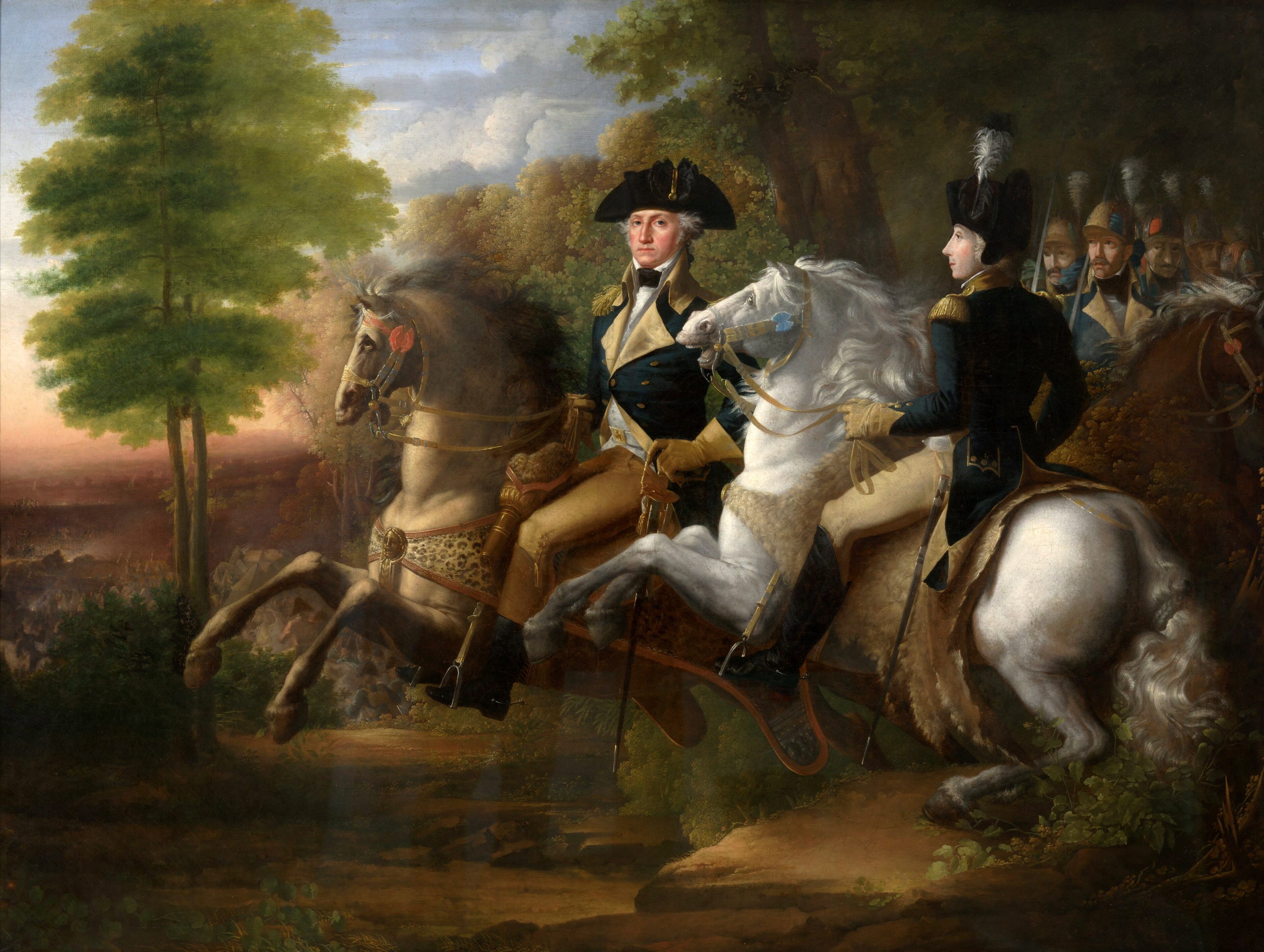
For his part, Washington, came to regard the young marquis as the son he never had. The portrait of Lafayette hung at Mount Vernon alongside Washington’s own, was painted by the same artist in nearly identical poses, as if the two men had agreed that posterity should see them together.
Their friendship had no precedent and needed no explanation. It was simply one of those bonds that forms in the crucible of shared adversity and can’t afterward be dissolved by distance or time.
Get your copy of The Century Safe Method and start building your Bridge to 2076 today. Also now available for Kindle!
Somewhere in 1778, at the height of the Revolutionary War, Lafayette gave Washington a pair of pistols.
They were French-made, produced by a gunsmith named Jacob Walster in the city of Saarbruck – saddle pistols, designed to be carried on horseback in holsters at the pommel, beautiful and functional in equal measure. Walnut-stocked, seventeen and a half inches long, finished in polished steel with rococo carvings and inlays of gold and silver. Lafayette had almost certainly purchased them before leaving France, probably while stationed in Metz, fifty miles from Saarbruck. They were among the finest arms a man of his means could own. 2
But Lafayette didn’t keep them. He gave them to his friend Washington. No ceremony is recorded. No speech survives. Just the pistols, passing from one soldier’s hands to another’s, carrying with them the weight of everything the two had been through together.
Washington carried the Lafayette pistols at Monmouth and Yorktown. He carried them later, during the Whiskey Rebellion, when he was president and the republic he’d helped found was still fragile enough to require a general’s presence on the road.
When Washington wrote to Lafayette at the end of the war – I owe it to your friendship and to my affectionate regard for you, my dear Marquis, not to let you leave this country without carrying with you fresh marks of my attachment to you – the pistols were already part of the story between them, already a thread in the bond Lafayette would describe in his own farewell: my love, respect, my gratitude for you are above expression; that at the moment of leaving you I felt more than ever the strength of those friendly ties that forever bind me to you. 3
The two men would never see each other again. Washington died in December 1799 while Lafayette was back home in France, having recently been released from prison. The pistols passed to Washington’s nephew, William Augustine Washington, and from him to his son-in-law, William Robinson of Sudley, Virginia. For twenty-five years they were held by people who understood what they were, waiting for the right hands to receive them next.
The right hands presented themselves on January 8, 1824.
The date wasn’t chosen casually. It was the ninth anniversary of the Battle of New Orleans – the engagement that had made Andrew Jackson the most celebrated military figure in America since Washington himself. Jackson was in Washington as a newly elected senator from Tennessee, guest of honor at a ball hosted by Secretary of State John Quincy Adams, when two members of the House of Representatives arrived at his quarters earlier in the day with a gift from William Robinson.
Congressman Charles Fenton Mercer of Virginia laid the case on the table and made the meaning explicit. These were the arms Washington had worn through the ups and downs of the Revolution, he told Jackson. They were the gift of Lafayette – the steadiest friend of Liberty in the Old World – to the most brilliant and extraordinary champion in the New. And now, on this day of all days, they were being placed in the hands of Washington’s rightful military successor.
Jackson understood precisely what was happening. He was in the middle of a presidential campaign – the 1824 election would prove one of the most contested in American history, ultimately decided by the House of Representatives in favor of John Quincy Adams in what Jackson’s supporters called the Corrupt Bargain.
The presentation of Washington’s pistols, on the anniversary of New Orleans, covered by newspapers across the country, was as much political theater as personal honor. Nobody in the room was pretending otherwise.
But Jackson’s written reply to Robinson cut beneath the theater to something genuine:
I shall keep them Sir, feelingly impressed with a remembrance of their peculiar history; and of the kindness of yourself expressed towards me in their presentation...they derive additional value & merit to be considered sacred & holy relics. 4
Sacred and holy relics. He meant it. And he kept them.
Sixteen months later, Lafayette came to Tennessee.
He was on the grandest tour America had ever staged for a foreign visitor – thirteen months, all twenty-four states, six thousand miles, crowds of fifty thousand in the cities and ten thousand in the small towns. Veterans from the Revolution lined the roads in ill-fitting old uniforms to shake his hand. In Boston alone, two hundred thousand people packed the streets. He was sixty-seven years old, and the country was giving him everything it had.
In May of 1825, the tour brought him to Nashville, and from Nashville to the Hermitage – Andrew Jackson’s plantation home outside the city. Auguste Levasseur, Lafayette’s secretary and the eyewitness whose account survived, noted the fine cultivation of Jackson’s farm, the order and neatness of the property, and with characteristic candor the shadow of slavery that lay over it. Then the party returned to the house.
Some friends of Jackson’s, Levasseur wrote, asked the general to show them the arms presented to him in honor of his achievements. Jackson obliged with great politeness, and placed on a table a sword presented by Congress, a sabre from the army at New Orleans – and a pair of pistols.
It was to the pistols that General Jackson wished more particularly to draw our attention.
He handed them to Lafayette and asked if he recognized them.
The latter, after examining them attentively for a few minutes, replied that he fully recollected them, to be a pair he had presented in 1778 to his paternal friend Washington, and that he experienced a real satisfaction in finding them in the hands of one so worthy of possessing them.
Lafayette had given those pistols to Washington forty-seven years before. He’d been just nineteen years old. Washington had been alive. The Revolution had still been in doubt. Now Washington was twenty-five years in the ground, and here were the pistols, in a Tennessee parlor, in the hands of the man who’d so gallantly defended the republic Washington had built.
At these words the face of old Hickory was covered with a modest blush, and his eye sparkled as in a day of victory. “Yes! I believe myself worthy of them,” exclaimed he, in pressing the pistols and Lafayette’s hands to his breast; “if not from what I have done, at least for what I wished to do for my country.” 5
All the bystanders applauded. Levasseur, who’d witnessed Lafayette received by hundreds of thousands of Americans over thirteen months of triumph, recorded it simply: they were convinced that the weapons of Washington could not be in better hands than those of Jackson.
Jackson kept that conviction to the end. When he died in 1845, his will bequeathed the pistols to Lafayette’s son – George Washington Lafayette, the man who bore Washington’s own name, who’d lived at Mount Vernon as a boy and stood in the Hermitage parlor the day his father held them again.
Jackson’s will language named every hand the pistols had passed through, an unbroken line of history:
the pistols of Genl Lafayette which were presented by him to Genl. George Washington, and by Col Wm Robinson presented to me...to George Washington Lafayette as a memento of the illustrious personages thro whose hands they have passed, his Father, and the Father of his country. 6
In 2002, the Washington pistols were purchased at auction by a Pennsylvania foundation, which donated them to Fort Ligonier – built in 1758, the year Washington first visited it as a young officer during the French and Indian War, the conflict that first made his name. They’re on permanent display as part of the Washington Collection at Fort Ligonier.
Copyright 2026 Lori Olson White
| Part 1 of 1 |
The Story Catalog is not an archive in the usual sense. What you’ll find here is a living catalog of Lost & Found Stories – deeply researched historical narratives told in parts, discovered through newspapers, letters, court records, logs, and the stubborn human habit of leaving traces behind.
Have you read the incredible true story of Aimee Henry and Mary Martha Parker? Call Me a Bastard is my longest serialized story to-date, and the one that started it all here on the Lost & Found Story Box. Check out the story from the beginning.
The Lost & Found Story Box is reader-supported. When you buy through links on our site, we may earn an affiliate commission.
End Notes
1 Marie-Joseph-Paul-Yves-Roch-Gilbert du Montier, Marquis de Lafayette, Memoirs of General Lafayette with an Account of His Visit to America, and of his Reception by the People of the United States; From his Arrival, August 5th, to the Celebration at Yorktown, October. 19th, 1824, Boston, MA.
2 Philip Schreier, Senior Curator, National Firearms Museum, The Lafayette/Washington Pistols, American Rifleman, May 28, 2018,
3 Marie-Joseph-Paul-Yves-Roch-Gilbert du Montier, Marquis de Lafayette, Memoirs of General Lafayette with an Account of His Visit to America, and of his Reception by the People of the United States; From his Arrival, August 5th, to the Celebration at Yorktown, October. 19th, 1824, Boston, MA.
4 “The Evening Post,” New York, NY, January 14, 1824, P. 2.
5 Auguste Levasseur, Lafayette in America in 1824 and 1825 (Vol 2, Chapter X), Philadelphia, Carey and Lea, 1829.
6 Andrew Jackson’s Last Will and Testament, Andrew Jackson Collection, Tennessee Virtual Archive (https://teva.contentdm.oclc.org/digital/collection/p15138coll33/id/108/)
Comments
Nothing yet. Say the first thing.
Sign in to join the conversation.