
| Part 1 of 1 |
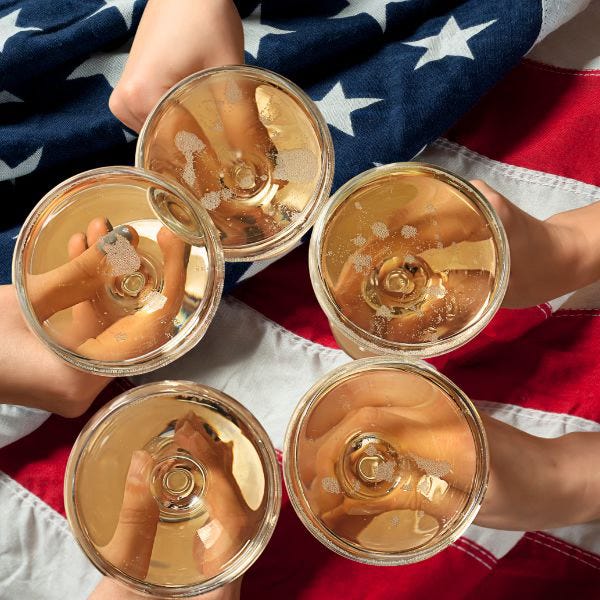
Release Date: July 4, 2026
Seven men spent part of their Fourth of July carrying notes across Lancaster, Pennsylvania.
Not love letters. Not official dispatches. Toasts.
On July 4, 1830, two separate groups had gathered to celebrate the fifty-fourth anniversary of American independence – the Democratic Republican Citizens of Lancaster at Columbia Garden, and the City Battalion Volunteers at the White House at Mr. Reigart’s Landing. Both events had opened with a fine dinner. Then the tables had been cleared and the Declaration of Independence read aloud to applause. Only then did attendees settle in for the real business of the day.
The toasts.
What followed filled an entire page of the next week’s Lancaster Intelligencer– presumably, as the editors noted, for those whose invitations had been lost in the mail. 1
If you’ve never encountered the formal toast traditions of early America, you’ve missed one of the truly great lost rituals of democratic life. It wasn’t casual. It wasn’t spontaneous. It was, in instead, a meaning-laden act of public transparency. And it was of great significance.
The details of the tradition went back to the Revolution itself. After independence, no patriotic gathering was complete without thirteen toasts – one for each of the original states. For decades after the war ended, those thirteen were essentially obligatory. The toastmaster, a role created specifically for the purpose, was a sober referee whose job it was to ensure that everyone who wanted to speak got their chance and that the evening didn’t dissolve into chaos before the newspaper got its copy.
The structure was codified. First came the Regular Toasts – numbered, unattributed, prepared in advance by a committee that had debated and revised each sentiment until the group could stand behind it unanimously. These were the liturgy. Consensus in public form.
Then came the Volunteer Toasts – where individuals rose, gave their names, and offered their own sentiments for the record. These were the congregation speaking back.
Every word went in the newspaper. Every name was on the record. If you raised your glass to a sentiment, everyone in town would know about it by Tuesday.
The Regular Toasts on July 4, 1830 followed the standard order. The day itself. The President. The Governor. Then, as in every such gathering across the country:
The memory of George Washington. Every effort of his life was directed to the establishment of free and equal rights, his fame will be treasured up as the proudest monument of his country’s glory. Drank standing.
Standing in silence. That was the protocol for Washington. Not nine cheers, not six – standing in silence. The man who’d been offered a crown and handed back a republic deserved a different kind of acknowledgment than applause.
Toast Nine that year was to Charles Carroll of Carrollton – then ninety-three years old, the last living signer of the Declaration of Independence. The Lancaster political group raised their glasses to him:
In the darkness of our adversity he pledged “his name, his fortune, and his sacred honor” for his country, in the light of our prosperity, let him be remembered with reverence and gratitude. 9 cheers.
Carroll would be dead within two years. The men in that room knew they were toasting a disappearing thread.
But the Regular Toasts weren’t all reverence. Toast Eleven inside Columbia Garden was a broadside:
Anti-masonry. Anti-Republican in its doctrines, selfish in its objectives, and proscriptive and persecuting in its character; it is designed as a political sword in the hands of a few aspiring demagogues and broken-down politicians.
The committee used one of their thirteen sacred slots – the liturgy, the consensus portion of the evening – to torch a political movement by name. In 1830, Anti-Masonry was a genuine third-party force threatening to split the First Party System coalition, and these men were not going to let the anniversary of independence pass without saying so publicly, collectively, and for the record. That was just one. There were six Anti-Masonry toasts across the evening between the two sets of toasts.
The final toast, Toast 13, was always a nod to the ladies, and usually poetic in form.
The Fair sex – May the sunshine of love illuminate their youth, And the moonlight of friendship consoled their decline.
The Volunteer Toasts showed the full range of what a man might choose to put his name to.
Dr. William B. Fahnestock over at the White House at Reiger’s Landing offered this, on liberty:
A steel-bound cord encircling the bourn of our country. Touch it, and eleven millions of free hearts will vibrate at the speed of lightning.
William D. Demuth, also of the City Battalion, offered something rather different:
The City Battalion of Volunteers. May they stick together as long as they have a button on their coats, and when they drop off, may they have the means to buy new ones.
The Volunteer Toasts raised by the Battalion told you who they were without anyone having to say so directly. They toasted former commanders by name. They toasted the defenders of Baltimore in 1814, the crew of the USS Hornet, the volunteers of specific engagements. They toasted the butchers who fed them, the farmers of Lancaster County, the mechanics of the city. These were men naming their own world, their own people, their own occupations – putting them in the newspaper with the same gravity they gave to Washington and Jefferson and Liberty.
H. Waltz, of the Battalion, raised his glass to “Lafayette – who clothed our naked troops and covered their bare feet in the dark days of ‘76.” A practical toast, from a practical man, for a practical act of friendship.
Please hit the ❤️ button at the bottom of the page to help this story reach more readers. And if you’re not already a subscriber, I’d love to have you join me. Thanks!
And then there were those seven men.
At some point during the Columbia Garden celebration, the Democratic Republican Citizens composed a toast specifically for the City Battalion across town – not a general toast to civic virtue, not a toast to the militia broadly, but a named, targeted acknowledgment of their neighbors:
To the City Battalion – in peace useful and patriotic – in war, should their country call, they would assert her rights with their blood.
Three men – Nathaniel Lightner, James Humes, and Henry Eichholz – were appointed by committee to carry it.
Think about what that means physically. Three men, in their Fourth of July best, walking across Lancaster with a written toast, delivering it formally to another group’s celebration, waiting while it was read aloud and drunk with approbation and applause.
Then four other men – Lieut. Reigart, Cyrus S. Jacobs, Samuel R. Slaymaker, and Bates Fordney – were appointed to carry over the Battalion’s reply:
To our fellow citizens celebrating this day at the Columbia Garden – Their kindly feelings toward the Battalion of Lancaster Volunteers and their known integrity of character convince us that what they do will be patriotic.
Seven men. Two toasts. One summer afternoon in Lancaster. Seven names among the multitudes in the newspaper the following week, attached to two sentences of mutual civic regard, delivered in person across whatever distance separated the two celebrations — because a sentiment wasn’t real until someone carried it and someone received it and the world heard about it.
We still do this, of course.
We share a photo of the flag on the Fourth of July. We post a viral video. We retweet or add a heart to the thing that signals what we believe so our people will know where we stand.
But I think something important has been lost.
In Lancaster in 1830, whether you wanted to torch the Anti-Masonry movement as a tool of aspiring demagogues or honor the farmers, butchers and mechanics of your city, your name and reputation were attached to that sentiment.
If you believed the sitting president was the savior of the republic or that temperance was the foundation of good government, the accumulated trust, credibility, and goodwill you held was attached to that, too, and everyone in your community – your family members, friends and neighbors, the people you did business with and those who just saw you on the street – knew by the next morning exactly where you stood. Who you were.
If you stood with them, against them, in the middle or simply to the side.
William D. Demuth made his joke about buttons and coats. Dr. Fahnestock offered his steel-bound cord. H. Waltz remembered Lafayette’s practical generosity to freezing soldiers. Every man in that room who had something to say proudly put his name on it for posterity.
Nearly two centuries later, we’ve traded that public accountability for the avatar, the screen name, the comment section, the anonymous post. The balaclava. We say things now, in public and online – vile and hate-filled things about our neighbors, our leaders, our country and the people we disagree with – that we’d never want our names, faces and futures attached to for a hundred years hence.
That’s what’s been lost. Not the ritual of offering toasts, but the public accountability and civility those toasts represented and, perhaps, demanded.
I for one, mourn the loss.
In that spirit – and because I think two hundred and fifty years of independence deserves a traditional celebration – here are some toasts I’d propose for the Fourth of July, 2026, offered in the tradition of the Democratic-Republican Citizens of Lancaster and the City Battalion Volunteers.
And yes, I’m happy to attach my name to them all.
The Constitution of the United States. Battered, borrowed, and occasionally bewildering – but still holding strong, which is more than its critics and its champions alike have deserved.
Drank standing.
The study of history. It reminds us that in signing the Declaration of Independence, the founding fathers bet their very lives on what they knew was a grand experiment, and they proceeded anyway. May their courage be our own.
Drank with gratitude and moderate relief.
The American farmer and rancher, the blue collar worker, and the small business owner. They were the backbone of the republic in 1776, in 1830, and in 2026. The professional speechmakers and talking heads have often faltered. They have not.
9 cheers.
The ancestors who came to this country and counted the days until they could proudly call themselves Americans. They changed the course of everything that followed by choosing to be here completely and wholly, no hyphen required.
9 cheers.
The warfighters and protectors who carry the cost of our freedom in their bodies, and their families who carry it in their hearts – their sacrifices too often go unrecognized and we should say their names out loud more than we do.
9 cheers.
The neighbor across the street whose yard sign or Christmas display or general demeanor you despise. In 1830, Lancaster raised a glass to their fellow citizens of known integrity and character regardless of political affiliation. We might try doing the same.
Drank in hopeful silence.
The memory of the last living person who remembers what it felt like when this country could debate with civility. May both the memory and practice be revived.
Drank in silence.
Infrastructure. Roads, bridges, the electrical grid, rural broadband, water treatment facilities and levee systems nobody thinks about until they stop working. The unglamorous covenant between a government and the folks who foot the bill.
6 cheers.
The enemies of our nation and those who stand with them – may the house of your father be ruined and your history damned.
With feeling.
The grandparents whose homes were our happy places, whose influence outlasted their lives, and whose love we didn’t fully understand until we became them. May we be for our grandchildren what was given to us.
Drank standing with a tissue.
The American Fair, the American Gentleman, and everyone else who shows up, does the work, raises the children, buries the parents, casts the vote, passes on the stories and is going to watch the fireworks tonight with a little lump in their throat that they’d never admit to in public. It’s gonna be okay.
9 cheers.
Happy Fourth of July, and God bless America.
Put your name on something today.
— Lori Olson White
Copyright 2026 Lori Olson White
| Part 1 of 1 |
The Story Catalog is not an archive in the usual sense. What you’ll find here is a living catalog of Lost & Found Stories – deeply researched historical narratives told in parts, discovered through newspapers, letters, court records, logs, and the stubborn human habit of leaving traces behind.
Have you read the incredible true story of Aimee Henry and Mary Martha Parker? Call Me a Bastard is my longest serialized story to-date, and the one that started it all here on the Lost & Found Story Box. Check out the story from the beginning.
The Lost & Found Story Box is reader-supported. When you buy through links on our site, we may earn an affiliate commission.
End Notes
1 “Celebrations of the Fourth of July,” Lancaster Intelligencer, Lancaster, PA, July 9, 1830, P. 2
Comments
Nothing yet. Say the first thing.
Sign in to join the conversation.