
The Finding America series explores the nation’s first 250 years through individual lives – ordinary people who lived close to history as it unfolded. These stories are grounded in records, memory, and place, and focus on how Americans lived while those historic decisions were being made. Together, they trace the slow, human work of building a nation – day by day, household by household, life by life. Visit the archives to read the entire series.
| Part 1 of 1|
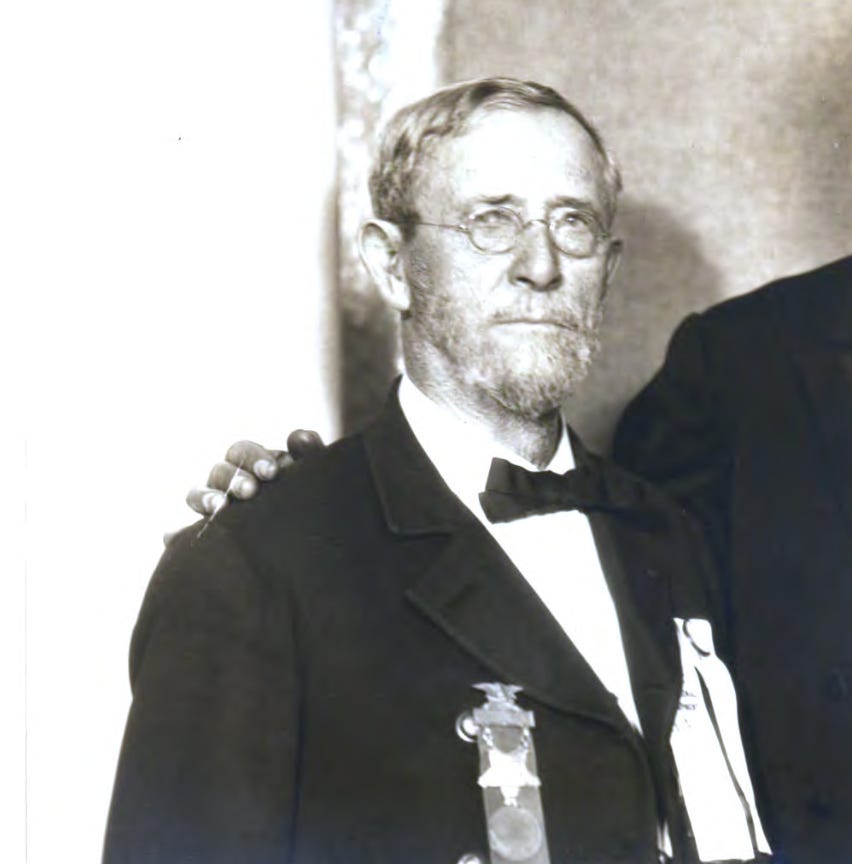
Release Date: July 28, 2026
In February of 1861, a young man named Smith Stimmel stood in a crowd at a Columbus, Ohio train station, waiting for President-elect Abraham Lincoln’s train to arrive.
He’d edged his way through the crowd deliberately, having heard someone say Lincoln would likely appear at the rear of the last car. When the train pulled in, Smith was within a few feet of it. Lincoln appeared on the platform – at 6’4” he towered head and shoulders above the reception committee – and the crowd erupted. Then, boylike, as Smith would later write, he worked his way to the head of the procession so he could follow every step of the way and get as close to the speaker’s stand as possible.
He heard Lincoln say something he never forgot:
“I hope that if my worthy competitor, Judge Douglas, had been elected and were here in my place at this time, you would be extending to him the same cordial greeting you are now giving me.” 1
Smith was eighteen years old. He’d never heard a powerful man say anything like it before.
“Boy as I was,” he wrote, “when I heard those generous words fall from his lips, my stock in Abraham Lincoln, already at high estimate, went up about 500 per cent.” 2
Smith would spend the next three-quarters of a century paying that stock forward.
Please hit the ❤️ button at the bottom of the page to help this story reach more readers. And if you’re not already a subscriber, I’d love to have you join me. Thanks!
Two years later, in the summer of 1863, Smith was at home on his family’s farm near Columbus when a circular letter from Governor David Tod arrived through the military committee of his county. The governor was looking for men for “highly honorable and strictly confidential service” – one from each county in Ohio – but the letter didn’t specify what that service would be. 3
Smith had already served a three-month enlistment in the 85th Ohio Volunteer Infantry by then, the 98-pound boy having talked his way past a skeptical recruiting officer the year before. And he was willing to serve again. A neighbor on the military committee gave him a letter of recommendation. He boldly presented it to the governor in person and was accepted.
When the organization was complete, the chosen one hundred were supplied with black horses and sent to Washington. Only then did they learn their assignment. Governor Tod named the company the Union Light Guard. Their duties, Smith wrote, were “to guard the front entrance to the White House grounds, and to act as an escort to the President, whenever he went out in his carriage or on horseback.”
In other words, to be bodyguards.
The boy who’d worked his way to the front of a crowd in Columbus to hear every word would soon be stationed at the front door of the White House.
What Smith Stimmel saw during the next two years wasn’t the Abraham Lincoln of the speeches and state papers. It was the other one – the Lincoln that only the people in his daily orbit ever knew. The young Ohioan paid attention, as he always had, and he remembered everything.
He noticed the hat first.
Lincoln wore an old-fashioned stovepipe silk hat that had clearly seen considerable service. It had several dents in it, and the fur was almost always rubbed the wrong way. Smith wondered about this until one evening, escorting the President out to his summer quarters at the Soldiers’ Home north of the city, they passed an army officer on horseback in full dress uniform – bright coat, sash, shining belt, gold cord on his hat, his horse fully trappings. The officer recognized Lincoln and raised his hat “with all the grace and dignity of a trained military man.”
Lincoln was busy reading papers and almost missed the salute entirely. When he looked up and saw the lifted hat:
“He immediately threw up his long arm and knocked off his tall hat, and then tumbled it back on his head and brought his big hand down on the crown to press it firmly in place. That was his return salute, and it was easy to see what had rubbed the fur on that hat the wrong way.”
Smith added, carefully:
“I don’t wish to give the impression that President Lincoln always saluted in this way. That was merely a hurry-up salute. It was his business to get his hat off quickly, and the quickest way he could do it was to knock it off.” 4
On another morning, coming in from the Soldiers’ Home, Lincoln and the lieutenant in command of the escort were riding side by side when the President suddenly turned his horse and cantered off toward a field where several cows were grazing. The escort followed, puzzled, as Lincoln rode in among the cows and pointed at one of them with his long bony finger, telling the lieutenant: “You see, just as I told you.”
The conversation, it emerged, had turned on whether one side of a cow was higher than the other. Lincoln had asserted that it was; the lieutenant had disagreed; and when Lincoln spotted the cows on the commons, he’d simply redirected the morning to settle the matter. Having convinced the lieutenant he was right, he wheeled his horse and cantered back toward the White House.
Smith thought it strange, at the time, that the President of the United States – with a gigantic war on his hands, with dispatches and cabinet consultations and the movements of armies to manage – would divert the morning to prove a point about a cow to an insignificant lieutenant. “But in later years,” he wrote, “I came to recognize that very common-place element in his make-up as a mark of his greatness.” Lincoln needed diversion. He knew himself well enough to take it where he found it. 5
The same quality appeared the night the White House stable caught fire. Smith was on duty at the front door when he heard the alarm. He located the flicker of light to the east and south, decided the fire department could handle it better than he could, and stayed at his post.
“Just then the front door of the White House flew open with a jerk, and out came the President, buttoning his coat around him.”
Lincoln asked where the fire was. Smith told him it seemed to be near the stable. “With that he started off on a dog trot down the steps,” Smith wrote, “and I followed him on the double quick, finding it difficult to keep close to him with his long strides that kept me on the dead run.” 6
At the stable, Lincoln learned that the horses had not been taken out. He rushed through the crowd and began to break open one of the large doors with his bare hands. The building was already full of fire. Nothing could be saved – not the horses, not the ponies belonging to Lincoln’s sons, not the goats. A dignified stranger took Lincoln by the arm and walked him back to the White House.
Later, Smith learned why Lincoln had seemed so particularly grieved. One of the ponies had belonged to his son Willie, who had died at the White House the year before. The loss of the pony brought the loss of the boy back.
“I was told he even wept when the loss of Willie’s favorite pony was reported to him. No man was ever more devoted to his family than was President Lincoln.” 7
There were larger moments too. On the afternoon of July 12, 1864, Smith rode with the escort to Fort Stevens, one of the earthwork defenses north of Washington, where Confederate General Jubal Early’s forces had been probing the city’s thin defenses. Lincoln arrived before the full strength of Grant’s reinforcements had come up, left his carriage, and took a position behind the earthworks. Then, unable to see well enough, he climbed up on top of the low protecting wall – a conspicuous figure in his tall hat, in plain view of Confederate sharpshooters across the valley.
The fort’s commander asked him to come down. Lincoln refused. The commander threatened to send a file of men to bring him down by force. Lincoln laughed and climbed off the wall. “He did not resent the officer’s command, “Smith wrote, “but acted more as if he were embarrassed at doing something not militarily proper.” 8
A short time later, an officer standing near Lincoln inside the fort was severely wounded by a sharpshooter’s bullet.
Eight months after Fort Stevens, on the morning of March 4, 1865, Smith sat on his black mare a few yards from the east front of the Capitol as Lincoln delivered his second inaugural address. The morning had been rainy and dark. Just before Lincoln began to speak, the clouds cleared and the sun came out. “His clear, strong tenor voice rang over that vast assemblage,” Smith wrote, “so clearly that he could be heard distinctly to the outer limits of the crowd.” 9
When Lincoln reached the passage about the war continuing until every drop of blood drawn by the lash was paid by another drawn by the sword, Smith could see men around him exchanging side glances and approving nods, and heard in suppressed tones: “That’s the stuff! That’s the stuff!” 10
Afterward, as the procession moved up Pennsylvania Avenue, someone in the crowd pointed toward the south. There, in the afternoon sky, was the planet Venus, visible in broad daylight.
“The superstitious had many strange notions about it, but of course it was simply owing to the peculiarly clear condition of the atmosphere and the favorable position of the planet at that time.” 11
Even in the grandest moments, Smith kept his feet on the ground. It was one of the things that made him a reliable witness.
The fourteenth day of April 1865 was warm, calm and beautiful. “All nature,” Smith wrote, “seemed to bask in the warm sunlight of assured peace.”
The war was effectively over. General Robert E. Lee had surrendered five days earlier. The city had spent three days and nights in celebration – bands playing, guns booming from the forts, crowds gathering at the White House to hear Lincoln speak. The guard retired early on the night of the fourteenth, tired, and Smith fell into a sound sleep.
Then he heard his name.
Someone was calling from outside the building. He put his head out the window. A man from his company – he recognized the voice – called up hastily: “Lincoln and Seward have been killed.” Then he turned and ran off down the street.
“If I had been struck a stunning blow in the face, I could not have been more dazed than I was for a moment on receiving that announcement.”
The men dressed in the dark without speaking. They saddled their horses in less time than it seemed possible. “As we saddled our horses not much was said by anyone,” Smith wrote. “It was too horrible to talk about.” 12
They rode first to the White House – quiet. A policeman on Pennsylvania Avenue redirected them to Ford’s Theatre. The street in front was blocked by a crowd. They were ordered to clear it, and they did, drawing sabers and pressing the stunned people back. The President had been carried across the street to a private house. The guard took up its position.
“All night I rode slowly up and down the street in front of that house. Sometimes it seemed to me like an awful nightmare, and that I must be dreaming; sometimes I would pinch myself and wonder if I was really awake and on duty, so hard was it for me to realize the fact that President Lincoln was lying in that house in a dying condition.” 13
They were relieved at seven in the morning. Twenty minutes later, America’s 16th president, the Great Emancipator, was dead.
The next day, one of Smith’s comrades was riding down the street when he encountered a stranger – a cavalryman from another troop – who was weeping. They stopped and exchanged a few words about Lincoln’s death. The stranger said: “It probably means more to me than it does to you; he signed an order that saved me from being shot.” 14
That was the Lincoln Smith had been guarding. That was who the world had lost.
Smith went back to Ohio Wesleyan. He read law. He practiced in Cincinnati and moved to Fargo, Dakota Territory in 1882, building a legal career and a political reputation in a territory that was still becoming a state and still seen as the “Gateway to the West.” In 1888 he was elected president of the Territorial Council of both Dakotas – the last man to hold that office before North and South Dakota were admitted to the Union. He practiced law for forty years, retiring in 1921.
The first serious attempt to bring the surviving members of the Union Light Guard together had been made in Cincinnati in 1898, when ten men gathered during the national GAR encampment. They made no formal organization. No record was kept. They scattered again.
Ten years passed. More men died.
In September 1908, nine survivors gathered at the GAR encampment in Toledo, OH: George Coats Ashmun of Cleveland, OH; Abraham Brechbill, M. B. Gordon and John Crowe of Defiance, OH; G. C. Banks of Antwerp, OH; George F. Laubender of Mt. Carmel, IL; Paul Metger of Salem, OH; Robert W. McBride of Indianapolis, IN, and Smith Stimmel of Castleton, ND.
This time the old soldiers organized, with Geoge Ashmun as president and Robert McBride as secretary. They resolved to search for missing members and keep in touch. Robert, who’d been quietly gathering the company’s history, had already published a pamphlet that year with the company roster and a brief account of its service. The nine men at Toledo knew what the numbers meant. Of the hundred who’d ridden to Washington on black horses in December 1863, most were already gone. 15
Within two years, Smith was on the lecture circuit. He spoke in college auditoriums and church halls and GAR meeting rooms, anywhere someone would have him. In Monmouth, Illinois, in 1910, a reporter noted that “while much of what he said is history, the personal element in it made it doubly interesting to the audience.” 16
In Council Bluffs in 1920, he painted scenes from Washington in April 1865 in words for a Presbyterian congregation. In Minneapolis in 1924, a reporter found him at eighty-one, two years retired from law, gray-haired and gray-bearded and still talking.
“I’m the only one of the 12 boys who hasn’t got sense enough to keep still about it,” Smith told the reporter. “But those were great times, you know.” 17
He didn’t say this with false modesty. He said it with the quiet certainty of a man who understood exactly what he was doing and why. The Lincoln he’d known – the hat, the cows, the pony, the long night in the dark street – wasn’t in the history books. It was in him. And the others were dying.
In 1914, the state of North Dakota sent Smith to Norway to present a bust of Lincoln to the Norwegian people, many of whose descendants had built the state Smith had helped govern. On the Fourth of July, in Christiania, he stood before a foreign crowd and said: “The grandest thing on earth is a sublime human character...Lincoln was divinely human.” Then he told them what he’d seen. 18
In 1928, Smith published a version of his reminiscences in the North Dakota Historical Quarterly – testing the material in a sympathetic regional publication, working out the shape of it. Two years later, at eighty-five, he published Personal Reminiscences of Abraham Lincoln –everything he’d been saying for twenty years, set down so it wouldn’t die with him.
The next year, a telegram arrived. George Ashmun was dead. Smith was now the last one. Sole surviving member of President Lincoln’s personal bodyguard. The phrase would follow him in every newspaper account from that point forward, the weight of it settling around him like a coat he couldn’t take off.
He kept talking.
Smith Stimmel died on April 13, 1935, in his home in Fargo, ND. He was ninety-two years old. The obituaries ran across the country. They said: sole surviving member of President Lincoln’s personal bodyguard. They said: pioneer attorney. They said: in his own expressed sentiment, his greatest fortune was his acquaintance with Lincoln.
He’d been eighteen years old, standing in a crowd at a Columbus train station, when he first saw the man. He’d worked his way to the front so he could hear every word, and it changed his world.
“To me it was much to have lived for nearly two years in close touch with a man like Lincoln. I was barely twenty when I entered the service, but to the end of my life I shall be grateful for the Providence which gave me such glimpses of one of earth’s grandest heroes, one of her noblest martyrs, one of the finest specimens of manhood which God has ever produced – Abraham Lincoln, patriot, statesman, gentleman.” 19
Copyright 2026 Lori Olson White
| Part 1 of 1 |
The Story Catalog is not an archive in the usual sense. What you’ll find here is a living catalog of Lost & Found Stories – deeply researched historical narratives told in parts, discovered through newspapers, letters, court records, logs, and the stubborn human habit of leaving traces behind.
Have you read the incredible true story of Aimee Henry and Mary Martha Parker? Call Me a Bastard is my longest serialized story to-date, and the one that started it all here on the Lost & Found Story Box. Check out the story from the beginning.
The Lost & Found Story Box is reader-supported. When you buy through links on our site, we may earn an affiliate commission.
End Notes
1 Smith Stimmel, Experiences as a Member of President Lincoln’s Bodyguard, 1863-65, North Dakota Historical Quarterly, Vol. 1, No. 2., January 1927. P. 5-33.
2 Smith Stimmel, Experiences as a Member of President Lincoln’s Bodyguard, 1863-65, North Dakota Historical Quarterly, Vol. 1, No. 2., January 1927. P. 5-33.
3 Smith Stimmel, Personal Reminiscences of Abraham Lincoln, William H. M. Adams, Minneapolis, MN, 1928
4 Smith Stimmel, Experiences as a Member of President Lincoln’s Bodyguard, 1863-65, North Dakota Historical Quarterly, Vol. 1, No. 2., January 1927. P. 5-33.
5 Smith Stimmel, Experiences as a Member of President Lincoln’s Bodyguard, 1863-65, North Dakota Historical Quarterly, Vol. 1, No. 2., January 1927. P. 5-33.
6 Smith Stimmel, Experiences as a Member of President Lincoln’s Bodyguard, 1863-65, North Dakota Historical Quarterly, Vol. 1, No. 2., January 1927. P. 5-33.
7 Smith Stimmel, Experiences as a Member of President Lincoln’s Bodyguard, 1863-65, North Dakota Historical Quarterly, Vol. 1, No. 2., January 1927. P. 5-33.
8 “Memories of Lincoln,” Morning Pioneer, Mandan, ND, April 15, 1935, P. 7.
9 Smith Stimmel, Experiences as a Member of President Lincoln’s Bodyguard, 1863-65, North Dakota Historical Quarterly, Vol. 1, No. 2., January 1927. P. 5-33.
10 Smith Stimmel, Experiences as a Member of President Lincoln’s Bodyguard, 1863-65, North Dakota Historical Quarterly, Vol. 1, No. 2., January 1927. P. 5-33.
11 Smith Stimmel, Experiences as a Member of President Lincoln’s Bodyguard, 1863-65, North Dakota Historical Quarterly, Vol. 1, No. 2., January 1927. P. 5-33.
12 Smith Stimmel, Experiences as a Member of President Lincoln’s Bodyguard, 1863-65, North Dakota Historical Quarterly, Vol. 1, No. 2., January 1927. P. 5-33.
13 “Lincoln’s Love for US Cost Lide, Says His Old Guard Here: Soldier who Served with Emancipator Two Years Recalls Assassination Night,” The Minneapolis Journal, Minneapolis, MN, February 11, 1924, P. 1.
14 Smith Stimmel, Experiences as a Member of President Lincoln’s Bodyguard, 1863-65, North Dakota Historical Quarterly, Vol. 1, No. 2., January 1927. P. 5-33.
15 “Men Who Guarded Lincoln are Coming: Survivors of Famous Civil War Squad Plan Reunion in This City. To Meet in September at G.A.R. Encampment,” The Evening Star, Washington, DC, July 30, 1915, P. 3.
16 “Interesting talk on Abraham Lincoln, Daily Review, Monmouth, IL, February 10, 1910, P. 5.
17 “Lincoln’s Love for US Cost Lide, Says His Old Guard Here: Soldier who Served with Emancipator Two Years Recalls Assassination Night,” The Minneapolis Journal, Minneapolis, MN, February 11, 1924, P. 1.
18 “Address: Hon. Smith Stimmel: The Unveiling of Bust Abraham Lincoln,” Chrisiana Norway, July 4, 1914,”
19 Smith Stimmel, Experiences as a Member of President Lincoln’s Bodyguard, 1863-65, North Dakota Historical Quarterly, Vol. 1, No. 2., January 1927. P. 5-33.
Comments
Nothing yet. Say the first thing.
Sign in to join the conversation.