
The Finding America series explores the nation’s first 250 years through individual lives – ordinary people who lived close to history as it unfolded. These stories are grounded in records, memory, and place, and focus on how Americans lived while those historic decisions were being made. Together, they trace the slow, human work of building a nation – day by day, household by household, life by life. Visit the archives to read the entire series.
| Part 1 of 1 |
Release Date: July 21, 2026
When the British left New York City on the morning of November 25, 1783, they left behind one final insult.
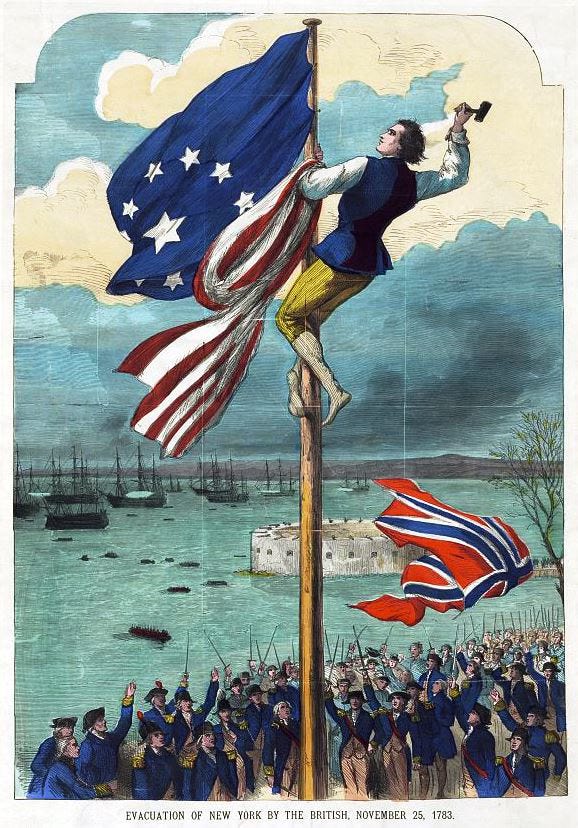
As the last Redcoats marched down to the river and rowed out to their ships, the royal ensign still flew over Fort George at the Battery – nailed to the flagpole, the halyards cut away, the pole itself greased from bottom to top.
Whether to spare themselves the humiliation of watching the American flag replace their own, or simply to leave the city one last indignity on their way out, no one could say for certain. But the effect was clear enough. General Washington was in the city. The artillery was prepared and ready to fire a salute. And the crowd gathering at the Battery – the overjoyed, long-suffering, patient citizens of New York who had endured seven years of British occupation – was staring at a British flag that no one could reach.
The grease defeated every attempt. Cutting the pole down would take too long. In desperation, someone fired a premature salute with the colors on a separate pole, which only made things worse – a humiliation piled on an embarrassment while the royal ensign continued to wave overhead as if in defiance.
Then a brawny young man, twenty-seven years of age, stepped forward.
Please hit the ❤️ button at the bottom of the page to help this story reach more readers. And if you’re not already a subscriber, I’d love to have you join me. Thanks!
His name was John Van Arsdale, and he was nobody in particular.
Born January 5, 1756, in Goshen, in Orange County, John was nineteen when the first shots of the Revolutionary War were fired in Lexington and Concord. He quickly quit his father’s ship to enlist in the Continental Army. What followed was the kind of service to country that left marks: The Quebec Expedition, cold, hard and ultimately a failure. The Battle of Fort Montgomery, where John was wounded and taken prisoner. The Sugar House prison in New York where American captives were held in conditions that men who survived would never forget. The hold of a British prison ship. Then, after his release, the Indian campaigns in the western settlements, where the war took on a different, grimmer character.
John had been through it all and from the very beginning, so when the British sailed out of New York Harbor, but left their flag flying, John quickly volunteered to take it down.
His first attempt failed – the grease defeated him too, and he came back down unable to hold his grip. Someone ran to Peter Goelet’s hardware store in Hanover Square, bringing back a saw, a hatchet, gimlets, and nails. Willing hands cut pieces of board into cleats and fixed them to the pole. John tried again, working his way up by the cleats, a line attached to the American flag trailing below him. A ladder was brought. He climbed higher then, reaching the top of the staff, tore down the British standard, and cleared the way for the new halyards through which Lieut. Anthony Glean ran up the Stars and Stripes.
The artillery fired a salute of thirteen guns. The crowd gave voice to their joy in hearty cheers. Out in the river, the last boatloads of British soldiers, who’d been watching from their oars, rowed off to their ships in silence.
James Riker, a historian who gathered the eyewitness accounts that survive, described the man who made it possible:
“a young man of medium height, whose ruddy, honest face, tarpaulin cap and pea-jacket told his vocation...none present, however superior in station, had sustained a better character or exhibited a purer patriotism.” 1
On making his way down the pole, John was greeted like the hero he was. Hats were passed and a considerable sum collected – nearly everyone within reach contributed, even General George Washington, if stories can be believed. John humbly accepted the silver, but not before protesting that what he’d done was unworthy of the reward.
Then he went home to Polly Crawford, his wife of just six months, and poured the coins into her lap – a moment that stayed with her for the rest of her life.
For decades, November 25th – Evacuation Day – was a genuine holiday in New York City.
Shops closed. Schools gave the day off. The streets filled with flags and military processions and the sound of salutes fired at the Battery at sunrise. Boys recited a simple rhyme: It’s Evacuation Day, when the British ran away / Please, dear Master, give us holiday. 2
The memory of seven years of occupation – the desecrated churches, the prison ships, the Sugar House, the long patience of a city waiting for its own liberation – was still alive in the people who’d lived through it, and they passed it to their children with the particular intensity of those who’d paid for something and wanted the cost remembered.
At the center of the celebration each year was the flag raised at the Battery at sunrise. John Van Arsdale raised it himself for as long as he was able. When he died in 1836, his son David took up the duty and kept it for the next fifty years, performing it on every Evacuation Day and every Fourth of July and every Washington’s Birthday, year after year, for whomever showed up.
Over time, the crowds began to thin.
The men and women who’d lived through the Revolution aged and died, and with them went the living memory of what the holiday commemorated. Thanksgiving fell in the same late November weeks, competing for attention and sentiment. The weather in New York in late November was cold and unpredictable, and patriotism, it turned out, had its limits when the wind was blowing off the harbor.
By 1874, the Evening Post felt it necessary to remind its readers that November 25th was Evacuation Day at all – noting that many of them were learning this for the first time.
“The city has outgrown evacuation day of which the fathers, or to be exact the grandfathers, of the present generation of New Yorkers, used to make much. For many years, patriotism has contended itself with celebrating the 4th of July, and other Revolutionary anniversaries have received less and less attention, especially is this true of local events such as that which we are referring to. It is therefore hardly surprising that many readers of the Evening Post are now reminded for the first time that this is the 91st anniversary of Evacuation Day, “the British the day the British ran away,” as the rhymester of the period following the Revolution added. 3
Still the veterans of 1812 kept faith. Every year a diminishing band of old men assembled to mark the occasion.
By 1882, however, even their assembly had shrunk to just three: General Dally, eighty-nine years old, and two companions of similar vintage, meeting at a saloon on the Bowery with no band, no escort, and no flags on the ferryboats. When asked about the humble showing, General Dally brought his fist down on the table. “I’ll be blanked,” he announced, “if I ever order the veterans out again.” He’d expected five members. He’d hoped for relatives of the dead veterans. What he’d gotten was two old men and his sixteen-year-old grandson. 4
The city, meanwhile, had largely moved on.
Get your copy of The Century Safe Method and start building your Bridge to 2076 today. Also now available for Kindle!
But David Van Arsdale had not. He made plans to raise the flag at the Battery on November 25th, 1883 – the centennial of the evacuation, a day marked by parades and ceremony and a great civic procession that the rain largely ruined.
Sadly those plans weren’t kept. On November 14, 1883, the eighty-seven years old keeper of his family’s tradition and the city’s passed away before he was able to performing what he had viewed as a sacred duty for nearly fifty years.
Before he died, however, David called his grandson, Christopher Forbes, to his side. Born in 1852, the firstborn of David’s firstborn would be his successor. The duty passed, as it always had – not through any official ceremony, not through the action of any organization or institution, but through the direct and personal act of one family member telling another: this is yours now. Don’t let it go.
Christopher Forbes did not let it go. He stood at the Battery on the 100th anniversary, and raised the flag.
Also passed to a new successor was another cherished keepsake of Evacuation Day: a piece of the original flag which John Van Arsdale had hoisted over the Battery. Like the country it honored, it, too had seen hardship. In 1819, the flag had been presented by the Common Council to Peale’s American Museum and later P. T. Barnum’s Museum, for safe keeping and public display, and for the next forty-six years, it was flown on Evacuation Day. Then, in 1865, a fire destroyed the museum and nearly all of the Van Arsdale flag – a piece just six inches long and two inches wide survived.
The charred relic was given to Hamlin Babcock, a First Lieutenant with New York’s 22nd Infantry during the Civil War, who, according to The New York Tribune, “fastened it to a small American flag that had been carried through the Civil War, and waved it from a window on Broadway on the day of the centennial.” 5
For more than a decade Christopher Forbes raised the Stars and Stripes over the Battery at sunrise, assisted by the Anderson Zouave Veterans Association, which acted as his escort with the same loyalty it had shown his grandfather. The ceremony was modest. The crowds were nothing like the early years. But the flag went up at sunrise on November 25th, every year, as it had gone up every year since 1783.
Then Asa Bird Gardiner arrived.
Asa was a colonel, a lawyer, and the head of an organization called the Society of the War of 1812, which had been founded – depending on which of its letterheads you consulted – in either 1776, 1812, 1826, or 1890. He’d determined that the honor of raising the flag at the Battery belonged not to Christopher Forbes or any descendant of the Van Arsdale family, but rather to his society – the legitimate successor of the Veteran Corps of Artillery, under whose auspices the ceremony had always been conducted.
The Van Arsdale descendants were quick in their response.
“That man lies,” said the historian Charles Riker, jumping to his feet at a Park Commission hearing in 1895, pointing at Gardiner:
“His organization is a ‘fake’ and I will show it up. Here is Christopher Forbes, a lineal descendant of the man who first nailed that flag to the staff and whose grandfather made him swear to faithfully perform the duty on every anniversary of Evacuation Day during his life.” 6
Christopher, standing beside him, confirmed the truth. Asa replied that they were the liars. The commission president had to restore order twice before the hearing could continue.
What followed was two years of hearings, affidavits, counter-affidavits, and resolutions passed by veteran associations declaring their support for Christopher and their contempt for Asa. An affidavit submitted by Asa was denounced by the man who had supposedly signed it – who said that pages had been inserted between his original pages, and statements he’d never made attributed to him. He said he’d obtained the original and destroyed it, and refused to sign any other.
In January 1896, the Park Board ruled in Christopher’s favor: His hereditary right, his sacred duty, was upheld. Asa’s pretensions, as the Tribune put it, were knocked out.
Christopher Forbes raised the flag at the Battery on November 25, 1896, at sunrise, precisely as his great-grandfather had done 113 years before.
Two years later, the Park Board changed their tune.
The ongoing controversy, they decided, made it simpler to assign the duty to a city employee.
On the morning of November 25, 1898, David Daly – foreman of the turf-cleaning force of the New York City Park Department – raised the flag at the Battery. The sun had been up for seventeen minutes before he managed it. The steam whistles of the vessels in the harbor sounded their salute. 7
A dejected Christopher Forbes stood in the crowd and watched silently.
The following year he applied again for permission to raise the flag. His request was denied. He didn’t appeal. As it turned out, there was no need: Vice President Garret Hobart passed away on November 21, 1899. He was just 55, and out of respect for the nation’s loss, all Evacuation Day activities were cancelled. 8
By most accounts, the last big celebration of Evacuation Day took place in 1912. That year, one hundred and thirty members of New York’s Old Guard, a ceremonial unit of patriotic veterans known best for their bearskin shakos and long blue frock coats, did what they’d been doing for eight-seven years. They marched to the Battery “to the old time tunes played by the Old Guard band.” 9
“Here they drew up in a line and stood at attention, while Captain George W. Homans and Captain George L. Winns advanced to the flagstaff and with the assistance of three employees of the Park Department, hoisted the flag while the band played “The Star Spangled Banner,” and a detail of artillerymen from Governor’s Island fired a twenty-one gun salute.” 10
After, the Old Guard retired for lunch and wine. Then reminisced and made plans for Ball to be held in the new year.
Five years later, New York City officially put an end to Evacuation Day activities. The Great War had been raging across Europe since the summer of 1914, and America and Great Britain were now allies, fighting shoulder-to-shoulder in the trenches to defeat German forces. The optics were wrong. The celebration too “anti-British” given the circumstances. 11
Two-hundred and forty-three years after the British sailed out of New York Harbor, few New Yorkers – few Americans, remember the name of John Van Arsdale, the sacred duty he passed down to his descendants or the way that duty was taken away. When Evacuation Day is remembered, it’s by local history groups who hold wreath-layings or flag raisings and tourists who find their way to Fraunces Tavern, where Washington bid farewell to his troops.
In 1941, Brooklyn Eagle columnist, James J. Heffernan invoked Evacuation Day in talking about which his saw as the “deadening of interest” in the history of New York City. He was old enough to remember when Evacuation Day was an annual holiday, he wrote. To remember “the re-enactment of the substitution of the Stars and Stripes for the Union Jack,” the cheering crowds, the parades.
He quoted Gustav Le Bon “The nation that has lost its history has lost its soul,” then asked the hard question, the still haunting question : How is our nation to keep its soul if its [history] is eradicate from our textbooks and its monuments are obliterated? 12
Copyright 2026 Lori Olson White
| Part 1 of 1 |
The Story Catalog is not an archive in the usual sense. What you’ll find here is a living catalog of Lost & Found Stories – deeply researched historical narratives told in parts, discovered through newspapers, letters, court records, logs, and the stubborn human habit of leaving traces behind.
Have you read the incredible true story of Aimee Henry and Mary Martha Parker? Call Me a Bastard is my longest serialized story to-date, and the one that started it all here on the Lost & Found Story Box. Check out the story from the beginning.
The Lost & Found Story Box is reader-supported. When you buy through links on our site, we may earn an affiliate commission.
End Notes
1 "Evacuation Day," 1783, Its Many Stirring Events: With Recollections of Capt. John Van Arsdale of the Veteran Corps of Artillery By Whose Efforts on that Day the Enemy were Circumvented, and the American Flad Successfully Raised on the Battery, By James Riker, New York, NY, 1883.
2 "Evacuation Day," 1783, Its Many Stirring Events: With Recollections of Capt. John Van Arsdale of the Veteran Corps of Artillery By Whose Efforts on that Day the Enemy were Circumvented, and the American Flad Successfully Raised on the Battery, By James Riker, New York, NY, 1883.
3 “Evacuation Day, Evening Post, New York, NY, November 24, 1874, P. 2.
4 “A Forgotten Anniversary: Hardly Any One but General Dally Thought of Evacuation Day,” New York Tribune, New York, NY, November 26, 1884, P. 9.
5 “Furious over the Flag: Rivals for the Honor of Hoisting the Stars and Stripes on Evacuation Day,” The New York Herald, New York, NY November 15, 1895, P. 6.
6 “Battery Flag Raised by David Daly: Employee of Park Department took the Place of Christopher Forbes. No Trouble Over Change. Celebration of the 115th Anniversary of Evacuation of New York, Old Guard Visits Brooklyn,” The New York Evening Journal, November 25, 1898, P. 5.
7 “Not to raise the Flag at Battery: Request of Christopher R. Forbes to Resume on the Fourth the Custom of His Ancestors Refused,” New York tribune, New York, NY, June 23, 1899, P. 10.
8 “Old Guard Observes British Departure: 87th Evacuation Day Parade by Subway and Elevated – and Some Afoot. Absent Review by Mayor. Feast in Antique Tavern and Armory Reminiscences fill out Busy Day,” New York Herald, New York, NY, November 26, 1912, P. 16.
9 “Old Guard Marches in “Funny Hats” on Evacuation Day,” The Evening World, New York, NY, November 25, 1912, P. 4.
10 “Old Guard Marches in “Funny Hats” on Evacuation Day,” The Evening World, New York, NY, November 25, 1912, P. 4.
11 November 25, 1917: For the First Time in 133 Years,” Daily News, New York, NY, November 25, 1999, P. 3.
12 “Heffernan Says:Send Fish North, Bib, Bust Spare is Castle of Past,” Brooklyn Eagle, Brooklyn, NY, February 28, 1941, P. 21.
Comments
Nothing yet. Say the first thing.
Sign in to join the conversation.