
I’ve been obsessed with Claude Code lately. So much that I’ve even lost sleep. With Anthropic dropping Claude Sonnet 4.5, I don’t expect much rest in the coming days either.
My girlfriend says I’m ignoring her because I spend all my time “flirting with Claude.” To tease her, I even updated my Substack welcome line to: “Cheating on my GF with Claude.” I think it’s funny. She doesn’t. 🤷🏽

Anyway, let’s get down to business. Anthropic didn’t just release a new model. They also:
shipped Claude Code v2
published new resources for building agents, and shared YouTube videos on context management, GenUI, and Claude’s progress over the years.
Here are 7 key takeaways worth your time:
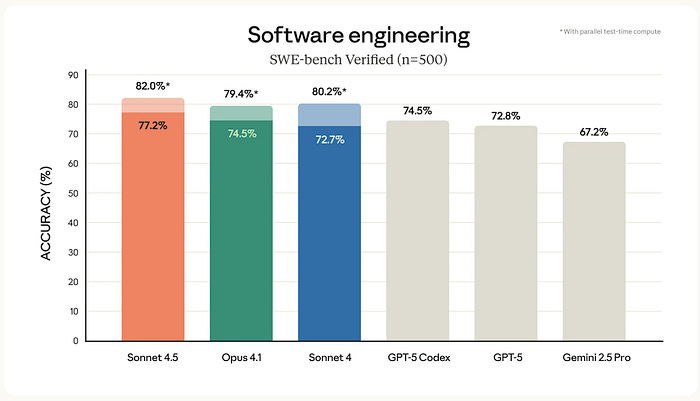
Claude Sonnet 4.5 now outperforms Opus on SWE-bench (official announcement).
Benchmarks aren’t everything, but they signal how much raw power the model has gained. Opus always felt slow, while Sonnet 4.5 is fast. I’ll now be using 4.5 as my default model for plan mode in Claude Code.
I wouldn’t be surprised if Anthropic releases an (expensive) Opus 4.5 in the upcoming weeks.
With 4.5 being shipped they also released Claude Code v2.0.0.
New native VS Code extension
/rewinda conversation to undo code changes (code AND|OR conversation)/usagecommand to see plan limitsTab to toggle thinking (sticky across sessions)
Ctrl-R to search history
Add subagents dynamically with
--agentsflag
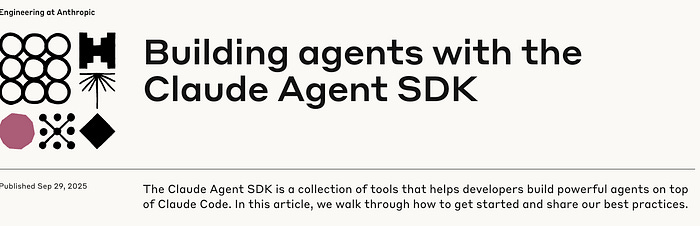
Anthropic published a detailed blog post on the new Claude Agent SDK, a full overhaul of the old Claude Code SDK.
It’s the same infrastructure Anthropic uses internally to run Claude Code, now opened up for any agentic use case, not just coding.
This makes it one of the most practical starting points if you want to design robust AI agents.
At its core is the Agent Loop framework:
Gather context (run scripts:
grep&tail, subagents, compaction)Take action (via tools & MCPs)
Verify results / self-evaluate (visual feedback, when programming: types, LLM-as-judge)
Loop / refine
The SDK gives you the building blocks to build a successful agent following these loop and best practices
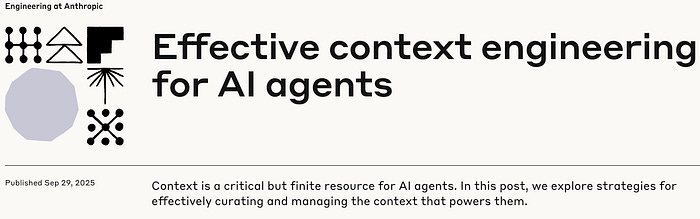
One of the key takeaways I learned from this blog post is that Agents work better when they fetch information on demand rather than loading everything upfront.
The shift from pre-inference retrieval to “just in time” context changes how you build AI agents. Instead of embedding and retrieving all data before the agent starts, you give it lightweight references (file paths, queries, web link) and let it pull what it needs during execution. Claude Code demonstrates this by navigating databases without loading full datasets, using commands like head and tail to analyze data incrementally while keeping context lean.
Design your agents to navigate and fetch context during runtime rather than drowning them in exhaustive pre-loaded information.
Worth your time. Check it out.
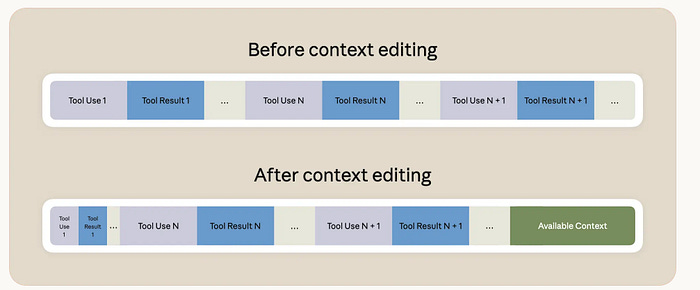
Context editing automatically clears stale tool calls and results from the context window when approaching token limits, preventing agents from exhausting their context mid-task.
The memory tool enables Claude to store and consult information outside the context window through a file-based system that persists across sessions, letting agents build knowledge bases over time.
Anthropic even demoed this in a YouTube video of Claude playing Catan (I love that game 😍)
Learn more here.
About 18 months ago in Berlin, I had a quick chat with our VP of engineering, and he mentioned a tech on the horizon: Generative UI (GenUI).
GenUI means interfaces that aren’t static but dynamically adapt in real time to each user’s needs. Instead of fixed screens, the UI evolves based on context, intent, and behavior, making software more personal and fluid.
Anthropic is now making this vision tangible with “Imagine with Claude,” a research preview that lets Claude build software live.
It’s still early, but it feels like how we’ll interact with software in the future.
Anthropic shared a short one-minute video showing how Claude’s outputs have improved over time.
It compares the same task across Claude 2, 3, and now 4.5, making the leap in capability instantly clear.
Comments
Nothing yet. Say the first thing.
Sign in to join the conversation.