
Recently I got off a meeting with a fund manager I’ve been getting to know well lately. He wants me to come on as a senior advisor, working with 20 to 30 portfolio companies on growth and go-to-market, in addition to helping with deal sourcing.
I said what you say in those meetings. Sounds great, let me think about the structure. After we wrapped, I closed the laptop and sat there for a minute, because something felt strange and I couldn’t place it.
Here is what it was.
Ten years ago I was at InsideTracker, in my mid 20s, still early on in my career, and sitting in rooms where the CEO and the board members and outside advisors did most of the talking. I watched those people closely. I observed and studied how they framed things, how people listened to them, and what they seemed to know that I didn’t (yet) know. The outside advisor in particular was a role I could barely comprehend. You mean this person doesn’t have a full time job? Or more surprisingly, this is what they do full time? Someone who showed up a few times a year, said a few things, and changed the direction of the company.
That was the chair I was looking at from across the room, and a fund manager had just asked me to take a seat right in it.
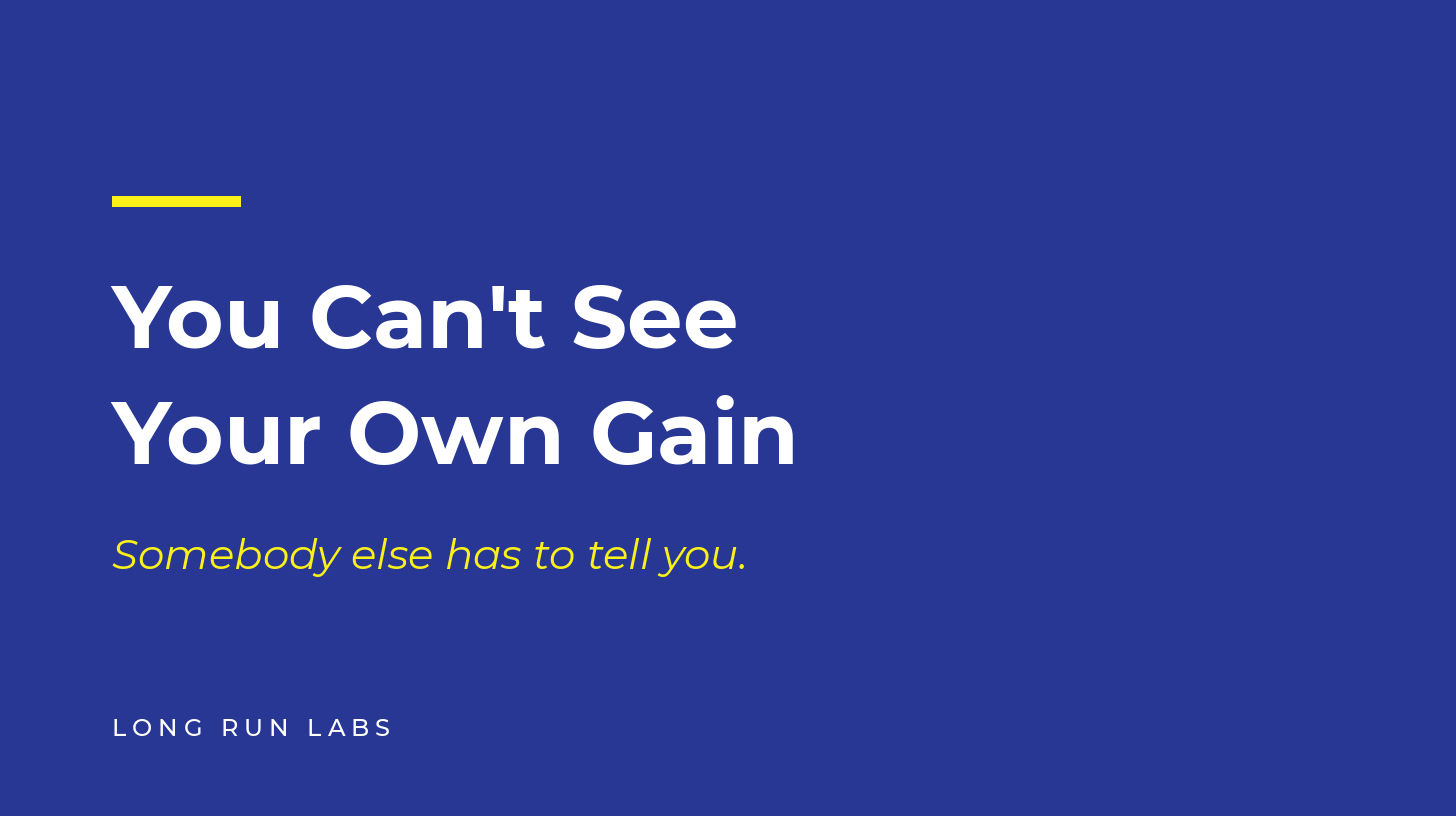
I put something short on LinkedIn afterward. Just a few words; an offhand thought that crossed my mind and made it past the “should I post this?” filter.
Ten years ago I was looking up to and admiring the people doing the work I’m doing now. Fun reflection. Onwards.
I did not include the trigger. I didn’t mention the meeting or the fund or the chair. I wasn’t trying to make a point. It was one of those posts you write because a feeling needs somewhere to go and you have a phone in your hand. You know, what Twitter was originally meant for; the random thoughts that we wanted to share with the world.
Christian Rawles left a comment on it:
“That’s living in the gain!”
Christian spent 15+ years owning an outdoor brand before selling it and moving into executive coaching, and he came on Long Run Labs back in the spring. Roughly 15 minutes into that recording, the conversation flipped. He stopped being the guest and started asking me questions I did not have good answers to. I left all of it in the episode, and have listened back to it a few times.
Entrepreneurs Need New Heroes
·
May 5
This week’s episode is a little different. It’s less a business-of-endurance conversation and more a serendipitous coaching session that I happened to record. About fifteen minutes in I stopped interviewing Christian and started being coached by him, and I decided to leave that in. If you’ve ever felt the gap between where you are and the person you’d need to become to get where you want to go, this one will land.
One of the things he gave me that day was Dan Sullivan’s frame from The Gap and the Gain. I bought the book and read it soon after. Short version, because I already wrote the longer version (linked above) when the episode came out:
The gap is the distance between where you are and the horizon you’re chasing. It is, by construction, uncloseable. Move toward it and it moves.
The gain is the distance between where you started and where you are standing right now. It is fixed. It already happened. Nobody can take it.
Most of us spend our whole working lives measuring against the horizon and almost none of it measuring against the start.
I understood that in May. I wrote about it in May. I recommended the book to people in May.
And then in August I accidentally did it, without noticing, and a friend had to tell me in a comment box.
There is a real difference between those two things and I don’t think we talk about it much.
Knowing a frame takes an afternoon. You read the book, you nod at the good part, you can explain it at dinner. Digesting one takes months and you cannot schedule it. It shows up sideways, attached to something specific, usually when you’re not looking for it.
I picked the book up again after that meeting. Not because I was trying to do a gratitude exercise. Because something had happened that I had no language for, and the language turned out to be sitting on a shelf where I’d left it.
That’s most of what a good conversation does, I think. It doesn’t change you on the day. It leaves something in the house that you find later when you need it.
The comments did something the post couldn’t do on its own.
Simon Freeman of Like the Wind Magazine replied with a line I keep thinking about:
“And here you are inspiring people who hope, in ten years, they’ll be doing the work you are now.”
Read that against the post. I wrote about looking up at people. Simon pointed out that while I was doing the looking up, a stack of people were looking up at me.
Another commenter (hi Eva!) put it even more plainly, mirroring my own sentence back at me: they look up and admire the work I’m doing right now.
So here’s the point I want to make:
Your gain is somebody else’s gap. The exact position you can’t see any value in, because you’re standing in it and it just feels like Tuesday, is the position somebody else is grinding toward and cannot yet reach. That’s a structural fact about where you’re standing, and it’s also the reason the gain is so hard to see from the inside.
You are the worst-positioned person in the world to evaluate your own progress. You have full access to every doubt, every near-miss, all the imposter syndrome (who else deals with this?) every thing you meant to ship and didn’t. What you do not have access to is what you look like from across the room. And the gain lives almost entirely in that view.
Which means the gain is not really a mindset you adopt. It’s information you have to go get.
Keep receipts you didn’t write. I have a folder of screenshots and forwarded emails that I used to think was vanity. It isn’t. It’s the only record I have of what I looked like from outside my own head, and it’s the only thing that reliably works when the gap gets loud.
Put yourself around people who can see you. This is most of why The Huddle exists, and I’ll be honest that I didn’t understand that when we started it. Jason, Ross and I built it as a place for early-stage founders to get unstuck. What it mostly does in practice is help show and tell people what they’ve already built, because nobody in the room has the distortion that the founder has.
Look at your own log the way you’d look at someone else’s. Every endurance athlete reading this has a training log going back years. You know exactly what you ran last week, and you have no felt sense whatsoever of the difference between the person who started that log and the person reading this sentence. Open it from the beginning sometime. It’s a strange experience. Mine goes back to 2018 and it’s a really cool way to see progress.
I’m not going to pretend the gap is the enemy.
The gap is the engine. It’s why I’m building a 35-show podcast network instead of one show, why I’m still chasing partnerships I have no business chasing or that other shows my size would never consider, or why the calendar looks the way it does. If I fully moved into the gain I’d be a much calmer person running a much smaller company, and I don’t actually want that.
The goal isn’t to stop looking at the horizon. It’s to turn around once in a while and check how far the trailhead is behind you. Then turn back around and keep going.
I’ll be back in the gap tomorrow. That’s fine. That’s the job.
But for about ten minutes after that meeting, I got to stand somewhere I’d spent a decade walking toward, and I got to notice it. A friend had to point it out to me in a comment box, which I think is exactly how this works for almost everybody.
The full conversation with Christian Rawles on the fear of success, abundance, and why entrepreneurs need new heroes is on Long Run Labs. Listen on [Spotify] / [Apple] / [YouTube].
Question for you: what’s the last thing you accomplished that you moved past so fast you never actually registered it? I want to hear about it below!!
Links & Credits
The Gap and the Gain, Dan Sullivan with Benjamin Hardy
Christian Rawles on Long Run Labs: [episode link]
Previous writeup on the Christian Rawles episode: [link]
No posts
Comments
Nothing yet. Say the first thing.
Sign in to join the conversation.