
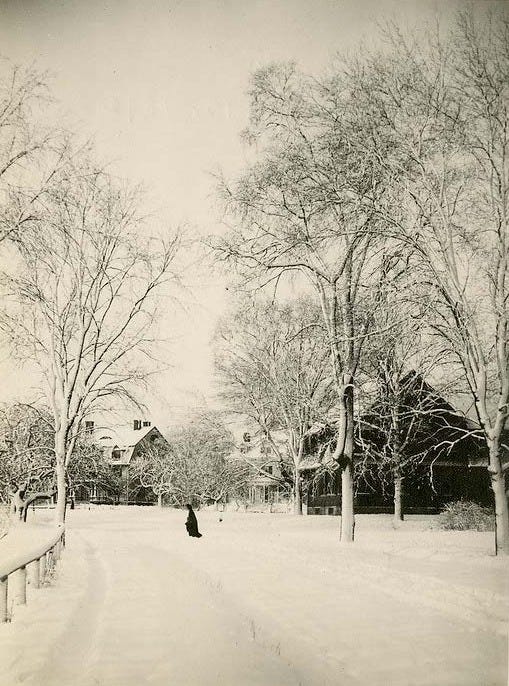
Scott Street, Cambridge, 1892. Outside: ice and silence. Inside: mending, popcorn, and a young woman learning discernment by the fire.
December 17, 1893
Dear Morris,
The weather in Ithaca can be no worse than weather in Cambridge. It is cold – although it snows and rains alternately. To make matters worse the boiler in Miss Gilman’s heating apparatus cracked and for the last three days the halls have been icy. However there are glorious open fires in all the bedrooms and I had just as soon be cold half the time if I may toast before an open fire the other half.
Yesterday some of the brave girls went into Boston while the rest sat around a morning fire in our room mending, popping corn and reading aloud. Tonight Mable and I are arranging for a lunch. We asked the maid for some crackers, cookies and apples, pretending that we were so hungry we could not wait until suppertime. All these now lie under an innocent red pillow. We want some butter and salt for our popcorn but hardly like to ask. Mrs. Lee’s room is next to ours but she will think the noise of the corn popper is the fire in the grate, besides she probably would not care if she knew.
This morning the trees were all covered with ice, and when the sun came out from the clouds the ice melted, and as the Cambridge people are too economical to have sidewalks, most of us decided not to go to church. We were not to get out of a sermon thus easily. Mrs. Lee read a sermon to us and finished off not with hymns as I half expected but with the opening chapters of her book. The first chapter was rather interesting, the second endurable but the third a bore. Did I ever give a school-girlish opinion of Mrs. Lee? Let us pretend that I never have.
Christmas and the preceding week I have promised to spend in Cambridge, the following week in Somerville. Although I have these numerous relatives to visit the most homelike place is as Mable and I both agree, this room in which I am writing.
There is the worst noise downstairs, someone must be signing hymns.
Yours sincerely,
Ethel.
By mid-December, Ethel has chosen to stay.
She could have gone home to Milwaukee. Her parents gave her permission. Instead, she remains in Cambridge — cracked boiler, icy halls, treacherous sidewalks and all. She frames it cheerfully: “I had just as soon be cold half the time if I may toast before an open fire the other half.” But beneath the humor is resolve.
And here, quietly, something shifts.
Earlier in the year, Mrs. Lee had seemed almost heroic to Ethel — a woman who had written a book, who spoke of knowing one of Ethel’s favored “New Woman” authors. There was a shimmer of admiration in those early descriptions.
Now, listening to three chapters read aloud from Mrs. Lee’s book, the shimmer fades.
The first chapter is “rather interesting.” The second “endurable.” The third — “a bore.”
The remark is not cruel, exactly. It’s more a moment of maturity. The admired author becomes a working writer. The intellectual idol becomes human. And Ethel, amused at her own earlier enthusiasm, checks herself:
Did I ever give a school-girlish opinion of Mrs. Lee? Let us pretend that I never have.
It is one of the first moments in the correspondence when she gently corrects her own former awe.
As 1893 closes, Ethel is not losing her appetite for brilliance. She is gaining discernment.
Why did she stay in Cambridge? The letters don’t say directly, but the likely answers are practical ones. The journey from Boston to Milwaukee in December 1893 was not a simple matter. It required multiple train connections, considerable time, and — for a sixteen-year-old girl traveling alone — an escort. Ethel’s mother had already made several round trips between Milwaukee and Cambridge that year, and there are hints in family letters that Kit’s health was sometimes uncertain. Ethel’s father, a corporate attorney with a demanding practice, appears rarely in the family letters as a traveler except on business. The logistics, in short, raised real barriers.
There is also the matter of Thanksgiving. Morris had just made the journey east specifically to see her, arriving in Somerville for what appears to have been several days. Had Ethel left Cambridge immediately afterward for Milwaukee, that time together could have been sharply curtailed — or foregone entirely.
The truth is probably somewhere in this blended set of winter realities: a mother who could not easily travel again so soon, a father who could not leave his practice, a journey that was genuinely difficult, and — perhaps — a young woman who had reasons of her own for staying close to Cambridge a little longer.
She calls her dormitory room “the most homelike place.” She may mean it more than she lets on.
She is not home. But she is building one.
—
Image Courtesy of the Cambridge Historical Commission, Charles N. Cogswell Collection. Public Domain.
New here? Start with the Welcome, or navigate the correspondence through the Letters Index.
[TLC-1893-49]
Comments
Nothing yet. Say the first thing.
Sign in to join the conversation.