
Welcome to Londonist: Time Machine’s Friday newsletter for paying subscribers, with a merry banquet of a teaser for everyone else.
Did you see Wednesday’s newsletter, which mapped and listed every surviving Tudor structure in central London? Well, today comes the logical follow-on, a guide to Tudor places beyond the central city.
This is a much tougher assignment. Central London is a relatively small area, and has been extensively redeveloped over the centuries. Intact Tudor is hard to come by. As we get further out, we find that more Tudor buildings have survived. What follows, then, is probably not comprehensive, though I think it is the most extensive list available online. I would be delighted to add to it, so please do get in touch if you know of further examples.
Before we dial back to the 15th and 16th century, let’s have the History Radar…
Upcoming events of interest to London history fans.
🎨 WOMEN OF FITZROVIA: Long-term local residents Sue Blundell and Nick Bailey give a free lunchtime talk at Fitzrovia Chapel exploring the history of the women artists who once populated the neighbourhood's garrets and studios. The discussion highlights how the Slade School of Fine Art's inclusive policies drew female creatives to the area, including notable Surrealist Eileen Agar and the women of the Omega Workshops. 18 August
🎻 FANNY BURNETT: Historian and author Lucinda Dickens Hawksley visits the Charles Dickens Museum in to discuss the life of Frances 'Fanny' Dickens. As the eldest sibling and a talented musician who trained at the Royal Academy of Music, Fanny served as a major inspiration for several characters in her brother Charles's novels. Hear about the legacy of this often-overlooked Victorian singer followed by a short Q&A session. 20 August
🧱CHARTERHOUSE OPEN GARDENS: Explore the unique atmosphere of historic "hidden" courtyard gardens at a summer open gardens evening at The Charterhouse in Smithfield. The evening features live music from the Sol Grimshaw Band, with refreshments available from a sparkling cocktail spritz bar and a sourdough pizza van. For a more indulgent visit, afternoon tea tickets include a prepared tea box and a glass of chilled prosecco to enjoy among the greenery. 20 August
🔪 SUMMER EVENING MUSEUM LATE: Europe's oldest surviving operating theatre opens its doors for a rare after-hours session in London Bridge. Explore the atmospheric Herb Garret at your own pace with a drink from the on-site bar, followed by an expert-led history talk detailing the surgical practices of the original Old St Thomas’ Hospital. 20 August
⚓️ MIGRATION MUSEUM TAKEOVER: The Migration Museum arrives at London Museum Docklands for an interactive session that blends food, culture, and personal history. Part of a wider festival of Caribbean culture, the Feast! Migration Museum takeover invites families to draw their dream celebration dinners while reflecting on their own heritage. Recommended for children aged five and over. 21 August
💧 CATHEDRAL OF SEWAGE: Witness the spectacular ornamental cast ironwork of the Crossness Pumping Station during a special steaming day. This Victorian masterpiece, designed by Sir Joseph Bazalgette to save London from the "Great Stink," opens for a guided tour that includes an illustrated history talk, a ride on a narrow-gauge railway, and a look at an extraordinary collection of historic toilets. A vintage bus pick-up from Abbey Wood station is available to ferry visitors to the site. 23 August
SUBTERRANEAN PUB QUIZ: As mentioned previously, I shall be hosting a quiz on subterranean London on 7 October 2026. The quiz, in cahoots with the Brunel Museum, takes place in a very special venue — the bottom of Marc Brunel’s 201-year-old tunnel shaft, adjoining the museum. Expect 50 questions, written by me, about Tube lines, sewers, lost rivers, catacombs and the like… all in one of London’s most evocative subterranean locations. More info and tickets here (open to everyone).
LONDONIST: TIME MACHINE WRITING COMPETITION: And a quick reminder that our London-history-writing competition closes for entries on Wednesday 19 August. Top prize, £350. Find out how to enter here.
In alphabetical order…
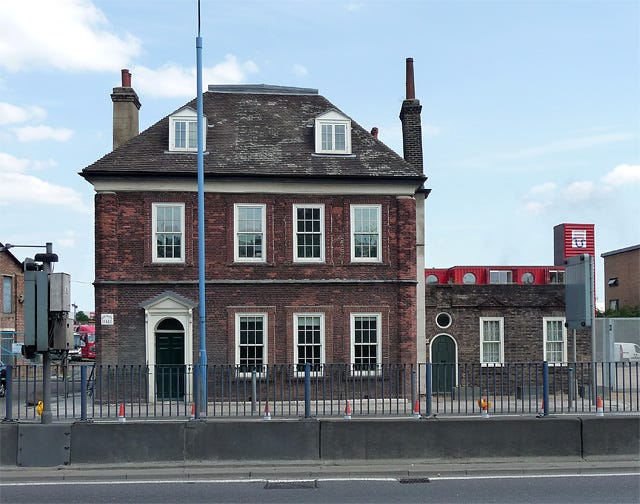
Bromley Hall (Bromley-by-Bow): The Blackwall Tunnel Northern Approach Road is not the first place you might think of looking for an early Tudor house. Yet here stands Bromley Hall, a squat brick building that might easily be mistaken for a Georgian townhouse. The little-regarded structure turns out to be the oldest brick-built house in London. Sadly, you can’t go inside unless you have business in one of the small offices that currently make use of this minor miracle of a building.
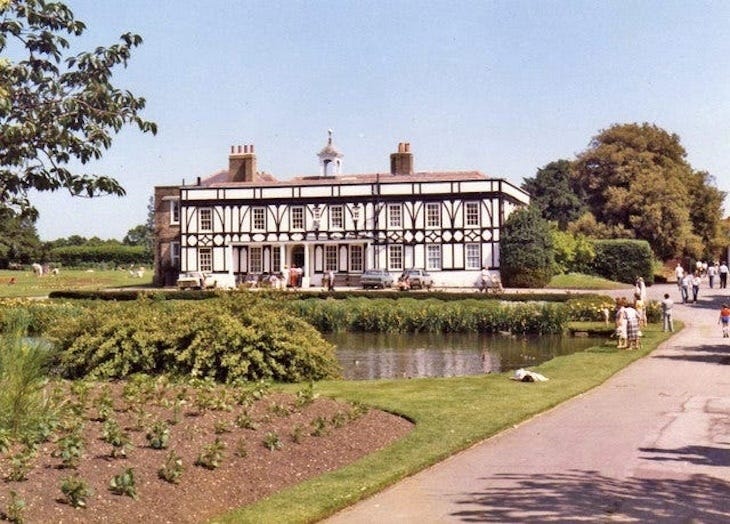
Broomfield House (Palmers Green): Long-term readers will know the story of this tragic pile. Built some time in the 16th century, the half-timbered mansion became a community hub in the 20th, with a small museum attached. Sadly, it was struck by four separate fires, and is now a precarious shell, trapped behind hoardings. Plans are afoot to demolish much of what remains, with some sections preserved, but we’ll never see the mansion intact again. Read the full history in my previous article.
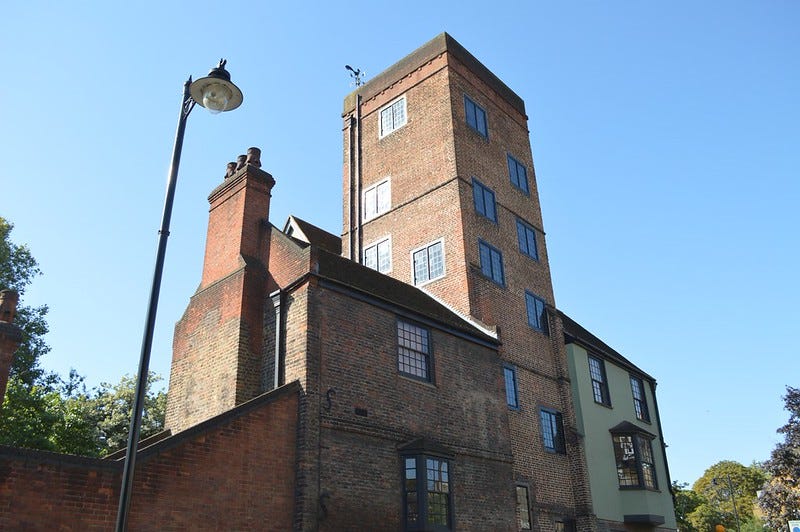
Bruce Castle round tower (Tottenham): I’ve always thought that this rotund upthrust looks like a pastiche Victorian water tower or some such, but it’s genuine Tudor. It was built around 1514 by Sir William Compton, who revelled in the job title of ‘Groom of the Stool’. Nobody knows why he built it, but if you were filthy rich in the 16th century, wouldn’t you yearn for a show-off tower as well? Today, the tower is part of the wonderful Bruce Castle local history museum. The nearby church of All Hallows has a Tudor porch in similar red-brick style.
Canonbury Tower: This erratically fenestrated confection was completed in 1532 for the use of the canons of St Bartholomew’s Priory (they didn’t have long to enjoy it; Henry VIII pulled the plug on the priory just seven years later). It’s been through many uses since, including a private home for Francis Bacon, Thomas Cromwell and Oliver Goldsmith. Today, Islington’s oldest building can be visited on booked tours.
Coombe Conduit: On the road to Norbiton stands a peculiar brick structure that looks somewhat like a chapel. It isn’t. This is a conduit head, built by Henry VIII to collect fresh water from nearby springs and convey it to Hampton Court Palace. The conduit is overseen by English Heritage, who open it to visitors once a month outside of winter.
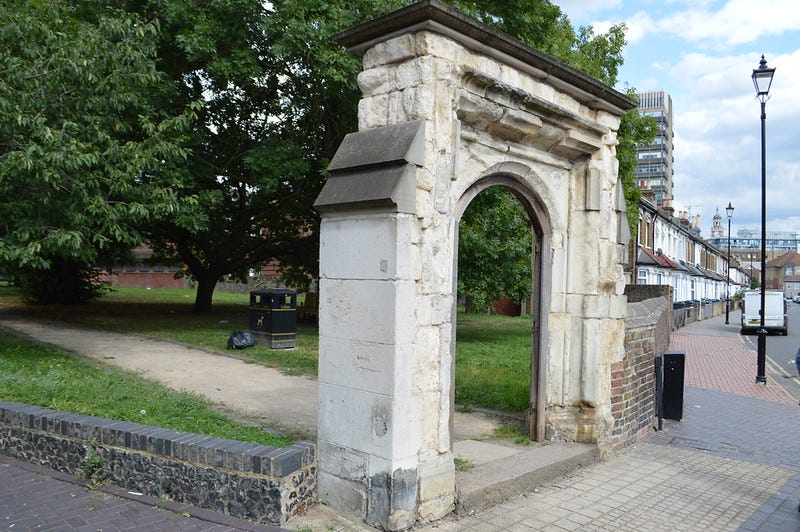
Croydon Minster: Croydon has put in a bid for city status on at least six occasions. Were it ever to succeed, then its minster might be upgraded to a cathedral. It’s certainly grand enough. Like many an old ecclesiastical building, its construction is an accretion of different eras, but the current form is mostly from the late 14th and early 15th century. Nearby stands a weather-worn arch, also from the Tudor period.
Nearby Croydon Palace is often described as Tudor, though it was mostly completed a few decades before that era.
Eastbury Manor House (Barking): There are few places less likely to conceal a Tudor manor house than a Barking housing estate, but there lies Eastbury among the inter-war semis. The Elizabethan mansion was built for merchant Clement Sisley on land recently relinquished by the dissolved Barking Abbey. Today it’s owned by the National Trust, and what it lacks in architectural harmony it makes up for in its ‘how the Francis Drake did that get there?’ oddness.
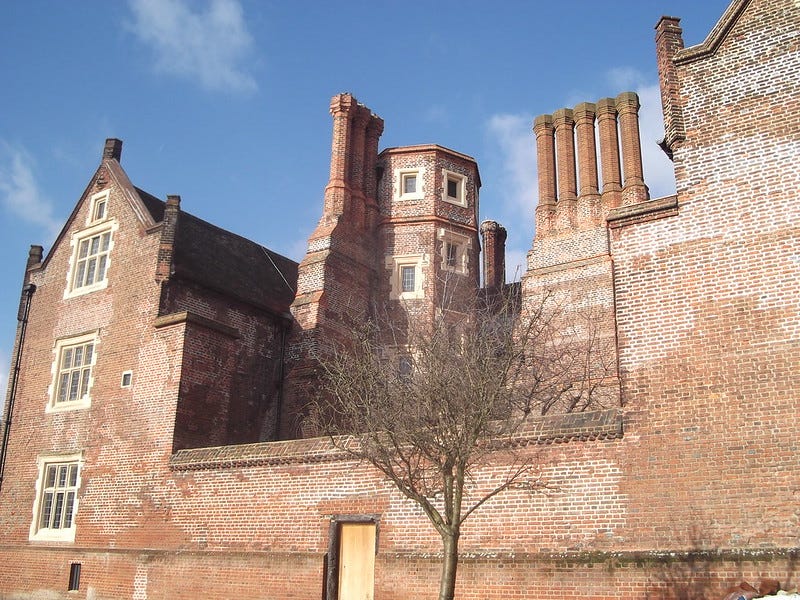
Eltham Palace: … is not strictly Tudor. Its great hall was built in the 1470s by Edward IV. But given that it comes from just a decade before our era, and Henry VIII grew up here, it’s earned a special day-pass to sneak onto this list. (Whatever its age, it’s certainly worth visiting.) Some very-definitely-Tudor buildings lurk nearby, including a row of houses known as Lord Chancellor’s Lodgings, and a Tudor-era conduit.
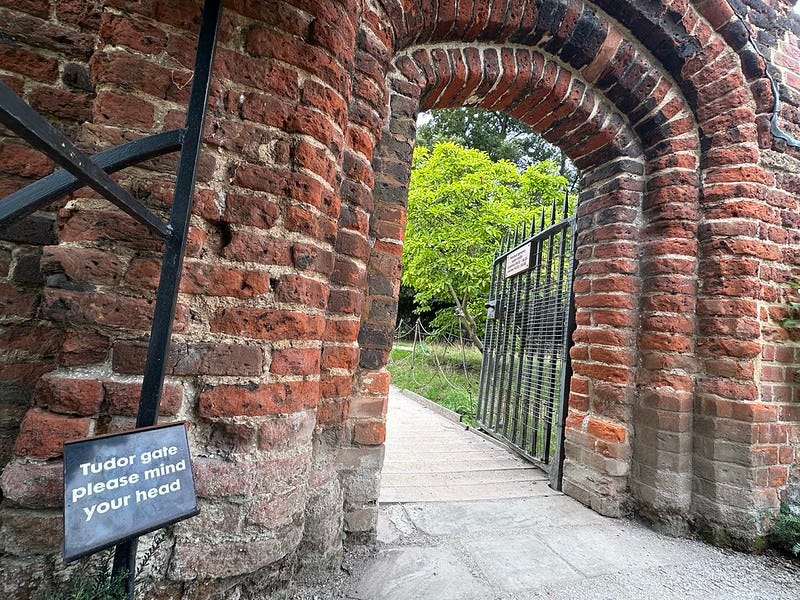
Fulham Palace: The home of the Bishop of London is a mush of architectural styles, but some of the key sections are late 15th century, including the Great Hall and one of the courtyards. There’s also this gorgeous gateway, with its Tudor-apt warning to mind your head. All of it is free to visit.
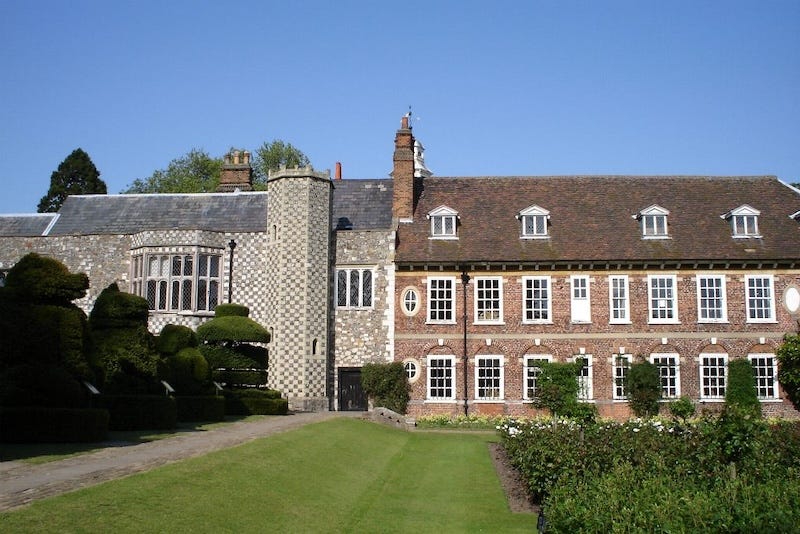
Hall Place (Bexley): This funny old building looks like — and is — two mansions scrunched together. One is Tudor stone, the other is 17th century red brick. And don’t they make a mismatched pair? The house(s) is open for guided tours, and the gardens attract locals all year round.
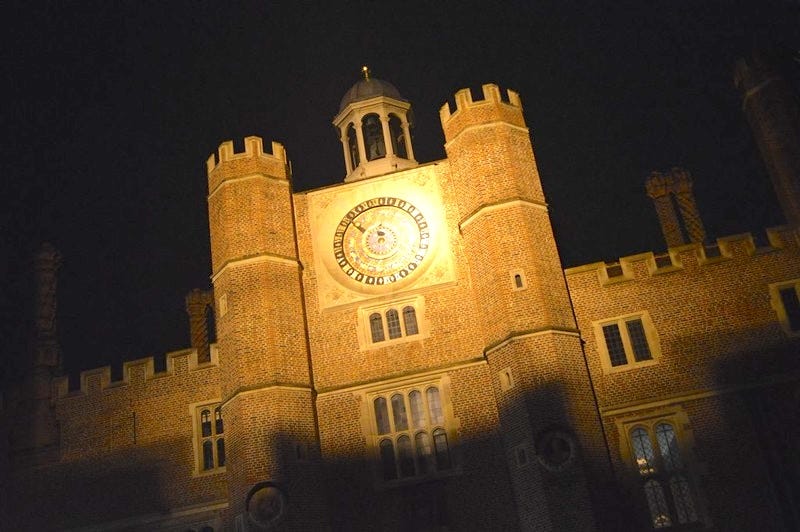
Hampton Court Palace: The building most intimately associated with Henry VIII, and Cardinal Wolsey from whom he nicked it, needs little introduction. The wider palace is again a mash of styles, with a major wing designed by Christopher Wren more than a century after our period. But the main entrance gateway and principal buildings are pure Tudor powerplay.
Headstone Manor (Harrow): An exceptional gathering of historic buildings, dating from different centuries. The Great Barn is the best Tudor example, a monumental structure built in 1506 to the orders of the Archbishop of Canterbury (the land owner). Today, it’s used as a function space, alongside the wonderful local history museum for Harrow.
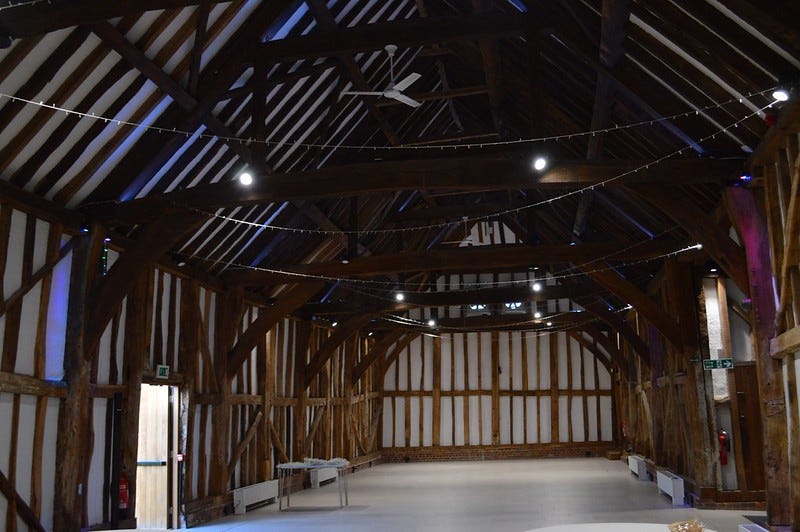
Lauderdale House (Highgate): Waterlow Park’s excellent cafe-gallery-events-centre has Tudor origins. The house was built in 1582 for a Lord Mayor of the time. It’s been much renovated in the centuries since, but suffered a disastrous fire in the 1960s. Even so, many of the original Tudor timbers and brickwork survive, visible in patches throughout the house.
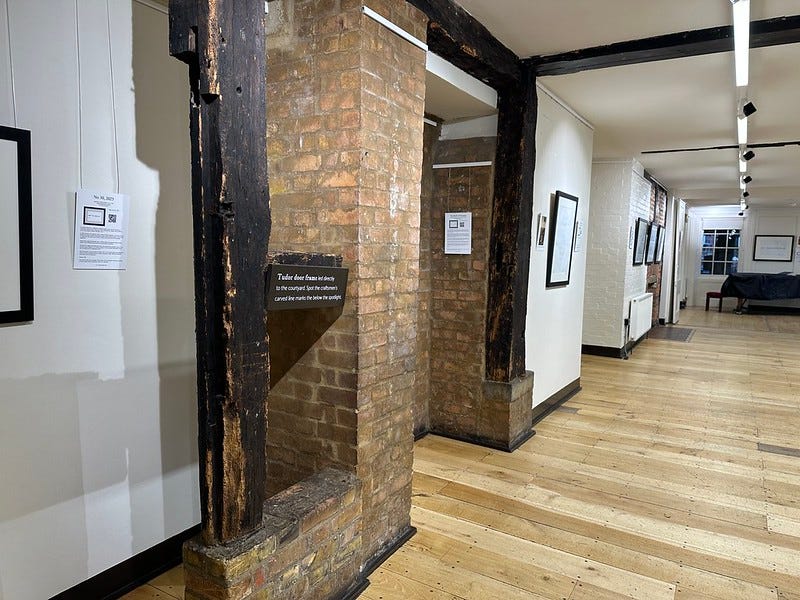
Manor Farm (Ruislip): Ruislip in west London is reached by the increasingly misnamed Central line, and there you will find a group of ancient buildings (being used as a Covid vaccination centre on my one visit). The Great Barn is from the 12th century which is (a) staggering, (b) not Tudor, so we must ignore (for now). Next door, though, is the early 16th century Manor House, long used as a local court, and now a visitor centre. According to Open House London, it also contains the oldest example of domestic wallpaper in the country. Nearby, a row of almshouses dates from the 1570s.
Comments
Nothing yet. Say the first thing.
Sign in to join the conversation.