
Welcome to Londonist: Time Machine, the newsletter of London history.
London is not very Tudor. I’m sorry. I know this must be a disappointment to some visitors, who expect to find half-timbered cottages, wattlesome gables and red-brick chimney stacks at every turn. Centuries of fire, Blitz and redevelopment have done away with most of it.
This is a shame, but the dearth makes the surviving buildings all the more special. You might feasibly track down every one. To that end, I’ve put together a guide to every Tudor structure I can think of in central London. And, of course, I have a map.
First, a quick announcement…
I’m delighted to say that Londonist: Time Machine is teaming up with the Brunel Museum to host what might just be the deepest quiz ever attempted in London. On 7 October 2026, I’ll be running a subterranean quiz at the bottom of Marc Brunel’s Thames Tunnel shaft, accessed from the museum. It was dug over 200 years ago, and is one of the most atmospheric locations I can think of to run a pub quiz (and, yes, there will be a bar… and prizes).
All questions will be themed around subterranean London — be it Tube lines, sewers, lost rivers, crypts, catacombs or bunkers. You might not know all the answers, but you’ll certainly learn a thing or two about the city beneath your feet.
This event is open to everyone. You can book as a team (max 5 people), or as an individual and we’ll sort you out with a team on the night. Get tickets quick to access the earlybird price. (See notes on venue accessibility here.)
Below, I’ve jotted down notes on every Tudor structure in central London, of which I am aware. I’ve also deposited them onto a map, so you can put together a self-guided tour of the buildings that interest you most.
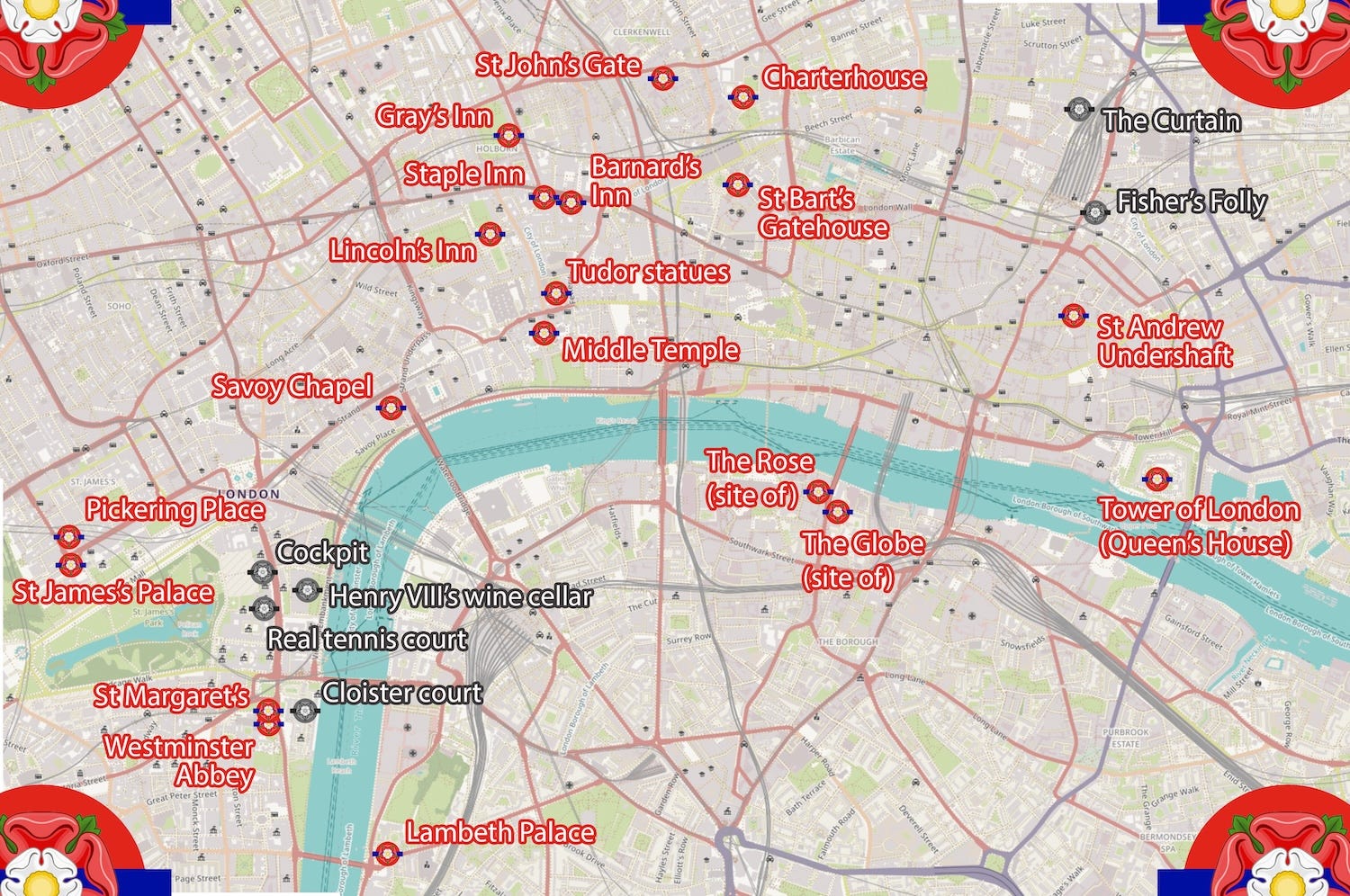
I’m pretty sure I’ll have missed a few things so, prithee, do let me know in the comments or by email if you have additions. In a follow-on article, I’ve also tackled Tudor buildings beyond the central section.
Here we go, then, in alphabetical order…
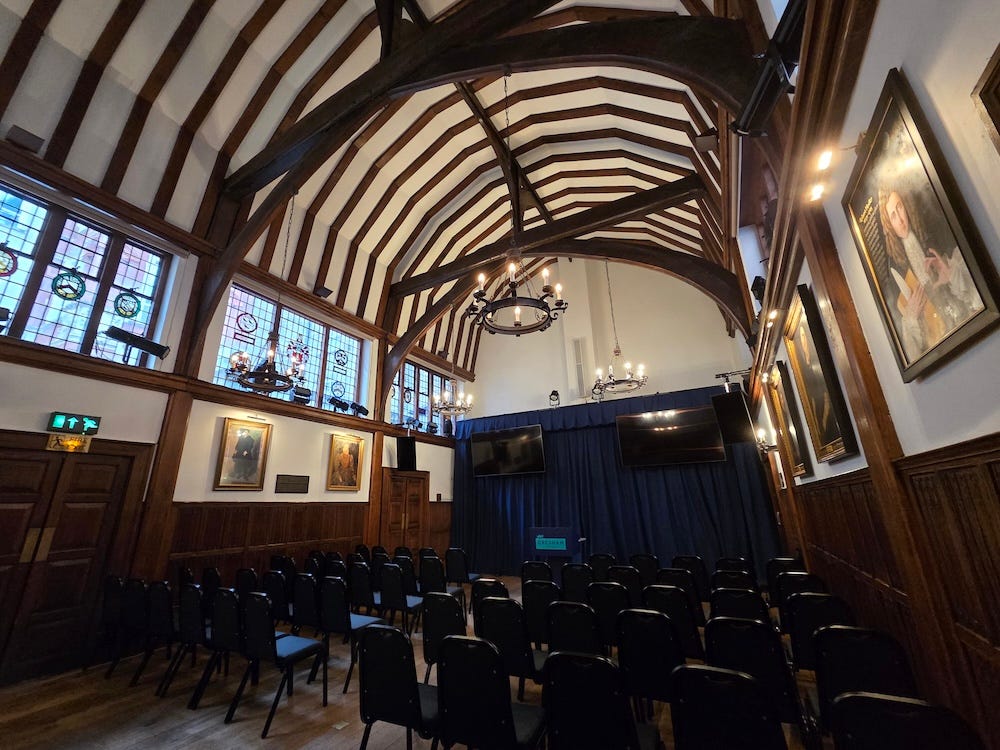
Barnard’s Inn Hall (Holborn): Want to see the only example of Tudor ‘crown posts’ in London? They’re inside Barnard’s Inn Hall, a 15th century survivor hiding down a Holborn alley. The building opens a handful of times per week for free public lectures organised by Gresham College. A group of Londonist: Time Machine subscribers took a tour in January 2026, and here’s the write-up.
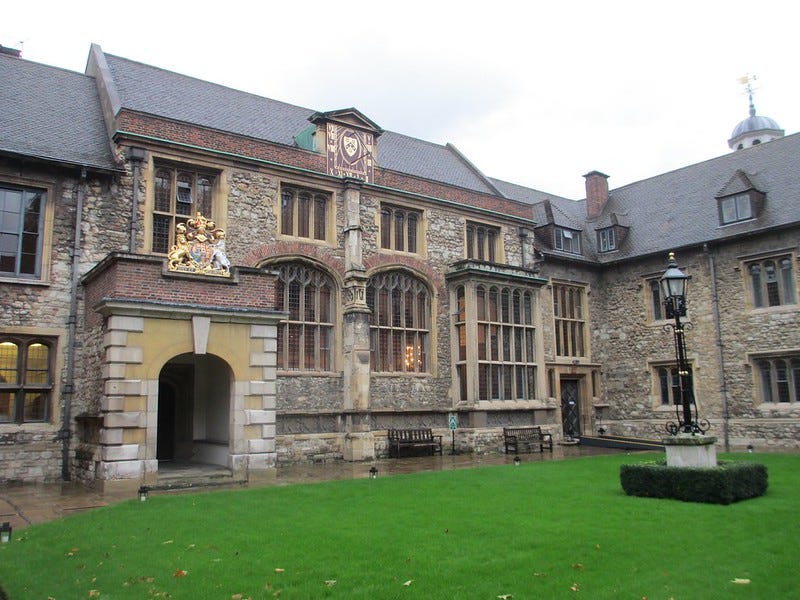
Charterhouse (Smithfield): The Charterhouse is one of those complexes whose buildings date from different periods. Much of it, however, was built in the aftermath of Henry VIII’s dissolution of the monasteries, when the plot was seized from the Carthusians and converted into a grand house. It went on to become a school and almshouses, and it continues in the latter role today. Regular tours of the site are available.
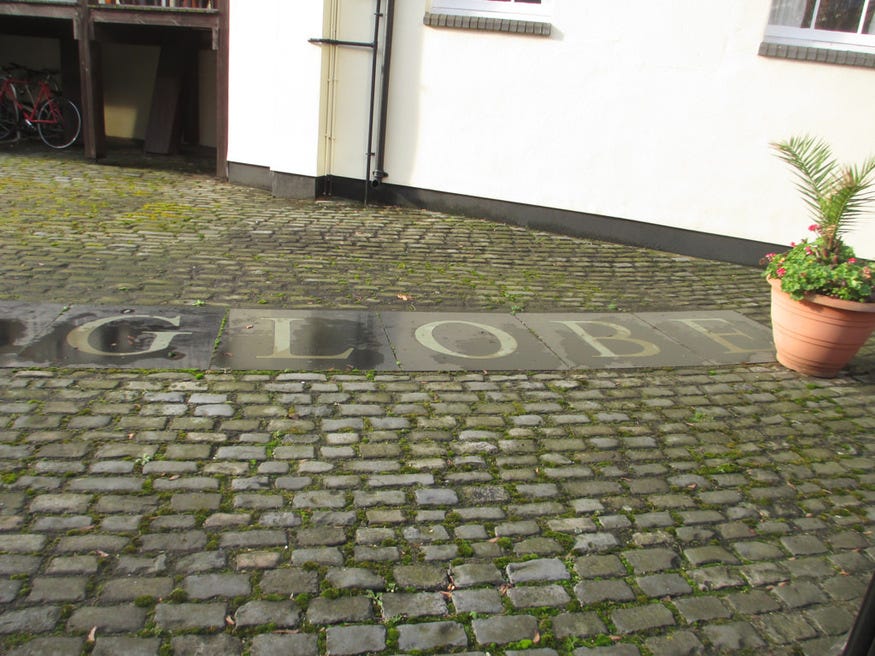
The Globe remains (Bankside): The Globe theatre pulls in Londoners and tourists alike, to watch stagecraft as the Bard knew it (well, without the smells and heckles). It is, of course, pastiche, built in the 1990s as a near-replica. However, the foundations of the original Globe can be seen for free away from the riverside, at Anchor Terrace, Park Street. There’s not much to see, admittedly, but there is a very good information board.
A short walk towards the river will find you next to the Golden Hinde. Sadly, this is a 1970s replica of Sir Francis Drake’s ship, and not proper Tudor. It is open for tours, however.
Gray’s Inn Hall: One of the four Inns of Court — fancy enclaves inhabited since ancient times by lawyers, barristers and their ilk. The main hall dates from the reigns of Mary and Elizabeth, though it’s largely a reconstruction after Blitz damage. In South Square you’ll find a statue of Francis Bacon (the philosopher, not the painter).
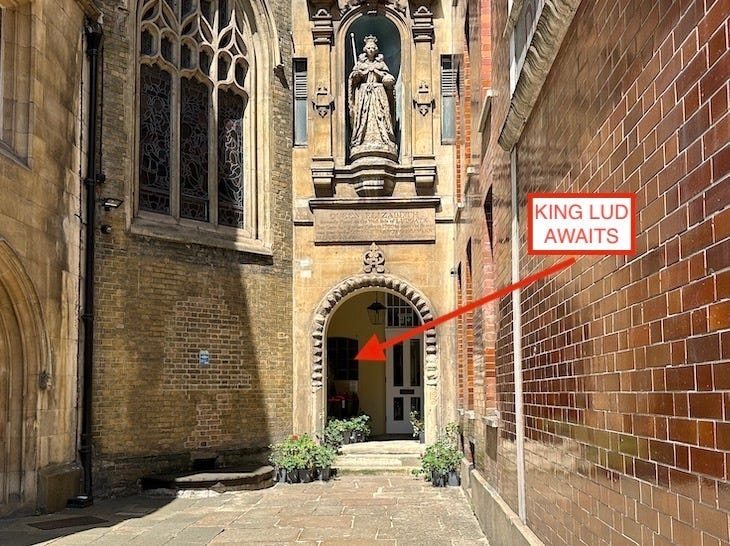
King Lud and Queen Liz (Fleet Street): Amongst London’s oldest sculptures, the statues of Elizabeth I and King Lud (plus sons) skulk in a courtyard beside St Dunstan-in-the-West. The figures all date from the 16th century, and once stood upon Ludgate. King Lud was the mythical founder of London, and also gave his name to Ludgate (in folklore, if not in reality).
Nearby on Fleet Street stands the very Tudor-looking Prince Henry’s Room. It’s pre-Fire, but sadly not quite Tudor, having been built in 1610.
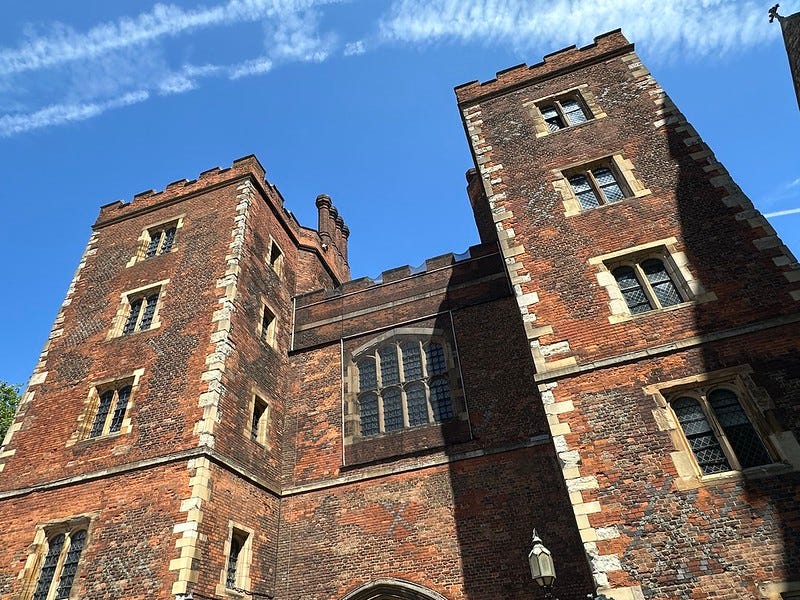
Lambeth Palace Gatehouse: Lambeth Palace is the London home of the Archbishop of Canterbury, and it has been for over 800 years (mitre been even longer). The palace is usually sealed off to the public, but we can get a good eyeful of the Tudor gatehouse from without.
My good friend Christopher Winn (author of I Never Knew That About London etc.) lived for a time in the palace, and shared his memories with me:
“The old doors were (are) the originals from 1490 and required brute strength to haul down the massive bolts and fling the door wide where they would be caught by huge metal latches. Occasionally, especially when it was windy, the latches wouldn’t catch and the doors would bounce out and slam shut again. This almost led me to the Tower when the gate slammed shut in the face of the Duke of Edinburgh (Prince Philip)!”
(I’ll do a full interview with Chris sometime. He has a hogshead of tasty stories to share.)
Lincoln’s Inn (Holborn): Another of the four Inns of Court, and the one with the best Tudor architecture. Most notable is the Old Hall, which is only just Tudor, dating from the early years of Henry VII’s reign. It’s been remodelled several times, and was completely dismantled and reassembled in the 1920s to solve structural issues, yet it remains a fine example of the era.
The eastern gateway of Lincoln’s Inn, leading onto Chancery Lane, is also from the Tudor period. Its bricks were reputedly made on site, hewn from the local clay, while the great oak doors are also of the era. This must be one of the oldest street doors in London. One person who makes frequent use of it is the fictional Tudor barrister Matthew Shardlake who, in CJ Sansom’s novels, lives on Chancery Lane, and uses the portal to reach his chambers in Lincoln’s Inn… an enviably short commute.
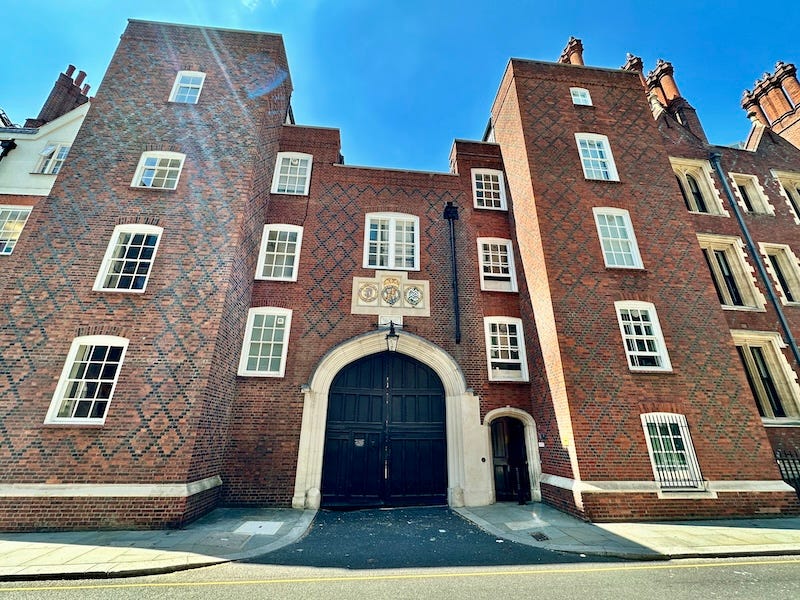
Just inside the gateway, the so-called ‘Old Buildings’ also have Tudor origins, though these have been heavily reworked over the years.
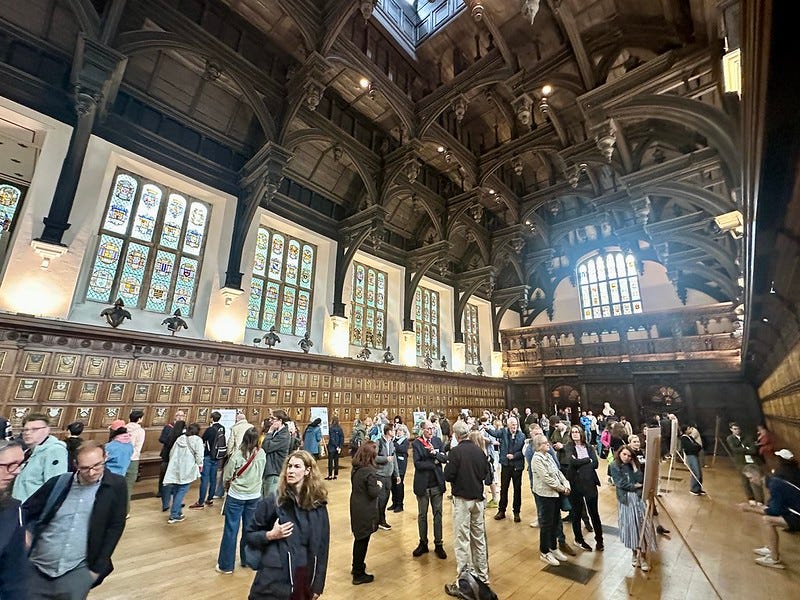
Middle Temple Hall (Fleet Street): Another of the Inns of Court, Middle Temple contains a veritable banquet of historic buildings, but only one substantial 16th century structure. Middle Temple Hall, with its double-hammerbeam ceiling, is exquisitely Tudor, right down to the furnishings. A table at one end is supposedly made from the timbers of the Golden Hinde. This was also the venue for the first performance of Shakespeare’s Twelfth Night on 2 February 1602 — Tudor by the skin of its teeth, given Queen Elizabeth would die a year later.
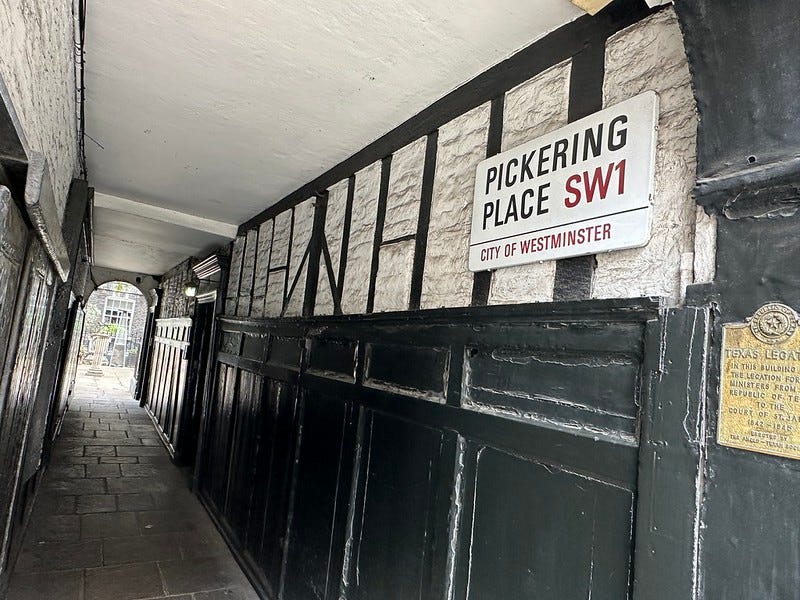
Pickering Place (St James’s): Is this the most dashedly handsome alley in London? 👇 The half-timbering of Pickering Place is of uncertain age. Historic England does not mention any 16th century fabric in its Grade II*-listing. However, Berry Bros & Rudd, the wine merchants who’ve inhabited the building for centuries, do claim it as a surviving fragment of Henry VIII’s tennis court (which certainly did occupy the site). This, then, is a slightly dubious inclusion, but one that looks so delicious it deserves to be part of the list.
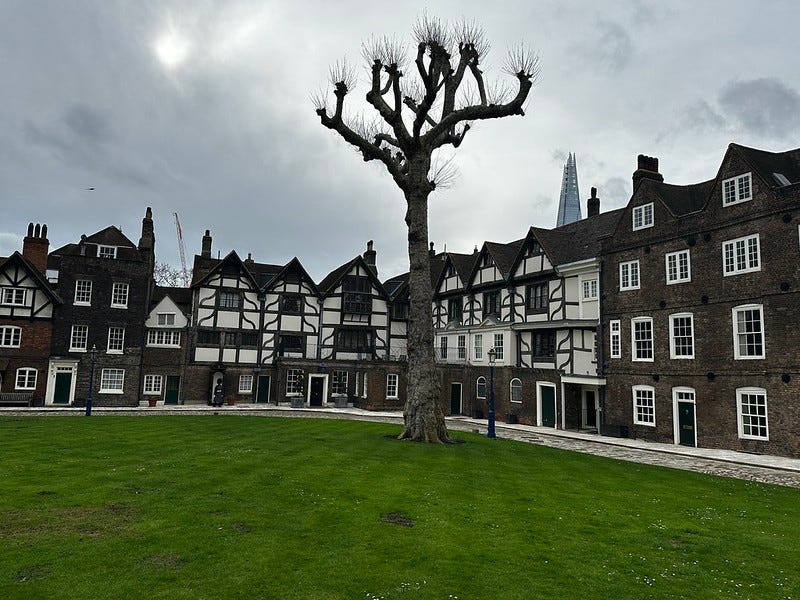
Queen’s House (Tower of London): As we all know, the Tower of London is a temporal tombola, with buildings from every century crowding together. It does, however, contain some notable Tudor structures. The most obvious is the Queen’s House, built in the 1530s for Anne Boleyn. She must have gazed out of those windows on many occasions, completely oblivious to the bloody fate that would one day await her on the Tower Green.
Boleyn would be buried inside St Peter ad Vincula, a church within the Tower, which was built around 1520 (and hence is another Tudor structure). Here, she would lie for eternity beside fellow decapitatees Catherine Howard, Jane Grey and most of Thomas More.
Rose Playhouse (Southwark): A theatre from the same era as The Globe, and located nearby. The remains were rediscovered in 1989 and, after a hard-fought campaign, were preserved for posterity. The site is today used for occasional performances. Thanks to Matthew Lyons for this addition.
Savoy Chapel (Strand): Officially known as The King's Chapel of St John the Baptist in the Precinct of the Savoy, this church was completed around 1512 in the reign of Henry VII, making it a rare Tudor church in what is today the West End. It’s not very well known, tucked away down a side street below Strand. And it’s administered by the Duchy of Lancaster (i.e. under the reigning monarch), so is classed as a ‘Royal Peculiar’ (a tautology if ever there was one).
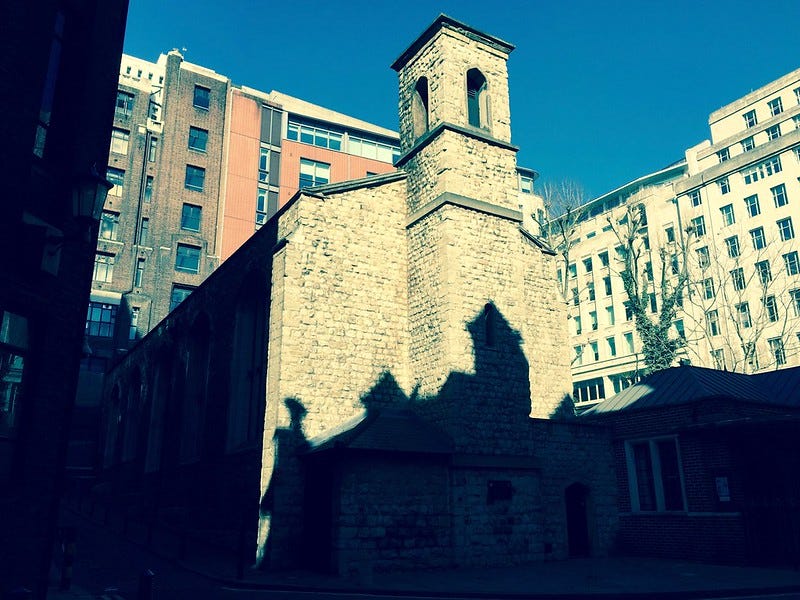
The church has some pretty major pop-cultural cachet. Bob Dylan filmed the promotional video for Subterranean Homesick Blues in the alley alongside.
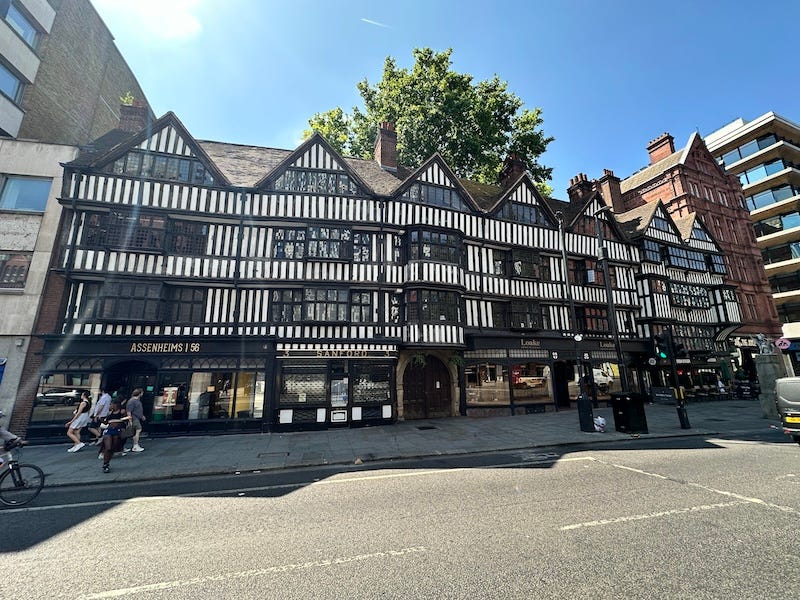
Staple Inn (Holborn): Surely the most famous half-timbered building in London, Staple Inn dates from 1585 and, like Barnard’s Inn, served as an enclave for law professionals. Its great hall survives, though is largely a rebuild after war damage. It’s the frontage, though, which has enchanted passers-by for centuries. Again, much of it will be replacement timber, but the overall effect is the most resplendent spread of Tudor in central London. (Incidentally, I’m typing these words on my phone from the excellent Brew Garden cafe beneath those timbers… but don’t tell the manager because he just admonished me for using a laptop.)
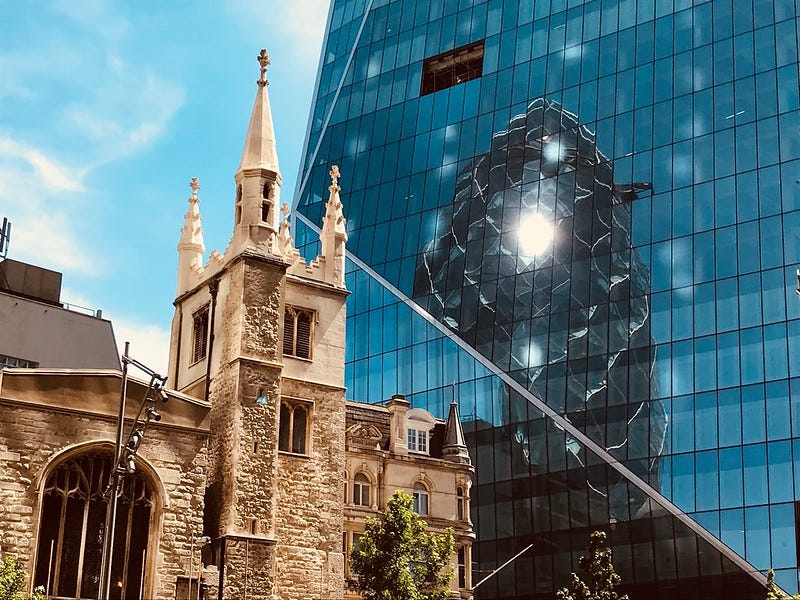
St Andrew Undershaft (City): What a survivor. Built in 1532, St Andrew somehow escaped the Great Fire, the Blitz and the recent encroachment of skyscrapers. Inside is a memorial to my personal hero, the 16th century historian John Stow. His effigy holds a quill, which is replaced every so often in a memorial service. The church’s unusual name recalls a great maypole or shaft that once stood nearby. A replica can now be found beneath the adjacent “Cheesegrater” building.
St Bartholomew’s Gatehouse (Smithfield): The full glory of the gatehouse was only revealed during the First World War, when a nearby bomb blast exposed the underlying timbers. The structure dates from 1595, long after Henry VIII’s men had gutted the old priory of St Bartholomew and torn down half the church in the frenzied greed of the Reformation.
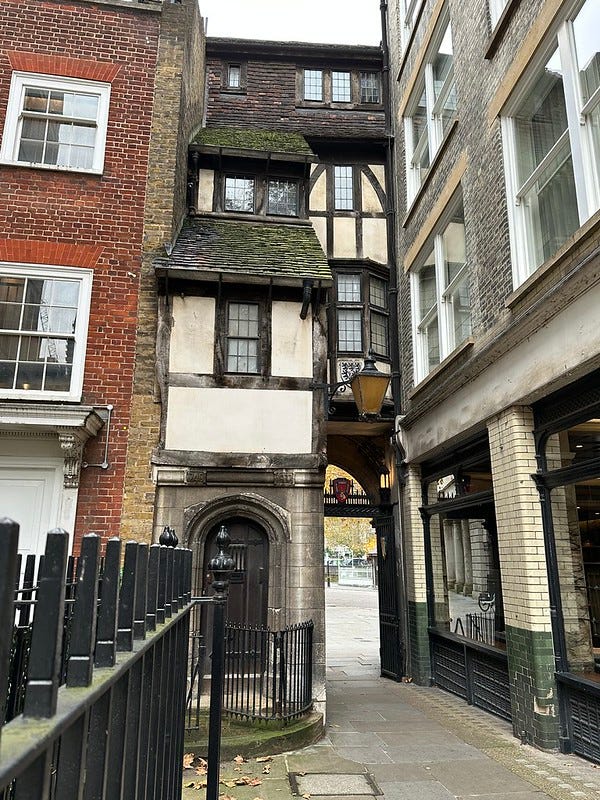
Nearby, on the 18th century gatehouse to Bart’s Hospital features the only outdoor statue of Henry VIII in London (caveats apply).
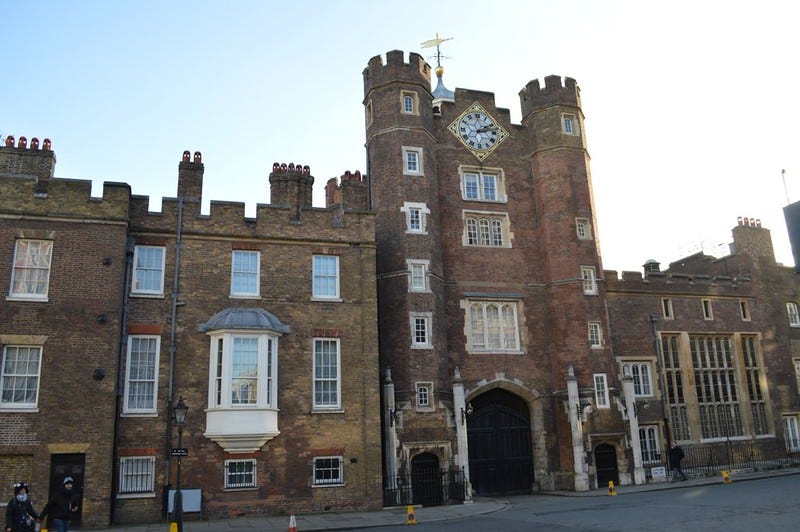
St James’s Palace: There’s no mistaking the quintessential Tudorness of that gatehouse, is there? The whole palace sprang up in the 1530s, on the site of a former hospital for lepers, thanks to the whims of Henry VIII. It’s been added to since, but this remains the largest and most complete Tudor structure in central London. It’s just a shame the public are so rarely allowed inside.
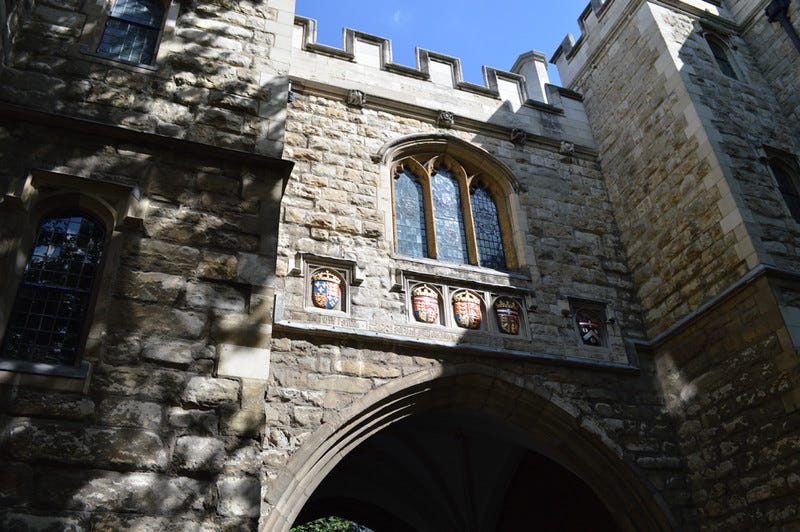
St John’s Gate (Clerkenwell): One of the few ancient gateways still standing in London, this structure once led into the Priory of St John. It was built in 1504, so only enjoyed a few decades of monastic comings and goings before the religious houses were swept away. The gate survived, and went on to become the childhood home of William Hogarth. What we see today, both inside and out, is largely Victorian repair, but it’s still Tudor at core, and a rare survivor of monastic London. It’s free to visit as the Museum of the Order of St John.
St Margaret’s (Westminster): If you said “I’m going to visit the church of St Margaret of Antioch in a World Heritage Site,” then most people wouldn’t realise you were talking about Westminster. But there the church stands, up against the Abbey, built to serve regular parishioners in contrast to its once-monastic neighbour. Built in 1523, this was the last Catholic church completed in London before the Reformation.
Westminster Abbey: Like the Tower, Westminster Abbey is essentially a medieval building with later additions (most recently a new lift and staircase about a decade ago). The main Tudor bit is, quite logically, the Henry VII Chapel, built as a royal mausoleum during the reign of that king. Numerous blue-bloods lie within, including Henry himself, Edward VI, Elizabeth I and Mary I. Head upstairs to the Queen’s Diamond Jubilee Gallery to see wax effigies of various monarchs, including Henry VII, whose face was created from a death mask, and so is probably a good likeness to the founder of the royal Tudor dynasty.
You probably won’t be able to visit the following Tudor structures. I include them to tantalise and tease…
Cloister Court (Houses of Parliament): Apart from the medieval Westminster Hall, almost all of the Houses of Parliament dates from the mid-19th century, when Charles Barry and Augustus Pugin built the iconic complex following a devastating fire. One of the few pre-Victorian survivals is the cloisters, just south of Westminster Hall, built in the early 16th century. The cloisters have, however, been damaged and restored on several occasions, so it’s hard to know what’s original. Thanks to Dave Hughes for this addition.
The Curtain (Shoreditch): Before they decamped to Bankside, Shakespeare and his thespi-friends would put on shows in the Shoreditch area. One Bardic stage, called The Theatre, was transported to the south bank to become The Globe. Another called the Curtain (built 1577) remained in use until at least 1627. It was then lost to history until an archaeological dig rediscovered its remains in 2012. The site has since been redeveloped, but the foundations are still down there, and should be the centrepiece of a Museum of Shakespeare, which has been ‘coming soon’ since before Covid. All’s well that ends well, I guess.
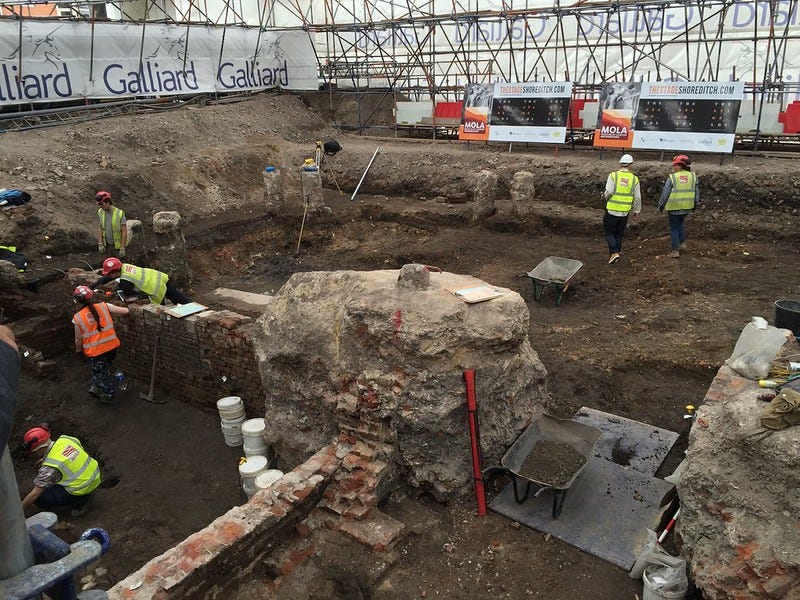
Fisher’s Folly (City of London): Tesco Metro on Bishopsgate conceals an unexpected fragment of Tudor London. Out the back, hidden from the gaze of both public and Google Earth, stands a section of wall from ‘Fisher’s Folly’, a large mansion belonging to one Jasper Fisher. There’s not much to see but, as they say, every little helps. Ian has the full story.
Henry VIII’s wine cellar (Whitehall): You won’t get to see this one unless you work for the Ministry of Defence (or know someone who can sneak you in). Deep beneath the MoD stands the wine cellar of Whitehall Palace — a vast complex almost entirely destroyed in a fire of 1698. The wine cellar was rediscovered during construction of the MoD. Unfortunately, it sat precisely where one of the building’s piles was due to sink, and so the structure was moved in its entirety by a few metres. I did manage to wangle my way in once, but had to promise not to publish the photos. Vic managed to get a couple, though.
Horseguards cockpit: Another hat-tip to Vic Keegan who recently gained access to the little-known cockpit close to Horseguards. From Tudor times, the space was used for animal fights, on which bets would be placed. It’s another surviving fragment of Whitehall Palace.
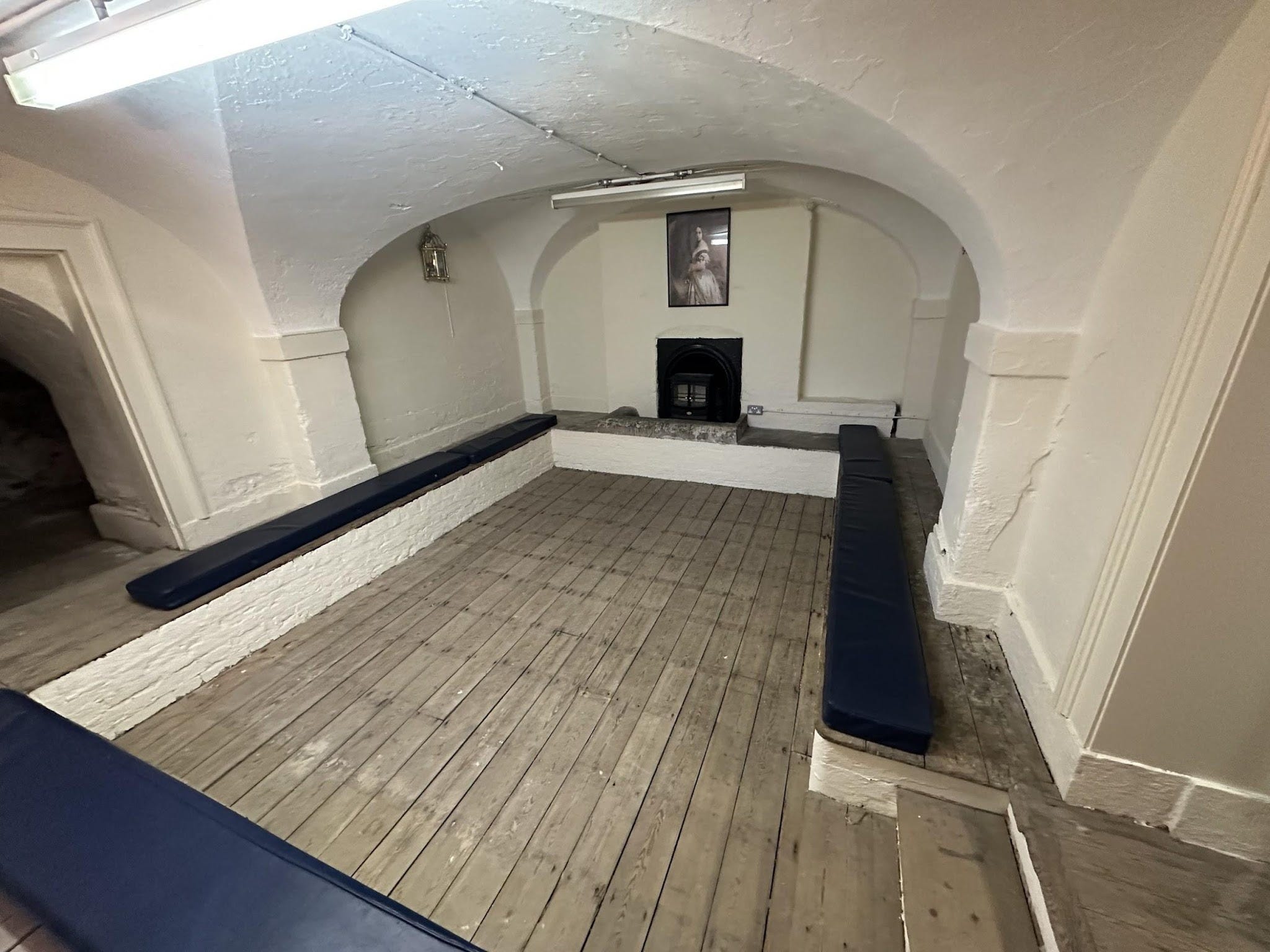
Real tennis court wall (Whitehall): Yet another fragment of Whitehall Palace has survived inside the courtyard of the Cabinet Office. A three-storey wall, once part of Henry VIII’s real tennis court, still stands proud. This Historic England photo is one of the few available online. Google Earth suggests the wall is now covered in ivy. I would love to see this (and the other Whitehall fragments), so if you have Cabinet Office clearance and fancy showing a history geek around, then please do get in touch.
Thanks for reading! I’d love to hear from you, either in the comments or by emailing matt@londonist.com, if you have additions to the list.
Part 2, looking at London beyond the central area, has now been published.
Know somebody who’s into Tudor London? Feel free to share this around…
Comments
Nothing yet. Say the first thing.
Sign in to join the conversation.