

One of the joys of being a cook, a collector, and a writer of the more speculative sort is the opportunities that come from a collection of books like this one. It ticks all those boxes and more, and since I know that more than a handful of LODESTONE readers are also enthusiastic cooks and lovers of cookbooks, here then for the first time, is an annotated and select bibliography for those of you interested in food, cooking, and their related passions.
Let’s begin with three that—as I sit in my little chef’s salon—seem just right as touchstones for the rest.
The first is Salvador Dalí’s, Les Dîners de Gala—a Surrealist feast of 136 surrealist recipes accompanied by bizarre illustrations by the melting-clock-master himself. This, by the way, was reissued by Taschen and is absolutely worth the 25€.
The second is Paul Photenhauer’s infamous/notorious/hilarious, Natural Harvest: A Collection of Semen-Based Recipes. With recipes like ‘Man Made Oysters,’ ‘Semen Sushi,’ ‘Cottage Cheese Surprise,’ and drinks such as ‘Slightly Saltier Caviar’ and ‘Irish Coffee, with a Shot of You,’ his paean to this ingredient that is “nutritious, inexpensive, and available in plentiful supply” writes its own way into this list. Bonus tip: he’s also done a semen-based bartending guide and one for cosmetics.
The third is Zach Golden’s flowcharty, What the F@# Should I Make for Dinner? which makes the list because its both profane AND useful. The companion website is fun too, although for some reason assumes anyone accessing it outside the US is there to wreck havoc and blocks them.
From these glorious heights, let us explore further those little gems which power late-night fantasies of feasts to come.
First off, we have, De Arte Coquinaria Abscondita (On the Hidden Art of Cookery) by Anonymous. Published in Venice, 1655, it is essentially a guide to “invisible dishes” presumably relevant to periods of religious fasting. It describes the preparation of broths that exist only in scent, loaves made from air and prayer, and instructions for “simmering” silence. The Latin recipes are interspersed with contemporary vernacular Italian glosses, suggesting it was intended for household use, not purely as allegory or monastic instruction.
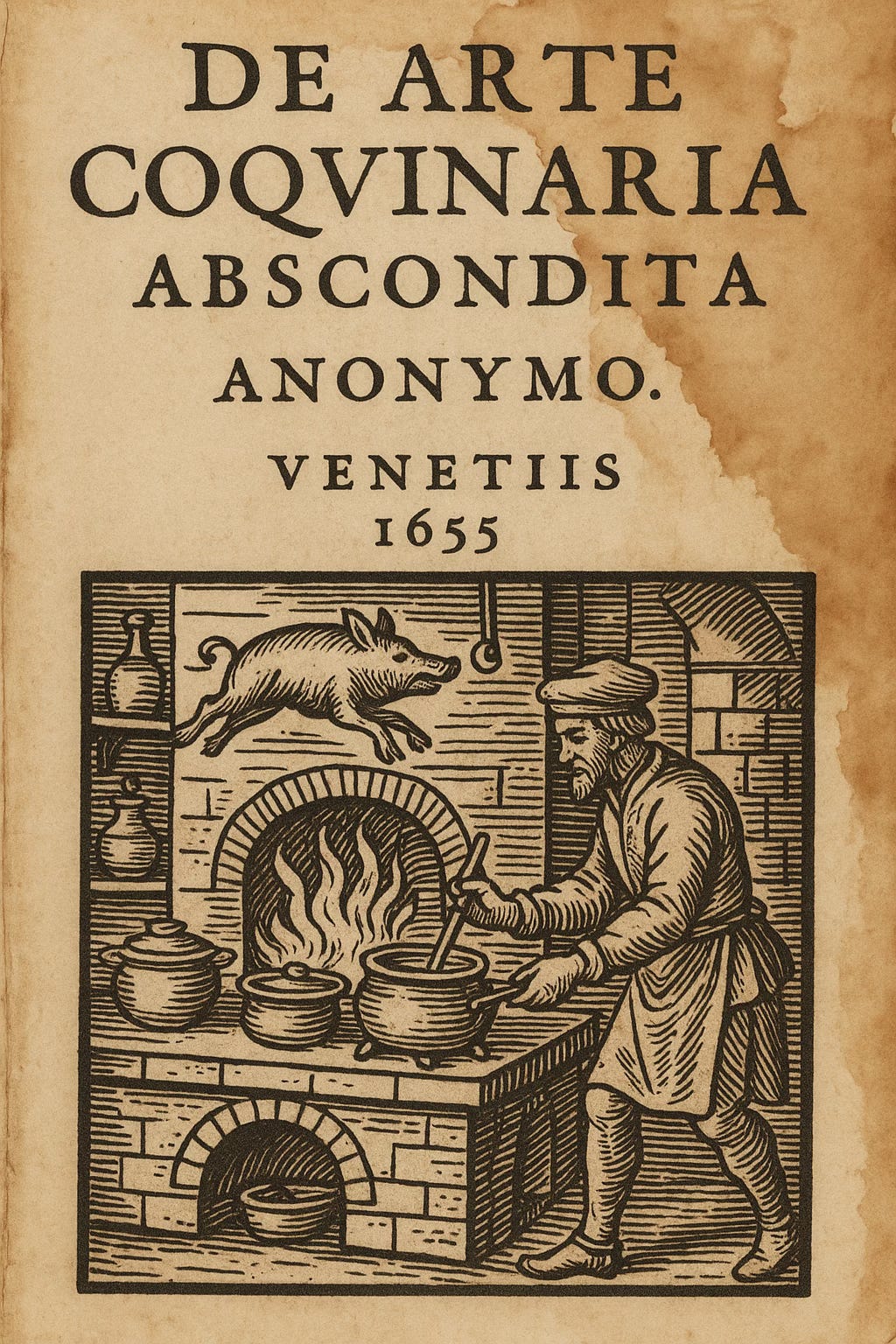
Perhaps not surprisingly, the text echoes alchemical writings of the same era, often substituting metaphysical elements—breath, shadow, memory—for practical ingredients, but it also follows the familiar structure of a kitchen manual: ingredient lists, preparation times, and serving instructions.
Since we’re sort of on the topic of alchemy, we have Margaret Fawcett’s utterly bizarre and charming, The Domestic Alchemist: A Household Book of Transmutations. It was published in London in 1799, by subscription.
Fawcett’s volume was advertised to housewives seeking thrift and ingenuity. It teaches how to “transmute” common ingredients into luxuries: beets stand in for port, burnt sugar mimics coffee, vinegar substitutes for lemon. The tone is earnest as many such publications were at the time, yet the language slips easily into the realm of spells and incantations.
The recipes are practical for a time of scarcity, but the book also reflects Enlightenment curiosity about chemistry and transformation. Fawcett encourages her readers to see the kitchen as a laboratory, where experiments in flavor mirror experiments in science.
While initially dismissed as a novelty, the book became a treasured household companion for those who delighted in its mix of pragmatism and poetry. Copies that survive like mine (inscribed to Miss Charlotte Bennington) are heavily annotated, suggesting it was genuinely used, not merely admired.
Alchemical too, in a way, is Johann Ludwig Richter’s 1836 foray into remembrance and food. Titled, Das Nachtmahl der Erinnerungen (The Supper of Memories), Richter frames his cookbook as an edible diary. Each dish is tied explicitly to memory: “Soup of Homecoming” combines barley and roots familiar to soldiers returning from war; “Cake of a Dead Friend” uses bitter almonds to conjure grief. The recipes work, the form holds, but each is anchored in personal narrative.
Obviously reflecting the Romantic obsession with memory and transience, instructions often include marginalia like “serve only when thinking of her” or “best eaten on rainy evenings.” These touches make it part memoir (albeit one painfully incomplete), part instruction.
Critics at the time found it overly sentimental, yet it resonated with a public eager for works that gave domestic life some sort of poetic gravity. Surviving copies are indeed rare (AbeBooks shows only one available for sale in the last 20 years), though fragments of its recipes reappear in later collections devoted to “comfort food.”
Adjacent to Richter’s meditations/recipes is Clémence Valette’s Le Goût Perdu (The Lost Taste). Published in 1891 in Paris, her work is an attempt to reconstruct flavors on the brink of extinction: hippocras, syllabub, certain medieval spice blends. She approaches each recipe as a careful exercise in historical imagination, often acknowledging that the original taste is irrecoverable. Despite the fact that us moderns can find most of the ingredients and recipes she mentions after a quick Internet search, the book still reads as somewhere between gastronomy and elegy, permitting us a small detour into the space where memory, loss, and want mingle.
And finally, let’s end, appropriately, with Raúl Márquez’s Manual de Cocina Imposible (Manual of Impossible Cookery).
First published, if published is even the right word for a bunch of mimeographed pages stapled between two pieces of card stock, in 1972 Mexico City, it is a roving parody of the seemingly endless stream of bureaucratic, formal, and occasionally pretentious cookbooks of the time.
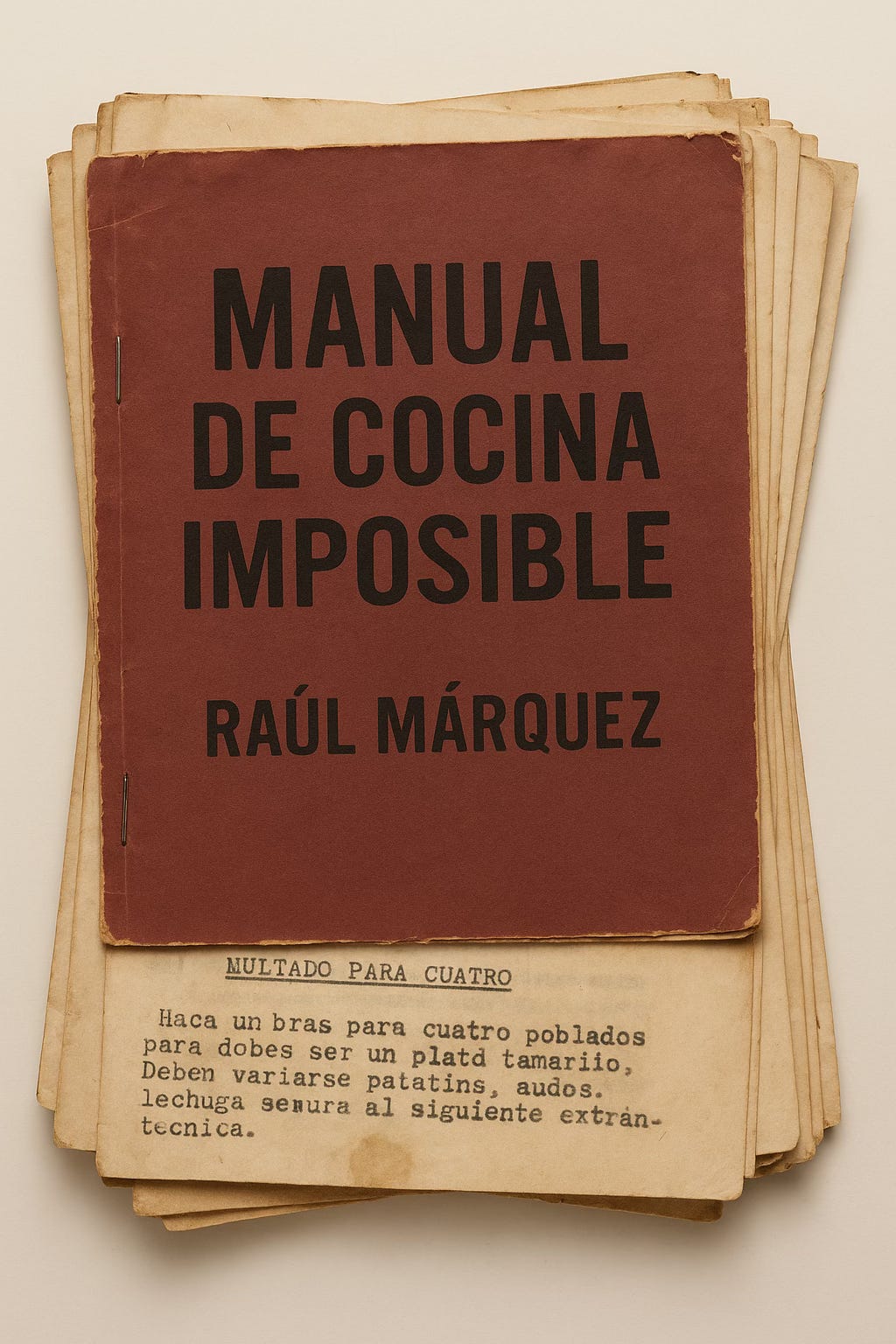
Recipes are impossible to complete to spec: ‘Soup with Too Many Hands’ requires more assistants than can be gathered around a pot or even in a kitchen (various ‘editions’ of the Manual specified various numbers, with the average being somewhere around 750). The recipe for ‘Perpetual Stew’ is right out of the algorithmic chaos of our current age, and has no end point to either the list of ingredients or how long they might be expected to cook.
As an artifact of the student movements in Mexico during the early 1970s, it is one-part political project and one-part culinary. During a period of frustrated and desperate innovation, each of the recipes reflects the desire to make something useful while at the same time being both comic and critical. The food shortages of the time meant that these ‘impossible recipes’ were often read (correctly, certainly) as allegories for the failed promises of the government and the endless struggles of the workers and students. Meals as metaphors for systems that never fed the people they endlessly claimed to serve.
But, despite this, as well as its profound satiricism, many recipes in the Manual are partly functional. A bean dish named the ‘Unfinishable Casserole’ became a staple in student kitchens. Something all of us can appreciate.
So, what’s for dinner tonight?
If you enjoyed this issue of Lodestone, I’d really appreciate it if you did something with it. Restack, send to a fellow aficionado of speculative cookery, repost on your favorite platform, or just give it a like. It does help this sort of work get a wider audience.
No posts
Comments
Nothing yet. Say the first thing.
Sign in to join the conversation.