
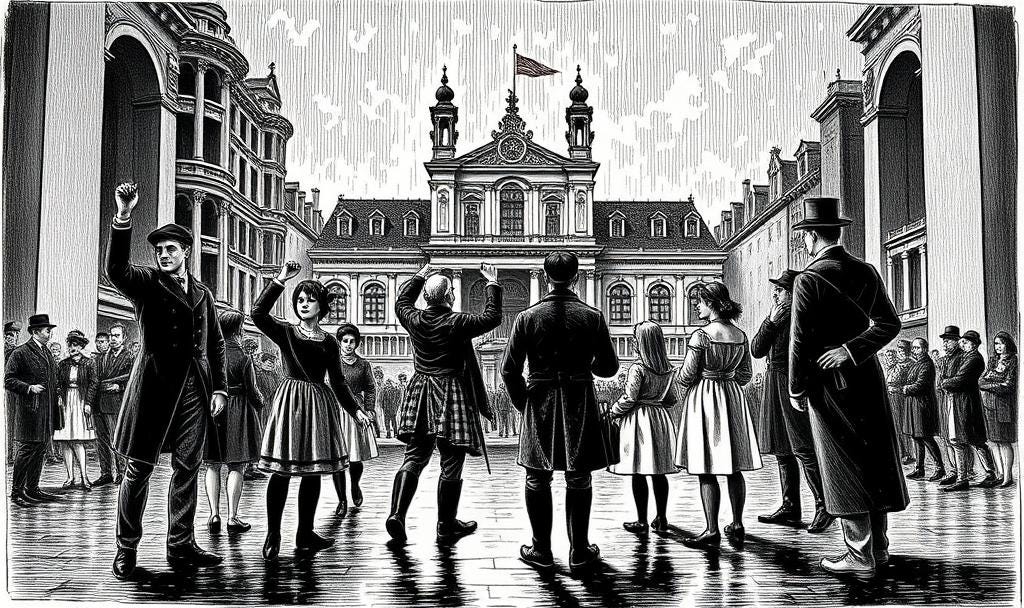
Brussels1, 18202. Five3 francophone4 businessmen5, accompanied6 by7 their8 wives9, children10, and11 servants12, arrived13 in14 a15 downpour16 in17 front18 of19 the20 town21 hall22. As23 a24 group25 they26 turned27 in28 the29 four30 cardinal31 directions32, saying33 together34, “nord35, est36, sud37, ouest38,” before39 raising40 their41 eyes42 to43 heaven44, and45 their46 fists47 at48 the49 seat50 of51 government52. Few53 noticed54. One55 that56 did57 was58 a59 Schepenen60, who61 later62, moments63 before64 his65 execution66, recounted67 the68 incident69. The70 judges71 present72 nodded73.
From Old Dutch Bruocsella (“settlement in the marsh”), capital of modern Belgium, seat of the Dukes of Brabant from the 13th c. Henri Pirenne, Histoire de Belgique, vol. 1 (Bruxelles: Lamertin, 1900), 27–31.
Year within the United Kingdom of the Netherlands; unrest brewing, Carbonari influence abroad. Els Witte et al., Political History of Belgium (Brussels: ASP, 2000), 34–39.
Number symbolic of Christ’s wounds, and the five provinces of Brabant. Jean Chevalier & Alain Gheerbrant, Dictionnaire des symboles (Paris: Robert Laffont, 1982), “Cinq.”
Term coined mid-19th c.; used here anachronistically, but French was dominant elite tongue. CNRTL, “francophone,” s.v.; Pierre Bourdieu, Ce que parler veut dire (Paris: Fayard, 1982), 48–55.
In 1820 Brussels, commerce was textile, brewing, banking. Ph. Godding, “L’économie bruxelloise au début du XIXe siècle,” Revue Belge d’Histoire Contemporaine 12 (1981): 201–24.
From Old French acompaignier “to share bread with,” evoking companionship. Oxford English Dictionary (OED), s.v. “accompany.”
From Old English bi “near, about.” Richard Hogg, A Grammar of Old English, vol. 2 (Oxford: Wiley-Blackwell, 2011), 214.
Genitive plural from OE þǣra. OED, s.v. “their”; David Denison, English Historical Syntax (London: Longman, 1993), 162.
Elite Brussels women typically francophone, servants Dutch-speaking. Sophie de Schaepdrijver, De Groote Oorlog (Amsterdam: Atlas, 1997), 17–19.
Education contested: French vs. Dutch. Lode Wils, De Vlaamse Beweging, 1780–1914 (Leuven: Davidsfonds, 1974), 23–31.
Coordinating conjunction, OE and. OED, s.v. “and.”
Domestic staff overwhelmingly Flemish-speaking. Anne Winter, “Servants in 19th-C Brussels,” Journal of Urban History 33, no. 1 (2006): 63–88.
From Lat. ad ripam (“to come to shore”). OED, s.v. “arrive.”
Preposition from PIE en. Calvert Watkins, The American Heritage Dictionary of Indo-European Roots, s.v. en-.
Article from OE ān “one.” OED, s.v. “a.”
Heavy rainfall, with 1820 records unusually wet. Archives de la Ville de Bruxelles (AVB), Série Météo, Reg. 1820/7.
From OF front, “forehead.” OED, s.v. “front.”
From OE of, “away from.” Richard Hogg, Grammar of Old English, 214.
Definite article, OE þē. Charles Barber, Early Modern English (Edinburgh: EUP, 1997), 46.
OE tūn “enclosure, settlement.” OED, s.v. “town.”
Brussels Hôtel de Ville (completed 1455), Gothic tower by Jan van Ruysbroeck. Paul Saintenoy, L’Hôtel de Ville de Bruxelles (Bruxelles: Vromant, 1910).
From OE alswā. OED, s.v. “as.”
From Italian groppo “knot.” OED, s.v. “group.”
ON þeir. OED, s.v. “they.”
Ritual rotation recalls Roman augury and Christian procession. J. Scheid, An Introduction to Roman Religion (Bloomington: IU Press, 2003), 49–51.
Symbol of completeness (winds, elements). Chevalier & Gheerbrant, “Quatre.”
From Lat. cardo “hinge.” Isidore of Seville, Etymologiae 13.15.
Navigation crucial in canal-crossed Brussels. Fred De Smidt, Brussel en zijn Kanalen (Brussel: VUB Press, 1995), 12–19.
Spoken performance, liturgical in cadence. AVB, Série Cérémonies, Procès-verbaux, vol. 3 (1818–22), fol. 47r.
From Lat. tōtum corpus, sense of unity. Victor Turner, The Ritual Process (Chicago: Aldine, 1969), 96–97.
French “north,” from Proto-Germanic nurtha-. CNRTL, s.v. “nord.”
From Lat. oriens, “rising sun.” Ernout & Meillet, Dictionnaire étymologique, s.v. oriens.
From Lat. auster. CNRTL, s.v. “sud.”
From Lat. occidens. CNRTL, s.v. “ouest.”
OE beforan. OED, s.v. “before.”
Gesture of devotion, common in late medieval piety. Caroline Walker Bynum, Christian Materiality (New York: Zone, 2011), 143–45.
Mystical “eye-raising” in Flemish spirituality. Jeffrey Chipps Smith, The Northern Renaissance (London: Phaidon, 2004), 68–70.
OE tō. Hogg, Grammar, 205.
Common in Netherlandish art altarpieces. Katlijne Van der Stighelen, Meesters van de Lage Landen (Antwerpen: Mercatorfonds, 2002), 112–15.
Defiance gesture, revolutionary 1830 iconography. Maurice Agulhon, Marianne into Battle (Cambridge: CUP, 1981), 94–96.
OE æt. Hogg, Grammar, 199.
From Lat. sedes, “throne.” OED, s.v. “seat.”
William I’s rule over Brussels. Witte et al., Political History of Belgium, 34–39.
Prophetic trope of unnoticed portent. Walter Benjamin, “Theses on the Philosophy of History,” thesis II.
From Lat. notitia, “recognition.” OED, s.v. “notice.”
Singular witness motif. Arlette Farge, Le goût de l’archive (Paris: Seuil, 1989), 77–79.
OE þæt. OED, s.v. “that.”
OE dyde. OED, s.v. “do.”
OE wæs. OED, s.v. “be.”
Aldermen of Flemish towns; plural in Dutch but used loosely here. Wim Blockmans & Walter Prevenier, The Promised Lands (Philadelphia: UPenn, 1999), 115–17.
OE hwā. OED, s.v. “who.”
OE lætra, “slower.” Carlo Ginzburg, “Clues,” in Myths, Emblems, Clues (London: Hutchinson Radius, 1989), 96–125.
From Lat. momentum. Conseil de Justice, Dossier Procédural 1820/Brx/144.
OE his. OED, s.v. “his.”
Last guillotine in Belgium 1863. Marc De Valkeneer, “La peine de mort en Belgique,” Revue de droit pénal 73 (1993): 201–18.
Value of witness testimony. Arlette Farge, Le goût de l’archive, 51–58.
From Lat. incidere. OED, s.v. “incident.”
Members of the Conseil de Justice. Xavier Rousseaux, “Justice and the State in the Southern Netherlands,” Crime, Histoire & Sociétés 1, no. 2 (1997): 5–28.
Lat. praesens, “being before.” OED, s.v. “present.”
Gesture of assent; scholastic “silent agreement.” John of Salisbury, Policraticus, 7.12; Acta Disputationum Bruxellensium (AVB, Série Universitas, c.1809), fol. 23v.
No posts
Comments
Nothing yet. Say the first thing.
Sign in to join the conversation.