
I teach applied recipe development to help readers create the aesthetic of living and cooking they want in their lives. I don’t just publish recipes; I teach you how to become a better cook, a better baker ~ aesthetically.
Share TASTE | Pacific Northwest
(TASTE Tip: Don’t forget to check What’s Next? at the bottom of the page. A super-fun interview on my my home fridges!)
Food is the tie that binds, no matter our culture, our location, or our regional preferences. Above all, food inspires generosity.
Mira Dessy, commonly known as The Ingredient Guru, is an educator of holistic nutrition on Substack. Mira is the definition of generosity as she continually extends herself in community to other food writers to showcase what they do best.
Mira kindly asked if I would be interested in an interview on the topic of my cookbooks! Who could resist?
What follows is the verbatim interview ~ ten questions that I answered in response to the call!
Mira:
“How would you describe your collection of cookbooks and nutrition books?”
My collection is weighted in favor of books that teach about flavor development as opposed to those that are memorialized in a single culture. Perhaps twenty percent are professional textbooks on baking, food styling, wine and nutrition. I look for authors with authentic voices on their subjects, many of whom are professional chefs or convey a strong regional standard.
“How many cookbooks (and food-related books) do you estimate you have—and how are they organized, if at all? (Alphabetical, by cuisine, by use, in stacks on the counter…?)”
Currently, I own 105-110 cookbooks, the majority of which are organized by region or topic. My partner and I bought numerous stainless steel Metro racks from the Oregon Culinary Institute when it closed in 2020. They're in our dining room, in my office and in my partner's office. We like the juxtaposition of the racks with the simple lines of our furnishings. I love the visibility of and easy access to the books. We have special Metro shelves for wine and liquor storage, baking paraphernalia and other non-food books.
“In percentage terms, how many of your cookbooks do you actually cook from?And how many are more for inspiration or learning?”
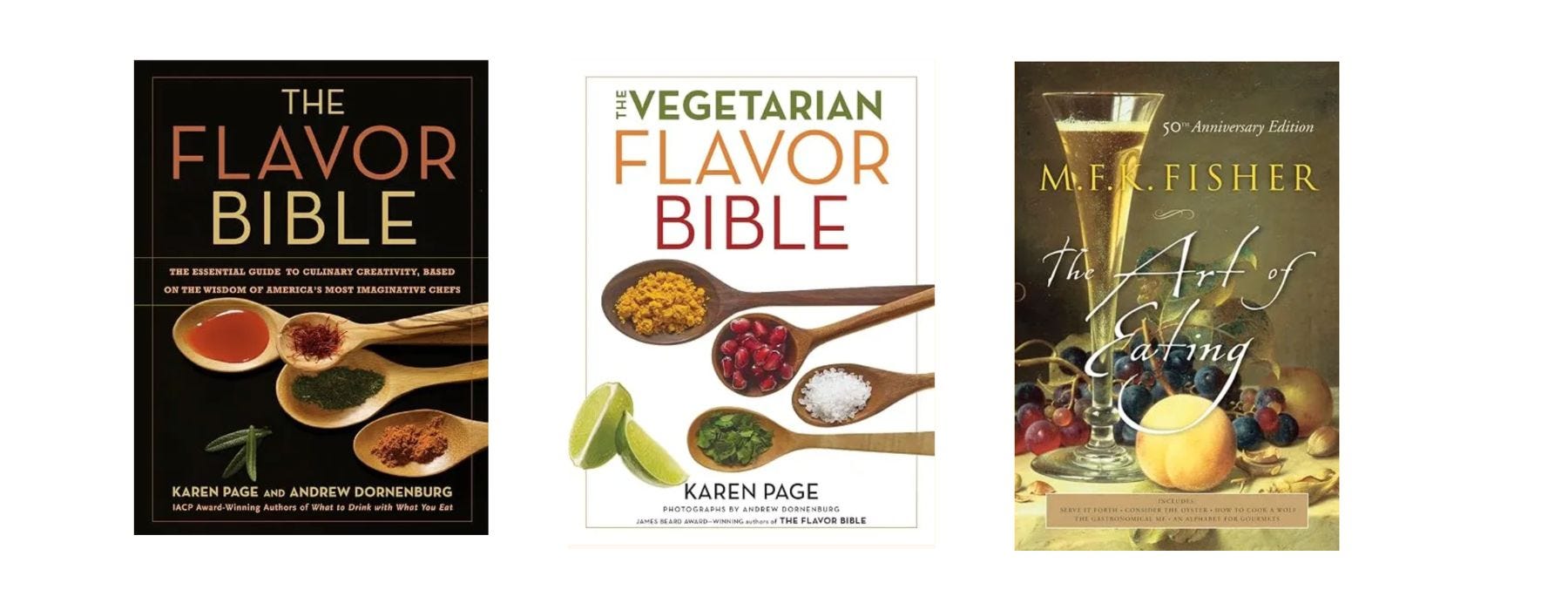
There is only a small percentage of books I don’t at least reference as many can contribute to my thinking on flavor development. The books I use constantly as manuals are The Flavor Bible: The Essential Guide to Culinary Creativity, Based on the Wisdom of America’s Most Imaginative Chefs by Andrew Dornenberg and Karen Page and The Vegetarian Flavor Bible: The Essential Guide to Culinary Creativity with Vegetables, Fruits, Grains, Legumes, Nuts, Seeds, and More, Based on the Wisdom of Leading American Chefs (same authors), which are standard fare in restaurants. While I love a deep dive on a particular subject, I don’t cook from books of memoir like M.F.K. Fisher’s The Art of Eating.
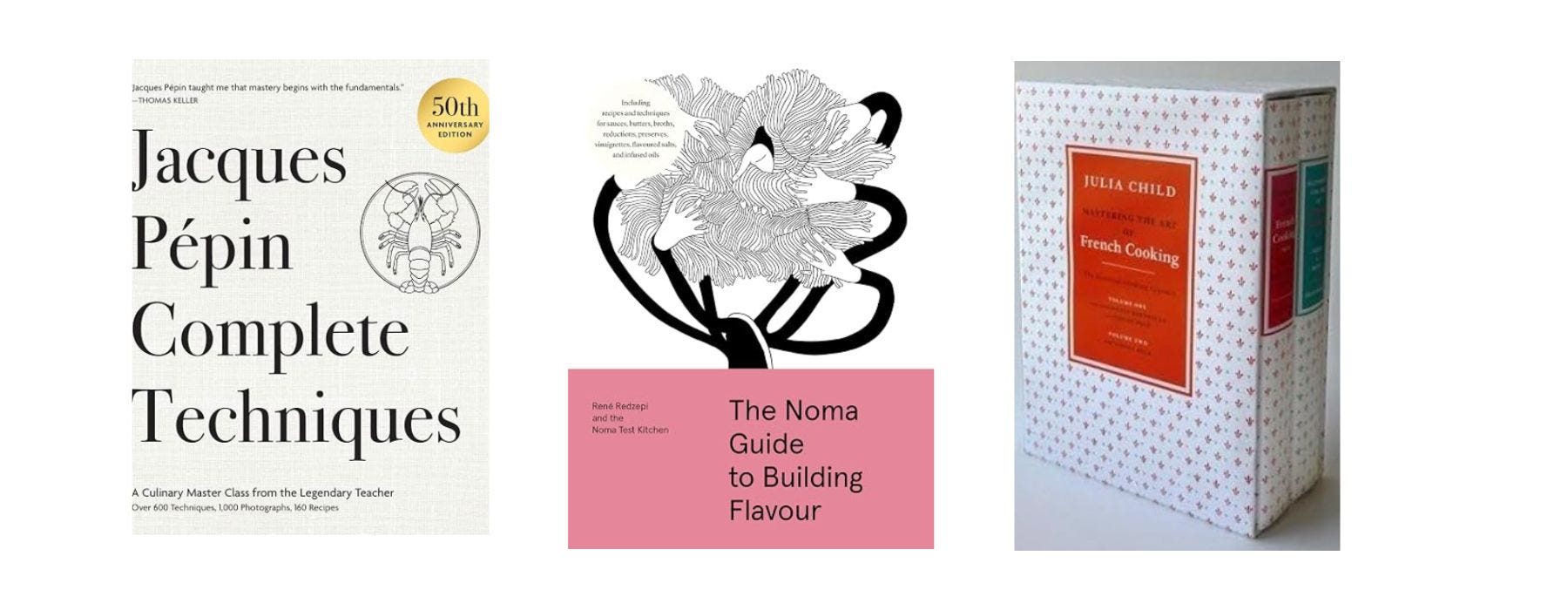
The first is Jacques Pépin Complete Techniques 50th Anniversary Edition: A Culinary Master Class from the Legendary Teacher. It was a gift to myself and my partner as a true desk reference. It's a distillation of Chef's technical skill with over six hundred techniques. We're still learners! The second is The Noma Guide to Building Flavor by Rene Redzepi and the Noma Test Kitchen. I bought it specifically to help flesh out my own cookbook using the inventive techniques the entire Noma staff created. The third, the two-volume set of Mastering The Art of French Cooking by Julia Child, was a surprise gift from my partner when he realized I didn't already own them. A little crazy, actually, given my passion for Julia Child. They're all teaching books.
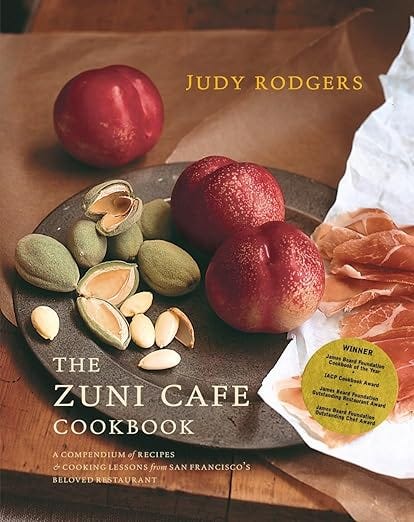
That's easy. It would have to be The Zuni Café Cookbook: A Compendium of Recipes and Cooking Lessons from San Francisco’s Beloved Restaurant. It's a beautiful synthesis of food lore, cooking technique, and honest cuisine. I incorporated Judy Rodgers' use of the tilde in my own writing ~ an homage to how much love I have for what she has taught us.
No cookbooks were used in my family as my adoptive mother disdained cooking! Though both of my grandmothers were cooks ~ creative Depression-era masters of managing miniscule food provisions ~ the cooking gene leapt over my adoptive mother. Cookbooks were an unaffordable luxury for them. They cooked what their mothers taught them; one grandmother grew and canned most of her own vegetables and fruit. I had the great good fortune to meet my birthmother at age thirty. Her large extended family were cooks! They grew everything they ate! Nature and nurture.
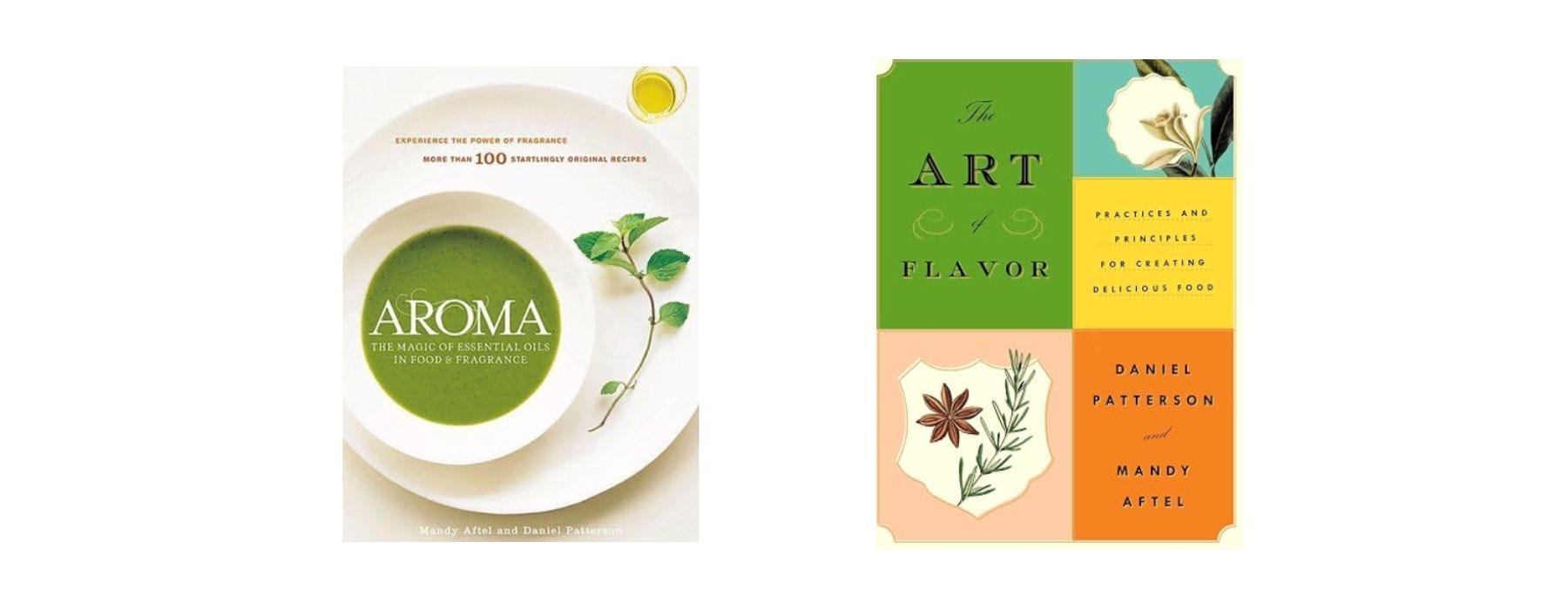
Several years ago, I read Daniel Patterson and Mandy Aftels' Aroma: The Magic of Essential Oils in Food & Fragrance which describes how pure essential oils capture the qualities of living plants. I believe it's out of print. Patterson is a two-star Michelin chef and Aftel is a well-regarded natural perfumer. It changed my thinking completely on aromatics as the primary component of flavor. Their second book, The Art of Flavor: Practices and Principles for Creating Delicious Food, teaches how to build the components of flavor using natural, food-safe essential oils, drop by drop. I used this process to develop Essential Douglas Fir Shortbread, which we wholesaled to Zingerman's in Ann Arbor, Michigan.
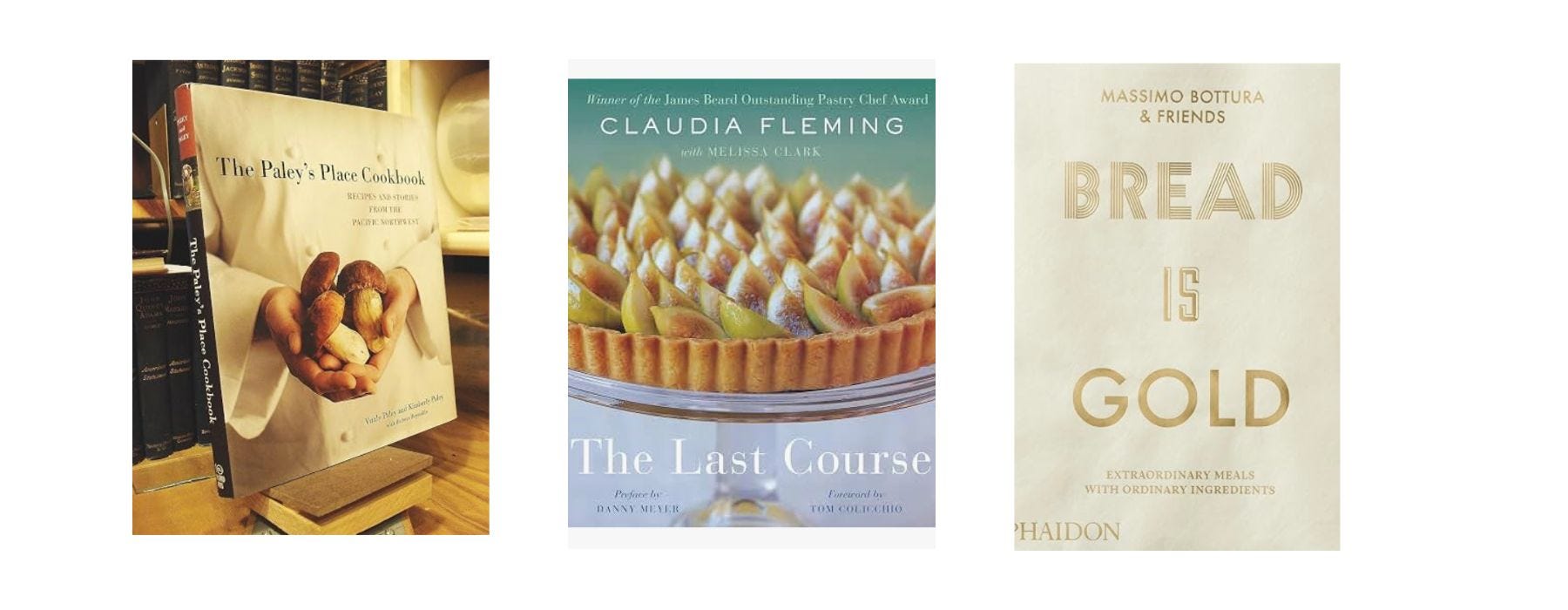
One is The Paley’s Place Cookbook: Recipes and Stories from the Pacific Northwest, by Vitaly (Vito) Paley. I did my culinary school externship at Paley's Place in Portland, a James Beard Award winner, and at Paley's big downtown restaurant, Imperial. The experience of working with their pastry chefs was priceless. Another is The Last Course by Claudia Fleming, the former pastry chef at Gramercy Tavern, part of the Union Square Hospitality Group. I love Claudia's style and flavor complements. The third is Massimo Bottura's Bread is Gold. Massimo, chef of the three-star Osteria Francescana in Modena, Italy, founded Food for Soul, an org that turns food waste into community by feeding those in need in beautiful restored spaces using the donated talents of other world class chefs. His "refettorios," soup kitchens dedicated to making extraordinary meals with leftover, donated, otherwise wasted ingredients, now exist in nine countries. Fingerprints and food stains all over this one.
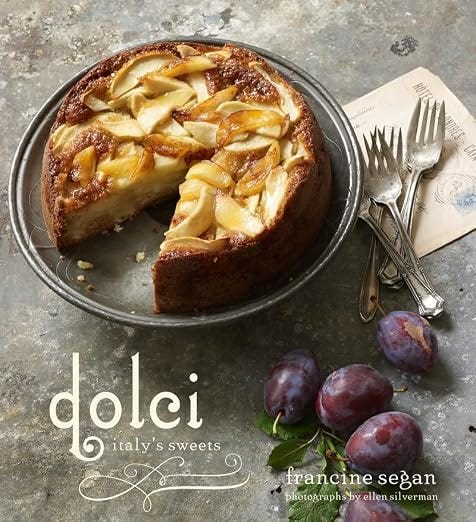
Francine Segan's Dolci: Italy’s Sweets is a book I come back to again and again just to savor the simple, luscious flavors of Italy. Admittedly, I do occasionally cook from it. The book inspired me to always make limoncello at home. We like it more than Italian versions because I can control the intensity of the lemon [more] and the sugar [less]. When I cooked professionally, I adapted the author's Ricotta Pear Cake to make it gluten-free for the trattoria. A bit tricky, but super-delicious.
I think of cookbooks as partners, as ways of furthering my own learning. We have the luxury of living on the 45th parallel where extraordinary micro-climates yield exceptional fruit, wine grapes and seafood. I'm deeply committed to exploring and promoting the flavors of the Pacific Northwest so I'm always looking for ways to perfect my skills and think about local ingredients differently.
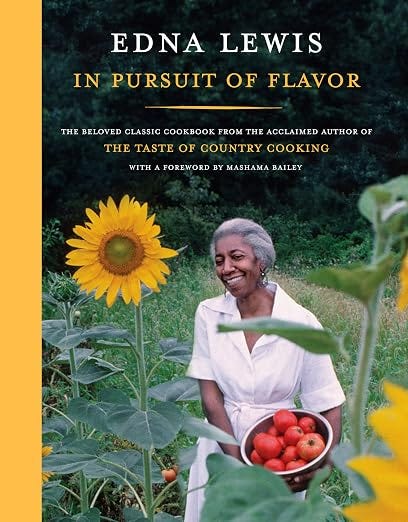
Hands down, it would be Edna Lewis's In Pursuit of Flavor. Miss Lewis is, then and now, widely acclaimed as the doyenne of American Southern foodways. When I was finding my way as an encore career chef in my mid-sixties, a regular trattoria guest with whom I had struck a relationship said, "Linda, your cooking is in the same style as Edna Lewis's." I couldn't have imagined a compliment so profoundly kind or transformational. Miss Lewis embodied simplicity, precision and elegance.
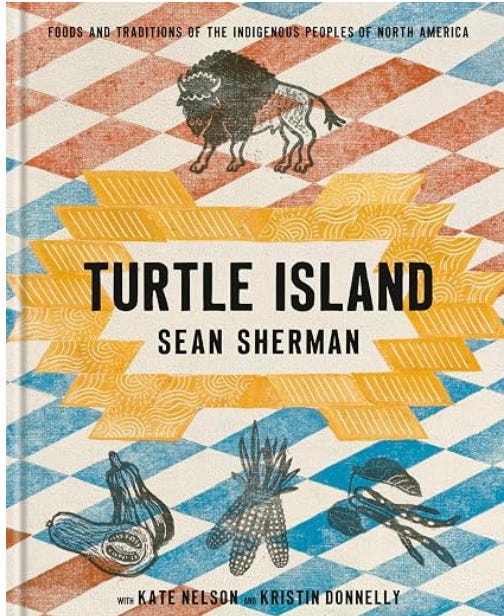
No question: Sean Sherman's Turtle Island: Foods and Traditions of the Indigenous Peoples of North America. Because the Pacific Northwest is rooted in Indigenous culture, I'm anxious to learn in-depth what the author, an Oglala Lakota chef, has to teach. Everything I've read about the book is that it's a tour de force. It's important to me to respect the cultures of those whose food is tied to place and season.
“I truly enjoyed learning more about Linda and the inspirations behind so much of what she shares on Taste. I also found myself smiling at her use of the tilde instead of an em dash. I may have to give that a try myself.
“She shares a wonderful collection of classic, regional, and foundational cookbooks, many of them centered on the art of flavor. It made me stop and think that flavor really is what food is all about, yet I suspect many of us don’t give it the attention it deserves.
“I especially enjoyed hearing about her family’s tradition of cooking from scratch without relying on cookbooks. I hope some of those recipes were passed down through the generations. Those are often the recipes we treasure most because they’re seasoned not just with good ingredients, but with love, family, and cherished memories.
“If you’ve enjoyed this glimpse into Linda’s shelfie, there’s more to come. Each edition of The Nourished Shelfie brings a new perspective, new inspiration, and perhaps your next favorite cookbook or read.”
Note: All image credits, except the lead photo, are Mira.
Another super-fun project is coming up. I just finished an interview with Substack author, Lynn Hill, whose Stack is called FoodStak. Lynn is an enormous resource for everything in the Substack food world.
I open my refrigerator doors to reveal all! That interview is coming up shortly.
Likes, Comments and Restacks are highly prized! Please click on the ❤️ icon to let the algorithm know our work is worth supporting.
If you enjoy learning how to coax out flavor; if you feel inspired to protect the beautiful food environment around you; if you enjoy more meaningful personal essay on what truly feeds us, you’re very welcome to push the Subscribe button.
Perhaps, even share with a friend. It’s nice to share.
TASTE has gratitude for every subscriber. Our particular thanks to our paid subscribers, our TASTE Buds, whose generosity supports every reader.
Every TASTE | Pacific Northwest post is human-created, personally written, personally read ~ to you.
If you’d like to read my complete AI-Use policy, please visit my About page.
Comments
Nothing yet. Say the first thing.
Sign in to join the conversation.