
June 25th, 1973: John Dean stood before the red leather “hot seat” reserved for witnesses in the Senate’s Watergate investigation hearings. In an age of wildly patterned, neon-colored ties, and zoot-suit-wide lapels, the self-contained 34-year-old lawyer seemed a paragon of unassuming properness in his crisp button-down shirt and tan suit. Hardly the potential “engine of impeachment” as The Washington Star columnist Mary McGrory speculated.
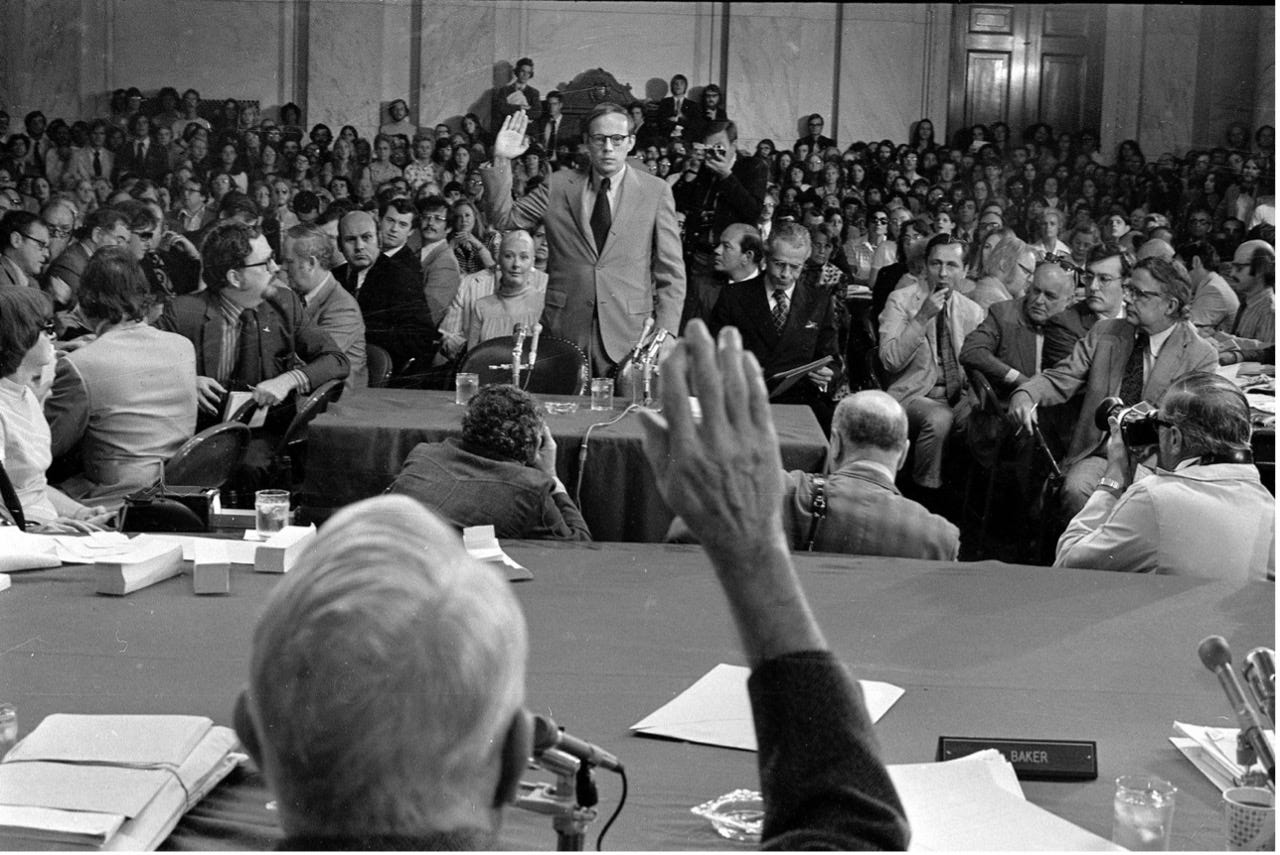
And yet, the grandiose caucus room was jammed full of people anxious to hear what this young White House counsel to President Nixon would say. Until recently, he’d been a virtual unknown around the capital city—until acting FBI director Patrick Gray implied in his April confirmation hearings that Dean asked him to destroy evidence about Watergate. That led to Watergate’s cover-up beginning to unravel, the White House’s two most powerful men—Bob Haldeman and John Ehrlichman—resigning, and Nixon firing Dean, setting him up to be the scandal’s scapegoat.
The Senate committee’s seven members sat fortressed behind long, carved mahogany tables, buttressed by congressional aides and staffers. Encircling them and Dean were 30-feet worth of television cameras and spotlights. A scrum of photojournalists sat cross-legged on the floor at his feet, their cameras pointed toward Dean’s face to record every grimace, any trickle of sweat, any glimmer of guilt. Within arm’s length of them were print reporters at makeshift desks, pen and notebooks ready. Spectators who’d waited for hours to snare a spot were so thick in number that many stood jammed against the marble walls, grateful to be leaning on the cool stone in D.C.’s summer oven of humidity.
The room rumbled with hundreds of whispered conversations, rumors, conspiracy theories, and questions.
But as soon as Dean raised his hand to take his oath, the room snapped from gawking cacophony to silence. Across the nation—in homes, offices, bars, and taxicabs—60 million people leaned toward TVs or radios, turning up the volume. And they stayed that way, mesmerized and horrified. For five jaw-dropping days, Americans hung on Dean’s every word—totally unprepared for the massive wrongdoing he revealed.
“Dean turned the lights on out there in the country,” said CBS correspondent Leslie Stahl. “Everything he said was a jolt.”
Having read and watched video of much of his testimony, I suspect people would feel the same way today—Dean’s revelations of White House exploitation of presidential power are that eerily similar to today’s headlines.
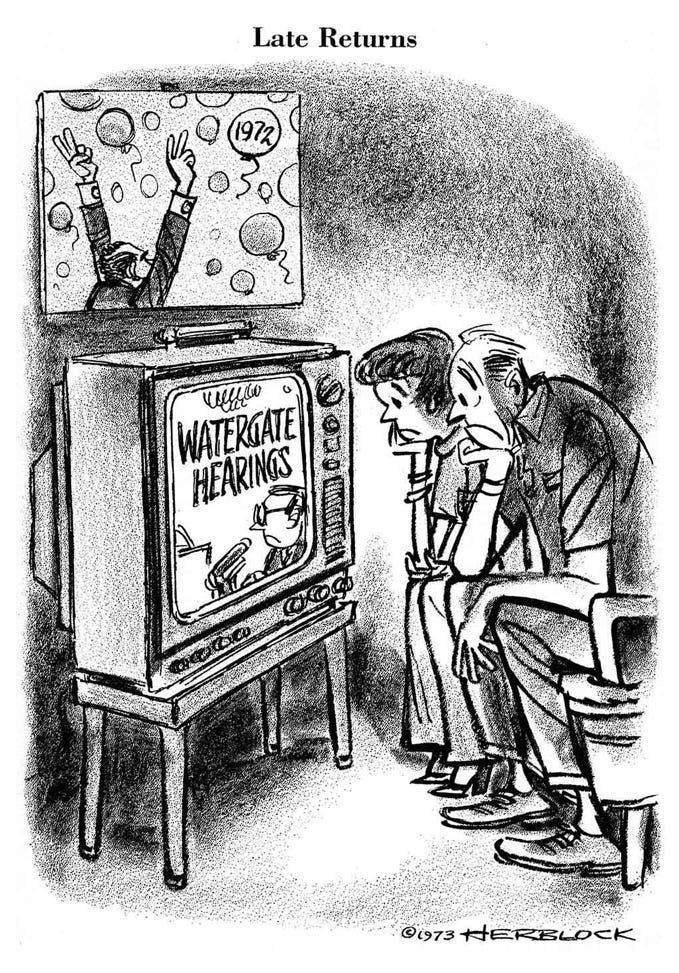
Watergate’s upheaval stretched over two years. From June 1972 (with the break-in and attempted bugging of the Democratic National Headquarters) to August 1974 when President Nixon resigned under pressure from fellow Republicans.
But to best show-rather-than-tell Watergate’s soul-shaking impact on Americans, their relationships, their belief in our government and sense of agency as citizens, I focused TRUTH, LIES, AND THE QUESTIONS IN BETWEEN on 1973. Because that was the year these Senate Watergate hearings unearthed one shocking revelation after another—about Nixon’s campaign “dirty tricks” and lies; his thirst for retribution; his weaponizing the FBI and IRS against his “enemies list;” his attempt to shut down the DOJ’s investigation into Watergate; his using hush money, threats, smears, and the promise of pardons to buy silence and fealty.
See those echoes?
Refusing to “be scapegoated,” Dean braved defying a president legendary for his wrath and vengeance and brought with him an explosive 245-page statement. He read it aloud in no-drama monotone, occasionally adjusting his round, tortoiseshell glasses. Dean’s statement recounted a meticulous timeline, meeting by meeting, in which he’d discussed the cover-up of the Watergate break-in with the president a staggering 35 times—typically with Nixon’s top advisers, Ehrlichman and Haldeman, also in the room.
Dean testified that Nixon knew of the break-in within days of it happening and approved giving hundreds of thousands of dollars to the Watergate burglars to buy their silence and perjury. Such as the time Dean told him that Howard Hunt—a former White House consultant, CIA operative, and convicted handler of the burglars—was demanding $125,000 or he “would have some seamy things” to tell. Dean urgently told Nixon there was a cancer growing on the presidency that could only be stopped by coming clean and telling the nation the truth.
But the president’s reaction to Hunt’s extortion was: “You could get a million dollars. And you could get it in cash. I know where it could be gotten.”
Dean dropped more bombshells during the senators’ follow-up questioning. Asked if Nixon ever used federal agencies for political revenge, Dean answered, “There also was maintained something called the enemies list. Rather extensive and continually updated”—opponents and critics Nixon suggested be targeted for IRS audits or FBI inquiry.
TV cameras caught the committee senators abruptly sitting back in their chairs, aghast.
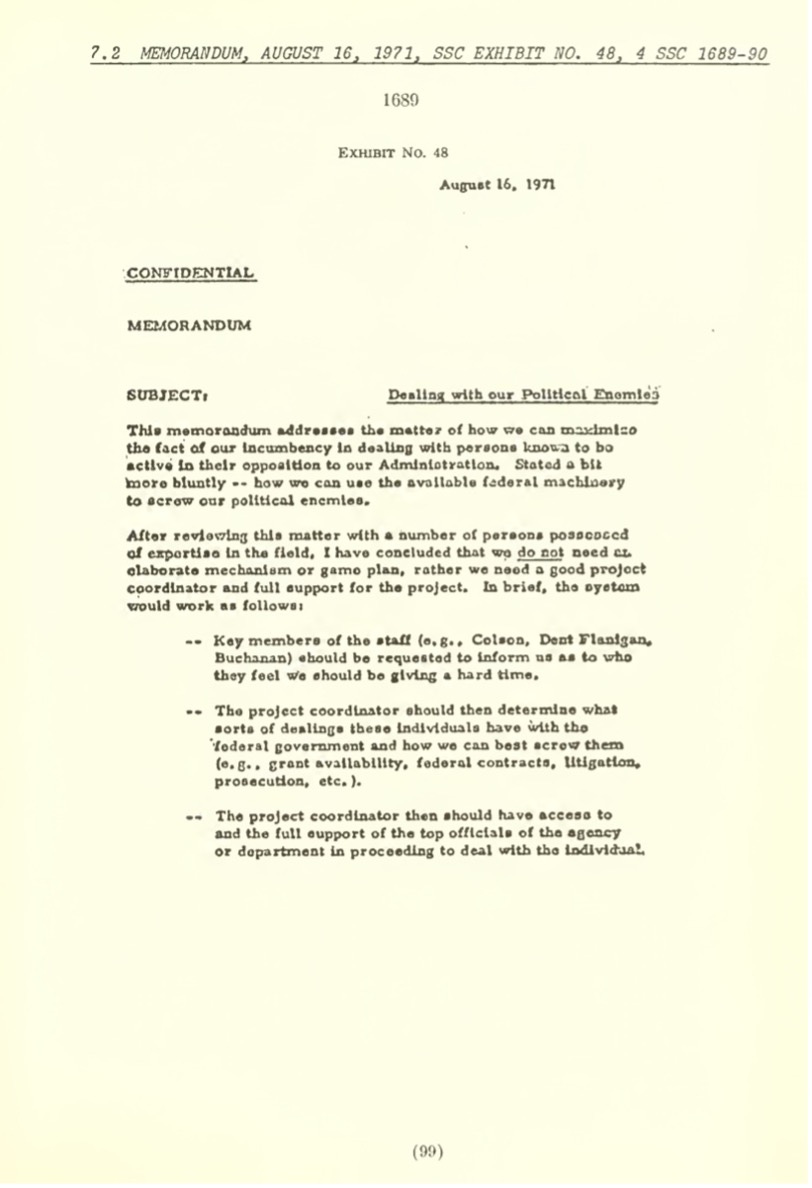
The next day, Dean returned to the hot seat and submitted a White House memo from 1971, detailing “how we can use the available federal machinery to screw our political enemies.” This particular memo listed twenty targets: Democratic fundraisers and members of Congress, plus journalists like the Star’s McGrory, the reporter who’d recognized before anyone else the danger Dean posed to Nixon’s smokescreen of lies (she’d recently been subjected to a prolonged and invasive IRS audit…coincidence?).
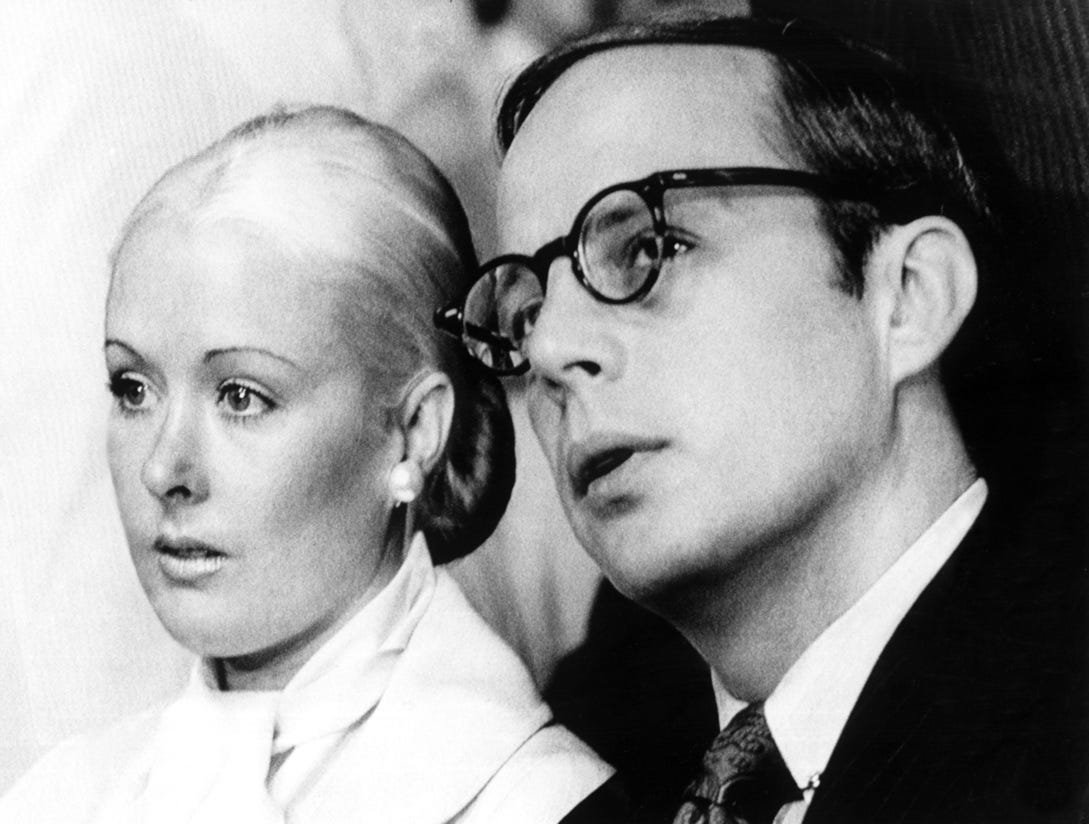
Throughout his 25 hours of testifying, Dean’s stylish, self-possessed wife, Maureen, sat quietly behind him, her platinum-blond hair pulled back into an elegant chignon, a picture of composure. Her unwavering presence built sympathy for the recently married couple—and for Dean being a young, star-struck attorney who simply followed orders from his hero.
But Dean had no corroboration of his copious, comprehensive notes.
It became his word against the president’s. While Dean’s careful testimony pushed many Americans into really questioning Nixon’s statements and actions for the first time, polls showed only 50 percent completely believed him. The other half dismissed him as “a whiner” out to save his own neck. One of the nation’s most-read columnists, Joseph Alsop, smeared Dean’s testimony as “the self-serving allegations of a bottom-dwelling slug.”
Many dismissed the shocking evidence of calculated wrongdoing by Nixon and his circle by falling back on defenses over-used again during our past decade of polarization: “well, what about…” false equivalencies or “everyone does it.” Humorist Art Buchwald enumerated the most popular denials and deflections in a tongue-in-cheek “Handy Excuses” list (below).
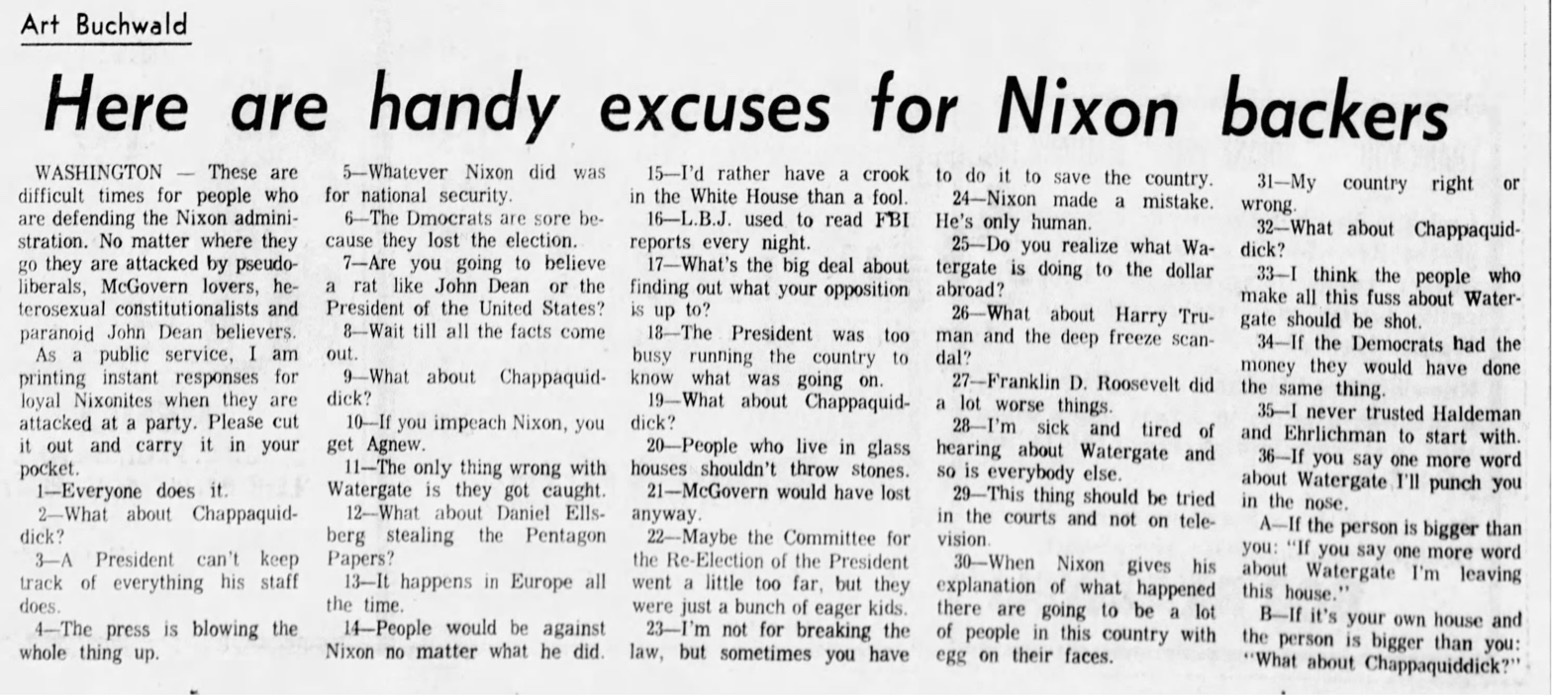
No matter which tact was taken, the reassuring (or head-in-the-sand) sentiment that Dean must be lying prevailed. He received so many death threats from Nixon devotees he had to go into witness protection.
Until July.
That’s when a surprise witness, Colonel Alexander Butterfield, revealed that Nixon had secretly taped all of his Oval Office conversations.
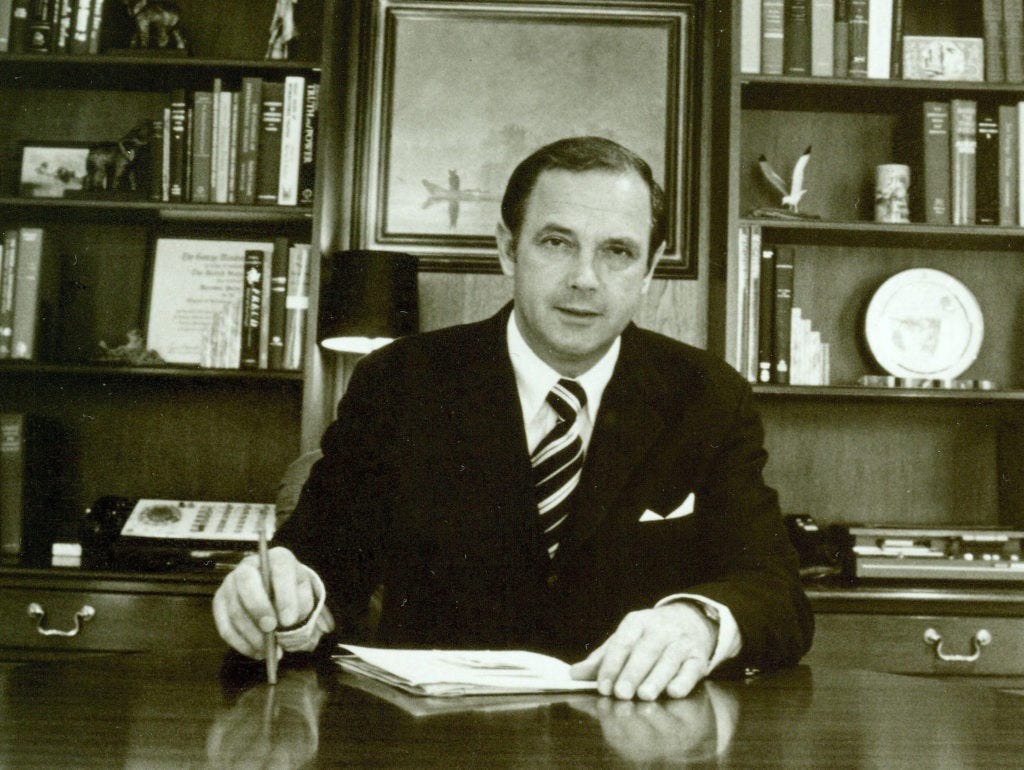
Which could disprove Dean’s claims—or prove them. More on that in July!
While working on TRUTH, LIES, I had the true honor and pleasure of interviewing Mr. Dean. You can view our conversations here. He responded quickly and graciously to my request for an interview that I hoped would offer you not only a summation of the complexities of Watergate, but also how he found the strength to break from his party and speak truth to power. The last bit feeling especially relevant these days. I so relished his no-nonsense honesty. His commitment to share wisdoms he’s learned the hard way—through personal experience and from studying American politics and its players for 50 years—was palpable.
Dean’s written a dozen books, beginning with his bestseller Blind Ambition. His latest, Authoritarian Nightmare, is a searingly insightful look at the MAGA phenomenon and the psychology of “social dominators” and followers—the pillars of extreme, cultish, and non-democratic allegiances. I highly recommend both.
And I wonder: who might prove to be today’s John Dean?
Yours in hope,
—L. M.
Comments
Nothing yet. Say the first thing.
Sign in to join the conversation.