
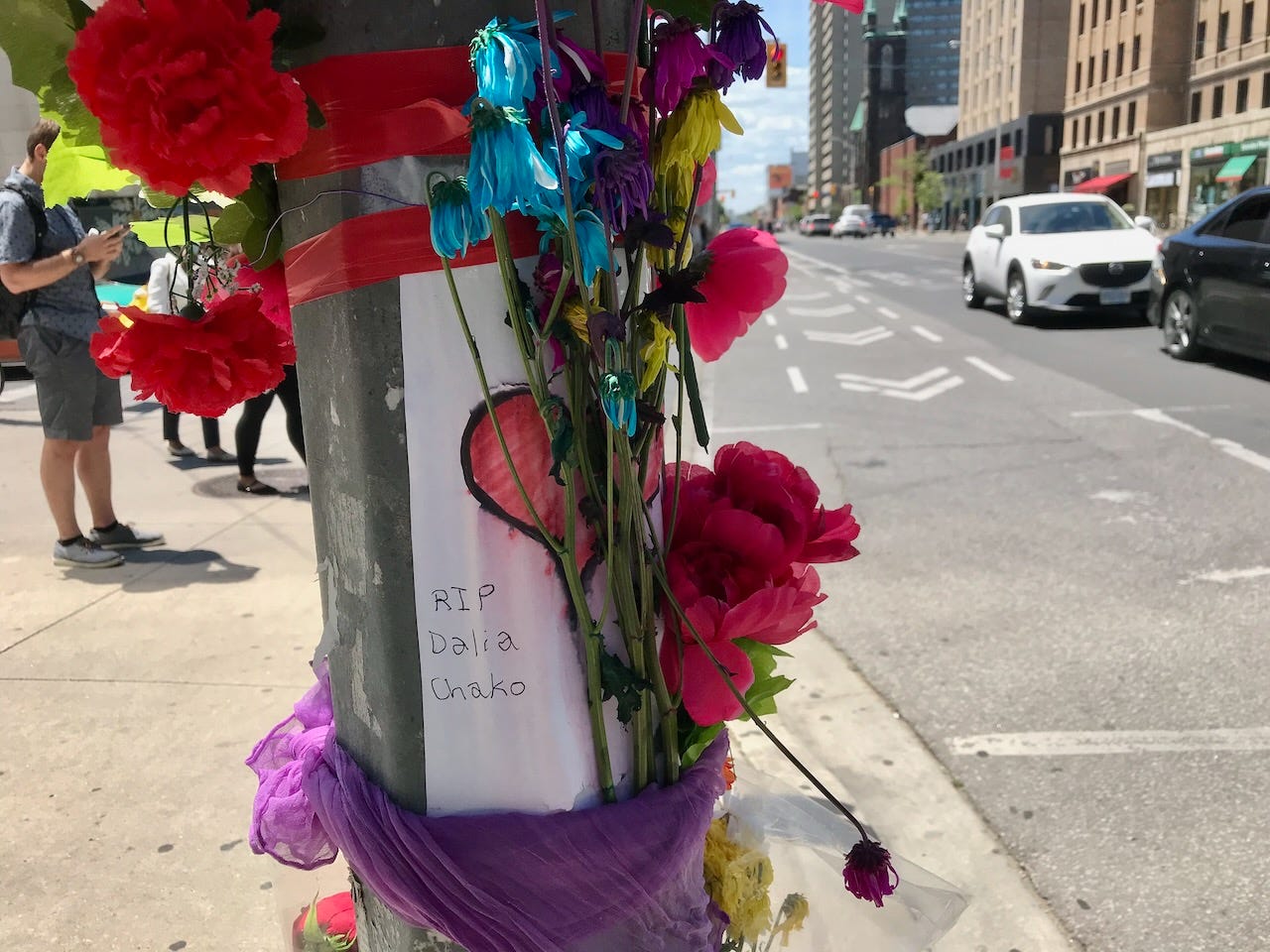
I was not surprised when the Ontario Court of Appeal overturned Justice Paul Schabas’ finding that Doug Ford’s removal of bike lanes was unconstitutional under the Charter of Rights and Freedoms. Schabas had concluded that removing the bike lanes “deprived bicyclists not only of security of the person but also of the right to life itself, and it did so in a manner that violated the principles of fundamental justice.” But the appeals court doesn’t concern itself with such trivial things. The constitution says that if the Province wants roads that kill its citizens, that is its right.
This isn’t our first rodeo; Toronto always loses. I noted in my previous post that “Under our constitution, the city is “a creature of the Province,” which has demonstrated that it can do pretty much whatever it wants.” Cities in Ontario have no rights unless the Province grants them. As the Justice noted in his overview:
The bottom line is this: there is no constitutional obligation to regulate the use of roads in any particular manner – no constitutional obligation to build bicycle lanes or to retain any that have been built. The legislature is free to legislate to remove a bicycle lane from a road – indeed, it may remove a road entirely – without implicating the Charter.
Had Court of Appeal Justice Grant Huscroft stopped with his statement that “Courts play no role in the policy development process, no role in the choices made by the government in proposing legislation,” I probably wouldn’t be writing this, and would have accepted that once again, Toronto got fucked. Even after he bluntly says he doesn’t care if people get killed, the “fundamental justice” of the constitution rules:
“Even if removal of the bicycle lanes were properly understood as having effected a deprivation of life or security of the person, any such deprivation would be in accordance with the principles of fundamental justice.”
But he didn’t. He didn’t stay in his lane. He writes, “The Charter has nothing to say about whether bicycle lanes are a good or a bad idea – wise or unwise policy. These judgments are no business of the courts.” And then he makes it his business. He stuck his nose into the process and the government's choices. Huscroft complains that Schabas “weighed in on policy and political considerations” and then does so himself. He writes:
“Common sense provides the answer here: increasing the number of lanes available for motor vehicles must, at least to some extent, and for some period of time, be capable of contributing to reducing traffic congestion. The legislation is therefore rational.”
Except there are mountains of evidence that common sense is wrong, especially on Toronto’s Bloor Street, where the lane will be used for parking most of the time. The Province’s own experts and consultants admitted this. And it was never rational; it all started when a bunch of restaurant and bar owners in the west end complained about losing parking to the bike lane.
Huscroft then attacks witness Dr Shoshana Saxe. “Dr. Saxe is a proponent of cycling. Her evidence, and that of the respondents’ experts more generally, was impugned by the appellants on this basis.” He suggests that “academic expert evidence – social science research in particular – must be approached by courts with considerable caution. It is often geared towards supporting preferred policy outcomes rather than discovering the objective truth of a matter under investigation.”
Shoshana Saxe is an engineer, and has been the subject of many posts on this site, like this one below. She knows her shit. She is not espousing mushy “social science.” Matt on Bluesky wonders, “Do you think “social science” is just when a woman tells you things you disagree with?”
She based much of her evidence on the concept of “induced demand,” but Hustcroft dismisses it as a “theory”, noting that there are many other considerations such as the price of gasoline. But then we come to the most outrageous paragraph. He first quotes Schabas:
“[T]he evidence is clear that restoring lanes of motor vehicle traffic by removing the bike lanes, or reconfiguring them so that they are no longer physically separated from cars, will lead to more accidents, injuries and deaths. … It is reasonable to conclude that people who cycle will be injured and killed when lanes for motor vehicles are installed and protected bike lanes are removed. That impact is grossly disproportionate to the asserted benefit, taken at face value, of saving some drivers of cars a few minutes of travel time.”
Huscroft responds (my emphasis)
“There is much that is wrong with this reasoning. It minimizes the purpose of the legislation, in effect trivializing it by characterizing it as saving some drivers a few minutes rather than reducing traffic congestion, which may in turn result in a wide range of positive effects. At the same time, it inflates the negative effects of removing the bicycle lanes, talking of injuries and deaths that will occur only if the bicyclists choose to ride on the roads that have no bicycle lanes – a situation that obtains on roads throughout the province.”
But the purpose of the legislation was trivial. It was the Minister of Transport complaining that he didn’t know if he would get to work on time. It’s guys running a bar in Etobicoke. And then, Huscroft blames the victims, suggesting that they will only be killed or injured if they choose to ride on the roads.
Cycle Toronto is considering an appeal to the Supreme Court of Canada. My first thought was that this would be a waste of time; under the constitution, Doug Ford can indeed rip up the road if he likes, and could appoint himself Mayor for Life if he wanted to.
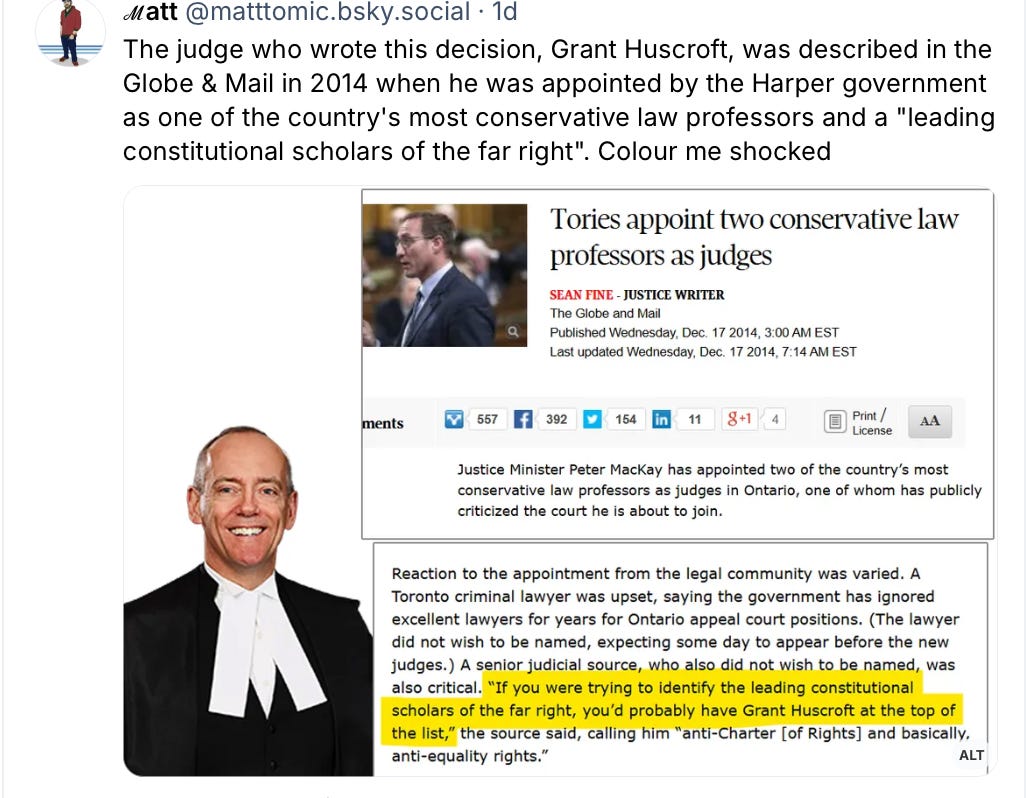
But then I read the decision and saw how Justice Grant Huscroft wraps himself in the Charter (which he evidently can’t stand) and then sticks his nose into the merits of bike lanes. He demeans Shoshana Saxe. He blames cyclists for their own injuries and deaths by choosing to ride in traffic. He comes off sounding like a car-brained jerk with a serious bias. I am not a lawyer and have no idea whether that is a basis for an appeal, but it gives me some hope.
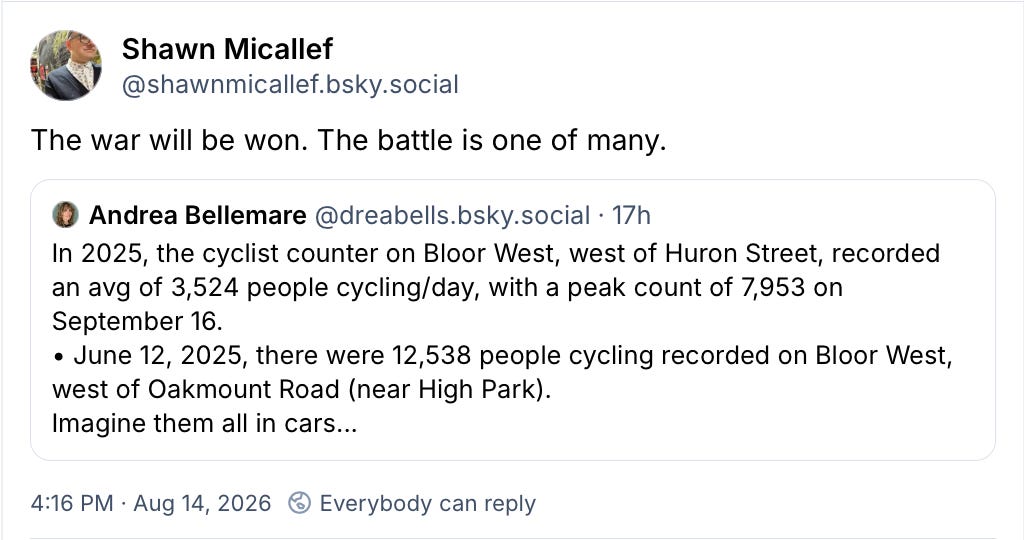
And so does Shawn Micallef. There are more of us every day, and the war will be won.
Totally coincidentally, I came home from the gym to read the decision after listening to the latest episode of The War on Cars, Human Transit with Jarrett Walker, which everyone in Doug Ford’s Ontario should listen to, and which starts with the quote:
The problem with cars in cities is that they don’t fit; they are too big.
Comments
Nothing yet. Say the first thing.
Sign in to join the conversation.