
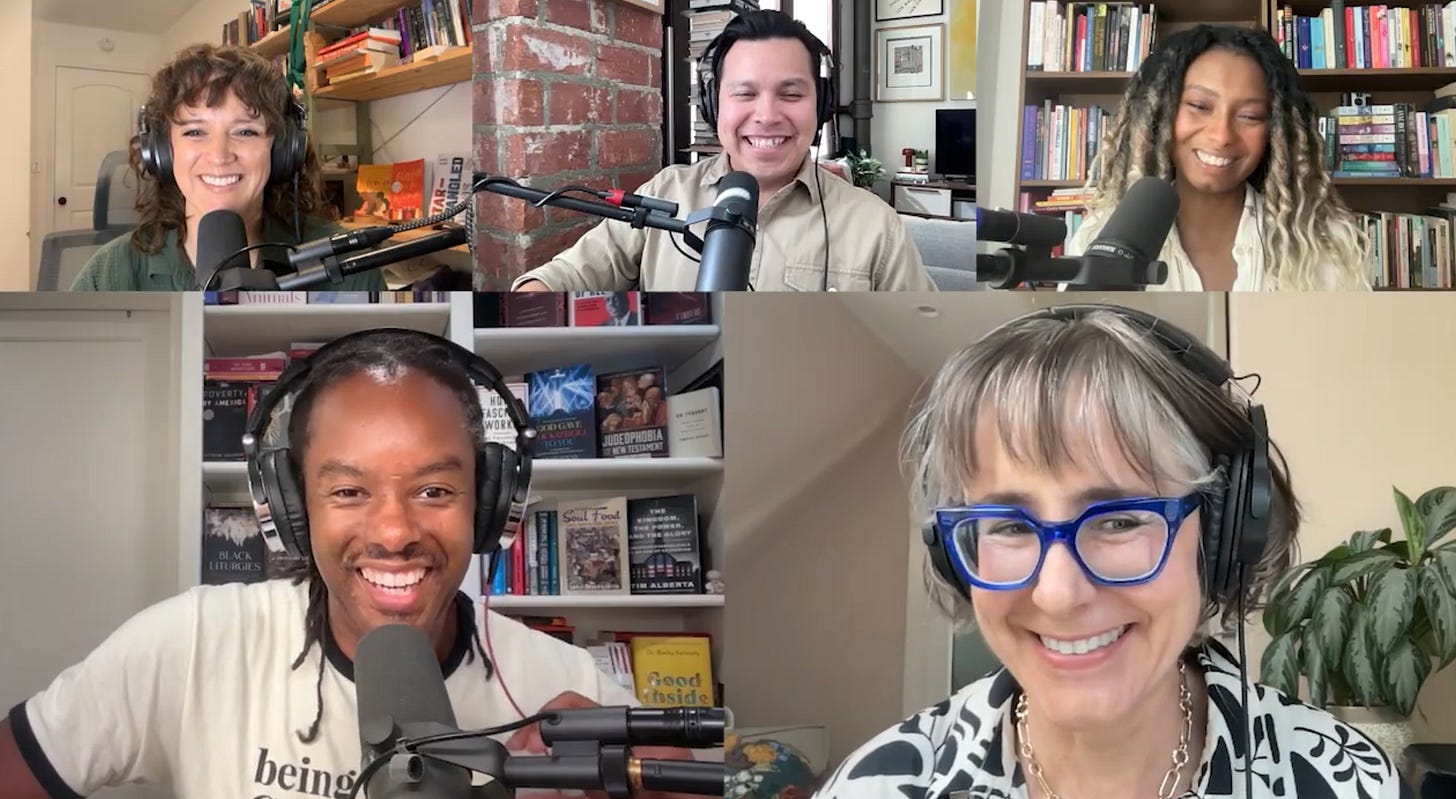
I’ve been doing a ton of podcast interviews recently and I always try to have a real conversation with the host and that usually creates something fun to listen to. But sometimes a podcast interview is special, like it is truly an “INTER-VIEW” where my views (assumptions, beliefs, self-understandings) not only get expressed, but formed through the conversation. Those are the best types of interviews, where the host isn’t just looking at their notes for the next question they want to ask, and I’m not just serving up well rehearsed stories. Where the conversation is really real. And I just recorded one of those, which you can (and should) watch here, but it was so good I thought I’d offer some highlights from it in this week’s post.
And that seems fitting because the episode was the continuation of a conversation that started here, on Substack.
Back in February I wrote a post about Trevor Noah and theological imagination that went unexpectedly viral, then a follow-up on hope and trust built around James Talarico’s politics of love. Then the Progressive Christians Podcast entered the chat.
The Progressive Christians Podcast is part of the ministry of The Loft, a worship community of Westwood United Methodist Church in Los Angeles. The line they use to describe themselves, which I love, is we are “the love your neighbor kind of Christians, not the storm the capitol kind.” Rev. Dr. Christopher Carter, Rev. Blair Stowe, Julia Black, and Wesley Garcia talk politics, pop culture, and whatever else they find interesting on the podcast, from a progressive Christian angle.
The team discussed my posts on an episode they did about Talarico (see timestamp 49:04) and someone sent me the clip of it. In that clip Rev. Blair Stowe developed my argument about imagination further by introducing the concept of eschatology. And that helped me think through a completely different problem (why are tech-bros so unethical?) so I riffed back with a post about eschatology and ethics. And at this point we were deep in conversation, real thought partners. And we had never met (or even DMed).
[There’s another post about that back and forth and about how theological online conversations can do real work. I’m working on that one for a talk I’m doing for Aspen later this month so I’ll share some more thoughts about it in a couple weeks.]
This post is about how I finally “met” the folks of The Progressive Christians Podcast when we virtually sat down together “face to face” to record an episode of their show. I came on to talk about Beyond Wellness and being (gulp) a public theologian. And here are some things I learned about myself and my beliefs from that convo.
About halfway through the conversation I said something I hadn’t planned to say (which frankly is sort of my MO).
I’m fine bringing the casserole to the neighbor. It’s very hard for me to accept the casserole.
I said it as a joke. But I think it was actually kinda insightful of where a lot of us are.
Let’s talk about the loneliness epidemic that we are officially in the midst of. Everyone is looking for belonging. Third places, run clubs, book clubs, the group chat, the sober bar, the supper club, the gym as the new club. I love it all. But it is also important to remember that belonging and community are not the same thing.
Belonging is something you receive. It’s a feeling that happens to you when you walk into a room and the room is glad.
Community is different. Community comes with a set of obligations. Real community is built on the thing you do not want to go to on a Saturday afternoon but you go anyway. Sometimes it is work.
And I think the reason a lot of us (me included) can’t find community is that we’ve come to expect the receiving without the work of the giving.
We spent a lot of time talking about the chapter about AA in Beyond Wellness, which was the hardest to write. For personal (you have to read the chapter to hear about those) and intellectual reasons, I went into the chapter planning to write a takedown. AA is too Christian. It doesn’t work for people who aren’t Christian. I had the whole argument sketched out before I’d done the research, which is not how any of this is supposed to go.
But in every chapter of my book I ask what a religious tradition knows that I don’t. And the religious aspect AA knows is a big one: we are not God.
Higher power is a hard concept for me. I don’t have a higher power, I’m not sure I’ll ever believe in one. But I can believe I’m not it, that I’m not God, and that turns out to be a real theological belief. And it is crucial for working the program because the fellowship part only works if you stop believing you are in control of everything or better than everyone. A room full of people can’t help you if you think you can teach, save, manage, or manipulate them. And we are back at the casserole: you have to accept the casserole and you have to believe you need it.
Which is a very tall order for some of us. Certainly for me. My toxic trait is I think I can fix just about anything.
You should have seen me in the spring of 2020. Using Clorox wipes to wipe down groceries. Sewing masks for my neighbors. Tracking down tests. I was going to solve Covid, out of sheer force of will. And then I noticed I was paying someone else to do my shopping, and it occurred to me that I was not, in fact, solving the pandemic for everyone. I was solving it for me. But not really that either.
Not God is not a lesson for just tech billionaires. I mean, it’s for them. [I wrote about that last week] But it’s also a lesson for us first born-Type A-over-achievers, who cannot let their neighbor bring them a lasagna.
Here is another way our conversation developed this idea. Julia Black, who referred to herself as “a baby theologian,” but don’t let that fool you, said:
“Humility requires so much of us, and it’s actually very scary, because it requires trust of the people around us.” — Julia Black
She’s right. To accept the casserole, I have to trust others, admit I need them. And in a culture that has spent 50+ years telling me my well-being is my personal responsibility, needing something is the one thing I’m not allowed to do.
Then Rev. Christopher Carter offered this insight about what gets in the way in conversations about race, particularly why some white people feel attacked when racism is discussed.
“Being uncomfortable does not mean you’re in danger. It means you have to sit with the tensions of growth. That’s where the learning is. It’s in the discomfort.” — Dr. Christopher Carter
There is an extraordinary example of this in episode 9 of season 42 of Survivor (which I just watched because it is now available on Hulu). At a tribal council Drea Wheeler voiced frustration that Black contestants were being voted out consecutively, and then Drea and Maryanne reframed the tribal council into a broader discussion on representation, optics, and lived experiences in reality television.
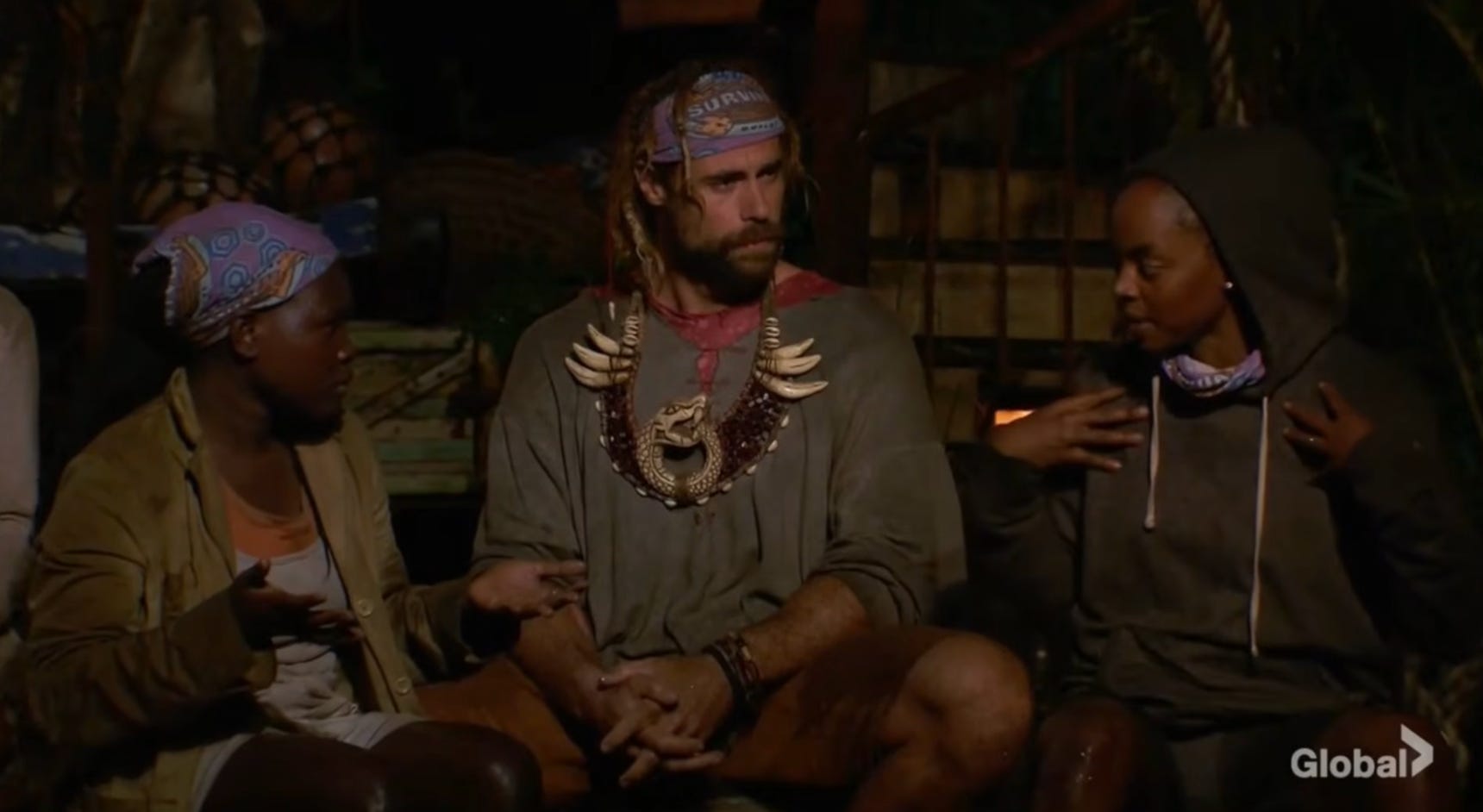
One white player, Jonathan Young, initially felt that his character was being personally attacked. He stated to the group, “I don’t feel this is right, because you’re coming at this like we’re racists.” And then he told Drea she was being aggressive. He interpreted an uncomfortable conversation about societal subconscious bias as being attacked.
A refusal to be uncomfortable is itself a way of thinking you’re God. It assumes the world owes you a version of growth that costs you nothing, that you get to be transformed on your own terms and your own schedule. But that’s never going to work.
And to bring this back to the idea of community, while accepting the casserole is uncomfortable it is not necessarily dangerous. I mean I guess if I continue with this metaphor there is some version of a dangerous casserole, but the discomfort of accepting is not the same as being in danger. Those are very different, and some of us have stopped being able to tell them apart.
This is also what wellness culture is actually selling. Not real health. Not real well-being. Invulnerability. Becoming radically self-sufficient. The promise behind the protocol, biomarker tracker, macro target, and continuous glucose monitor, is that if you optimize hard enough you will never be the person who needs the casserole. You will only ever be the person who brings it.
And then life happens. Shit happens. It always does. You get injured, you get sick, the body you were worshipping shows itself to be fragile. And it is all your fault. You didn’t have the right regime. You should have started sooner, done it better. But again, sometimes stuff just happens. We get sick and we are all going to die, even if we take all the supplements and inject all the peptides. And our fragility and mortality is not a moral failure. It is just human life.
Which has me thinking that individualism and self-blame are connected. You cannot have one without the other.
There are seven practices in Beyond Wellness, and I did all of them, even when I didn’t want to, within some religious container. Yoga, mindfulness, twelve step program, psychedelics, and more. Different traditions, different communities.
One thing was true every single time. The religious version of a practice forced community back in. Every single time. The mindfulness you find on an app is a technique for managing your own nervous system; the mindfulness practiced by practitioners of color in the sanghas I write about takes the isolating experience of racism and addresses it with other people with similar experiences, which is where the healing actually takes place. Fasting in Ramadan is not fasting for thinness, it’s fasting with a completely different set of obligations and formations attached to it. And AA isn’t group therapy only to help you. You go to a meeting because someone in that room might need to witness your story to cope with their own.
But for this week, here are two things I’m trying to build community:
Go to the thing I don’t really want to go to, because it will matter to someone that I did.
Let someone do something for me that I could handle on my own. Accept the metaphorical (or literal) casserole.
The first one makes me a good neighbor. The second one makes me humble. And I think both might be religious acts.
The full podcast conversation is here: appropriation, psychedelics in a yurt, why my Instagram feed is currently split between women doing pull-ups and women disappearing. And subscribe to the Progressive Christians Podcast while you’re there (they are the real deal and delightful).
And as always, if you have enjoyed this post there are a couple of ways to support me.
Subscribe to the newsletter (free or paid, both are great):
Order a copy of my new book, Beyond Wellness:
And if you have read Beyond Wellness, leaving a review on Amazon helps get the book in front of more readers:
See you next week!
Comments
Nothing yet. Say the first thing.
Sign in to join the conversation.