
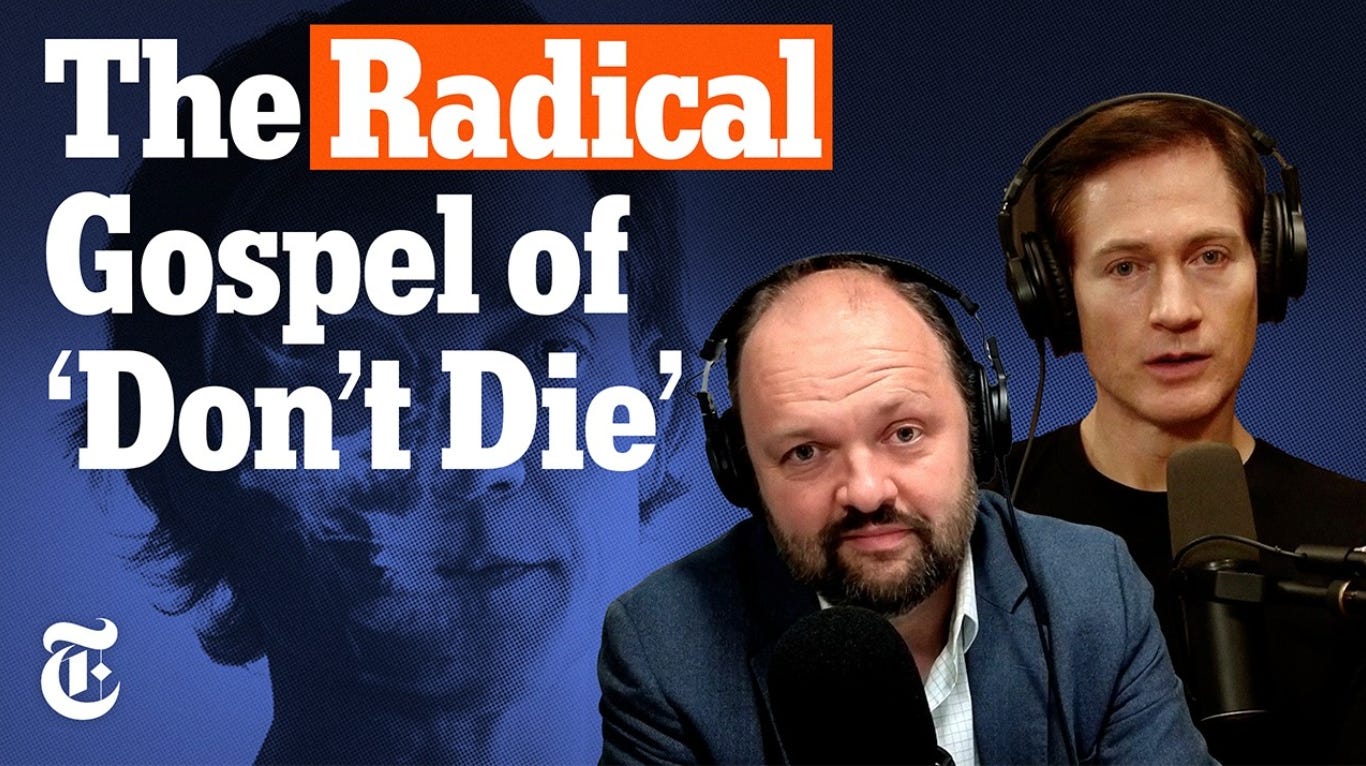
I woke up early this morning because I knew Ross Douthat was posting his Interesting Times interview with Bryan Johnson today, and listened to the whole thing before I got out of bed. It was just what I needed to finish this post, which is something I’ve been noodling with all week.
Every scholar of religion should have a nemesis. Mine claims he has some of the best biomarkers of anyone his age, is actively building a religion, and puts the experience of taking a psychedelic on par with falling in love. Every time I listen to Bryan Johnson talk I come away more convinced that he has gotten the entire human project fundamentally wrong.
It drives me crazy that he stops eating at eleven. It drives me crazy that he has spent millions of dollars optimizing his own body. It drives me crazy that he has convinced himself that a man measuring his own nighttime erections is doing it for the good of humanity.
But I have been using Bryan Johnson as a straw man. He is a convenient shorthand for everything I find wrong with wellness culture (individualistic, overly focused on bio-markers, lacking of collective responsibility or an ethical core). For a long time I have just been calling all of this narcissism, but it’s becoming clear narcissism isn’t the entire story.
So here is my hot take as a religion scholar: Bryan Johnson’s whole Don’t Die philosophy is actually a theology with a doctrine of the body, an account of sin, a form of confession, and an eschatology. And I think it is a bad one.
Let’s start with what Johnson says his goal is. In Ross Douthat’s interview he says he’s building a self-driving body. He envisions a future where the body’s health can be put on auto-pilot. There will be nanotech in the bloodstream catching problems before we know we have them and AI reading labs and dosing meds to us.
Johnson has implied in the past that for him the body is God, but really his plan is to stay alive long enough to benefit from ways he thinks AI will extend our lives. And he is open to whatever form that ends up taking, including a future where humans have no body at all. Put differently, what Johnson is describing as the fulfillment of his bodily autonomy is actually the realization of the body’s irrelevance.
So the body was never really the object of devotion here. Something else is, and there’s an old name for it. Theology calls it aseity: the quality of being completely independent, contingent on nothing, dependent on no one. Aseity is classically the line between God and everything God made. So assuming we can achieve aseity is really radical theology. It is assuming we are God. Here we have a theological justification for narcissism.
So where did all Johnson’s theology come from? Johnson didn’t invent a religion. He’s inadvertently reimagining the one he left.
Johnson was born in Provo and raised Mormon. But he told Douthat about a crisis of faith he had after reading a biography of Joseph Smith (Richard Bushman’s Rough Stone Rolling). One thing to note is that Bushman is a believer. He’s the Gouverneur Morris Professor of History emeritus at Columbia, a practicing Latter-day Saint, and a man who has said he finds no contradiction between faith and scholarship. The book doesn’t hide the polygamy or the treasure-digging. Bushman explored all that and remained a Latter-day Saint.
Which tells you exactly what Johnson needs from a religion: it has to survive all scrutiny.
People who are part of Johnson’s Don’t Die movement sit down weekly together in a meeting modeled on AA. There’s an opening, a mantra, and then each person apologizes to their body for something they’ve done to harm it. In this theology our bodies are definitely keeping score.
And then, this summer, Johnson announced he’d been diagnosed with autoimmune gastritis, a chronic condition in which the immune system attacks the acid-producing cells of the stomach. There is no known cure. And then following the confession model of Don’t Die, Johnson blames his condition on prior “bad habits” like the sugary cereal he ate as a child, the soda and fast food he survived on while building a company.
Then he does something more interesting than self-blame. He calls the diagnosis a gift. If he’s going to prove the Don’t Die thesis, he tells Douthat, being diagnosed with something incurable is the ultimate test:
“If I believe in Don’t Die, and if I want Don’t Die to be real, I must go through the gauntlet of getting diagnosed with an incurable disease and more.”
But here is where things get theologically problematic because no matter what happens, his theology is confirmed. If he cures his condition, that’s proof the Don’t Die concept is possible. If he manages it indefinitely, that’s proof the protocol works. If it kills him, he becomes a martyr who lived just a bit too early on the timeline. There is no result that proves he was wrong.
And that, finally, is what I mean by bad theology. Not that it’s false. It’s that nothing can argue with it.
Douthat asks Johnson: Suppose you achieve your goal and you don’t die. Would you want to live forever alone with yourself?
Johnson doesn’t answer directly, which I think shows just how individualistic the Don’t Die project is at its core.
To be sure, community is one of the five pillars of the Don’t Die protocol, along with sleep, diet, exercise, and restraint. But these are all framed as things we do because they have an expected outcome. The outcomes are why they really matter. Community is not intrinsically good. Is it is good only if is contributes to your bio-markers.
That makes these pillars really just a collection of good habits. I’m not against forming good habits, being disciplined. And Johnson is nothing if not disciplined. But the question for me is still, is all this discipline directed to the right end?
If you are long-time reader of my Substack, you know I’m not myself religious in the conventional sense. But I think even “nones” like me have something to learn from religious ideas of human flourishing and the religious forms of discipline I admire the most are in the service of community and others. Monastic renunciation for the community. The Ramadan fast attached to almsgiving. Shabbat as a day focused on family. Disciplined self-management absent of a concern for your neighbor, community, or social justice does not count for me as part of a good life.
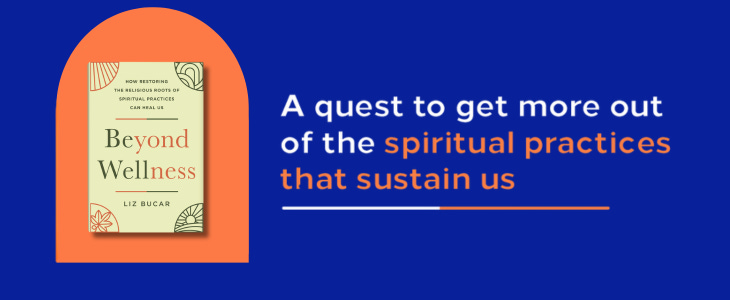
That was the entire reason for writing Beyond Wellness: we have built a vision of wellness based on individual habits while largely giving up on the importance of how we treat each other. Johnson has a role for sin, discipline, confession, and salvation. Great, as someone interested in religion I love all of that. But what he doesn’t have is obligations to other people.
Don’t get me wrong, I understand the appeal of Don’t Die. I’m not pro-death (seriously, who is?). I’d like to stick around a long time too. But the sentence isn’t finished. Don’t die for what? Don’t die for whom?
If you enjoyed this post please consider picking up a copy of Beyond Wellness. And if you have already read it a review on Amazon costs nothing and really helps getting it in front of readers.
Leave a review for Beyond Wellness
Comments
Nothing yet. Say the first thing.
Sign in to join the conversation.