
One reason that I love GTAing at Dallas Theological Seminary is because I get to keep a pulse check on the classroom. How are future pastors and ministry leaders processing what they’re learning. What feels weird? Where do folks find themselves feeling stuck? When do they feel the urge to double down? Where is that protective part stemming from?
Spoiler alert, I’m always studying my students. And for the last few weeks as I graded dozens of position papers for my trinitarianism classes I can’t help but notice how many students feel stuck when it comes to imagining God beyond the sharp confines of maleness. There’s a prevalent pattern of stuckness. This is important because imagining God that is much bigger than anthropomorphized notions of gender, sex, or identity isn’t a wackadoodle liberal approach ;). It’s the historical Christian conviction. While God the Father and God the Son are distinctly manly ways of relating, He is not a word that speaks well of the Trinity.
The triune God is not male because God is much more.
The first time I ever wrote a seminary paper examining maternal imagery in the psalms my very accomplished very beloved very old professor shared that this was the first time that he’s ever read a paper like that. Work that reveals God’s maternal heart is important because the more it shows up on the page, the more it can correct harmful teaching and encourage the church. Several years I wrote a mother’s day post about how Eve often takes on the role of Mother of All the Living. But Elizabeth’s work is a gentle reminder that mothering all the living is work that actually belongs to the Divine. Celebrating God’s maternal imagery makes space for God’s “more-ness” to remain front and center.
God loves all of us like a mother, and that is good news.
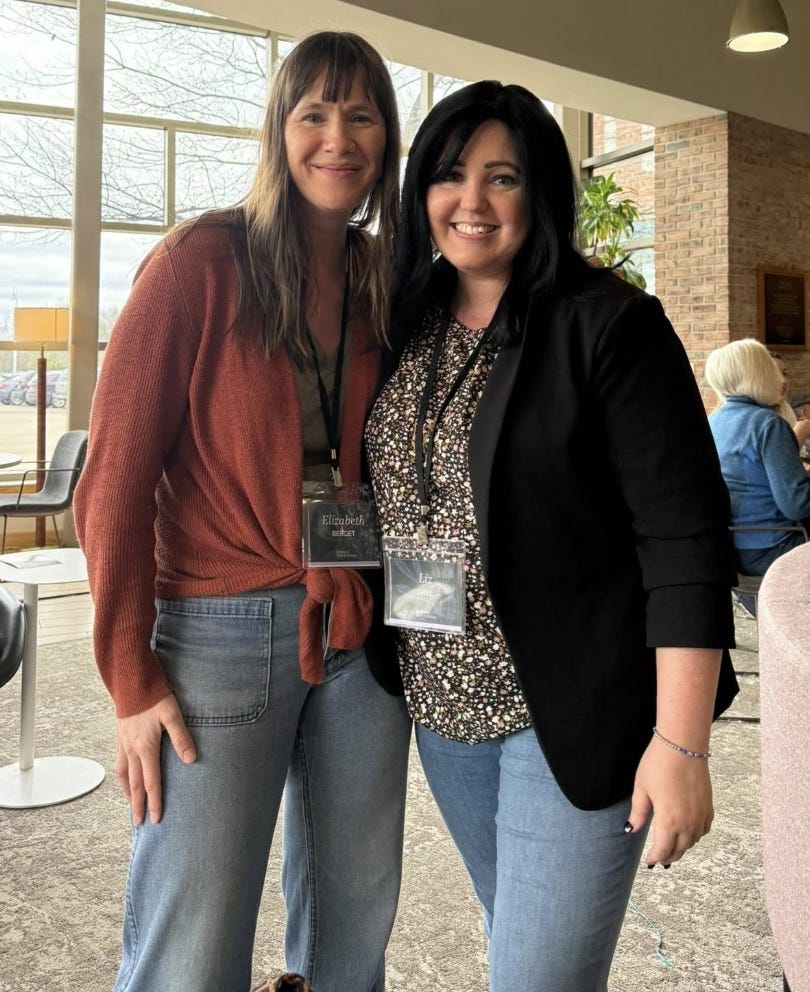
Meet Elizabeth Berget. Her book nurtures readers away from notions that attempt to keep God in a box, mooch off of divine authority, and keep women small. Her stunningly thoughtful book is imaginative, hopeful, and inspiring. Elizabeth is funny, down to earth, and so very wise. I hope this work encourages you to experience the love of the Father, Son, and Spirit— one mother of us all.
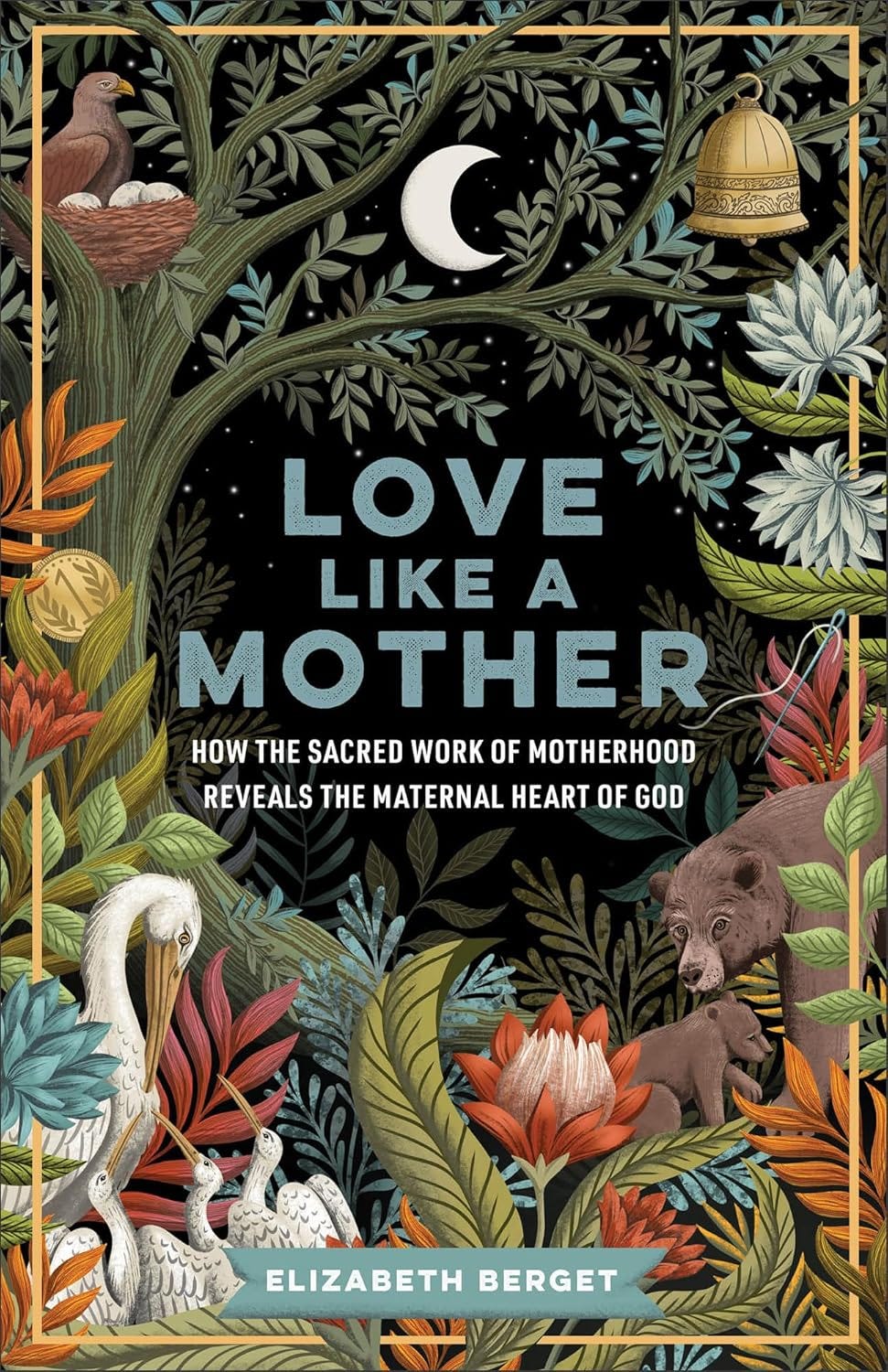
Below I hope you enjoy a sneak peak from chapter one from Love Like a Mother from Brazos Press
I stood in the predawn light of our bathroom with one hand slung around my husband’s waist and the other gingerly holding a freshly used pregnancy test. The three-minute tilt-a-whirl of waiting for results had finally come to a stop, and I now found myself considering the bacterial ramifications of saving the pregnancy test in a Ziploc bag as a memento for posterity.
I was going to have a baby.
Minutes earlier, I had hobbled my very full bladder into the bathroom and ripped open the box I’d so carefully placed on the counter the night before. I had crossed and uncrossed my legs as I squinted once more at the tiny printed instructions on how and when and where to urinate. Never one to play fast and loose with the rules, I’d stopped just short of using a level to ensure that the back of our toilet was actually a flat surface, per the guidance given.
After a deep breath, I’d gone for it. I had counted my Mississippis, started my phone’s timer, and then joined my bleary-eyed husband in the hallway. While we waited, I worked to slow my breathing in an attempt to convince my anxious body that I wasn’t actually standing at the dizzying edge of a steep precipice. When the timer rang out, we’d stood in the bathroom and hugged after a bewildered first and then delighted second look at those two pink lines, and I fell head over heels off the edge into something between overwhelmed and overjoyed.
I wasn’t exactly surprised by the pregnancy; we’d waited five years into our marriage to try. The truth was, I’d felt ready for kids for a little over a year (though, at the time, I would not have known what “ready for kids” was if it had punched me in my well- rested face). But what did surprise me was how quickly the mantle of motherhood settled into my bones— or maybe just into my head, which at that point felt like it was audibly pounding. I had decided, out of an abundance of caution, to give up caffeine entirely, so the headache that consumed me as I journeyed into motherhood was the very first drop in what would become a cascading waterfall of sacrifice and love for my kids.
That instinct to protect the life within overtook me quickly and fiercely.
Outwardly, I may have complained about being bereft of so much of what makes this life worth living: soft, unpasteurized Brie on crostini, a glass of red wine on a Thursday night while watching The Office, napping on my stomach at the beach. Yet on some ancient, internal level, I knew that I would happily give up these things forever if it meant my baby stayed safe.
And that is just what mothers do. When those two lines appear on the test, they add up to more than just an addition to the family. In that moment, |+| equals a new life, a new identity. Moms-to-be intuitively begin to check for signs of spotting with each visit to the bathroom; they force down prenatal horse pills and count every flutter and kick. Their lives begin to revolve around the effort to create a life that is happy and healthy for the baby within. In short, their wombs become cultivators of compassion.
And God is no stranger to this kind of compassion.
The Wombed Compassion of God
It is tricky to picture God with a womb, isn’t it? It’s easier for us to imagine a
God who looks like Zeus, complete with bulging biceps and a white beard. But Christian tradition teaches us that this image stems more from Renaissance art than it does from the pages of Scripture. The consensus that God has no gender reflects broadly accepted teaching among most corners of Christendom, from Richard Rohr to John Piper. Piper himself, who once controversially stated that God gave Christianity a
“masculine feel,” nonetheless dispelled the image of a Zeus- like God when he said, “God is not male. . . . From eternity, God has not had a body—a physical body— and therefore, he doesn’t have male features: facial hair, musculature, male genitals, no Y chromosome, no male hormones. . . . ‘Male’ is a biological word, and God is not a biological being.”[1] This matters because considering God a male diminishes God, who exists above and beyond human categorizations.
But in Exodus 19, no one would have blamed the newly freed Israelites for picturing a dominant, masculine deity, like those of some of their neighboring cultures.
We read that they stood like ants at the base of a mountain that was covered with dark clouds and violently shaking, waiting to formally meet this God who had parted the seas and turned the Nile bloody. We read, “All the people who were in the camp trembled” when God descended on the mountain in raging fire and billowing smoke and thundered the law down from the summit (Exod. 19:16). But fifteen chapters after these first impressions, it’s almost as if God pauses, having gotten ahead of himself, and provides an overdue introduction to his new people. In Exodus 34:6 we find God’s very first self- description of his character in the Bible, and what we read, given the context, is surprisingly comforting and unexpectedly maternal: “The Lord, the Lord, the compassionate and gracious God, slow to anger, abounding in love and faithfulness” (NIV).
The first self-referencing descriptor God uses is compassionate, which in Hebrew carries a lot more intensity than it does in English. The word is rakhum, and it has its roots in the Hebrew word for womb (rekhem), which indicates that the compassion of God, the rakhum of God, is a womb- born, deeply emotional love that time and again moves God to act on behalf of his children. The word conveys the urgency that a mother feels when her baby cries— an instinctive, reflective response that she feels in her body to soothe her baby’s distress.
We read of God’s rakhum for the Israelites when they were enslaved in Egypt. God heard their cries and was deeply moved, urged by his compassion to the incredible acts that led to their liberation. Later, in Psalm 51:1, it was God’s rakhum compassion that King David appealed to when he prayed for forgiveness after wronging Bathsheba: Have mercy on me, O God, according to your unfailing love; according to your great compassion blot out my transgressions. (NIV)
It was rakhum that compelled God to respond to the desperate cries of his exiled children later in the Old Testament, saying, “Can a woman forget her nursing child or show no compassion for the child of her womb? Even these might forget, yet I will not forget you” (Isa. 49:15). With these words, the prophet Isaiah was essentially asserting, “Can a woman forget to ‘womb’ the son of her womb?”[2] Perhaps the most stark example of the meaning of rakhum comes in the account of Solomon and the baby. You have probably heard the story; it’s a memorable one. Two women from the same household each had a baby within days of one another. One of the babies tragically died, and an allegation was made that the mother of the deceased baby had swapped the babies in the night, claiming the living baby as her own. Solomon pondered this accusation and declared that the baby should be cut in two so that each mother could take a half.
While the lying mother agreed to Solomon’s ruling, the true mother of the living baby was deeply moved out of her rakhum. Pastor and author Chad Bird writes, “The Hebrew [in 1 Kings 3:26] is something like ‘her wombs warmed,’ that is, ‘her compassions grew hot within her.’ This mother, who had borne this child in her womb, ‘wombed’ him once more. Far from being cold- hearted, like the lying mother in this story, the true mother was warm- wombed toward him. So much so, in fact, that as she told Solomon, she would rather the false mother have the child than that he should be cut in two. Such womb- like compassion is gripping and unforgettable.”3
This is rakhum. And if God chose this wombed word to begin his spoken self- revelation, then perhaps it is there that we should begin the search for an answer to the question: Does God love us like a mother?
[1] John Piper, “The Frank and Manly Mr. Ryle,” Desiring God, January 31, 2012,
https://www.desiringgod.org/messages/the-frank-and-manly-mr-ryle-the-value-of-a-masculine-ministry; John Piper, “God Is Not Male,” Desiring God, March 10, 2014, https://www.desiringgod.org/interviews/god-is-not-male.
[2] Chad Bird notes that “Isaiah, a master wordsmith, is saying, ‘Can a woman forget to “womb” the son of her womb?’ He could have said ‘love’ or ‘be gracious to’ or ‘show mercy to’ but he chose the ‘womb verb’
to echo the other Hebrew noun for womb or belly, בֶּטֶן (beten),” (@birdchadlouis), “Womb-Like Compassion in Hebrew,” X (formerly Twitter), November 11, 2023,

Chad Bird@birdchadlouis
Womb-Like Compassion in Hebrew When we want to describe emotional pain or pleasure, joy or grief, we often turn inward—I mean, literally *turn inward,* to the organs inside our bodies. In older English, people used to say someone was “venting their spleen” when they expressed

11:57 AM · Nov 11, 2023 · 113K Views
. 3 Bird, “Womb-Like Compassion in Hebrew.”

Elizabeth Berget is a speaker and author of Love Like a Mother: How the Sacred Work of Motherhood Reveals the Maternal Heart of God. Her work has appeared in Christianity Today, Coffee + Crumbs, Mothering Spirit, and other online spaces where mothers gather to find meaning in the mundane.
She shares her thoughts in her Substack newsletter, Back of the Flock, where she explores the image of God in the everyday work of motherhood. Berget has lived in Africa and Asia but now resides in Minneapolis, Minnesota, with her husband, three kids, and one mischievous dog. And yes, she’d love to hold your baby.
Elizabeth’s book enters the world headfirst on May 5th. If you haven’t yet, go ahead and preorder this beautiful book here. Be sure you’re following her in all the places and celebrating her work. Birthing a book like this into the world is no small thing.
Continue the conversation below: How do you see a mothering God at work in the world?
Be well, beloveds.
Thanks for reading For Flourishing! This post is public so feel free to share it.
Comments
Nothing yet. Say the first thing.
Sign in to join the conversation.