
One of the biggest myths about abstract art is that it’s all chaos - random paint splashes, unplanned gestures, the kind of art “any child could do.”
I’ve [probably heard that as many times as I’m asked - But how does design apply to abstract art? Isn’t it just intuitive?”
Don’t get me started. (Well, actually, I guess I already have…)
Here’s the truth: in abstract art, I see design as critical to the success of a painting. Why? Because in abstraction, design replaces subject matter. Without a strong underlying structure, the work can quickly feel unresolved, confusing, or simply forgettable. The eye drifts aimlessly from one color field to another with no hierarchy, no signposts, no direction. All of which are essential if you want the viewer to feel both safe enough to stay with the work and stirred enough to dive deeper into its richness.
First off - what do I mean by Design?
When I say Design in the context of abstract painting, I don’t mean rigid rules or lifeless grids. I mean the underlying architecture of a painting - the skeleton that holds all the intuition, energy, and emotion together.
Design shows up in things like:
Composition – the placement elements, how they’re balanced (or not).
Contrast – the play between light and dark, bold and quiet, big and small.
Movement – how your eye travels across the surface.
Hierarchy – which areas lead, and which take a supporting role
So let me if I may bust a few myths on this subject-
Myth 1: Design is about following rules.Truth: Design is about making choices that guide the eye, create balance (or intentional imbalance), and bring impact. Rules aren’t cages; they’re tools.
Myth 2: Design kills spontaneity.Truth: Good design actually supports spontaneity. It gives your wild marks, messy gestures, and intuitive moves a place to land so they resonate instead of fizzling.
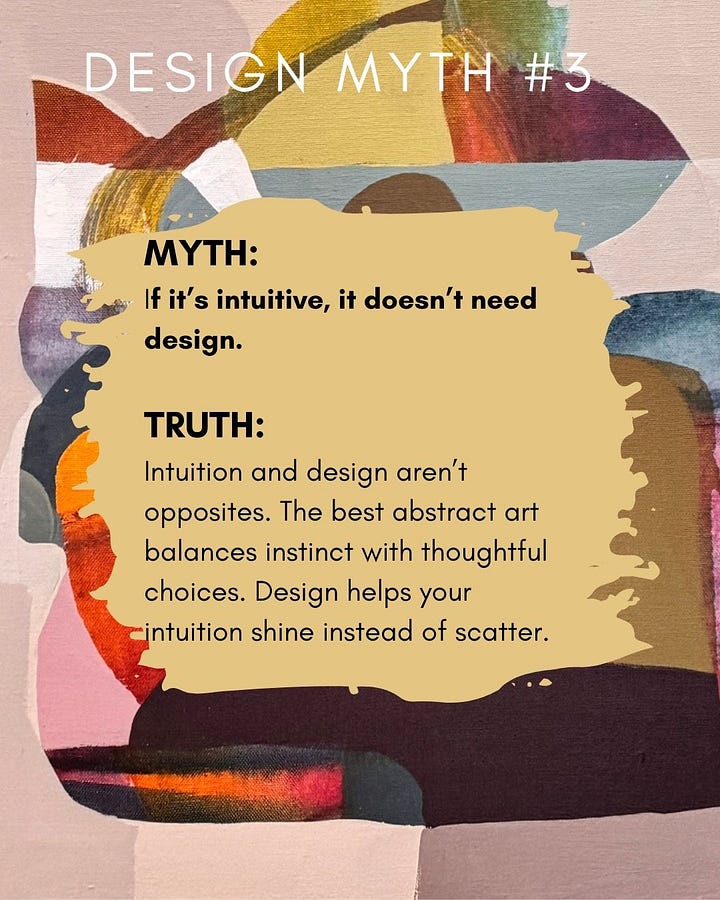
Myth 3: If it’s intuitive, it doesn’t need design.Truth: Intuition and design aren’t opposites. The best abstract art balances instinct with thoughtful choices. Design helps your intuition shine instead of scatter.
Myth 4: Design is just for representational art.Truth: Design is vital in all art. In abstraction, it’s not about depicting something recognizable - it’s about creating tension, movement, and flow that feels true.
In my own work (and in my teaching), I find that once you start seeing through the lens of design, you can’t unsee it. Suddenly, you understand why one painting grabs your attention and another falls flat. You start to spot continuity, disruption, visual “bridges” that carry your eye around the canvas.
Strong design doesn’t make your art less free. It makes it unforgettable.
🎨 I’d love to hear from you:Have you ever stood back from a painting and thought, something’s missing - but you couldn’t quite put your finger on it? That’s usually design whispering in your ear.
What’s your relationship to design in your work—friend, foe, or something you’re just starting to explore?
With love,Liz xx
p.s. I’m excited to unpack this with my students in my upcoming 3C Elite Workshops, when we will be digging deep into this dance between chaos and design. Keep a lookout for my upcoming workshops (in-person and online in 2026) Please reach out to hello@lizmurphystudio.com if you would like to be notified of workshops before they sell out.
No posts
Comments
Nothing yet. Say the first thing.
Sign in to join the conversation.