
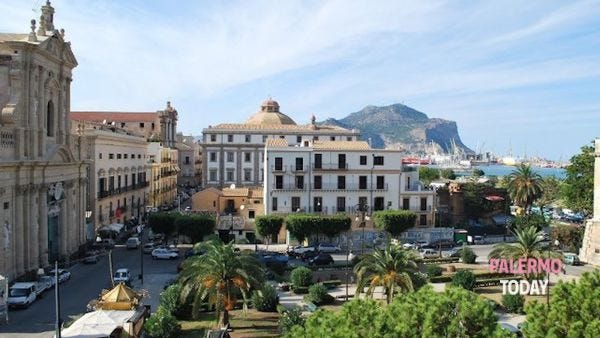
[I pulled this photo of the Piazza Kalsa off the web, but it appears to have been taken from the very building that holds my studio apartment of the past month. What’s missing from view are the trucks usually parked directly below my balcony plus a small homeless encampment at lower right. Those two baroque churches along the left-hand street ring their bells a lot, which I hardly mind hearing. The church further in background has already hosted two weddings this weekend, and it’s only Saturday evening.]
I’ll not miss the street noise from where I’ve been living in la Kalsa, one of the more venerable neighborhoods of Palermo. La Kalsa is sometimes advertised as the city’s Arab Quarter, though in truth there seems little left geographically or architecturally from the Arabs except perhaps some foundation stones and a pattern of narrow twisty streets. It was a Norman/Viking force in the 11th century - so now almost a thousand years ago - that displaced Arab rule on the island and eventually led to establishment of the medieval and modern Kingdom of Sicily. In one form or another, that kingdom lasted until the 1860s. Resentment over its loss was one of the factors that drove creation of la Cosa Nostra during the late-19th century, although it did not demand that organization’s more underhanded and cruel practices.
The people who run the small shops around this piazza appear to be locals, or at least they sound like locals. The few I’ve had dealings with this month have been entirely polite and friendly. Their only English expression is usually “OK,” which has challenged me to expand my Italian vocabulary. This morning, I think that I managed to tell the pleasant guy who lives above me with his wife and small son (plus a noisy little dog) that I would be gone soon but hoped to come back in October.
Below me is a tiny shop with hand-lettered signs. Its proprietor has sold me good local beer at only 2.50 Euros per large bottle. At all hours, even 2 or 3 A.M., he and his wife can be seen taking care of a bambino that I’m guessing is their first grandchild. Mom and dad may be working one of the hundred or so restaurants within walking distance. The older couple sit along the street just below what’s seen in the photo given above with the baby in a carriage - even at 3 A.M. - while watching whatever else is happening in the piazza and hoping for somebody else to come along and buy a drink. Yes, I’ve felt like a complete interloper here; yet as an American from the semi-South, I’ve also been experiencing something of the old William Faulkner “past is not past and never really was” sentiment. 21st-century social change is not much on view here, despite people carrying smart phones.
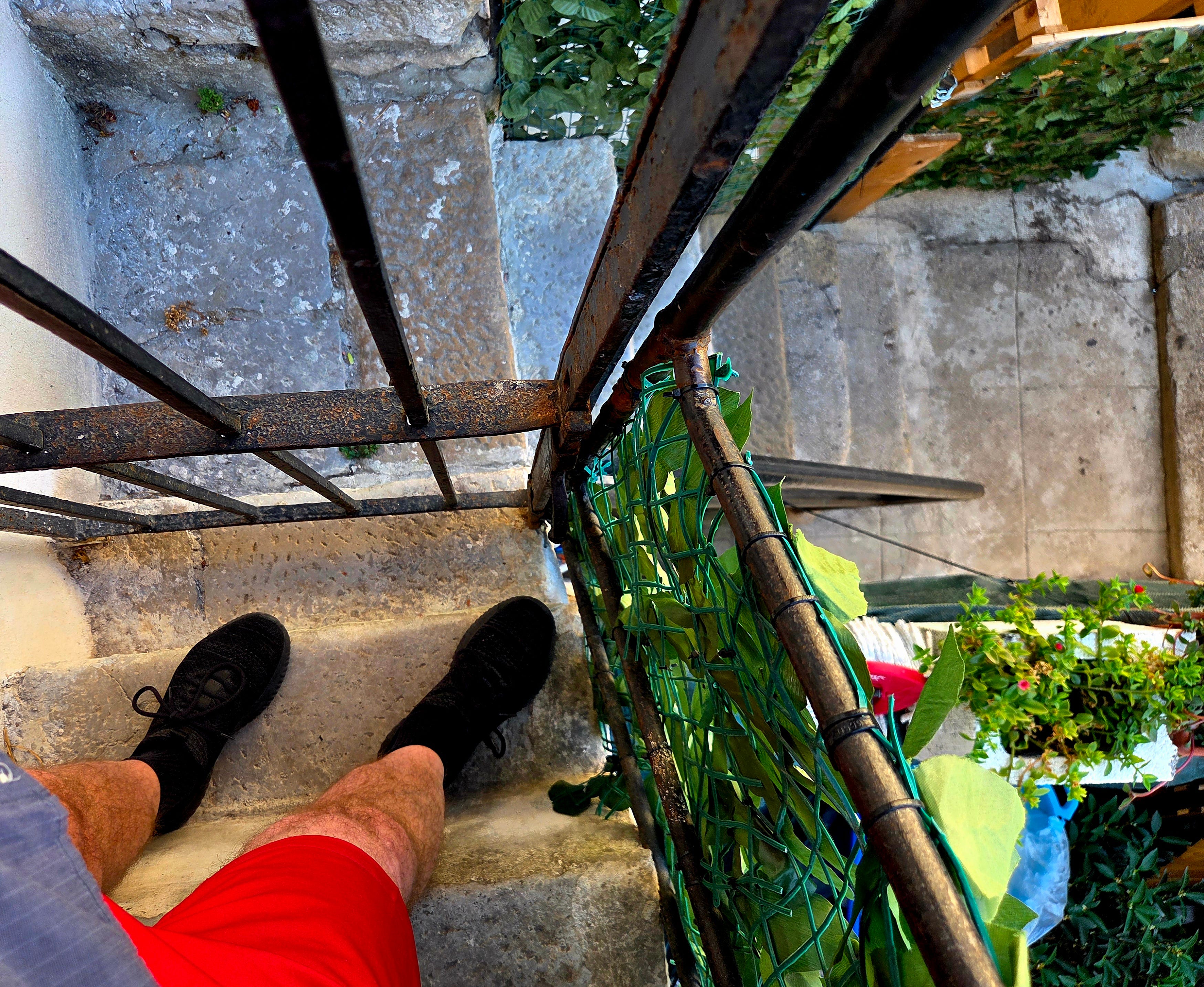
[Old Palermitanian stone staircase with newer American shoes and legs. Before the bottom step is an elderly iron gate with a latch that will pinch your fingers badly if you’re not careful. Climbing up and down these steps since early July has made me wonder what Faulkner might have done to describe the experience; and were those steps and gate here when General Patton’s tanks were rolling up nearby beaches in the summer of 1943? Very likely, although that is no longer within living memory for any but a few of the locals.]
On view today is the reality that, within just the past 30 years, much of la Kalsa has been revitalized in a manner that strikes Americans from the older East coast cities as familiar. Where 40 to 50 years back there was intense inner-city poverty and 18th- or 19th-century buildings still showing the effects of Allied bombing runs in 1943, now those buildings are (mostly) cleaned-up and functional. Inside of them are artigianale shops and restaurants that come across as delightful but sell their wares at about half the price of Washington and a quarter that of New York or Paris.
The past two weeks have been particularly hot in Palermo albeit somewhat less so than in a few of the European cities that have been in headlines this July. It’s still possible here, even in mid-summer, to feel a breeze coming up from the sea should one happens on a street that’s broad and runs straight, or almost straight, to the waterfront. Such is not generally the case with the road running by the churches shown in the photo at top; but lack of breeze has not stopped local men - and it is mostly men, mostly of middle age - from gathering in the afternoon and evening in front of a fish monger. Some continue to smoke tobacco if not as many as one would have seen 40 or even just 20 years ago. The men now gathered may have watched enough of their older family members die by age 60 from the effects of cigarettes. Viewing Humphrey Bogart smoke on screen remains as charming as ever, but then one didn’t have to live with the longer-term consequences for Lauren Bacall and their children. Better to enjoy the fish that’s on sale (and it does appear to be mostly fresh each day) plus cheap beer and wine.
When I next come back to Palermo, I probably will not choose to stay in this immediate neighborhood. It still feels too much like what belongs, even in today’s tourism-mad economy, to a population that for want of a more colorful term we can call indigenous. Modern genetic studies have confirmed that Sicily holds a remarkable mixture of ethnic backgrounds, yet that measurement has not stopped the island’s 21st-century population from expressing a unified identity. They have AC units in most of their buildings today, but sitting outside on a hot summer evening still seems to be part of that identity. Forget skin color, shape of the nose, or physical stature. (The shop owner below me is about 6’2” and could have been a linebacker on an American football team.) Enjoyment of first-person company is a better marker, as is the enjoyment of old architecture even on the hottest summer day.
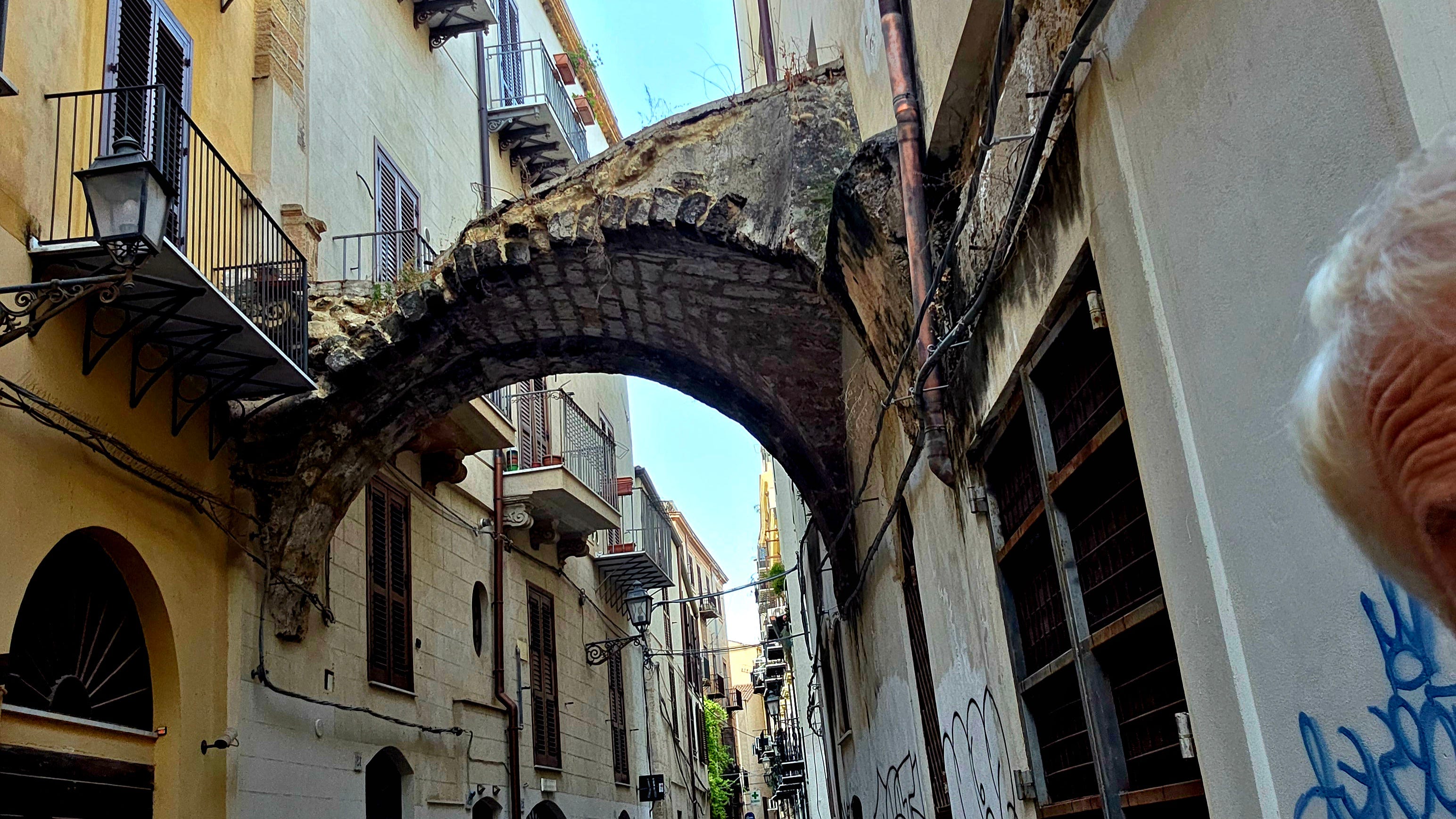
[I’ve not yet learned the story of this peculiar bit of old archway, which is found above a street in the center of la Kalsa. At least some of the structures on either side look to be 20th-century, that or they show the effects of renovation and modernization maybe as recently done as the 1990s. Yes, there’s graffiti on some Kalsa walls but not really that much.]
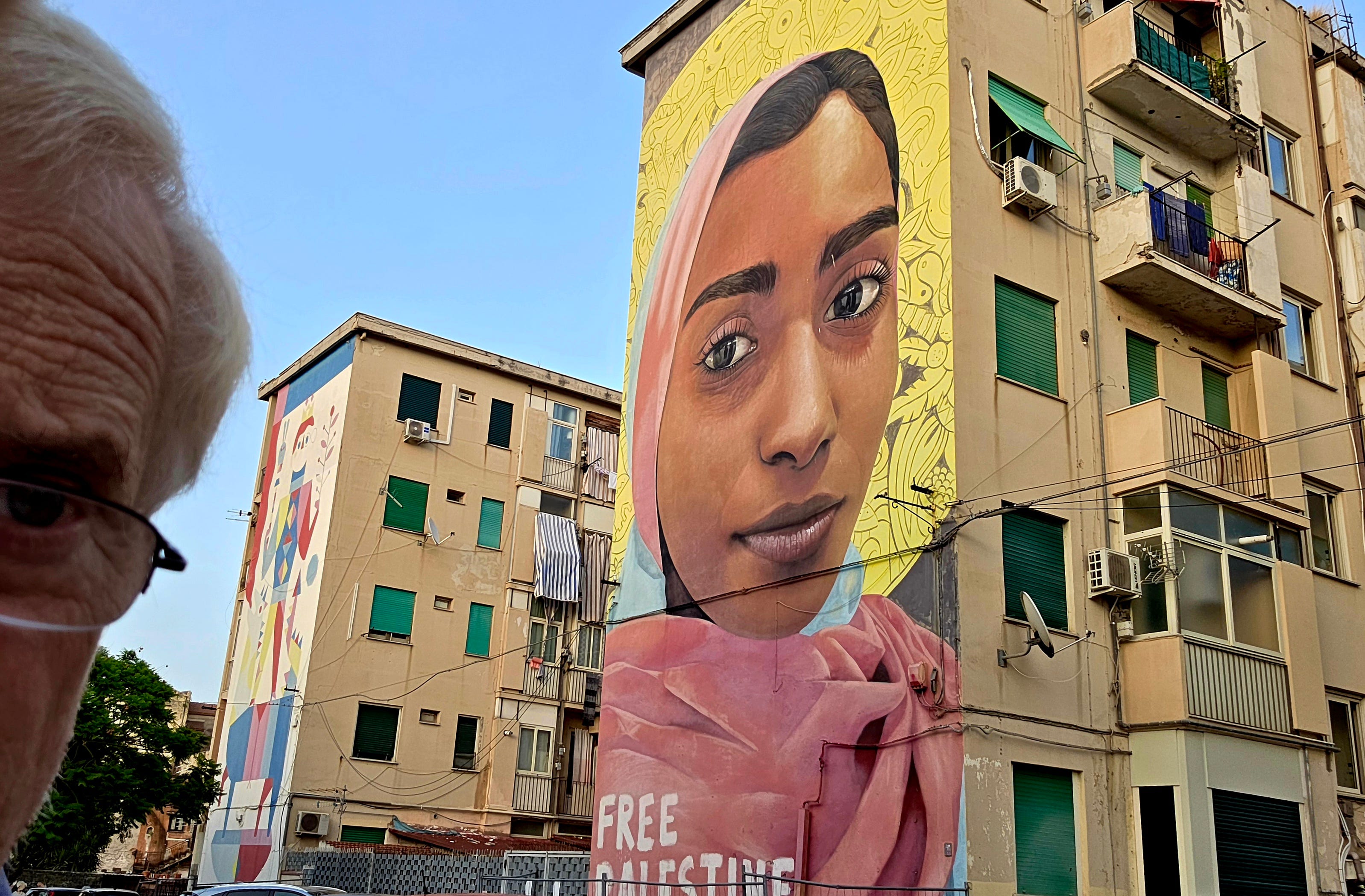
[This can be seen along a street heading back towards the center of Palermo but still within la Kalsa. The apartment buildings are modern, as are of course the artwork and the contemporary politics - expressed in English.]
No posts
Comments
Nothing yet. Say the first thing.
Sign in to join the conversation.