
Several years ago, in a moment of meditation, I got a clear message from the universe: Slow Down.
That message was life-changing. Slowing down forced me to reevaluate every aspect of my life. It led to changes in my work, marriage, family, self-care, and even opened the doorway to deconstructing (and ultimately leaving) the religion of my childhood.
Slowing down is NOT slow living. It’s more of an intentional mindset rooted in what you value most.
This sounds amazing until you realize that to live intentionally by your values, you have to figure out what those values are.
I have to learn this lesson again and again and again. Last month I was chatting with my therapist and she encouraged me to re-define my values, as they’ve likely changed since I last figured that out.
So I set out this month to do just that: figure out my values. Somehow, though, this time around it’s been much more difficult.
I did all the typical things. (And they’re worth trying if you’re new to value identification!)
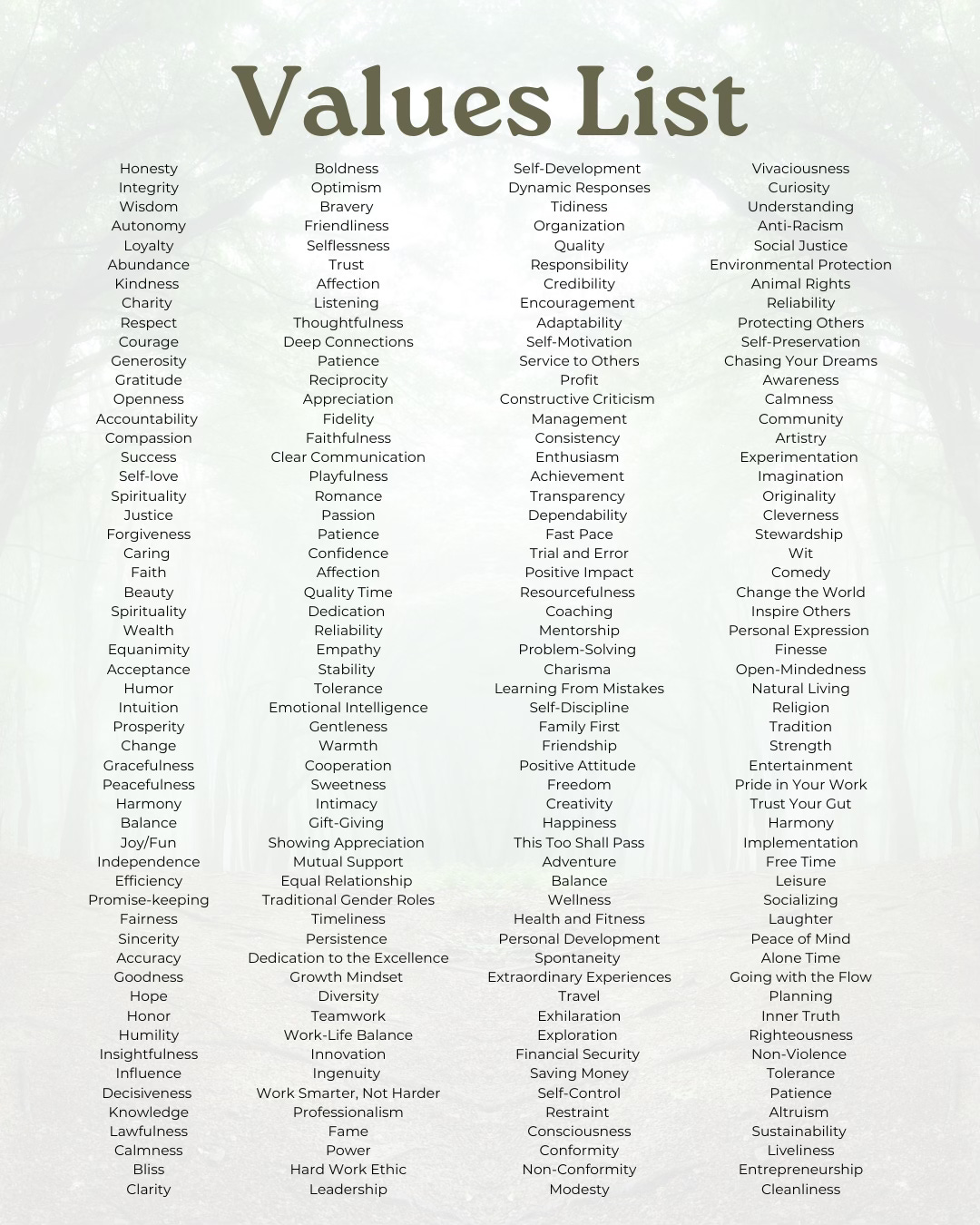
The first recommendation in identifying your values is always to find a list of values and sort through them. This was the first thing I did after my therapist encouraged me to identify my values. I compiled a list of values from various places and put them in a spreadsheet. Then, I compared two at a time and picked the one with which I resonated more. Think about it like a vision test - what is better, A or B? It took a little bit of time, but eventually, I whittled the list down from 216 to 4.
Here’s the list I used:
The next exercise I tried was to identify people I admired and to describe what about them I admired most.
I worked through the exercise with a few people I knew personally, a few people in my community, and a few public figures. In each person, I’d try to identify 2-3 things I respected about them or wanted to see in myself.
The last exercise I tried was new to me. It comes from the book Think Like A Monk by Jay Shetty.
In the book, he recommends reflecting on 3 of your best decisions and 3 of your worst decisions. For each, answer these questions:
Why did you make that decision?
What did you learn?
What would you do differently?
As you answer each of these questions, see what values emerge.
As I read the exercise, I was struck by the approach and immediately grabbed a pen and paper to try it. Coming up with my 3 best decisions was easy. Coming up with the 3 worst decisions was more difficult than expected. I tried not to overthink or philosophize, and instead committed to three decisions that even though everything worked out ok, I wouldn’t make again.
This is easily one of my favorite exercises and one that revealed to me WHY my values were what they are. It also made it very easy to determine what my core values are in the present version of myself.
If you haven’t ever tried it, or if it’s been a while, I’d encourage you to work through this same experience. What are your values?
Pick from a list, identify what you admire in others, and reflect on past decisions to understand what it is you value.
From there, you can begin to slow down and live intentionally. It’s a beautiful journey and one that is constantly changing and becoming more and more beautiful along the way.
Comments
Nothing yet. Say the first thing.
Sign in to join the conversation.