
I was sitting in Mass just two Sundays ago when I got to listen to the most beautiful homily I had ever heard about the end of the world. This is the usual topic for discussion on the last Sunday of the liturgical year, since the readings offered to us by the Church in the weeks preceding Advent point us to consider the four last things: death, judgment, hell, and heaven. It is fitting, indeed, to close out the year in this way, and it is one reason why I believe so firmly that it is in everyone’s best interests that we delay decorating for Christmas at least until after the last Sunday of the liturgical year. An earlier and earlier celebration of Christmas can mean that we become too distracted to contemplate the Second Coming of Christ. We forget that the Child came and that the Man will come again. He came first as a Child that we might learn to love Him; but He will come again as King and Judge—and for this, we must be ready.
But as I was sitting in Mass, listening to that beautiful homily, all I could think of was C.S. Lewis’s The Last Battle. The homily was beautiful in the same way that that book is beautiful: it was a reminder that all things must end, for we are dust, and to dust we shall return; but Christ has prepared a place for us, and the story that begins when all the others come to a close shall never, never end. The thought came to mind that I wished I were reading that book just then (not at Mass, you understand), but I like to read the Narnia books together and in order; and I couldn’t imagine just pulling it off the shelf to read on its own. But then, I realized, as undoubtedly others have realized before me, how fitting it would be to read The Chronicles of Narnia with the liturgical year. So I have written out a plan for my family’s use, and I hope you can join along, too.
N.b. We will be following the publication order, not chronological order. You will see, of course, that this is right and just. Thank you.
December and Early January: Advent and Christmastide
The Lion, the Witch, and the Wardrobe
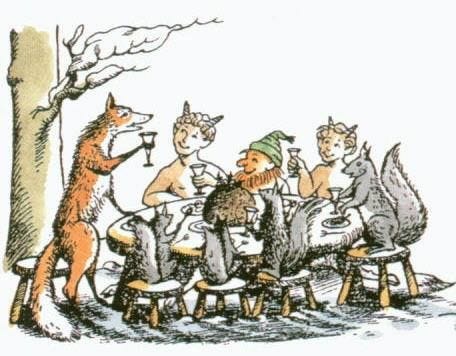
If The Last Battle is most fitting for the end of the liturgical year, The Lion, the Witch, and the Wardrobe is most fitting for the beginning. It is cozy, for one thing, but it also gets to the heart of the matter, which is that the season of Advent is meant to prepare our hearts for the coming of Christ; it is meant to fill our hearts with joy and anticipation to know that “Aslan is on the move.” And then, there’s Father Christmas. J.R.R. Tolkien was critical of Lewis’s inclusion of Father Christmas in the book. I find it delightful and even edifying (but, of course, what do I know?). It is Father Christmas’s coming that deals the first real blow to the White Witch, who lashes out in violence upon discovering that he has returned, though she had kept him out a long time. His gifts to the children and especially the breakfast tea that he provides hearten them for the remainder of the journey.
I think I read that Dominika, following the Narnian fashion, makes a breakfast tea for her children on the feast of St. Nicholas, which falls each year on December 6. (If it wasn’t actually Dominika who said this, I’m sure she would approve anyway.) It’s such an elegant idea, so brilliant—so bookish! I love it so much and will be doing this from now on. My favorite thing about it, actually, is that we celebrate St. Nicholas before Christmas, and he, like all the saints, point us to Christ. He fills our hearts with joy and reasurres us that yes, indeed, Christ is coming. And that is true of Father Christmas in the book, as well! He is a forerunner—a signpost—for Aslan. He comes not for himself or as the end all be all, but as a bearer of good news: the King is coming.
My hope is that we can get to the chapter when Father Christmas comes on December 5, and then we can enjoy our Christmas tea together in the morning.
January and February: Epiphany and Carnival Season
Prince Caspian
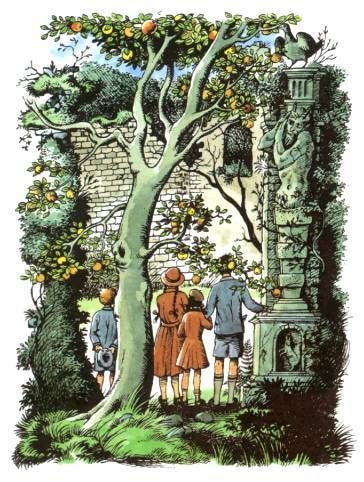
I live in a region of the United States in which Mardi Gras (or Carnival) is a very big deal—so much so that it is a season, not just a day. It begins on Epiphany and comes to a close on Fat Tuesday, the day before Ash Wednesday, or the day before Lent begins. Here, there are countless Mardi Gras parades and balls and kings and queens. It, therefore, seems fitting to me to read Prince Caspian, which is about the restoration of the rightful king of Narnia, in this season. The four kings and queens of Narnia—Peter, Susan, Edmund, and Lucy—having disappeared into time, return once more to Narnia in order to reveal to the nations, you could say, the kingship of Caspian—his right by birth. As Peter, the high king over all kings in Narnia says to Caspian, “I haven’t come to take your place, you know, but to put you into it.” Caspian’s kingship, of course, is a sign of the higher kingship of Aslan; it is He Who is the true king of Narnia.
It would be quite fitting to make a king cake to enjoy together when you get to Caspian’s coronation near the end of the book. If you’ve been told you can only have a king cake on January 6, let me assure you that in Louisiana, people eat king cakes all season long. Kendra Tierney has instructions for how to make a king cake from canned cinnamon rolls. But if you haven’t ever had a real king cake made in Louisiana, I’ll just drop this here. There are bakeries that deliver king cakes all around the country! Shipping can get a little pricey depending on where you live, but consider splitting the cost of one with another family or two. If you’re reading the series together, it would be so fun to enjoy a king cake together!
February, March, or April: Lent
The Voyage of the Dawn Treader
Whenever I’m asked which is my favorite of the books in this series, I always think of this one first (though, if I’m honest, I think it’s actually tied with The Horse and His Boy, which is in every way a perfect book). I love this book, and although I had never considered it in this way, I think it would be a fitting book to read during Lent.
The voyage the children go on to seek the Seven Lost Lords of Narnia and, perhaps, the end of the world—Aslan’s country—seems representative of the journey embarked upon by a soul searching for Christ. I am reminded of St. Therese saying that “the world’s thy ship, not thy home”—that is, we are made for another country, for another world, and we are here so that we might make it to that world some day.
The Voyage of the Dawn Treader can feel episodic because the children and the crew of the ship are going from adventure to adventure, but so is life—life is episodic. As they sail in that great Narnian vessel, they are faced with their vices and must confront and conquer them. Caspian and Edmund must contend with avarice and the desire for power; Eustace must overcome his selfishness; and Lucy must conquer her fear, lack of trust, and vanity. And in Eustace’s case, we see a beautiful, heartbreaking reflection on how it is Christ and Christ alone Who can heal us and deliver us from our sins. It is He who must strip us down and clothe us in new life. And for what else is Lent, than to help us realize that we are dust, and to dust we must return? For what else is Lent, than to help us contend with our vices and to give us the time to focus on inviting Christ into our hearts so that He might strip us down and clothe us in His grace? We must take the journey; we must travel on towards Aslan’s Country.
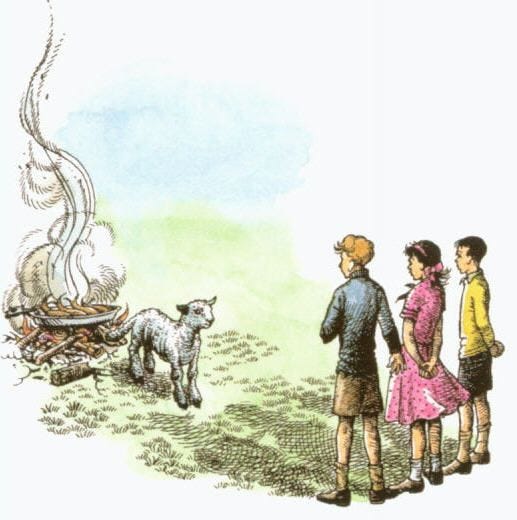
There are so many more things I could say about this precious book—the Lamb!—but I think when you read it again, or perhaps for the first time, during Lent, you will see all those things and more.
No treats since it’s Lent!
April and May: Easter
The Silver Chair
The Silver Chair is what I would call a sleeper novel, at least for me. I never think of it first when I’m reminiscing about my favorite Narnia books, but every time I read it, I am so moved.
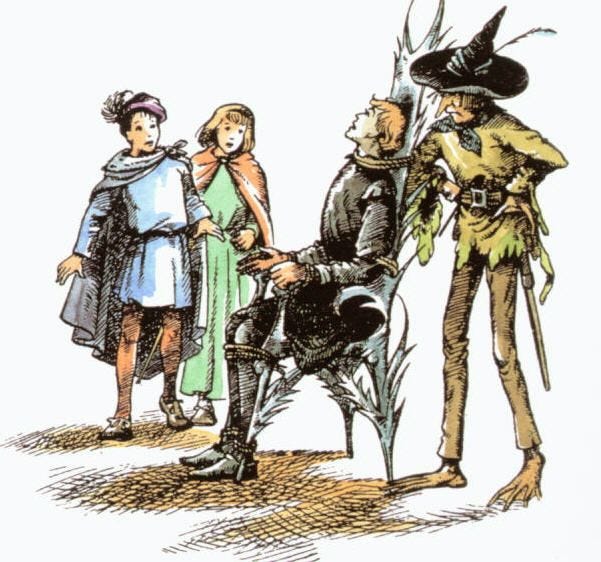
I’m starting to wonder if C.S. Lewis was doing this intentionally because I would place no other novel from the series during this season than The Silver Chair, though at first glance it may not seem fitting. In this novel, Eustace and Jill are brought to Narnia with a task: to rescue the Prince Rilian, son of Eustace’s beloved Caspian, who has been lost for ten years. Through the simple, true faith of the marshwiggle Puddleglum—one of the most delightful characters in the whole series—they conquer the serpent and deliver the prince from his tomb. In the end, too, we see through Jill and Eustace’s eyes how the blood of Aslan gives new life; we see the resurrection of the dead.
Ah! I can hardly wait to pick this book up next spring, but I’m not sure yet what kind of treat I’ll make for us to enjoy when we finish reading it. When I think of foods related to this book, all I want to eat is pie because of—well, if you’ve read the book, you’ll know.
June and July: Pentecost
The Horse and His Boy
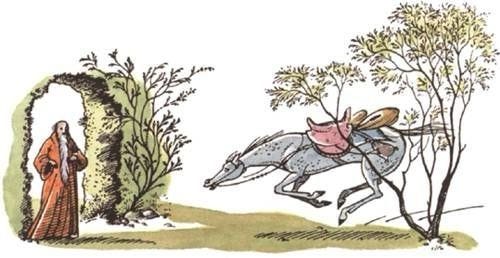
The Horse and His Boy, like I said earlier, is practically a perfect novel. I could wax poetic about it forever, but I will try to restrain myself. In my opinion, it’s this book more than any other book from the series that best represents the intimate knowledge and love that Christ has for each of us. It is a book that helps me to understand that Christ truly is with us always, and a book that has transformed how I understand suffering.
It can be easy to feel as though Christ is not really with us, or that we are far too unimportant for Him to remember us. We do not see Him, of course, but He is there. We see how Aslan is the cat keeping Shasta company by the graves. He is the lion urging the horses on faster than they thought was possible to run. He sees the suffering of Aravis’s servant girl and enacts justice on her behalf. He is intimately involved in the action of the story—in a way that he is not involved in other books.
It would serve as a good reminder following Pentecost, I think. It can be tempting to believe that Christ has ascended and that He remains very far from us. But He is beside us always.
I love the idea of eating a proper Narnian breakfast as Shasta does with the dwarves after finishing this book. They enjoy porridge with cream, bacon and eggs, mushrooms, buttered toast, and coffee.
August and September: Time after Pentecost, or Ordinary Time
The Magician’s Nephew
We have begun the quiet time of the year, liturgically speaking—the season in which the Church, having recalled and revived the drama of her Spouse’s Life once more, retires in quiet contemplation. There are feasts still on the horizon, yes, especially the nativity of the Most Blessed Virgin Mary and the glorious feast of All Saints’ Day; but the Story of that Life that gives all meaning to the whole of the liturgical year has drawn to a close. There is a sadness to this time of year, at least to me.
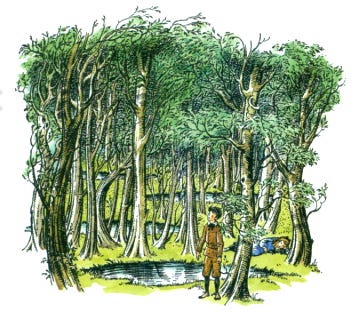
And now, before concluding the year, we must return to the beginning. It is in The Magician’s Nephew that we go back to the creation of the world—the creation of Narnia. We see how Aslan creates the world, we see how he breathes upon the first talking animals, how he breathes upon the first king and queen of Narnia; we see how sin and death and suffering enter this world while it is still new, and we see the promise of how the world is to be redeemed, one day.
I will admit that The Magician’s Nephew is my least favorite of the books, but I never skip the reading of it because to do so would be like skipping Genesis before reading Revelation. It is difficult to understand how things might possibly come to an end if we do not understand that they once did, in fact, begin. And so, we must learn about how Narnia came to be through the power of Aslan. It’s The Magician’s Nephew, I think, that really sustains you throughout the last book because it reminds you that Aslan is the master of this world—its beginning, as well as its end.
If you really wanted an activity to go with this book, I would suggest going apple picking if such a thing exists in your part of the world. If not, eating some beautiful, sweet apples while reading the book outside in the golden light will do.
October and November: the End of the Liturgical Year
The Last Battle
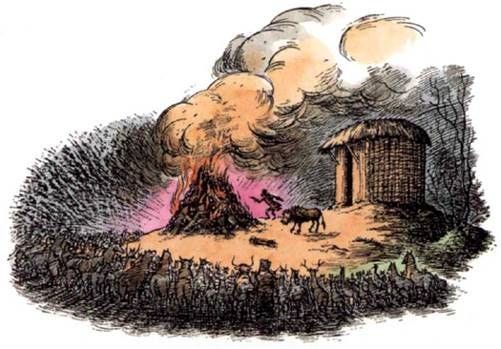
We have come to the end of the year and the last book in the series. This one is a hard one to read—so hard, in fact, that it’s the only book in the series I think might actually take us two months to read. And that’s because I will often ask my husband, who will typically read out loud to all of us, to stop and put it down because I just can’t bear it.
There is a lot of suffering in all of the Narnia books, but interestingly, we usually enter into the books when Aslan is prepared, in the fullness of time, you could say, to act. A hundred years of winter and no Christmas pass for the Narnians under the Witch’s domain. Ten years does Caspian mourn the loss of his only son. Shasta lives his whole childhood suffering hardships and the absence of parental love before he escapes with Bree.
And yet, we do not see this suffering. Perhaps that is why The Last Battle is so jarring to read. We are used to stories by now in which Aslan is poised to act, and we are expecting a particular kind of happy ending. But here, in this book, the act itself is the destruction of the world, and the last king of Narnia is as powerless as we are to save that beloved country.
We see death (so much death!)1, we see the final judgment, we see the destruction of heaven and earth, and we discover the New Narnia, which will never pass away. And in the closing paragraphs of the book, having experienced the pain and suffering of the end of the world, we can begin to understand what the Scriptures mean when they say that there shall be no more tears in heaven.
And I saw a new heaven and a new earth. For the first heaven and the first earth was gone, and the sea is now no more…And God shall wipe away all tears from their eyes: and death shall be no more, nor mourning, nor crying, nor sorrow shall be any more, for the former things are passed away. And he that sat on the throne, said: Behold, I make all things new. Revelation 21:1;4-5
Lewis is able to communicate the mystery and wonder and awe of what it must be like behold the Face of God—to go further up and further in, and to enter a Story that will never end.
In The Last Battle, Lewis shows us that we must die in order to truly live, and that the world in which we live is but a shadow of the real creation that awaits us if we truly desire it. This is a book that shows us those Last Four Things. And it is a book that will make you desire Heaven. For all of its goodness, we see and understand that the Narnia that has passed away is but the beginning. And so, we must go further up and further in. We must make Heaven our home. It is there that we will know Him.
If you haven’t cried yourself silly by the end of this book, I don’t know what to tell you. I always want to go run through a field with my children after reading it. If you think of a treat to celebrate the ending, let me know in the comments!
I hope you enjoy this guide to living out the liturgical year with The Chronicles of Narnia! My favorite thing about this is that there’s really a lot of flexibility regarding when to read each of the books. You don’t have to start on a particular day to make it work! I’m looking forward to reading them in each liturgical season and especially to discussing the books with our children.
Thanks for reading! This post is public so feel free to share it.
Listen, this is a hard read, even for me as an adult; before reading it out loud to your children, gauge what they can handle. There are scary things in the other books, too. Every child is different and mine have done well with the books, but everyone has different limits.
No posts
Comments
Nothing yet. Say the first thing.
Sign in to join the conversation.