
Hi Little Loves,
2026 marks 10 years of LVPR, and if there’s one thing this industry has taught me, it’s this: the minute you think you’ve figured PR out, it changes.
That’s actually why I’ve stayed in it.
I’ve never been someone who could work in-house and focus on one brand forever. I’d be bored. What I love about agency life (and what keeps my ADHD brain very happy) is the constant shift. And over the past decade, the way we do this work has changed more than once.
When I started LVPR, influencer marketing was the shiny new thing. I didn’t know anything about it. So we learned it. Built it. Turned it into a full department.
Then the industry shifted again. Today, a large share of earned media utilizes (and requires) affiliate links, which has completely changed how placements are prioritized, how editors make decisions, and how brands measure ROI.
And now? AI.
We’re entering a phase where the seemingly right placements are shifting; it’s understanding what search terms are prioritized and incorporating them into web copy, it’s identifying what outlets rank highest with LLMs, and truly optimizing the brand’s digital AI presence for success. Earned media is hugely relevant, and any AI platform will tell you that your presence is greatly affected by your brand’s earned media strategy.
It’s still the Wild West, and we will be riding the industry innovation in real time.
Another decade-old wisdom: you cannot stand still in this industry. You have to stay curious. Pay attention to what’s changing. Ask questions. Find people who know more than you. Invest in learning before you feel ready.
On a personal note, I’m also heading out soon for some family time. One of my commitments this year is remembering that we’re not just building businesses, we’re building lives. The work will always be there. The moments won’t.
So here’s to evolving, staying curious, and making space for both.
— Ali
Inside this issue:
We’re unpacking the AI conversations in our offices and beyond. Ali explains why brands are underinvesting in their strongest assets, Sarah questions whether AI is diluting industry standards, and the Little Ladies round up what’s trending, comforting, and culturally necessary right now.
Before we let you scroll too far: Fill out our interest form and let’s make your brand stand out.
As a founder, I sometimes notice patterns that are a little uncomfortable to call out. But they’re important.
Here’s one I’m seeing constantly: brands obsessing over earned media, influencers and the algorithm of the week, while completely underinvesting in the channels they actually control. This is such a missed opportunity, so I’m freeing up some time this month to spread some love via free owned channel audits and some wisdom below.
We’ve had AI on the brain, but in an AI-first world, that’s a problem because AI pulls from everything you own: your site, your blog, your founder content, your email, your LinkedIn, your product pages to decide:
Whether to recommend you
How to describe you
Or whether your competitor gets the spotlight instead
If your owned channels are outdated, thin, or inconsistent, AI fills in the blanks for you.
And I promise these LLMs don’t always get it right. Let’s talk about where brands are missing the mark and the quick fixes that matter.
1. Your Website
It’s easy to get swept into a social-first mindset, but your website is still your home base.
If you optimized your site six months ago and haven’t touched it since, you’re already behind. AI models and visibility tools evolve constantly. What positioned you well 90 days ago may not position you competitively today.
Every quarter, brands should be auditing their site and asking:
Are we clearly stating our category, use cases, and benefits?
Are our product pages meaningfully differentiated from competitors?
Is our expertise and authority obvious within seconds of landing?
Your website is more than a one-and-done project. It’s quarterly hygiene that keeps you relevant for both customers and the visibility bots.
2. Your Blog
Owned editorial content is no longer “nice to have,” but a control center for brand narrative.
Every brand should have a blog or article hub that lives on your domain, targets key category topics and is attributed to a real author (founder, medical advisor, CMO, etc.).
And no, this doesn’t have to be complicated. Your Substack or newsletter content can (and should) live on your website. Repurpose it. Expand on it. Let it work harder for you.
Not getting the editorial coverage you want? Write it yourself. Own the language. Publish the narrative. Let AI learn from you..
3. Your Substack/Newsletter
Think of Substack as your super-speedy brand focus group.
It’s a great place to:
Test topics and messaging
See what your audience actually engages with
Identify content themes worth expanding on
Build a loyalty-driven owned audience
Testing eliminates guesswork. Plus, every piece of content you publish becomes another signal AI can learn from.
4. Your Socials
It’s 2026. Customers are absolutely checking your socials. AI is too.
Social presence now functions as a credibility signal. Each platform should have a clear role, and the strongest brands show up consistently with a defined point of view.
If your last LinkedIn post was in 2023 or your Instagram bio doesn’t clearly explain what you do, you’re sending weak signals. As my kids say, it looks “a little sketch.” That confusion impacts both customers and AI interpretation.
The Big Picture
Owned channels aren’t just marketing anymore. They’re your AI training ground.
If you’re not actively shaping your language, your positioning, your expertise, your authority, AI and your competitors will do it for you.
Want a Quick Reality Check?
I’m opening up 10 free 30-minute Owned Channel Audits this month. No hard sell. No pressure.
We’ll look at:
Website positioning gaps
AI visibility risks
Blog/Substack opportunities
Social authority signals
Quick fixes your team can implement immediately
Just clarity on where you’re strong and where you’re leaving opportunity (and revenue) on the table.
You can reserve your spot HERE. Questions? Feel free to drop a reply.
This is something I’m seeing more and more as AI becomes deeply embedded in the PR and discovery landscape.
And honestly? It’s something we’re actively working on improving internally at LVPR, too. We spend so much time helping brands tell their stories that sometimes we forget to step in front of the camera ourselves.
But the brands that win in an AI-driven world won’t just earn attention, they’ll own their narrative everywhere it lives.
Roses are red, my Inbox is blue. Here are our faves that we picked just for you <3.

Her Campus Newsletter: Gotta stay up to date with the youth.
People Brands and Things: Like an electrifying dopamine hit of the latest in the PR/marketing world
On Brand: A tapped-in, online take on branding, socials and marketing from On Alex Manderstam, founder of media company Girls Club.
The Benito Bowl (Bad Bunny’s halftime show)
(potentially related) the new trend of local lookalike contests for the current trendy celebs
Boutique workout classes. Confirmed that BUNDA indeed kicks your bunda, and JETSET Pilates gets you set for… something… probably war. TBD.
A big, 16oz mug: Perfect for busy wfh mornings and the subsequent 2pm pick-me-up.
Matcha lattes at home. A fun little experiment between emails and client calls
The viral sweet potato beef bowl: The ‘P’ in LVPR stands for ‘protein.’
Embracing boring. Slowing down after the work day to bake some banana bread to (the GoNanas mix is really good). Boring is also really good.
The sun setting later… spring is coming
Caught in 4k: PR Pros falling behind the zeitgeist?!
Nobody Wants This: Girl, catch up.
Summer House: The new season. After quite a boring last season, the fun vibes are back!!
Secret Lives of Mormon Wives: A fave from our founder a few months ago, a newfound fave of the team… just a little late.
What have you been loving lately? Spill in the comments so we can add it to the rotation.
INDUSTRY BABY
Meet Sarah, our Gen-Z Account Exec: she’s talking to industry pros to figure out what’s actually popping.
Along the lines of AI causing seismic shifts in our industry, I’ve read the think pieces about its ethics, economics and environmental impact, but that’s a column for another day.
I’ve also been reading a lot of generic, poor-quality writing recently. I mean, why is every Linkedin post like that? Why are brand sites sounding the same? Why does my inner monologue suddenly have a cadence that lists everything in threes? In an industry that’s all about language, I keep asking myself: what happens when a large language model starts speaking for us?
Part of me fears AI might be pushing PR into its Slop Era, one full of mediocre quality full of tired, generative tropes: Bloated lists, identical sentence structures, overuse of em dashes and Oxford comma, standardizing then sterilizing the subtle art of professional communication. Or worse, the fake citations and hallucinated quotes often spat out by these LLMs (remember, they’re not a search engine), degrading the integrity and credibility of the field.
“Whether its the lists, sentence structure, or over-use of em dashes and oxford commas — or worse, the hallucinations and fake citations ChatGPT can often spit out — these LLMs have been producing a lot of the same thing.”
Thanks, Chat. Could have (and did) say it better myself.
This is not a slam-piece on AI. Like any innovation, it has massive upsides (AI & GEO reporting is pretty cool! ). I worry about what the misuse of a nuanced tool could mean.
I had the honor of taking an entire class in grad school on Generative AI and the media with the incredible Nicholas Diakopoulos. His research alongside Hannes Cools has highlighted the importance of AI literacy, noting that journalists have similar fears: AI oversimplifying nuance, misrepresenting information (via hallucinations and bias), or potentially dulling the very critical thinking that makes our work human.
Creativity and real engagement with material matter, especially in media. Do I expect every client or brand to fully get that? No. But somewhere in the earned media chain from brand copy > pitch > publication, there ought to be journalistic autonomy and actual human effort.
I seem to share this sentiment with some media across the pond as well, the Press Gazette noted that journalists are bombarded by a wave of AI-generated slop sent by PR pros who were handed slop to begin with.
I get it: a CEO shouldn’t be their own spokesperson, and maybe they shouldn’t write their own bio. But outsourcing personal details to ChatGPT (which, I cannot stress enough, is not Google) is… bleak. If every link in the earned-media chain gets diluted by AI mush, quality nosedives. From the internal comms/marketing, to the PRos, to journalists, then readers, then eventually the next generation. Suddenly nobody can write a sentence without four em dashes, we are all delving all the time, then nobody can write a sentence full stop.
Yes, slippery slope. And yes, I’m doubling down.
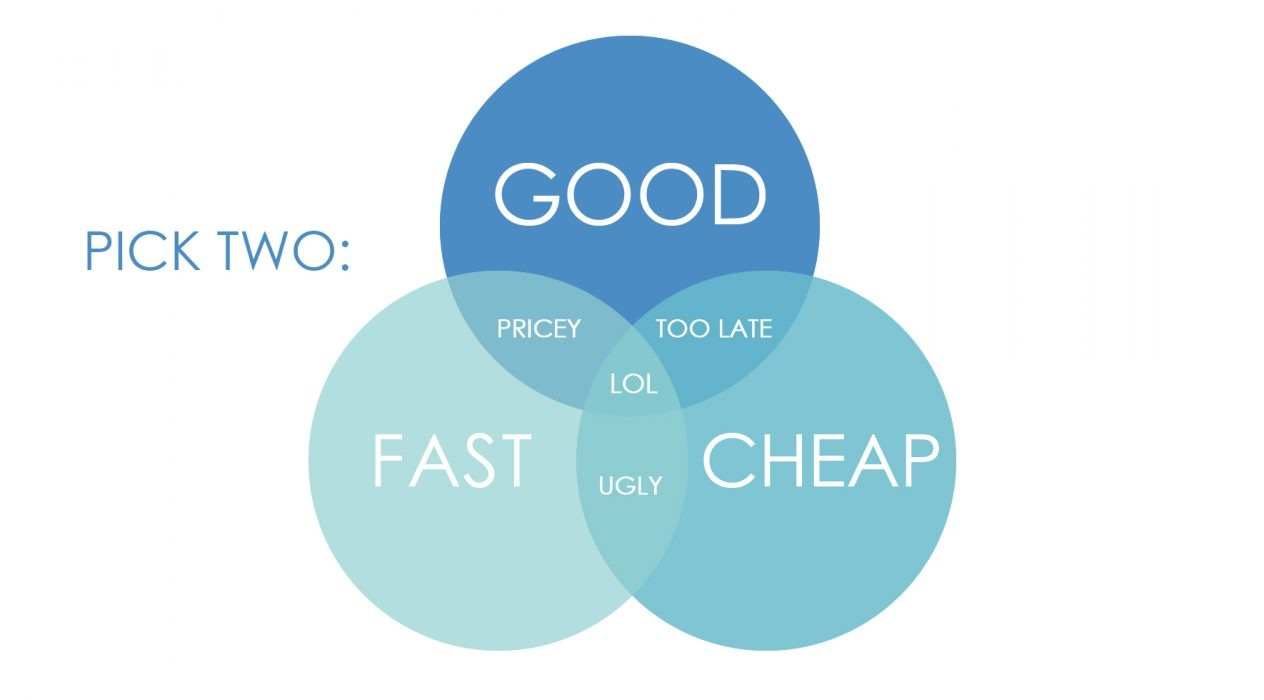
See the figure above. I have been told that with most things, we only get to pick two. And if the thing we’re cheapening is the mind and our ability to think, write or communicate, I worry that cutting out “good” means we’re stunting ourselves.
There’s a balance here, tech and innovation can support the work without sacrificing skill for convenience. I am ten-toes-down on speaking and thinking for ourselves.
But as more and more people, more and more executives turn to AI for seemingly everything: advice, contracts, captions, even pitches, I worry that a good pitch is going to become a needle in a slop bucket.
What do you think? This is for sure my hottest most timely take yet. Standing on business.
Chat soon,
Sarah
P.S. Want to yap with Sarah or see your takes in the next Industry Baby? Hit the button below!
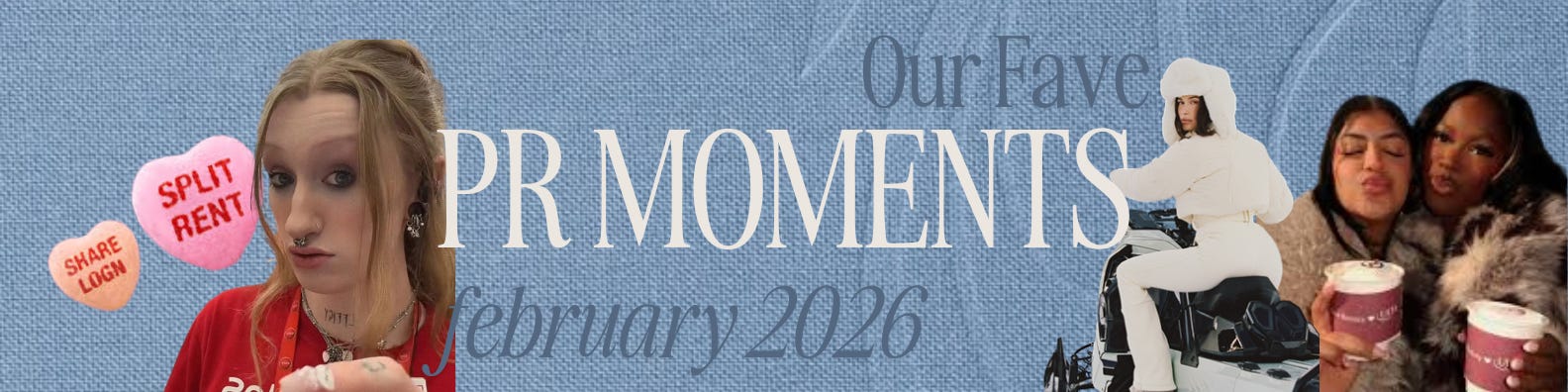
The Staples baddie gives us the inside scoop on all that Staples has to offer, from to the weirdly unknown services. Turns out treating office supplies like fun lifestyle content is top-tier promo, an exciting proof of concept when employees and brands work with each other instead of against each other.
Super bowl commercials this year were less… cheesy? Doritos skipping a Super Bowl ad showed us sometimes stillness is the move. By sitting out the multimillion-dollar commercial frenzy, the brand stirred organic buzz and marketing think-pieces, disruption and conversation can be just as powerful as airtime when you trust the audience to fill in the gaps.
Sweethearts updates their classic Valentine’s candy hearts to be more relatable in 2026: in their new Love in This Economy bag, budget-savvy messages like “SPLIT RENT,” “SHARE LOGIN,” “CAR POOL,” “BUY N BULK,” and “COOK FOR 2” are mixed in alongside the old favorites, acknowledging love and inflation at the same time
Rhode and Rare Beauty dropped dueling winter brand trips and accidentally gave us a masterclass in positioning. Rhode’s “Snow Club” was giving glossy quiet luxury, while Rare Beauty went cozy, wellness-coded. Same tactic, totally different energy. And yes, the internet conspiracy theory says the overlap was intentional. Either way… the side-by-side comparison only made both identities sharper.
Less of a fave and more of a relevant catch: Socials star Khaby Lame sold his likeness to an AI company for $975M. It’s a bold move that blurs the line between human influencer and digital persona, raising big questions about the future of content, branding, and what it even means to “be online.” Some call it genius. Some call it spooky. Our group chat says “and so it begins…”
No posts
Comments
Nothing yet. Say the first thing.
Sign in to join the conversation.