
Welcome to Little Flames Contributor Series.
When Benjamin Kwarteng sustained a cervical spinal cord injury in 2008, his life changed instantly. Today, he’s an entrepreneur, mentor, and disability advocate who is focused on creating practical solutions that encourage independence, dignity, and inclusion.
In Part One of my conversation with Ben, we talk about his spinal cord injury, the realities of navigating the world as a wheelchair user and what Ben refers to as “disability privilege.”

Name: Benjamin Kwarteng
Superpowers: Perseverance, optimism and turning barriers into opportunity.
My Favourite Ben Quote: “Your circumstance is not bigger than your character. We often look at our circumstance and we might let it overshadow who we are as individuals but we need to realize that at the end of the day if you allow that to control who you are, you will fall into the victim position.”
THE INTERVIEW (edited for clarity)
Melissa: For readers who may not know your story, can you tell us how you acquired your spinal cord injury?
Ben: In November 2008, my sister, my nephew, and I went back to Ghana. When we arrived, our luggage was missing, and we were told the following day to retrieve them. On our way back to the airport, I sat at the front of the taxi, my uncle sat behind me and my sister sat behind the driver. From my uncle’s house to the main road, the road had large potholes, which made the ride bumpy before we reached the main road.
When we got to the main road, the area was busy with multiple roadside restaurants, people playing loud music, and smoke in the air from what looked like someone burning things on the side of the road. We drove less than a kilometre before approaching a bridge.
Those were my last memories of being in Ghana. I woke up a week later in Marseille, France.
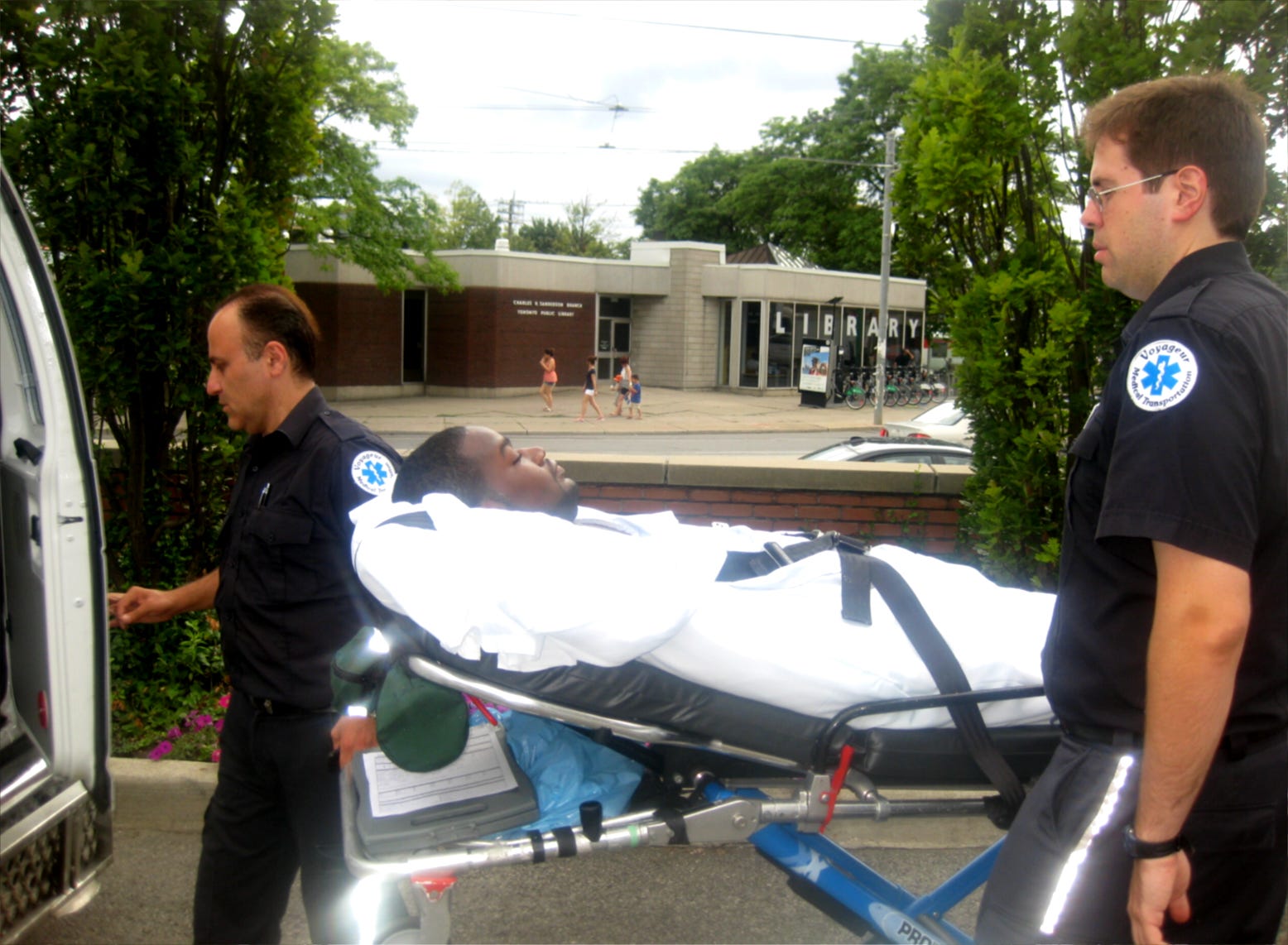
I was informed that I was in a vehicle accident, and I was flown from Ghana to France to undergo surgery for my injuries. I sustained a spinal cord injury that left me a quadriplegic, leaving me completely paralyzed from the neck down. The injury completely changed the course of my life.
* Read more about Ben’s accident here.
Melissa: When we first spoke, you introduced me to the term "disability privilege." I've been injured for 19 years and have never heard those two words used together. What experiences, both challenging and positive, led you to see disability through that lens?
Ben: When people hear the term “disability privilege,” many are surprised. After all, living with a disability often comes with significant challenges, barriers, and disadvantages. As a quadriplegic living with a spinal cord injury for over 18 years, it hasn’t always been easy. There have been many moments of frustration.
This comes from a person who has been denied service simply because I could not physically open my bag to take out my wallet and pay for food.
I usually meal prep for the week so I know what I’m eating, but sometimes I want something different. One day I stopped at a Subway restaurant. As I approached the entrance, I saw there were stairs leading up to the door, and there wasn’t an accessible button to open it automatically.
I waited for someone to pass by who could help me. The first person I asked simply walked past without acknowledging me. When another person approached, I said, “Excuse me, ma’am, could you please help me open the door?” Before I could finish, she clutched her purse and replied, “Sorry, I have no money,” then walked away.
I’m used to experiences like this, so I waited again. A young woman and a man approached and asked if I needed help opening the door. I said, “Yes, please, if you don’t mind. Could you also ask one of the employees to come over? There’s no way for me to get up the stairs.”
When the employee came outside, she took my order and then asked how I wanted to pay. I said, “Could you please open my pouch and take out the money?” She replied, “Sir, I can’t go into your bag. Can you put it on your lap so I can pick it up?” I explained that I didn’t have enough movement to do that. She apologized and said she wasn’t allowed to go into my bag. She suggested I come back with someone who could help me. I thanked her and went home.
One time I was sitting in a park talking on the phone when it slipped from my hand and fell to the ground. I noticed a woman sitting on a nearby bench, deeply engaged in a phone conversation. I approached her and asked if she could help me pick up my phone. To my surprise, she got up and ran away from me. I believe she may have thought I was trying to harass her, but I also understand that, from her perspective, she may have felt uncomfortable or unsure of my intentions.
These are the kinds of moments that happen when people with disabilities are misunderstood, overlooked, or even seen as a threat simply because of how we look or move through the world.
On the other hand, many people have stepped in to help when I didn’t even ask. When I get on the streetcar, people often lift the seats so I can position my wheelchair comfortably without me saying a single word. Some have opened doors the moment they noticed I was struggling. Others naturally understand the situation and are more than willing to help without hesitation. There have been times when my wheelchair has broken down and complete strangers have helped push me six blocks all the way home.
Another example of what I mean by disability privilege is accessibility accommodations. There are times when a person using a wheelchair may be allowed to bypass a long line because standing for extended periods simply isn’t an option. While some people may see this as special treatment, it is actually an accommodation that helps ensure equal access. There have been times when I’ve refused that accommodation because I could sense the frustration of others waiting in line.
In Canada, we often say, “If you don’t like the weather, just wait five minutes—it will change.” That’s how I try to look at life. I see my glass as half full, with room to grow. I also understand that just because one person cannot help doesn’t mean everyone will refuse. Sometimes you simply have to wait a little longer for help. You have to be patient.
But let’s not forget the hidden opportunities that can come with disability. These experiences can make a person’s perspective more meaningful to others because they’ve lived life from a different point of view. They can also create a deeper sense of empathy, resilience, and understanding that shapes how we see the world and how we advocate for others.
I also recognize that there are certain supports and accommodations available to people with disabilities that provide opportunities, security, and assistance that others may not have access to. In that sense, there can be forms of disability privilege.
For example, in Canada, people with disabilities may receive financial support through government programs. The Canada Disability Benefit and other disability-related supports help offset some of the additional costs associated with living with a disability.
One of the most valuable programs is the Registered Disability Savings Plan (RDSP). It allows people with disabilities to save for their future while receiving substantial government contributions. Depending on income and personal contributions, the government can provide matching grants and bonds that significantly increase long-term savings. For many Canadians with disabilities, the RDSP creates an opportunity to build financial security that might not otherwise be possible.
Coming from Ghana, where many people with disabilities receive little or no government support, I have seen firsthand how transformative these programs can be. In many parts of the world, people with disabilities are left to rely almost entirely on family members or community support. In Canada, there are systems that help promote independence, dignity, and future planning.
Travel is another area where accommodations exist. Many transportation providers and attractions offer attendant or companion programs, allowing a caregiver or support person to travel or enter at a reduced cost—or free of charge. These accommodations recognize that many people with disabilities cannot travel independently and should not be financially penalized for requiring assistance.
None of these supports erase the realities of disability. I still rely on caregivers every day. My spinal cord injury affects every aspect of my life—from getting out of bed in the morning to dressing, eating, and managing daily activities. The challenges are real and ongoing. But acknowledging these supports is important.
Disability privilege is not about saying that life with a disability is easier. Rather, it is about recognizing that society has created programs, accommodations, and services that help people with disabilities participate more fully in their communities. These supports do not give people with disabilities an advantage over others. Instead, they help address some of the barriers that disability creates.
Melissa: Your optimism is contagious. Do you see optimism as a personality trait, a choice, or something you’ve actively cultivated over time?
Ben: Some people naturally lean toward optimism, but after a life-changing injury, optimism becomes a daily choice. There were certainly moments when I could have focused only on what I lost. Instead, I chose to focus on what remained possible.
Over the years, I’ve intentionally cultivated optimism by celebrating small victories, surrounding myself with supportive people, and finding purpose in helping others by mentoring others with disabilities on how to live with their injury and be fulfilled in life. My faith, my family, my caregivers, and my entrepreneurial projects have all helped me maintain that mindset.
For me, optimism isn’t pretending that life is easy. It’s believing that even in difficult circumstances, there is still room for growth, purpose, and hope.
Melissa: Can you share one or two questions you wish people wouldn’t ask—or assumptions you wish they wouldn’t make—about you because of your disability?
Ben: One assumption I wish people wouldn’t make is that because I have a physical disability, I am somehow less capable intellectually or professionally. My wheelchair affects my mobility, not my ambition, creativity, or ability to contribute.
Another assumption is that my life must be sad or tragic. While living with a disability comes with challenges, it also includes success, friendships, laughter, dreams, and achievements. My disability is part of my story, but it is not the whole story.
I encourage people to focus on the person before the disability. Ask questions out of curiosity and respect rather than making assumptions.
Melissa: Beautifully said.
Little Flames is a free, reader-supported literary newsletter dedicated to honest creative nonfiction. If this interview moved you, please consider sharing it with a friend who needs to hear it.
Notes from Mel
Ben shared the spinal cord injury (SCI) resource website he built himself. For more info, click these links:
Ben’s blog A Journey Filled With Wonders, offers his reflections from nearly two decades of living with a spinal cord injury (SCI)
Is there something you’re eager to know but are afraid to ask?
I love when readers reach out with the things they want to know but are afraid to ask. Two of the questions I asked Ben in our interview—about how he sustained his injury and what questions and assumptions he wishes people would, and wouldn’t, make—came directly from questions readers sent me. I can’t always guarantee an interviewee will feel comfortable answering each question, but Ben was open and generous. Thank you, Ben, for your willingness to share.
Join me for Part Two (coming September 8), where our conversations shifts from the challenges of disability to the innovations they’ve inspired, exploring Ben’s work as an entrepreneur—from his caregiver app and adaptive fashion to his commitment to improving independence for others living with disabilities.

No posts
Comments
Nothing yet. Say the first thing.
Sign in to join the conversation.