
Why many readers did not fail certain classics so much as meet them too early
The four main ways school can make a living book feel dead on arrival
How to decide whether to retry now, retry later, or retire the book permanently
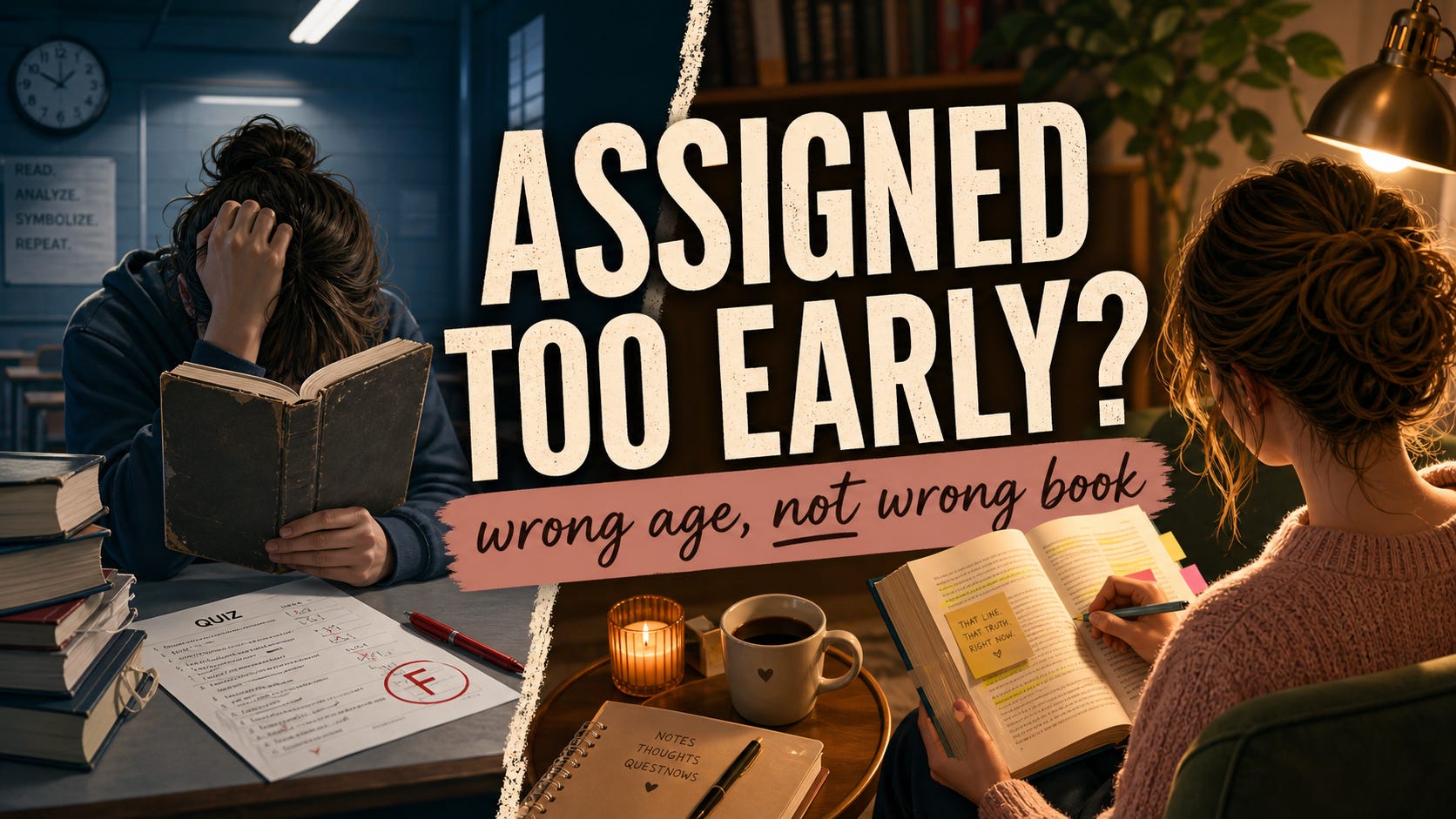
Not dramatic confessions. No one is standing in the rain admitting to a secret inheritance situation, unfortunately. Mostly the confessions are quieter and more familiar:
“I know I am supposed to like that one, but high school ruined it.”
“I read it too young and understood absolutely nothing.”
“I only remember being tested on symbolism.”
“I hated it then. I am scared to find out whether I still hate it now.”
I am collapsing the patterns here, not quoting anyone directly, because the point is not one reader’s confession. It is how many readers have some version of the same little literary bruise.
Pause.
That last one is the whole thing, really.
Because a lot of adults are walking around with literary grudges they formed at sixteen, under institutional lighting, while being asked to identify motifs for partial credit.
And somehow we have decided those grudges are permanent truth.
Interesting.
What if you did not hate the book?
What if you hated the circumstances?
What if the problem was not that the classic was boring, irrelevant, or impossible, but that you were handed it before you had enough life to attach it to anything?
Some books did not fail you. Your sophomore year failed both of you.
And honestly, that is fair. Sophomore year is not exactly known for its sophisticated relationship to ambiguity. Sophomore year is acne, panic, cafeteria politics, and being asked to have mature thoughts about moral compromise when your frontal lobe is still basically in beta.
Many classics are not too hard.
They were just introduced with the warmth of a parking ticket.
We like to pretend reading is a pure encounter between reader and book.
How elegant. How false.
Reading is always an encounter between a reader, a book, a season of life, a body, a schedule, a teacher, a deadline, a mood, a translation, and whether anyone explained what on earth you were supposed to be looking for.
This is especially true with classics.
A classic is not just an old book with a serious facial expression. It is a book that has survived long enough to gather reputation, classroom baggage, cultural authority, and a small cloud of people saying “important” in a tone that immediately makes everyone tired.
So when a reader says, “I hated that book,” I always want to ask:
When did you read it?
Who assigned it?
What were you told it was about?
Were you allowed to care about the story before anyone made you excavate the symbols?
Did anyone give you the historical context?
Were you reading a translation that sounded like it had been assembled from damp cardboard?
Did you have to write an essay before you had even felt anything?
Because there is a huge difference between a bad book and a badly timed book.
And school, bless its complicated little bureaucracy, is very good at badly timing books.
Some classics are not difficult because the sentences are hard.
They are difficult because the life inside them has not happened to you yet.
A book about a marriage collapsing under silence lands differently after you have seen adults avoid the truth for twenty years.
A book about ambition becoming self-destruction lands differently after you have watched someone get exactly what they wanted and somehow become less human in the process.
A book about social rules grinding down private desire lands differently after you have had to choose between what you wanted and what would keep the peace.
Try explaining that to a room full of teenagers whose most urgent social question is whether someone meant the period at the end of a text passive-aggressively.
Exactly.
This is not an insult to teenagers. Teenagers are brilliant in their own way. They are intensely alive to hypocrisy, humiliation, longing, injustice, desire, status, and being perceived while existing in a hallway.
This makes them excellent readers of certain books.
It also means some classics are being assigned before the emotional furniture has arrived.
You can technically read about regret before you have regrets.
But the room echoes.
This is where many classroom experiences go to die.
A book has a plot. Characters. Tension. Scenes. Secrets. Bad decisions. Social pressure. People wanting things they should not want and refusing to say what they mean.
Wonderful. Human. Alive.
And then someone walks in with a worksheet and says, “What does the green light symbolize?”
Immediately, the book becomes a scavenger hunt conducted under duress.
No wonder readers shut down.
Symbols matter. Of course they do. Imagery matters. Structure matters. Form matters. I am not here to drag literary analysis into the street and take its lunch money.
But analysis works best after the story has been allowed to live.
If you teach the symbol before the desire, the object before the ache, the theme before the wound, students learn to treat literature like a code they are failing to crack.
That is not reading.
That is literary escape room behavior.
And some of you are still carrying the frustration of being told a book mattered without being shown why anyone inside it was desperate, trapped, ridiculous, hungry, lonely, or lying.
There is a specific way a book feels when you know every page might become a quiz.
Not richer.
Worse.
You read defensively. You do not follow curiosity. You scan for evidence. You make tiny mental flashcards. You wonder whether the teacher will ask about the minor character who appeared once and apparently represented industrial decay or something equally restful.
The book becomes a threat.
And because grades are involved, the threat feels personal.
If you do not understand the book, you are not merely confused. You are behind. You are less smart than the person who raised their hand and said “alienation” with terrifying confidence.
This is how a living book becomes a standardized test with better prose.
Years later, you remember the feeling of failure more clearly than the book itself.
So when someone suggests revisiting it, your body says, absolutely not, we have already been humiliated by this paperback once.
Understandable.
Incorrect, sometimes.
But understandable.
Sometimes the problem was not you.
Sometimes the problem was the edition.
There are translations that make a book feel like a person speaking across time. There are also translations that make a book feel like it has been sealed in a jar and left in a basement.
There are editions with helpful notes that quietly hand you the keys. There are editions that assume you were personally present for every political, religious, and social reference of the nineteenth century.
There are audiobooks that make a difficult book suddenly breathe.
There are annotated editions that turn confusion into context.
There are companion guides that do not cheat the experience but keep you from wandering around with a candle in a mansion full of locked doors.
Format matters.
This is where people get weirdly moralistic. They act as if the purest version of reading is you, alone, confused, suffering nobly through a copy with a tiny font and no notes.
No.
That is not purity. That is poor equipment.
If a book needs a map, use a map.
Some classics are frequent victims of bad timing.
The Great Gatsby is often handed to teenagers as a book about symbolism and the American Dream, which is technically true and also somehow the least alive way to introduce a novel about longing, performance, class, reinvention, fantasy, carelessness, and people treating each other like decorative exits.
Read too early, it can feel like rich people having parties and making poor choices near a swimming pool.
Read later, it becomes a book about wanting so badly to become someone else that you build an entire life around a person who cannot save you.
That lands differently after you have watched adulthood fail to deliver the self you ordered.
The Scarlet Letter often arrives wrapped in punishment, Puritanism, and the general classroom mood of “please identify the theme of sin.”
No wonder everyone gets tired.
But later, if you come to it through shame, public performance, gendered judgment, and the way a community can feed on a woman’s supposed moral failure while congratulating itself for being righteous, suddenly it has teeth.
The Catcher in the Rye is a strange case because some readers meet Holden at exactly the right age and feel seen. Others meet him at the wrong age and think, with some justice, please stop complaining.
Return later and the book may look less like teenage whining and more like grief, trauma, and a young person with no adequate language for pain.
Or not. You are allowed to still dislike it. We are not forming a rescue committee for every adolescent narrator.
Wuthering Heights is often mistaught as romance, which is one of literature’s great acts of marketing malpractice.
If you meet it expecting love, you may feel betrayed.
If you meet it later as obsession, class injury, revenge, abuse, and two generations trying to survive the emotional weather system created by people who should absolutely not have been left unsupervised on a moor, it becomes much more legible.
Moby-Dick is frequently punished for being Moby-Dick.
Fair.
It contains long chapters about whales. It is proud of this. It will not apologize.
But if you only meet it as “important American novel, please endure,” you miss that it is also funny, strange, theatrical, obsessive, and about a man projecting his entire cosmic grievance onto an animal that is, and I cannot stress this enough, just trying to be a whale.
Sometimes the right re-entry point is not “try harder.”
Sometimes it is “try with context.”
Not every assigned classic deserves a second chance.
Beautiful news. You are free.
The point is not to spend adulthood re-litigating every book that ever made ninth grade feel longer than necessary.
The point is to know the difference between three categories:
Retry now.
Retry later.
Retire permanently.
Retry now if the book still bothers you in an interesting way.
Not guilt. Curiosity.
If you find yourself saying, “I hated it, but I wonder if I missed something,” that is a live thread.
Follow it.
Retry now if your life has caught up to the book. If a novel about marriage, work, ambition, grief, class, faith, desire, compromise, or regret suddenly sounds less abstract than it did at seventeen, the timing may have changed.
Retry now if you can choose better conditions: the right translation, a good audiobook, a companion guide, a slower pace, a friend to read with, or permission to stop if the book still feels dead.
Second chances work best when they are not administered like punishment.
Retry later if the interest is theoretical but the desire is absent.
“I know this is important” is not desire.
“I can imagine wanting this someday” is different.
Retry later if your life is too crowded right now for a book that requires emotional or intellectual space. There are seasons when a difficult classic will enlarge you. There are also seasons when it will simply sit on your chest and ask for an essay.
That is not failure.
That is scheduling.
Put it on the later shelf. Later is a real place.
Retire permanently if the only reason you are considering the book is shame.
Retire permanently if you have tried it more than once, in decent conditions, and every attempt feels like entering a room where the air has been removed.
Retire permanently if you understand why the book matters and still do not want a relationship with it.
That is allowed.
The canon is not a hostage negotiation.
You can respect a book from a distance. You can be glad it exists for other people. You can say, “Not mine,” and move on with your life.
This is not anti-intellectual.
It is readerly honesty.
It has three re-entry itineraries matched to different reader temperaments: the reader who needs the story first, the reader who needs better equipment, and the reader who needs emotional readiness.
There is also a member-outcome example showing how a better entry point changed the experience of a classic that once felt dead on arrival.
If you are already a member, keep reading.
If you are not, this is a genuinely good use of $10 if there is a classic on your shelf that still feels like unfinished business.
Paid members get the re-entry itineraries below, plus the full Literary Fancy archive on day one: companion guides, reading resets, member worksheets, the Unhinged Classics roadmap, and practical help choosing the classic that fits this season of life.
Use this if school trained you to look for symbols before you cared about anyone in the book.
Your goal is to restore plot, character, and desire.
Try this:
Comments
Nothing yet. Say the first thing.
Sign in to join the conversation.