
In This Post
📚 Middlemarch, The Brothers Karamazov, Beloved, and the very ordinary panic of reopening a book that no longer recognizes you
📖 Why forgetting is usually not an intelligence problem, and why the thing you actually lose is the thread
☕ A simpler way back into difficult books, without turning reading into clerical labor in knitwear
There is a very specific kind of despair that arrives when you reopen a novel, stare at the page, and realize everyone inside it has become a beautifully dressed stranger.
You know this feeling.
The bookmark is still there. The coffee ring is still on the margin. You even remember liking the book. And yet suddenly there is a woman named Dorothea in a room with a man you vaguely distrust, and apparently this used to mean something to you.
Then the self-accusation begins.
I should have taken better notes.
I should have been more disciplined.
I should not have let six days go by.
Somewhere along the way, a lot of us learned to interpret this as a character flaw. Not a reading interruption. Not a very normal consequence of having a life. A flaw.
That is the first bad story.
The second bad story is the one where the cure is paperwork.
Start a tracker. Build a spreadsheet. Maintain a notebook so elaborate it looks like you are preparing testimony. Highlight more. Summarize every chapter. Construct a minor administrative state around one Victorian novel and call it dedication.
Be honest. The minute the system starts feeling like office work, you stop wanting the book and start resenting it.
That is not a memory solution.
That is how a hobby dies in business casual.
I do not actually think most readers forget books because they are lazy, unserious, or incapable of focus. I think they forget books because books are long, ordinary life is noisy, and we keep trying to remember the wrong thing.
You do not need to remember everything.
You need to remember where the life is.
That is a different project.
Take Middlemarch. It is not difficult because George Eliot hated you personally. It is difficult because she gives you a whole town full of marriages, vanities, illnesses, ambitions, money worries, spiritual aspirations, disappointments, and emotional weather systems, then expects you to move around inside it without getting dizzy.
Or The Brothers Karamazov. Everyone is related. Everyone is suffering. Everyone is talking about God, guilt, appetite, fathers, justice, money, and the soul at a volume that suggests indoor voices were not yet available in Russia.
Or Beloved, which does not move like a polite line from point A to point B. It returns. It circles. It haunts. If you lose the emotional pressure in that book, you can still remember events and somehow no longer know where you are.
These are different reading problems.
What they share is this: when the book goes fuzzy, the thing that is usually gone first is not your intelligence.
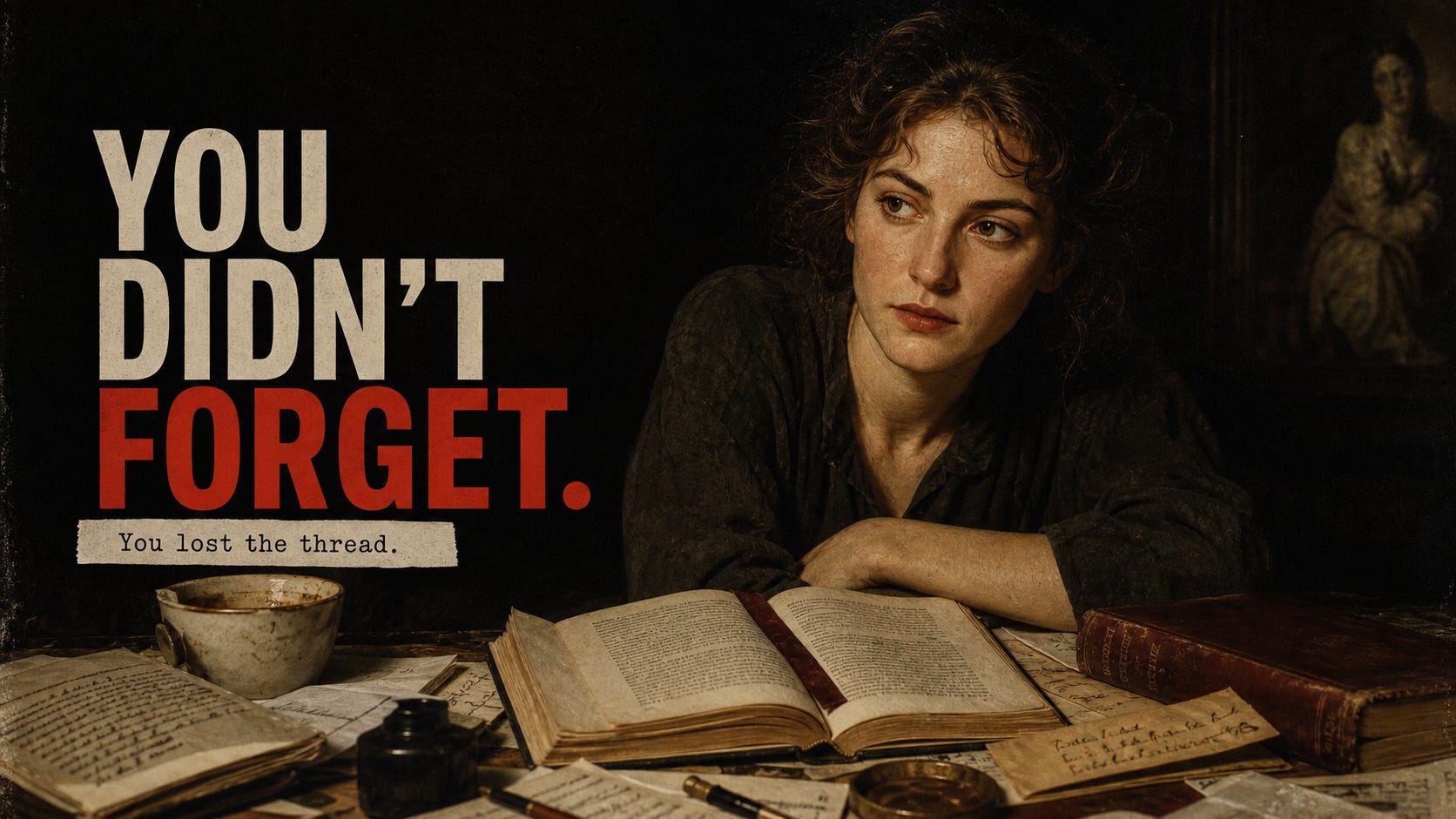
It is the thread.
You lost the line of movement. The pressure. The live wire. The question that made the next page feel necessary.
And once that thread is gone, many readers do something very noble and very useless.
They start over.
From page one.
Like pilgrims of despair.
I have done this. Plenty of readers have done this. We act as though sincerity will be measured by how much unnecessary ground we are willing to recross.
Meanwhile the book is sitting there like, you could have just walked back in.
That is the contradiction at the center of this whole problem. People think remembering a book means storing its contents. Usually it means preserving a return point.
You do not need a filing cabinet.
You need a door.
Here is the easiest way I know to build one.
When you stop reading, do not write down everything that happened. Write one sentence about what changed.
Not the furniture. Not the weather. Not every side corridor of the plot. What changed.
Dorothea starts to see that admiration is not intimacy. Ivan can no longer keep one thought from poisoning the rest. Sethe realizes the past is not behind her, it is in the room.
That one sentence does more real work than three pages of dutiful recap, because stories move through change. If you can find the change, you can usually find the book again.
Then keep a tiny cast list. Tiny.
I mean the kind of tiny that would deeply disappoint a person who loves tabs.
Not every character. Only the ones who currently matter. One line each. Something vivid enough for your brain to grab. Dorothea: spiritually hungry, terrible at self-protection. Casaubon: dry scholar, walking frost warning. Dmitri: appetite in boots. Denver: lonely daughter trying to grow a life in haunted air.
That is not a system.
That is a trail of bread crumbs.
And before you close the book, leave yourself one live question.
Not an essay prompt. Not something clever. Just the next thing your mind actually wants answered.
Will she admit what she now knows? Who is about to turn on whom? What is this house hiding? Why does this person suddenly feel dangerous?
If you stop with a live question, you come back to a book with momentum.
If you stop with nothing, you come back to a hallway.
That is what most people are feeling when they say they forgot the book. Not emptiness. A hallway.
I think school has a lot to answer for here. Many of us were trained to treat books as containers of information we were supposed to retain correctly, under fluorescent lighting, on schedule, with consequences if we did not. It is not shocking that adult readers still sometimes act as though a novel is a quiz that has been delayed by errands.
But books are not improved by being remembered like tax codes.
They are improved by being kept alive.
I remember the mood, but not the mechanics.
That is still useful. Mood means you have not lost the book entirely. Use the cast list to restore the machinery around the feeling. You do not need every bolt. You need the engine.
I remember the plot, but I do not remember why I cared.
Go back to the question, not the events. Who was exposed? Cornered? Tempted? Ashamed? Threatened? Interest comes back faster through tension than through inventory.
I feel guilty every time I look at the book.
Now we are no longer dealing with memory. We are dealing with emotional association. Move the book. Change chairs. Read for twelve minutes. No heroics. Small clean returns beat grand recommitments almost every time.
The deeper point is not that you should become more efficient.
The deeper point is that you are allowed to build a reading life that can survive interruption without immediately turning punitive.
Remember the thread. Leave yourself a door. Come back like a person.
What if you could finally finish the classics—without the guilt, pressure, or burnout?
With just 12 pages a day, you can read 9 classic books in a year—even if life feels full and your TBR list overwhelms you.
✨ I created a free guide just for you:

All new Literary Fancy subscribers receive the guide in their welcome email. Already a subscriber and didn’t get it? Just reply to this post or message me—I’ll send it your way!

Comments
Nothing yet. Say the first thing.
Sign in to join the conversation.