
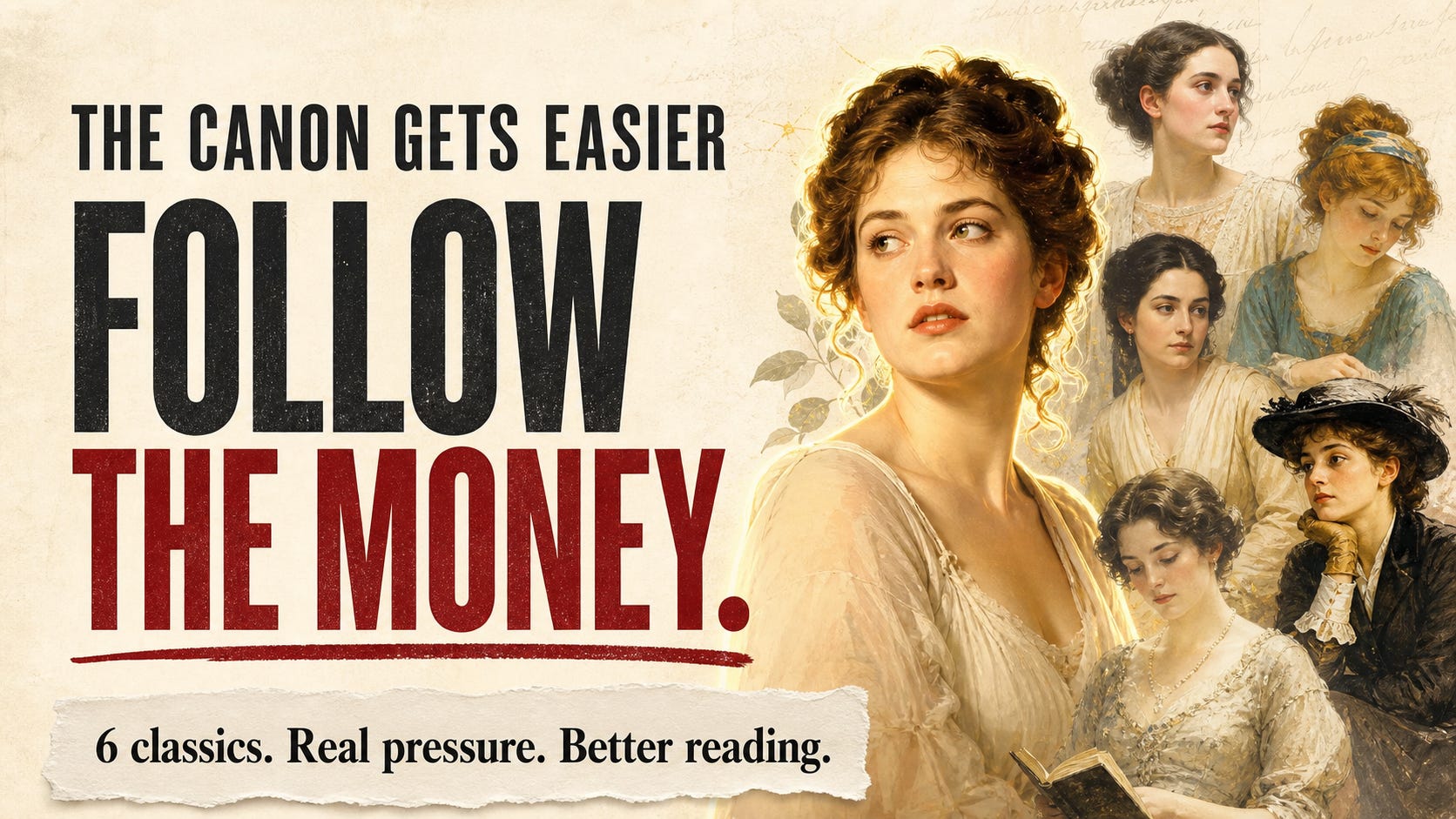
There is a specific kind of person who will tell you a classic is “really about morality” in the same tone someone uses to explain decorative soap.
Meanwhile, somebody inside the novel is trying not to lose the house, the husband, the future, the social position, the last shred of dignity, or the one marriage proposal standing between her and disaster.
So no, I am not against themes.
I simply think a lot of classics get much easier the second you stop treating them like stained glass and start treating them like pressure systems.
If a book feels abstract, follow the money.
Who has it.
Who needs it.
Who is pretending not to need it.
Who can marry without it.
Who is trapped because they do not have enough of it.
Here are six classics that get better, sharper, and considerably less ceremonial once you read them that way.
People talk about this book as if it is just sparkling banter, romantic misjudgment, and Mr. Darcy looking emotionally constipated in a field.
All of that is part of the charm.
It is also a novel about what happens when a family has daughters, no sons, shaky financial security, and a legal system arranged with all the tenderness of a slammed door.
The Bennet girls are not wandering around having abstract feelings about courtship. They are living inside a marriage market with real consequences.
Once you remember that, Charlotte Lucas stops looking merely practical and starts looking like a woman making the least bad decision available. Mrs. Bennet becomes less ridiculous too. Annoying, yes. Also not entirely wrong to panic.
This book is not just about passion, conscience, secrecy, and one deeply suspicious attic situation.
It is also about money, employment, dependence, and how few safe options a woman has when she is poor, and inconveniently dignified.
Jane’s moral intensity lands harder once you understand the material pressure around her. She cannot afford many mistakes.
She cannot simply float off into self-discovery with a charming tote bag and a sabbatical.
The book gets clearer when you track the fact that love, work, inheritance, and survival are all sitting at the same table throwing elbows.
This one becomes immediately more legible if you stop calling it a coming-of-age novel for six minutes and admit that money enters this story like a curse in gloves.
Pip does not just mature.
He gets financially rearranged.
He starts imagining a self he could not previously afford. He mistakes gentility for worth, access for transformation, and money for a kind of emotional correction. That is the trap.
Read the novel as a story about new money producing new delusion, and suddenly the whole thing tightens.
Emma Bovary does not just want romance.
She wants a life with better lighting, better objects, better rooms, better gestures, better texture, better evidence that she is not trapped inside the provincial disappointment currently chewing on her nerves.
That desire keeps colliding with debt.
Which is why the novel hurts.
Fantasy here is not only emotional. It is material.
She spends toward a dream she cannot sustain, and the arithmetic comes for her with the patience of a villain who has always known her address.
If you read the book through longing alone, you get one novel. If you read it through debt and appetite, you get the sharper one.
Yes, this is a novel about love, marriage, family, faith, farming, society, trains, despair, and the general Russian tendency to make every emotional experience feel climatological.
It is also full of leverage.
Who can leave a marriage.
Who pays for scandal.
Who gets absorbed back into society.
Who does not.
Who can afford a moral experiment and who gets socially executed by it.
Anna’s tragedy is not floating above society in pure feeling. It is happening inside rules, status, money, reputation, and the brutal asymmetry of what men and women are allowed to survive. Once you track the cost structure, the novel becomes less foggy and much more cruel.
Which is to say, better.
Lily Bart is not merely a refined woman making unfortunate choices.
She is in a beautifully furnished emergency.
Everything about this novel sharpens when you read it as social elegance with an eviction notice humming underneath it. Lily’s charm, wit, and beauty are real assets, but they are assets inside a system that can still spit her out the second she mishandles timing, money, or marriage.
This is one of the clearest examples of the rule.
If a classic feels lofty, ask who is about to lose the room.
That is the hidden engine in more books than people admit.
And that is really the larger point.
Many readers do not struggle with classics because they are not smart enough.
They struggle because the books were introduced badly.
Too much reverence.
Not enough leverage.
Too much abstraction.
Not enough pressure.
The canon gets easier when you stop asking, “What is the noble theme here?”
And start asking, “Who is cornered, and what is it going to cost?”
That is not reductive.
That is often where the life is.
And if you ask me, life is what people were looking for when they picked up the book in the first place.
Which classic got better for you the second you understood the actual pressure in the room? Tell me in the comments.
If you love the way I talk about books here, becoming a member gets you the part where I actually help you build a reading life around them.
The member’s library is full of practical, useful resources: reading guides, starter packs, classic roadmaps, title lists, deeper companion posts, and tools that make classics feel a lot less intimidating and a lot more alive.
It is for readers who want more than hot takes. It is for people who want help choosing what to read, where to start, and how to keep going.
Member's Library
Jun 12

Your complete paid-member archive, organized by what you want to do today. Choose your next classic, find a companion guide, improve how you read, or watch a class.

Comments
Nothing yet. Say the first thing.
Sign in to join the conversation.