
“Scott. Come on. You’re making that up.”
“No, I’m not! It really works.”
“You’ll just dilute the adenosine and nothing will happen!”
“Nope. We have science on it! It works!”
As you come back from the trauma bay, you hear your senior resident arguing with Scott, the pharmacist, in bed 21.
“What’s going on?” you ask.
“Scott is making up Science…” she tells you. “Here! Take a look at this ECG and tell me what you’d do? Assume vitals are stable and the patient is doing ok.”
“Oh fun! Reverse staffing! I love getting quizzed by the senior resident” you tell her as she gives you an aggressive eye roll. “But, ok. Let’s take a look:”
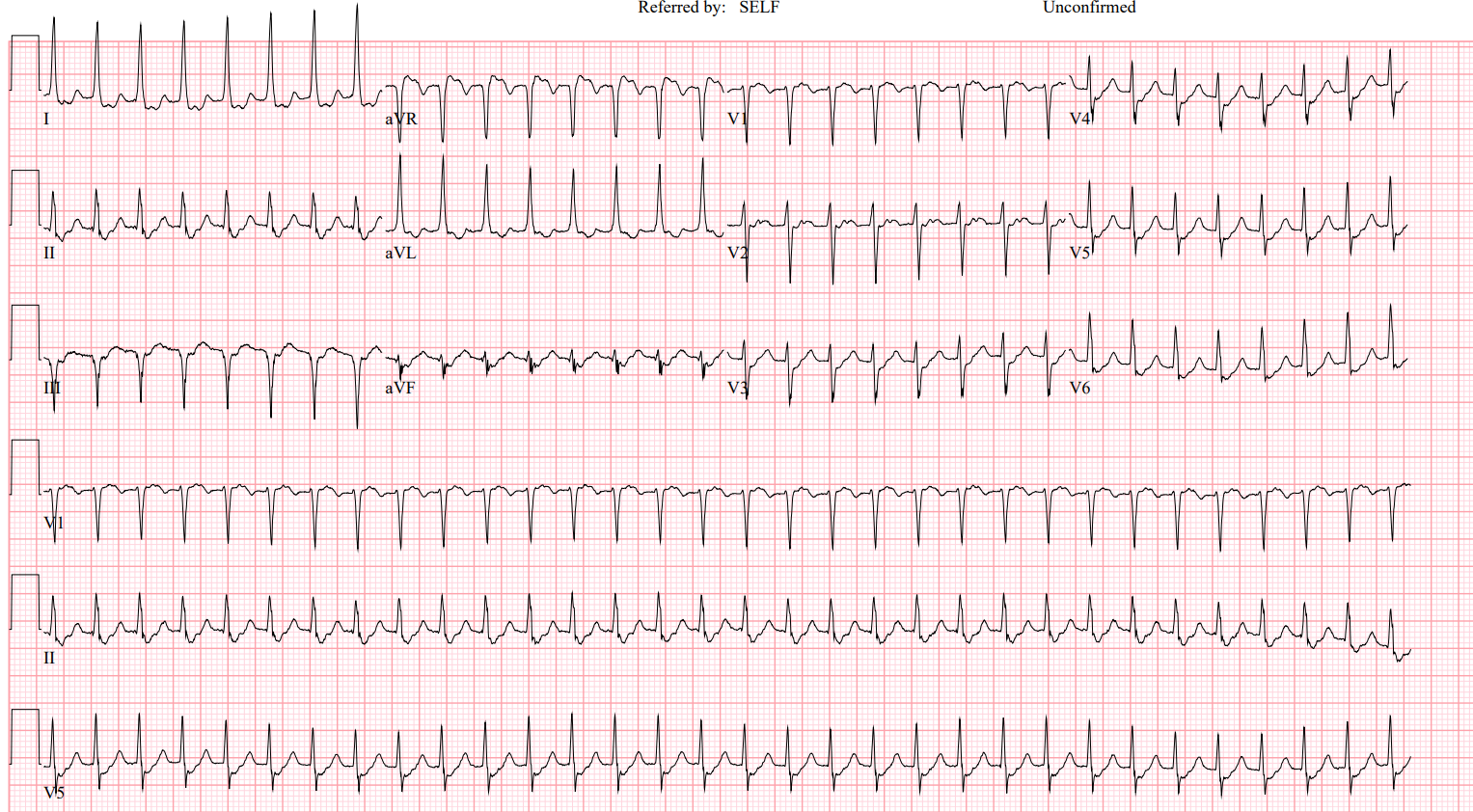
Rate: 170s
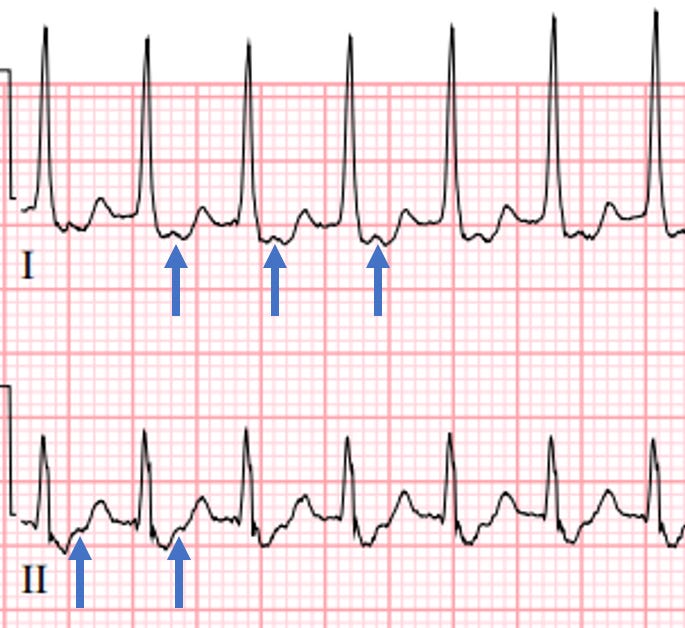
Rhythm: Not sinus rhythm. Interestingly, it looks like we may be seeing retrograde p waves in the inferior leads. I’ll mark them out below
Axis: Normal to slight left axis
Intervals: narrow QRS complexes, no PR interval, normal QTc
Morphology: Some evidence of strain given the ST segment depressions in the inferior and lateral leads. Some elevation in aVR. Likely secondary to rate
Final Read: Some kind of SVT (supraventricular tachycardia) with retrograde P waves and likely rate related strain.
To better see the retrograde P waves, I zoomed in on leads I and II and marked some of them out with blue arrows below:
“It sure looks like SVT to me. You said the patient is stable, right? So I’d probably give adenosine…” you tell the senior resident.
“Exactly!” She says. “Now how would you give it?”
“Uhhh… In their arm?” you say as she glares at you. “I mean.. I don’t know. Probably by the stopcock method where you attach the adenosine to one port, a flush to the other and get the adenosine in as fast as possible?”
“Scott… Would you like to weigh in here?” she asks him.
“Sure! Doc, have you ever considered putting the adenosine and a flush in the same 20 cc syringe and just pushing really fast?”
“No, Scott, doesn’t that dilute the adenosine? Wouldn’t that make the adenosine not work?”
“THAT’S WHAT I SAID!” the senior resident exclaims. “But apparently, Scott has some science to share with us.”
“Thanks for making this weird and putting me on the spot” Scott says. “I first learned about this from an AliEM (Academic Life in Emergency Medicine) post called, “Trick of the Trade: Combine Adenosine with the Flush.” What you do is grab a 20 ml syringe, draw up the adenosine and saline in the same syringe and then push it quickly into an IV.”
“Sure… but does it work?” your resident asks skeptically.
“It does! Interestingly, this was first reported in 2003 in the Journal of The Korean Society of Emergency Medicine. This team enrolled 65 patients with SVT over 30 months. They gave half of the patients adenosine and then rapidly flushed while the other half got adenosine and 15 ml of saline in the same syringe. And guess what?? The success rate for the traditional method was 80% and the single syringe method was 85.7%! It wasn’t statistically significant, but it sure looked promising.”
“Ok, so one time it worked, any other studies?” you ask, intrigued.
“I’m glad you asked!” Scott says. “There was a follow up study published in Academic Emergency Medicine in 2020. This study mimicked the Korean Journal’s study. They divided half of the patients in the single syringe group (SS) and half in the traditional two syringe group (TS). 53 patients were enrolled in the study. Patients were initially given 6 mg of adenosine and then up to two repeat doses of 12 mg if they did not convert.”
“In the SS group, 73.1% converted on the first dose as compared to 40.7 in the TS group. And, successful conversion up to 3 doses was 100% in the SS group as compared to 70.4% in the TS group. Both of these groups were statistically significant.”
“Now, no study is perfect and the authors do note some limitations. The method of administration from the TS group was not standardized and the location of the IV wasn’t standardized. Also, they were shooting to recruit 75 patients per arm, so the study was underpowered. Finally, and the authors should be applauded for this, they remind us that this was an observational study, not a randomized trial and we need to be careful with any conclusions we draw from this. They recommend additional studies to increase validity of their results.”
“Huh! Fascinating. So, basically all of the science that we have so far seems to say that this works pretty well and argues against the dilution theory. That’s pretty interesting. Maybe we should try it on this patient? What do you think?” you ask the team.
Case Wrap Up:
You decide to use the single syringe technique to push adenosine for this patient in SVT. After 6 mg of adenosine, the patient converts back to normal sinus rhythm.
Recap:
Traditionally adenosine has been given in a “two syringe” method with the medication in one syringe and the flush in another
Data suggest that it’s reasonable (and possibly more effective) to put the adenosine and saline in one syringe and push it quickly
This method is certainly easier for administration
Hit me up with any questions,
Lloyd
**Looking for a dynamic guest lecture on Emergency Cardiology for your Grand Rounds? Reach out here for a lecture request by Dr. Tannenbaum. If you have reached out already, I have emailed you back. If you haven’t gotten it, please message me directly on Substack or just reply to this email.**
_________________________
Lloyd Tannenbaum, MD
Comments
Nothing yet. Say the first thing.
Sign in to join the conversation.