
I made my secular friends a quiet deal.
Come hang out with me here, I said — not in those words, but it was the offer underneath the writing. Come for the climate, the science, the borderlands, the craft. And while you’re here, you’ll catch a glimpse of a spiritual life. Nothing that asks anything of you. A window you can look through and step back from. I’ll keep it intriguing and I’ll keep it safe.
I meant it kindly. I also meant it as management. I have been, my whole life, a person who could make difficult things legible — translate them, frame them, hand them over in a form that wouldn’t cost the listener too much. It is a useful skill and I am good at it. It is also, I have come to see, a way of staying in control of what people are allowed to see of me.
And somewhere on the Camino, I realized the glimpse was a skin I’d already shed.
Let me tell you about the notebook.
In 2021, on an earlier stretch of the same pilgrimage, I carried a small yellow Moleskine with the Magnificat copied out in my own hand. Mary’s song — my soul magnifies the Lord — the words she says when she learns what is being asked of her. I would find a church along the route, sit down in front of a statue of her, and recite it. Then I would wait for it to take hold.
It did not take hold.
I worried at it instead, the way I worry at everything. He has shown strength with his arm — but he doesn’t have arms! What does it mean? I turned it over and over, looking for the handle, the way in, the interpretation that would let me file the line under understood and move on. I was treating a poem like a problem. I was sure that if I were only smart enough, attentive enough, I would crack it, and then I would have it.
I never cracked it. Somewhere along the route, I lost the notebook. I have no idea where. I set it down at a café or a fountain or a church and walked on, and by the time I noticed, it was gone, and the question went with it — still open, still unsolved. What does it mean that God has shown the strength of his arm? I left France in 2021 not knowing, and a little annoyed that I didn’t.
In May I went back to the Camino, and this time the Magnificat came with me in a small blue notebook, copied out again in my own hand. It rode in my fanny pack alongside the other little notebook — the practical one, with the gîte reservations and the daily mileages and the names of the towns where I needed to turn. Mary’s song and the logistics of walking zipped into the same pouch against my hip all day long.
Something was different this time, though it took me the whole walk to understand what.
The Magnificat had become both lighter and heavier. Lighter because I was no longer trying to crack it — I had stopped turning it over looking for the handle, stopped treating it as a problem with a solution I could earn. And heavier because, without the gripping, it could finally reach me. He has cast down the mighty from their thrones, and has lifted up the lowly. I would recite it quietly on the trail and my heart would ache with a longing that had nothing abstract in it. My community was far away and never far from my mind. The line was not a riddle anymore. It was about home, and it hurt.
A few days in, I came out of a small chapel — one of those that holds maybe twenty people — at the same moment as another pilgrim. We had both stayed to pray. Maybe it was the closeness of that small space, still around us as we stepped back into the light. We fell into talking.
I found myself telling her about Tucson. About the people being taken. Families separated, with a vengeance that frightens me. I told her about La Ristra — about how the community is showing up to resist, the art therapy groups for the children, the emotional support for the mothers who do not know where their people are. I teared up. She teared up. We stood there, two strangers outside a chapel, crying.
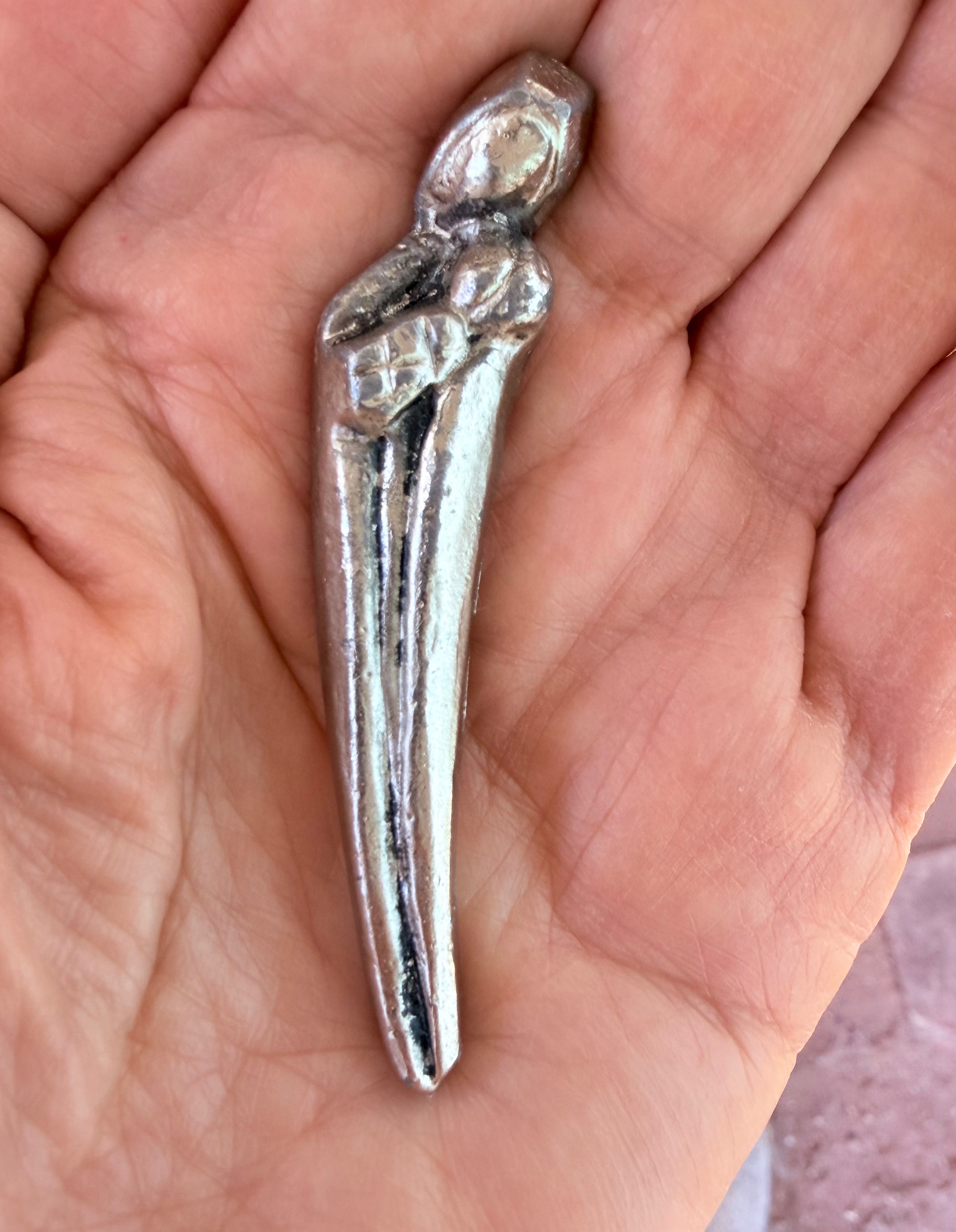
And then she reached into her pocket and took out a small pewter Madonna and child. Mary. She put it in my hand and closed my fingers around it. She held me, and she told me that when she got home she would tell my story in her parish — that they would pray for my community, that they would spread word of what is happening, that they would help us hold the line.
I walked on. And a little way down the trail, I asked myself: is this how God works? Quiet conversations outside small chapels. Two people who were strangers an hour ago, weeping over the same grief. A deeper understanding of how bound to each other we all are. A promise, pressed into your hand, to hold the line.
I have been reframing my whole life.
As a young scientist I could not stop asking who decides how a question gets posed — and why the posing so reliably left out the people most exposed to the answer. Whose vulnerability counts as data. Whose truth gets to sit at the center of the study. I thought this was a method. A good one; it served me for forty years. I did not know it had older names than mine.
This spring, in Valencia, a friend taught me recordar. Not to recall a fact — to pass it back through the heart, to let it cross the chambers a second time and come out changed. And last week, in front of a room of a hundred and sixty people, I talked about metanoia — the turning of the mind, the word the Gospels use for the change that is not a new idea but a new direction.
I did not put them together in the room. I put them together afterward, walking, the way the true things have all come to me lately — not at the podium but on the path.
Reframing is metanoia and recordar at once. It is the turn of the mind and the passage through the heart, the same motion in two registers. I had been doing half of it for forty years. I had been very good at the turning. What I did not know how to do — what the pilgrimage finally taught me — was to let the turn go down through the heart and ripen there before I called it knowledge.
The young scientist reframed by force. She was right, and she was fast, and the speed was the limit. What I am learning now is slower. The frame still dissolves — but it dissolves the way a question dissolves when you stop gripping it, not the way a problem yields when you finally outsmart it. I am not reframing harder. I am letting the frame be remade in me.
I know how this sounds to some of you. I know, because I have been you, and in many rooms I still am.
I have spent my life as a quick study. I trust what I can think my way into. I am suspicious of knowing that arrives any other way — through the heart, through the body, through a stranger pressing a small statue into my hand. If you are bristling a little right now, I understand. The bristle is the skin. It is the thing in us that decides, very fast, what we will and will not let in. I wore mine for sixty years. I was good at it. It kept me safe, and it kept me from a great deal.
What I am learning, slowly, is to let the skin go. Not to think less — I will never think less — but to let what I think pass down through the heart and ripen there before I call it knowledge. To stop controlling what I am willing to let in.
Here is why this matters beyond me, and beyond a river in France.
We have spent decades believing that the gap between knowing and acting is a gap of information. That if people only understood the science — the curves, the thresholds, the losses — they would act. We have produced the information, brilliantly, for forty years. The gap has not closed. I do not think the gap is made of missing facts. I think it is made of the same thing that kept the Magnificat out for five years: a frame we cannot think our way past, because thinking is what built it.
The pilgrim outside the chapel did not hand me a statistic. She handed me her grief, and a promise, and a small pewter Mary, and she changed what I was able to carry home. That is what closing the gap actually looks like. Not more information. A turning of the mind that goes down through the heart and comes back as something you will act on because you can no longer not.
So I want to ask you the question I am asking myself. Not what more do we need to know — we know enough. But what would it mean to stop trying to think our way to action, and to let the knowing finally take hold?
I don’t have the whole answer. I am going to spend the next while here, in this newsletter, trying to find it out loud. I hope you’ll come with me — not for a glimpse this time. All the way in.
No posts
Comments
Nothing yet. Say the first thing.
Sign in to join the conversation.