
Well, I just got told.
I got scolded because I dared question why I only got paid for 90 minutes of work that took me over two hours to do.
Now, I admit that I probably made the tasks too complicated. I admit I am still figuring out how to approach the challenge of making AI models produce deviations where one response is better. It’s a learning curve, and that’s why I probably took longer than the “average” person to do according “to research.”
You see, they put 30-minute caps on each section of the task, which involves writing prompts, assessing quality, justifying assessments, and making any minor edits for at least 3 turns in a multi-level conversation.
It’s easy . . . I guess.
But the problem is that these caps are illegal. According to an article posted on the National Employment Law Project:
Wage theft most commonly comes in the form of minimum wage violations and overtime violations, which are often the first things you may think of when you hear wage theft. That said, wage theft can come in many forms, some of which you may have experienced without you knowing. Here are some things your employer may do that are signs of wage theft.
Paying less than minimum wage
Not paying appropriate overtime (1.5x your normal hourly rate)
Withholding your final paycheck after you quit your job
Withholding tips
Asking for unpaid work (labor while off the clock) . . .
(Kim, Paul. “Business Insider: Wage theft is when an employer witholds benefits, such as breaks or compensation, that an employee has already worked for.” July 12, 2022).1
The person I was talking with (by email) was the head of the payroll department. He explained there was nothing they could do because the policy was to cap the tasks. I conceded that it wasn’t his department’s problem and asked if he could get me in touch with someone who holds the power to change the policy. He basically dismissed me by saying (I’m paraphrasing, but I am keeping the receipts of the conversation) that it has nothing to do with who is in charge and that it is a perfectly legal policy.
The next part of his argument is what led me to write this article: “... without [the time caps], there would be no limit on what someone can earn for any task.”
Let me translate that sentence for you, in case I’m reading it differently than you are. This person (and the company behind it) thinks that workers will slack off and take their time if given appropriate amounts of time to create the high-quality tasks they want. And, despite the ever-changing rules and goals of projects, 30 minutes is enough time for the average person (and I guess I’m below average?).
The reality of this is very different. Some tasks, especially creative ones, take more time and more trial and error, as everyone works differently. Some tasks are so short that I barely make anything off of them—on those days I will do anywhere from 30 tasks to 50+ to make my personal hour goal (I am doing this to earn extra money, not as a full-time job). The more difficult the task, the longer it will take to get it right.
Sometimes I have a great idea, and things flow. Sometimes I have an idea that takes a few tries (like the task I am referring to). Sometimes the answers I get surprise me and lead me into research because we have to fact-check everything. I’m faster when I focus on things I am more familiar with, but even then, I sometimes have to follow up on the AI answer—because it is a computer and I am a human who doesn’t know everything.
It seems that this is what they think contract workers do:
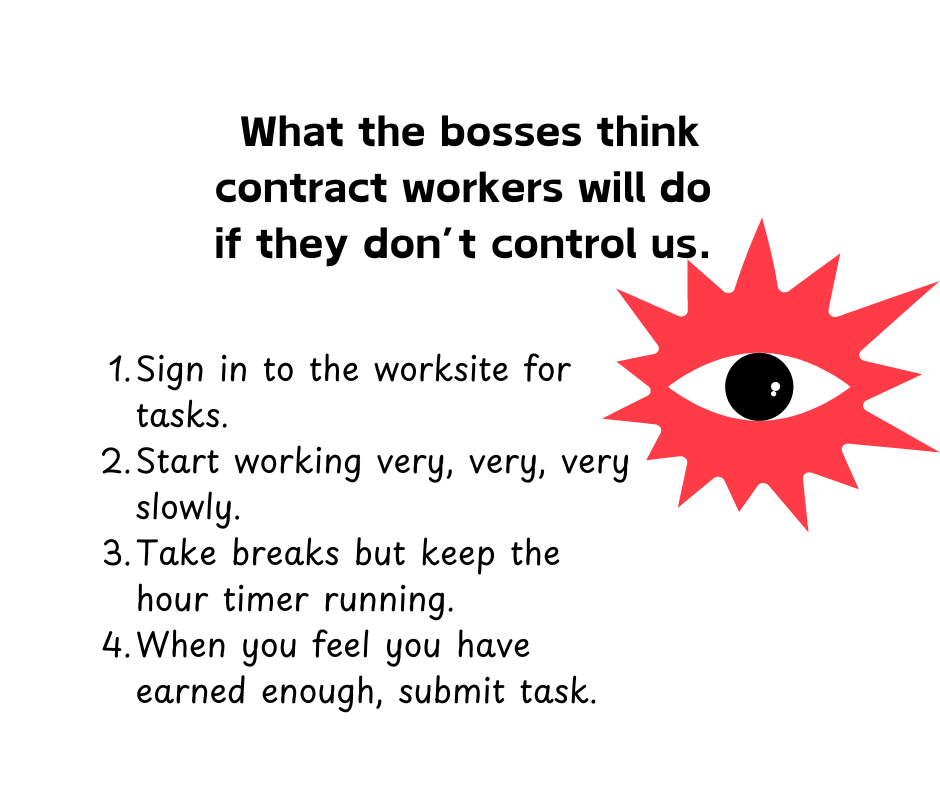
But this is what we really do:

Lest you think I am just complaining for no reason because I chose to work from home, I want to point out that I have ALWAYS been a contract worker in education, the arts, and writing. Sure, some of those jobs (particularly in higher academics) were paid traditionally, but I have rarely worked one job at a time, and those contracts were sometimes semester-by-semester hires. I did side jobs—theater directing, teaching public classes to children and adults, producing, writing books, editing other people’s books, and sometimes even tutoring. All contract work.
I consider myself part of the creative economy—an important but often disrespected part of any society. In 2021, the United Nations Educational, Scientific, and Cultural Organization published a white paper on the working conditions of creative cultural workers, which points out that industries in the creative economy “often generate up to 10% of national GDP, provide nearly 30 million jobs worldwide, and employ more people aged 15–29 than any other sector.” Almost half of those workers are women. That’s part of the good news. Read the more recent articles on their website for more good news.
The bad news that is relevant to this article is this:
One fifth of those employed in cultural occupations (20%) work part time and the gender difference is substantial with around 28% females compared to 18% men in part time culture sector jobs. They work primarily on a contractual, freelance and intermittent basis and their income continues to decline, fluctuate and remain uncertain. The result is lower tax contributions, leading to lower access to social security, pensions and other welfare provisions. Indeed, the largest subsidy for the arts comes not from governments, patrons or the private sector, but from artists themselves in the form of unpaid or underpaid labour. (Dunn, Thom “Creative industry workers suffer the most stolen wages, according to UNESCO” Feb. 10, 2021)
The landscape of work has changed over the past few years, starting with the pandemic and shifting political tides. I took a step away from what I was doing to figure out what was next for me, and I’m still working on it. I have some creative projects in the works that excite me. I started making up any financial gaps by doing work online—whether it was writing for others, editing, or leading creativity and improvisational workshops. Then AI opportunities came along, and I took on some of that work because it was lucrative and interesting. My goal, for myself, is to take on work that challenges me, while continuing to explore how I can advocate for a more just, creative, collaborative world.
I did not expect to walk into a field that is so young that it hasn’t figured out that human workers don’t work the same as AI models, but AI models cannot succeed without human workers. A field that desperately recruits human workers even when they don’t have actual work to do. The field survives only because of contract workers, but it doesn’t respect those workers enough to trust them to do the work promptly, nor does it value the time of the workers.
Now I’ve learned that it is technically stealing money because of that mistrust.
I can’t quit because I need the money. (I suppose I could be removed if someone sees this, but I hope it is an eye-opener and I’ve already expressed my displeasure.) I don’t know if I will be doing my best work because I will be watching the clock, and that adds to the stress when I am learning new projects.
I haven’t decided yet if I should make an official complaint (I think I need more people to speak up before I do). But I can make everyone aware that this is a problem that needs to be fixed.
The reality of our world is that it is changing. Jobs will be changing because of AI. Supposedly, that will create more time for people to enjoy life—unless we continue on the toxic path of late-stage capitalism that insists we work ourselves to death. More time to explore and enjoy life opens up a world of creative possibilities, and that would only strengthen our economies and make our lives more fulfilling.
Meanwhile, I can’t get paid the right amount for work I’ve already completed. Many creative workers don’t get their money at all, as someone argues that the price is too high.
That has to change.
The emphasis is my own. I am not a lawyer. I learned this possibility from the former president of a faculty union and then did some research. If you think you are facing an issue of wage theft, consult a lawyer or make a complaint with the U.S. Department of Labor.
Comments
Nothing yet. Say the first thing.
Sign in to join the conversation.