
If I want to use AI technology to advertise my most recent book, I must pay $100 monthly.
To collaborate on visual creations with a team, I must pay $100 per team member monthly (minimum 3 team members).
To get an AI positioning report for my upcoming fiction novel, I must pay about $150.
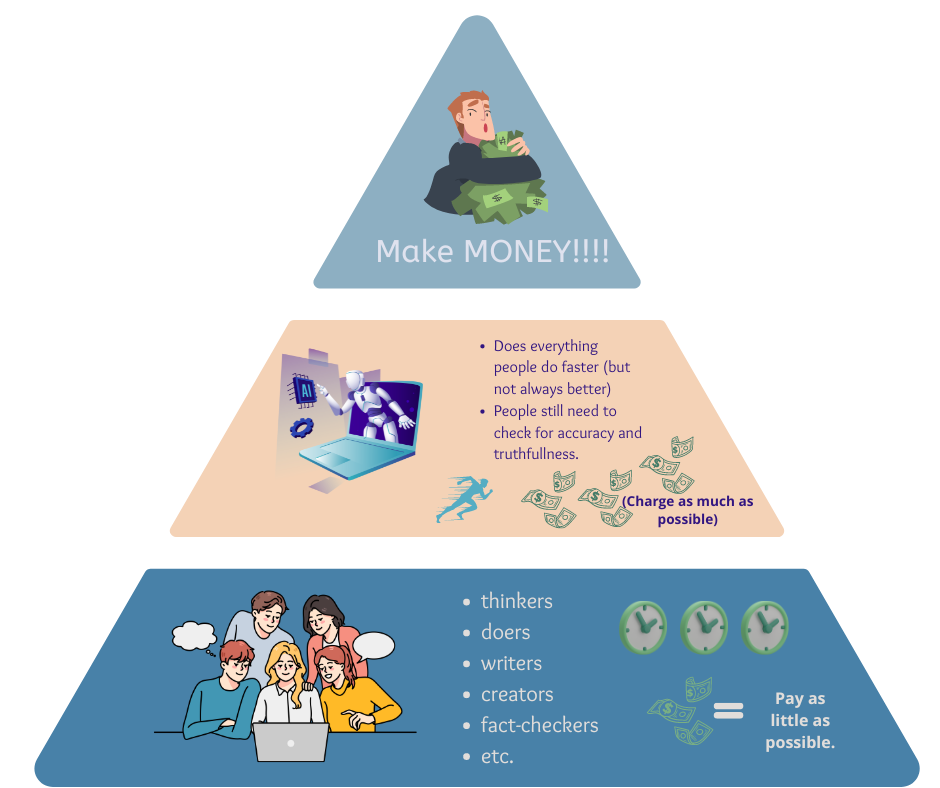
I recognize that building new technology takes time. I can only hope that the human workers building the technology are making decent salaries for their time (but I tend to doubt it). AI technology saves time, but companies raise prices so it costs more for something that takes moments to do (with fewer human resources).
Where does that money go? It doesn’t go back into worker’s pockets, that’s for sure. As my most recent post explained, worker’s time is not valued as much as AI time—so no matter what, the people at the bottom of the period lose out.1
Let’s look at the examples of publishing that I posted above. If I want an AI positioning report, I pay $150 and get it in about 30 minutes. Cool and useful. However, I still need to check the accuracy because AI chatbots make mistakes and occasionally hallucinate sources. (Yes, friends, that “factual article” supporting your questionable claim might not exist.) Still, if I want to work with a human, it is $399—so yes, technically AI saves money, in this case. If I fully trust AI, it might be worth it. But, because I value people’s time and expertise, I might choose the more expensive human interaction.
The story changes when it comes to the AI-run advertising program, complete with analytics and honing down to a precise audience unless you already happen to be a well-known author or are writing the types of books that will naturally become best-sellers. (I’m not). If your last quarterly royalty payment was only around $10.00 (give or take), then $100 monthly is unsustainable.
When you are an independent contractor who occasionally collaborates with others on various projects, $300 to use collaborative technology is also unsustainable.
I’m sure someone reading this thinks, “Well, you are just a failure at business.” Some of you are probably preparing to sell me something that can help me. Don’t bother. I’ll find a different way to support my goals.
For you see, I am more than willing to spend money to make money if I can be assured that my money is going to the people doing the work. If I can be sure that people are being paid equitably, the product is worth the cost, and that my money is not simply feeding the pockets of the greedy entrepreneurs who think more highly of themselves than their workers.
What happens when AI becomes stronger and there is more time available? What happens when the work humans do becomes more undervalued but the cost of technology keeps ascending to the point where we cannot afford any of it? There are two scenarios:
The rich get richer, and everyone else struggles to survive.
We learn how to use our time in more creative, sustainable, and caring ways, valuing human work and all life more, while supporting one another in a world that rises on the foundation of human kindness and equality, where nobody is superior to the other because of the imaginary value of money.
I know which world I want to live in. Do you?
If you are interested, my timeline for any projects for that company has been empty for a week. I can’t imagine why. (sarcasm).
Comments
Nothing yet. Say the first thing.
Sign in to join the conversation.